- The paper introduces a novel geometry-driven method using Delaunay graph scoring to reconstruct accurate building wireframes directly from 3D LiDAR point clouds.
- The methodology leverages curvature signature extraction and Transformer-based corner and wire selection to adaptively reduce search space and capture structural features.
- Experimental results on the Building3D benchmark demonstrate significant improvements in wireframe precision and robustness, especially in noisy, sparse, and occluded regions.
Delaunay Canopy: Topology-Centric Building Wireframe Reconstruction via Delaunay Graph Scoring
Introduction
Delaunay Canopy introduces a geometry-driven approach for reconstructing building wireframes directly from airborne LiDAR point clouds. The key proposition is the utilization of a Delaunay triangulation-derived graph as an intrinsic geometric prior, enabling the pipeline to operate fully in 3D, adaptively reduce the search space, and robustly disambiguate sparse, noisy, or occluded regions. This strategy explicitly addresses the limitations of prior approaches, which either struggle with combinatorially large search spaces in noisy/sparse settings or lose critical 3D context through 2D projections as in BWFormer.
Conventional methods decompose the problem into corner and wire inference but rely on heuristic candidate selection over the full point cloud or make restrictive 2D reductions. Delaunay Canopy, in contrast, performs Delaunay triangulation to instantiate a graph that encodes local geometric context, then performs curvature signature extraction to produce highly discriminative priors for corner and wire selection. This pipeline is evaluated with new SOTA metrics on the Building3D benchmark.
Methodology
Delaunay Graph Scoring
The foundational operation is the construction of a Delaunay graph over the point cloud. Each triangle in the tessellation approximates a patch of the underlying roof surface, even over highly irregular or sparse regions. The core metrics are:
- Face Normals: Robustly oriented per-triangle normals, computed using the standard right-hand rule and reoriented to always point upward.
- Edge-wise Dihedral Angles: For each interior edge, the dihedral angle between adjacent face normals quantifies the local surface deviation; large values correspond to sharp geometric features (edges, folds).
- Vertex-wise Corner Scores: For each vertex, the mean of its incident edge dihedral angles yields a data-driven indicator of local curvature, directly linked to the likelihood of that vertex representing a true structural corner.
These metrics are inherently 3D, avoid the information loss and quantization of 2D projections, and can be efficiently computed on large city-scale point clouds.
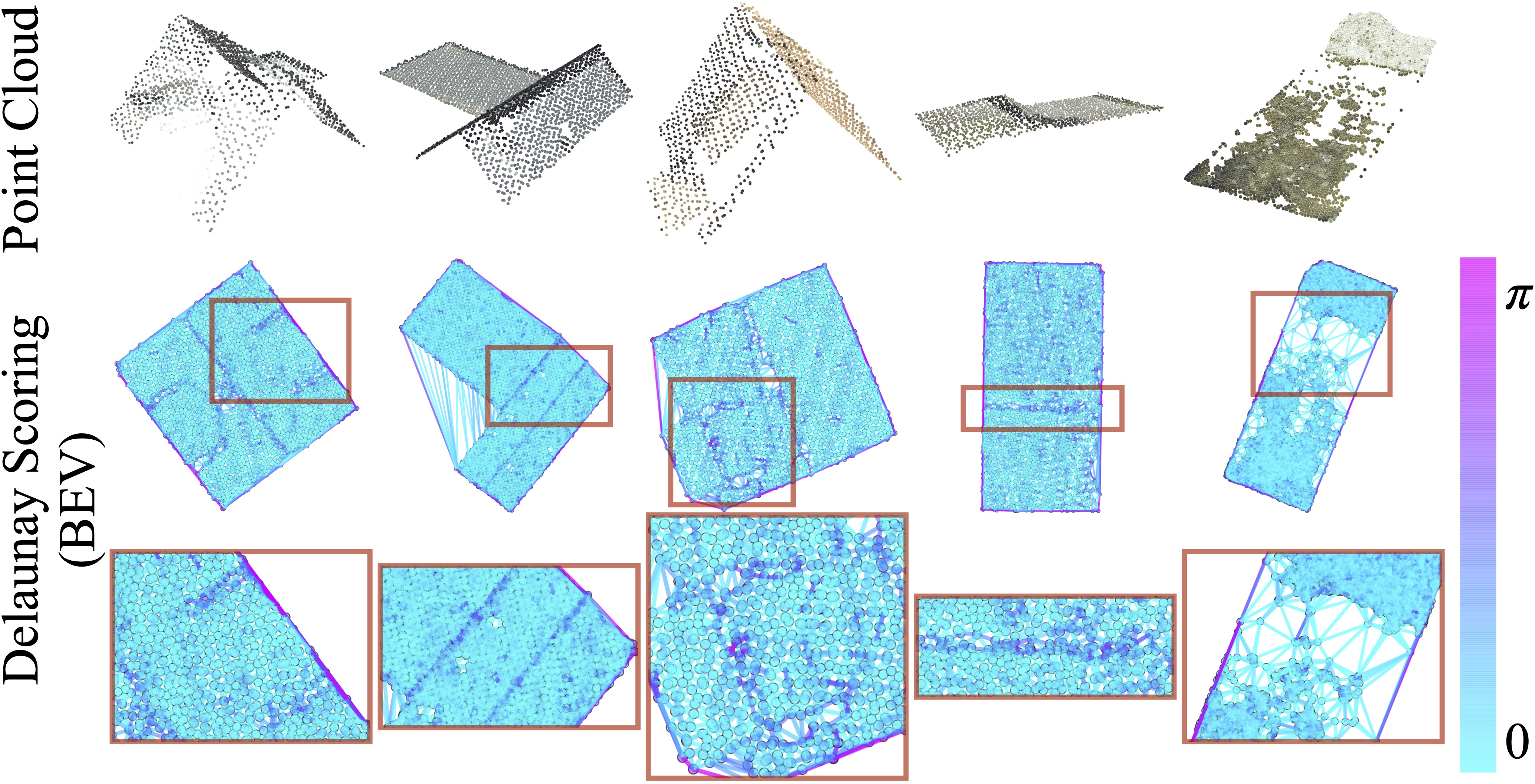
Figure 1: Edge-wise dihedral angles and vertex corner scores on a Delaunay graph across a point cloud, demonstrating robust curvature capture even at high sparsity.
Adaptive Corner and Wire Selection
Corner Selection: Vertices are scored and ranked by their corner scores. The K highest are selected as corner candidates, resulting in a search space that adaptively and sparsely targets high-curvature (structurally salient) regions, in contrast to Farthest Point Sampling (FPS), which is structure-agnostic.
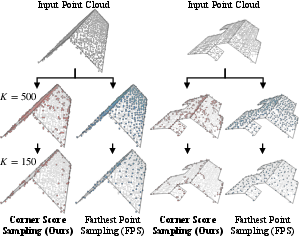
Figure 2: Comparison between Corner Score Sampling and FPS. Corner Score Sampling selectively retains pronounced curvature points.
A Transformer-based corner selection module further refines these candidates to the final predicted set.
Wire Selection: All pairs among predicted corners are enumerated as wire candidates. For each, the Delaunay graph is used to extract the "wire-wise path score": the mean dihedral angle along the geodesic path connecting the pair. Transformer-based wire selection uses this path score for geometric-weighted query scaling, prioritizing wires that align with high-curvature graph sequences. All processing is differentiable and end-to-end trainable.
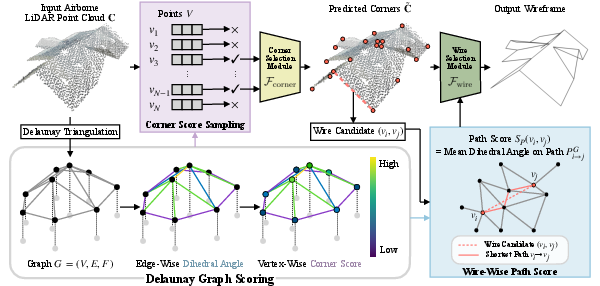
Figure 3: End-to-end pipeline, from Delaunay triangulation and curvature scoring, through corner/wire candidate selection, to final wireframe generation.
Experimental Evaluation
Comprehensive evaluation is conducted on the Building3D dataset, covering both the Tallinn city and entry-level splits. Metrics include Wireframe Edit Distance (WED), Average Corner Offset (ACO), corner/wire precision/recall/F1, and ablation studies.
Numerical Results: Delaunay Canopy outperforms all baselines:
- On Tallinn City, achieves WED=0.232, ACO=0.194, Corner F1=88.3, Edge F1=80.0, surpassing previous leading methods including BWFormer.
- On Entry-Level, achieves WED=0.230, ACO=0.190, Corner F1=90.2, Edge F1=82.4.
- Notably, demonstrates a significant performance margin on both distance and structural metrics, particularly on interior corner recall and complex roof topologies.
Ablations reveal corner score sampling and prior-based query scaling each provide nontrivial gains; their combination yields maximal accuracy and compactness in the predicted wireframe.
Qualitative Analysis
Challenging regions: Visualizations indicate superior fidelity in sparse, noisy, or minimal curvature zones, including robust recovery in regions where ground truth boundaries are under-represented in the input.
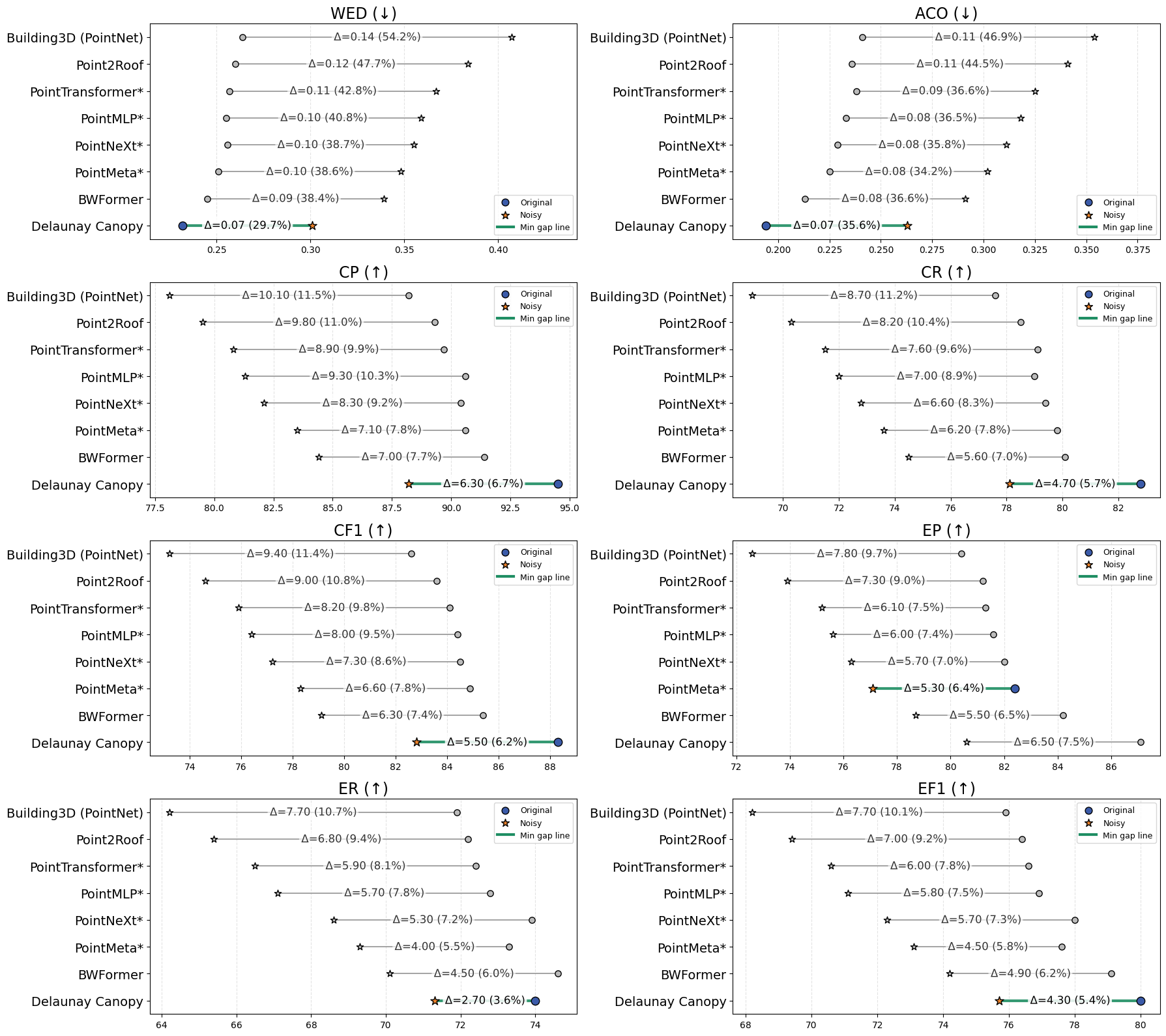
Figure 4: Performance drop due to input perturbations; Delaunay Canopy exhibits the lowest relative decrease, confirming resilience to LiDAR noise and occlusion.
Whereas FPS and 2D-projective methods substantially degrade under data dropouts or occlusions, Delaunay Canopy leverages the geometric extrapolation inherent to Delaunay graph traversal and curvature priors.
Wireframe-to-Mesh reconstruction: The wireframes produced are coherent and detailed enough for downstream triangulation into watertight meshes, with marked preservation of structural corners and wire connectivity.
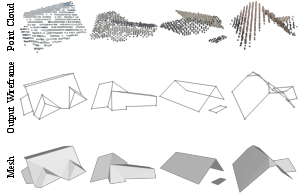
Figure 5: High-fidelity mesh reconstructed from the output wireframe. Underlying geometry is preserved with sharp, accurate form.
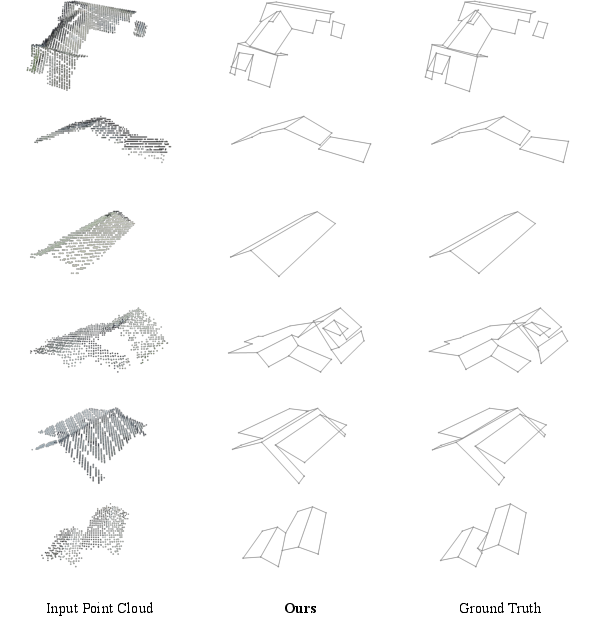
Figure 6: Real-world application of Delaunay Canopy on the Building3D dataset, producing valid wireframes over diverse building architectures.
Limitations and Extensions
Failure cases are observed under three main conditions: (i) critical regions unsampled by the LiDAR scan (missing entire roof sections), (ii) overly smooth or curved surfaces with ambiguous topology, (iii) volumetric/topologically closed objects for which a bijective Delaunay projection by (x,y) is ill-defined. These highlight the dependency on surface openness and the presence of geometric saliency in the scanned data.
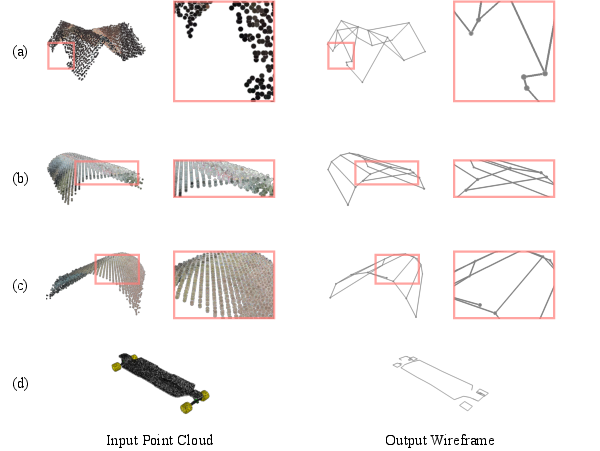
Figure 7: Limitations—failure in data-absent regions, smooth surfaces, and closed-topology objects.
The underlying mechanism—surface-based adaptive geometric priors—suggests extensibility to non-building domains such as automotive shape abstraction and interior scene reconstruction, pending adaptation to different scanning artifacts and topology regimes.
Theoretical and Practical Implications
The explicit geometric prior by Delaunay graph scoring differentiates this approach from previous end-to-end and data-driven pipelines. It fuses analytical geometry with neural modules, granting the model robust prior structure and guiding both learning and inference toward semantically meaningful, compact representations. Practically, this yields wireframes that are precise, editable, and applicable to large-scale urban-scene processing as required in XR, robotics, and geo-surveying.
Conclusion
Delaunay Canopy establishes a principled hybrid geometry-ML strategy for wireframe reconstruction from airborne LiDAR scans. The integration of Delaunay triangulation, curvature-driven sampling, and adaptive Transformer modules enables a decisive advance in precision and robustness. Future research directions include adaptation to volumetric and smooth-curved architectural forms, handling stronger occlusion scenarios, and cross-domain generalization to arbitrary topological objects.
References:
Delaunay Canopy: Building Wireframe Reconstruction from Airborne LiDAR Point Clouds via Delaunay Graph (2604.02497)