- The paper introduces a novel machine-learning approach that applies SVMs and decision trees on engineered contour line features to detect violin width reduction.
- It employs elevation maps and precise feature normalization to transform subjective expert evaluations into reproducible, objective data models.
- Results reveal that systematically engineered geometric descriptors consistently outperform raw elevation data in classification accuracy.
SVM and Decision Tree Techniques for Detecting Violin Width Reduction via Geometric Representation
Historical Context and Motivation
The study investigates the quantitative detection of violin width reduction, a modification frequently encountered in historical bowed instruments dated before 1750. Traditionally, identification of such reductions has relied on subjective expert assessment, including visual and tactile inspections or endoscopic imaging. This subjectivity introduces inconsistencies, especially given the subtle topological changes—such as the transition from "U-shaped" to "V-shaped" contour lines post-reduction—that may escape even experienced luthiers. The research introduces a systematic machine learning approach using geometry-based features extracted from 3D photogrammetric meshes, aiming to establish an objective, reproducible standard for classification.
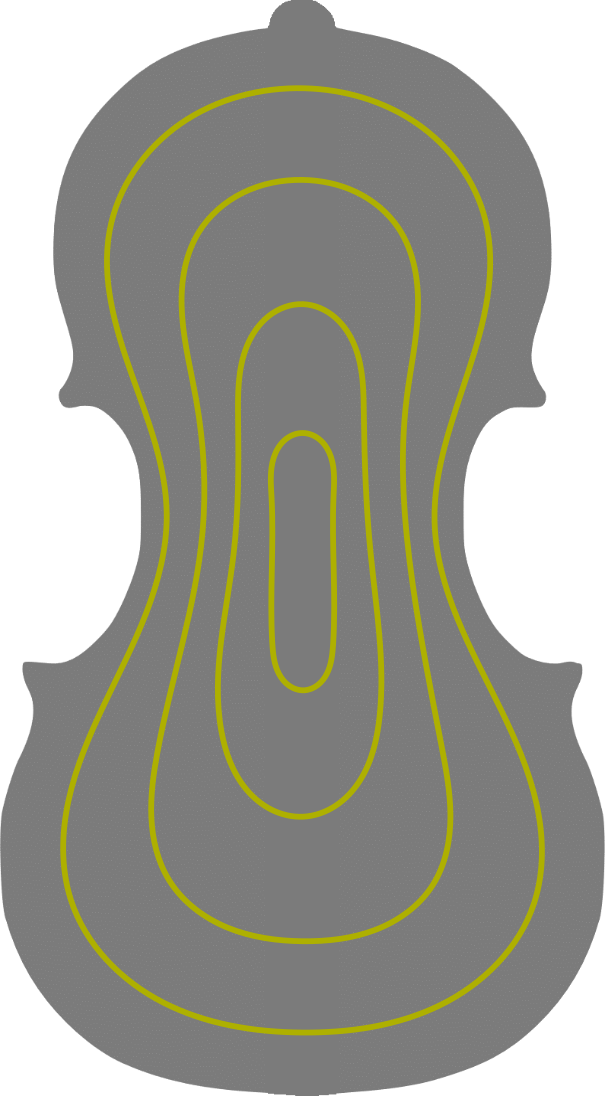
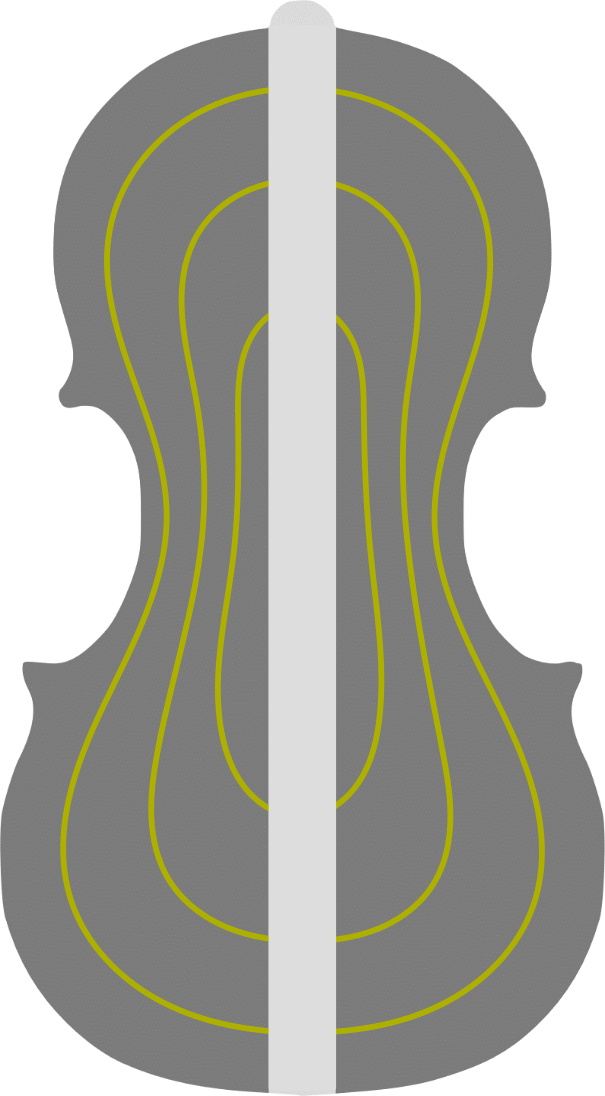

Figure 1: Impact of the reduction of the width of the sound box on the contour lines.
Data Representation: Elevation Maps and Feature Engineering
The dataset comprises 25 bowed instruments, with five suspected reductions, digitized using a photogrammetric pipeline validated at sub-millimeter resolution. The geometric information is encapsulated in elevation maps, which encode the surface heights of the sound board on regularly spaced square grids. Missing intersections between mesh and grid are filled with zeros—in alignment with the symmetry plane.
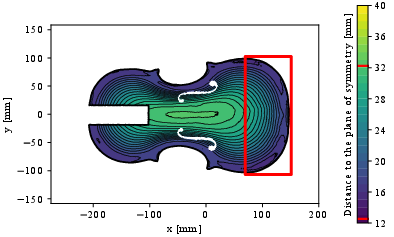
Figure 2: Elevation map sampled every 0.25 mm and zone of interest (red rectangle).
To facilitate model input, elevation maps are resampled either relatively, normalizing grid dimensions to each instrument, or absolutely, defining a common bounding box across the corpus. Both configurations are demonstrated, with grid resolutions spanning from coarse (5×10) to fine (100×250).
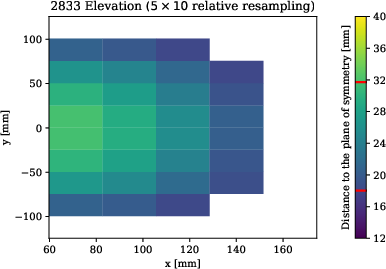
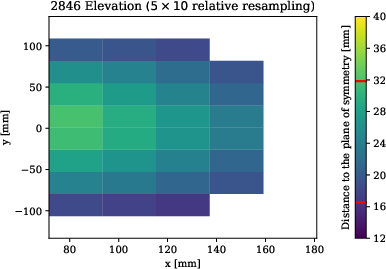
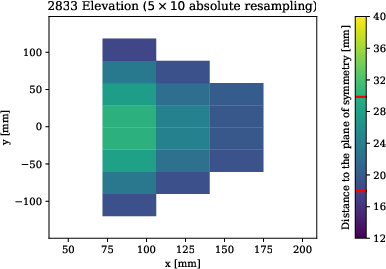
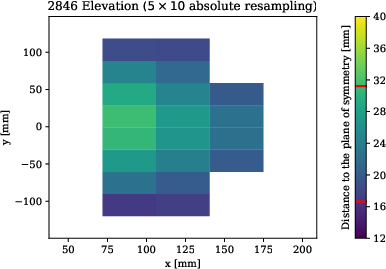
Figure 3: Resampled elevation maps for non-reduced (top) and reduced (bottom) instruments, showing relative and absolute approaches.
Feature normalization includes centering and scaling, omitting grid nodes with zero values to avoid bias. In parallel, a feature-engineering approach fits parametric "parabola-like" curves to contour lines—using four parameters (α, β, γ, δ)—yielding one-dimensional profiles that succinctly encode shape characteristics across multiple height levels.
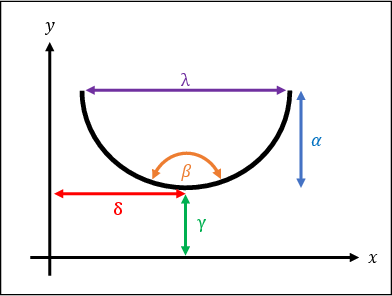
Figure 4: Impact of the parameters on contour lines fitting.
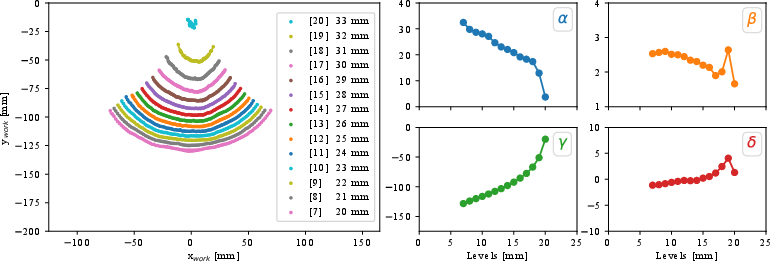
Figure 5: Fitting of contour lines and profiles of parameters α, β, γ, and δ per level.
Dimensionality reduction is also explored via PCA on vectorized elevation maps, with grid locations exhibiting missing values masked uniformly across the dataset. This enables compact representations suitable for limited training samples.
Classification Framework and Methodology
The classification task leverages SVMs (with RBF and linear kernels) and Decision Trees, utilizing leave-one-out cross-validation given the small dataset. Balanced accuracy—average of true positive and true negative rates—is used due to class imbalance. Hyperparameters (regularization 100×2500 for SVM, tree depth for Decision Trees) are tuned per split via nested cross-validation, obviating arbitrary selection and ensuring robust generalization estimates.
Deep-learning paradigms (PointNet, DeepSets, MLPs, CNNs) are excluded due to inferior performance in preliminary tests, attributable to limited corpus size and subtle geometric class differences.
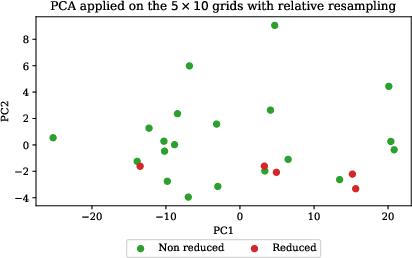
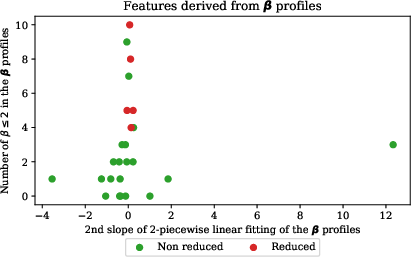
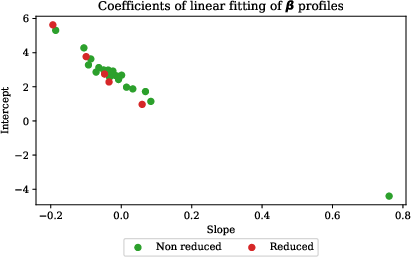
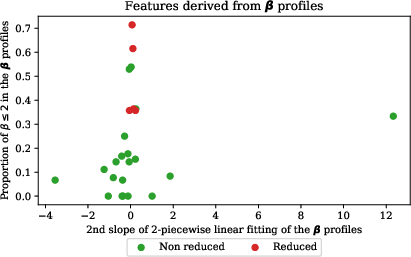
Figure 6: Several 2D representations of violin features, including first two PCA components and 100×2501 profile derived features.
SVMs trained directly on raw elevation maps yield inconsistent results. Peak balanced accuracy reaches 90% in select configurations, notably with fine grid resolution and normalized maps, but most combinations fall significantly lower—with some models producing misleading predictions (balanced accuracy below 50%). Model sensitivity to regularization is pronounced, as demonstrated by drastic accuracy fluctuations with minor changes in 100×2502.
By contrast, engineered contour parameters—particularly those using the 100×2503 profile, slopes, and polynomial fits—consistently achieve high accuracy (frequently attaining 100% with strong SVM regularization). PCA-reduced elevation maps do not significantly outperform raw elevation grids; optimal results are achieved with only two principal components in combination with strong regularization.
Decision Trees are generally outperformed by SVMs. Their accuracy on elevation maps and PCA features is modest, but engineered geometric descriptors again yield stronger predictions (balanced accuracy ≥ 90%), establishing the robustness of domain-informed features in this context.
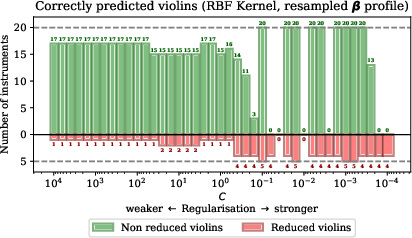
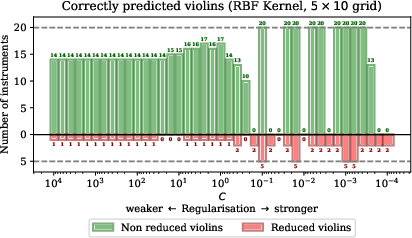
Figure 7: Leave-one-out cross-validation for several regularisation strengths, illustrating SVM sensitivity.
Implications, Limitations, and Future Perspectives
The research underscores the limitations of using high-dimensional raw geometric inputs for discriminating reduced violins, given the propensity for overfitting and instability in small datasets. Despite occasional parity in accuracy, engineered features derived from contour line profiles provide more reliable, interpretable, and consistent performance than elevation maps or PCA projections.
Practically, this finding advocates for prioritizing domain-specific feature extraction over generic, high-dimensional representations in shape classification tasks with limited sample sizes. Theoretically, it challenges assumptions regarding the superiority of information-rich representations if not coupled with appropriately sized datasets and robust feature selection.
Future developments may include the integration of hybrid descriptors, combining raw elevation information and engineered profiles, potentially utilizing semi-supervised or transfer learning approaches to mitigate sample size constraints. Approaches to automated shape analysis and contour fitting could be further optimized, while more extensive datasets may enable the re-evaluation of deep learning architectures. In the broader context of AI for cultural heritage, this study reaffirms the necessity of problem-specific feature design for effective organological analysis.
Conclusion
Machine learning classifiers applied to violin photogrammetric data reveal that engineered geometric features—especially contour line parameters—outperform raw elevation maps in the detection of historical soundbox reductions. Robust regularization schemes and dimensionality reduction cannot fully compensate for the superiority of compact, informative domain-driven descriptors in this task. Elevation maps remain valuable for comprehensive geometric characterization and may augment engineered features in future work, but contour-based inputs currently set the objective standard for high-accuracy classification in limited, metadata-rich datasets (2604.02446).