- The paper demonstrates that the interplay of nonreciprocity, dispersion, and Kerr-type nonlinearity drives distinct dynamical regimes including nonlinear-skin, wave-mixing, and self-trapping.
- It employs a collective coordinate approach and extensive lattice simulations to determine critical time scales for regime transitions.
- Numerical results confirm that even weak nonlinearity suppresses coherent non-Hermitian wave jumps, impacting transport control in metamaterials.
Dynamical Crossovers of Nonlinear Wave-Packets in the Hatano–Nelson Model
Introduction
This work delivers a comprehensive theoretical and numerical investigation of nonlinear wave-packet dynamics in the Hatano–Nelson (HN) model with onsite cubic (Kerr-type) nonlinearity. The study elucidates how the interplay of nonreciprocity, dispersion, and nonlinearity induces a sequence of dynamical regimes—nonlinear-skin, wave-mixing, and self-trapping—with distinctive transport and spreading phenomenology. Notably, the analysis demonstrates that wave amplification inherent to nonreciprocal (non-Hermitian) systems means even weak nonlinearity grows exponentially, fundamentally altering otherwise linear wave transport, suppressing coherent phenomena like the non-Hermitian wave jump, and establishing precise conditions for the onset of nonlinear and self-trapped behavior.
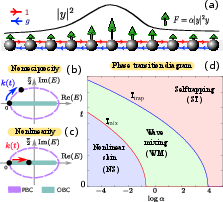
Figure 1: (a) Schematic of the nonlinear HN chain. (b) Linear wave-packet evolution under nonreciprocity and dispersion. (c) Effect of nonlinearity. (d) Theoretical regimes (NS, WM, ST) in the α–t parameter space.
Model and Analytical Classification of Dynamical Regimes
The system is governed by the discrete nonlinear HN equation,
−idtdyn=gyn−1+yn+1+α∣yn∣2yn,
with g>1 setting nonreciprocity and α controlling nonlinearity strength and focusing/defocusing character.
In contrast to conservative lattice models (e.g., DNLS), the non-Hermitian amplifying character (g>1) leads to exponential growth of weak perturbations, rapidly pushing the system from linear wave evolution into the nonlinear regime. By constructing a continuum theory and leveraging a collective coordinate (Gaussian ansatz) approach, three dynamical regimes for an initially Gaussian wave packet are identified, determined by the scale of the time-evolving nonlinear frequency shift ν(t) relative to the energy spectrum scales (level spacing d and total band width Δ):
- Nonlinear-skin (NS) regime: For ν(t)<d, linear-like (coherent) wave-packet transport persists, and analytical predictions for acceleration and amplitude remain accurate.
- Wave-mixing (WM) regime: When t0, nonlinear mode coupling induces resonant energy exchange and packet decoherence.
- Self-trapping (ST) regime: For t1, a fraction of the wave packet becomes self-trapped (localizes), and the remainder spreads ballistically.
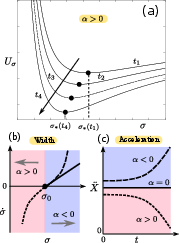
Figure 2: Analytical estimates, including the effective Hamiltonian potential for width dynamics and predictions for nonlinear acceleration trends under focusing/defocusing nonlinearity.
The transition times between these regimes, t2 and t3, are derived analytically and validated against numerical simulations.
Nonlinear Corrections to Wave-Packet Transport and Acceleration
In the NS regime (t4), nonlinearity modifies the packet dynamics in two distinctive ways:
- For focusing nonlinearity (t5): The wave-packet acceleration t6 is suppressed compared to the linear value and decreases with time; packet width growth is reduced. This is attributed to the effective negative contribution of nonlinearity to the evolution equation for width.
- For defocusing nonlinearity (t7): t8 increases with time; packet spreads more rapidly.
These predictions are quantitatively confirmed by both the analytical collective coordinate theory and direct lattice simulations. Importantly, the time-dependent acceleration is a non-Hermitian effect and distinguishes the model sharply from Hermitian (conservative) nonlinear lattices.
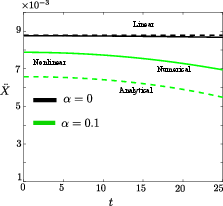
Figure 3: Comparison of wave-packet acceleration magnitude t9: lattice simulations (solid) vs. theory (dashed) for linear and nonlinear cases. Nonlinearity suppresses and time-modulates the acceleration.
Numerical Verification of Dynamical Regimes and Crossover
Extensive direct simulations are performed with large HN chains (−idtdyn=gyn−1+yn+1+α∣yn∣2yn,0), exploring a wide range of nonlinearity −idtdyn=gyn−1+yn+1+α∣yn∣2yn,1 and nonreciprocity −idtdyn=gyn−1+yn+1+α∣yn∣2yn,2. Key observables include the participation number −idtdyn=gyn−1+yn+1+α∣yn∣2yn,3 (spatial width), instantaneous center-of-mass, and spatiotemporal distributions in real and −idtdyn=gyn−1+yn+1+α∣yn∣2yn,4-space.
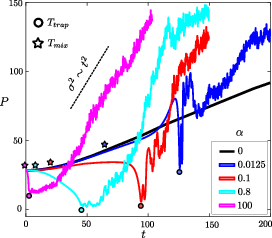
Figure 4: Participation number −idtdyn=gyn−1+yn+1+α∣yn∣2yn,5 characterizing the spreading/localization regimes for various −idtdyn=gyn−1+yn+1+α∣yn∣2yn,6. Stars and dots indicate −idtdyn=gyn−1+yn+1+α∣yn∣2yn,7 and −idtdyn=gyn−1+yn+1+α∣yn∣2yn,8, respectively. Ballistic spreading (slope 1 in log-log) signals the self-trapping regime at large times.
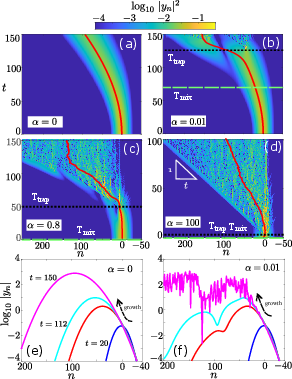
Figure 5: Spatiotemporal amplitude evolution for (a) linear and (b–d) nonlinear cases. Transition from coherent unidirectional propagation to mode mixing, then to formation of self-trapped high-amplitude core.
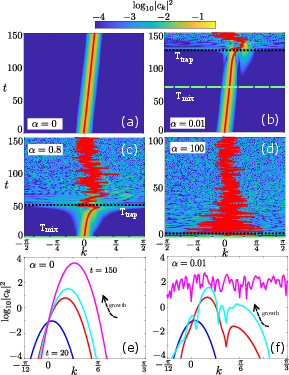
Figure 6: Amplitude dynamics in mode space (−idtdyn=gyn−1+yn+1+α∣yn∣2yn,9) for linear and nonlinear cases, visualizing coherent drift (linear), onset of resonant mode mixing (WM), and eventual stochastic excitation (ST).
The regime diagram (Figure 7) captures the dependence of g>10, g>11, and the widths of each regime on both g>12 and g>13. Increasing nonreciprocity (g>14) significantly accelerates the onset of nonlinearity-dominated (WM/ST) behavior, shrinking the window for observable linear/nonlinear-skin transport.
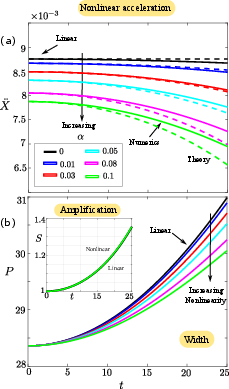
Figure 7: Dynamical regime diagrams in the g>15-plane for different g>16. Blue circles—g>17; red squares—g>18. NS and WM regimes narrow with increasing g>19.
Suppression of the Non-Hermitian Wave Jump by Nonlinearity
A salient claim is that nonlinear interactions generally preempt the non-Hermitian wave jump—a coherent, abrupt spectral rearrangement possible only in the linear HN model [JMAFS2026]. Explicit comparison of characteristic time scales demonstrates that even weak nonlinearity leads to exponential growth of the nonlinear frequency shift, so that the system reaches the WM or ST regimes before a wave jump can occur. Only by making α0 can α1 become the dominant timescale, consistent with the jump's absence in experimental platforms with inevitable nonlinear effects.
Implications and Outlook
The results have direct consequences for the control of transport in nonreciprocal and non-Hermitian metamaterials. Coherent high-velocity transport regimes—the nonlinear-skin regime—can persist only within a sharply limited window in both time and nonlinearity. As lattice asymmetry or intrinsic nonlinear response is increased, self-trapping and prolonged incoherence become unavoidable, with significant consequences for device design and the observation of non-Hermitian linear phenomena.
Experimentally, the strong predictions for the absence of the wave jump, the precise crossover times, and the nonlinear modulation of packet acceleration are all readily testable across photonic, acoustic, atomic, and electrical nonreciprocal platforms.
Future directions include systematic analysis of wave-mixing-induced decoherence, the inclusion of external damping or gain, generalizations to higher dimensions, and the study of more complex forms of nonlinearity. Incorporating engineered dissipation [VGGSMC2024; JMAFS2025] could produce further nontrivial dynamical regimes.
Conclusion
This study establishes that the inclusion of even weak cubic nonlinearity in the HN model enforces a robust sequence of transport-to-localization crossovers, replaces spectral/real-space coherent features with wave mixing and self-trapping, and renders non-Hermitian (linear) phenomena inaccessible in most physically realizable systems. The interplay between nonreciprocity, dispersion, and nonlinear amplification sets the precise boundaries of these behaviors in parameter space—a foundation for theoretical analysis, materials design, and experiments aiming to access or exploit nonreciprocal and nonlinear effects in wave dynamics.