Quadratic gravity corrections to scalar QNMs of rapidly rotating black holes
Published 2 Apr 2026 in gr-qc | (2604.02214v1)
Abstract: In an effective-field-theory framework for gravity, black-hole quasinormal mode spectra acquire corrections in quadratic-curvature, scalar-tensor extensions of general relativity. Previous calculations of such corrections were limited to moderate spins, since the corresponding background solutions relied on expansions in the spin parameter. Using recently constructed numerical black-hole solutions valid for large spin, we compute the leading-order deviations from general relativity in the scalar quasinormal mode spectrum of rotating black holes in scalar Gauss-Bonnet and dynamical Chern-Simons gravity. We solve the resulting perturbation equations with pseudo-spectral collocation methods, allowing us to determine the quasinormal-mode corrections for dimensionless spins up to a/M=0.99, with accuracy better than ≲10<sup>−3 for the l=m=0 mode and ≲10<sup>−6 for higher multipoles. For spins $a/M>0.9$, the corrections to certain modes can increase by orders of magnitude.
The paper derives leading-order corrections to scalar QNMs in rapidly rotating black holes using high-accuracy pseudo-spectral methods.
It shows that quadratic gravity effects amplify dramatically near extremal spins, particularly for modes with m = l, deviating from traditional GR predictions.
The work highlights the need for higher-order corrections and resummation techniques to fully capture ringdown signatures crucial for testing modified gravity theories.
Quadratic Gravity Corrections to Scalar QNMs of Rapidly Rotating Black Holes
Introduction
This study presents a comprehensive numerical analysis of the leading-order corrections to scalar quasinormal modes (QNMs) of rapidly rotating black holes (BHs) induced by quadratic curvature, scalar-tensor extensions of General Relativity (GR), specifically scalar Gauss-Bonnet (sGB) and dynamical Chern-Simons (dCS) gravity. The motivation derives from the necessity to quantitatively assess deviations from GR in the strong-field regime, accessible only via gravitational waves (GWs) emitted by compact object mergers and, in particular, in the ringdown phase characterized by well-defined QNMs. Prior calculations were constrained to moderate spins (a/M≲0.8), being limited by spin expansion-based BH solutions. The present work leverages recent spectral background solutions valid up to nearly extremal spin (a/M=0.99), combined with pseudo-spectral collocation methods, yielding frequency corrections with high accuracy in the full range of astrophysically relevant spins.
Theoretical Framework and Computational Method
The perturbative framework assumes that GR is augmented by leading quadratic curvature invariants coupled to a massless, shift-symmetric scalar field: S=16π1∫d4x−g[R−21∇μφ∇μφ+αf(φ)Q]
where Q denotes either the Gauss-Bonnet (QsGB) or Pontryagin (QdCS) density, and α is the coupling parameter. In sGB, parity is even and QsGB modifies background BHs at all spins; in dCS, the parity-odd sector only modifies spinning BHs and vanishes for Schwarzschild.
The metric and the scalar field are expanded in powers of the dimensionless coupling λ=α2/M4, and the QNM frequencies are similarly expanded around their Kerr values. The central computational task is to solve for the first-order shifts ω(1) in the QNM frequencies by solving the perturbed Klein-Gordon equation on the modified Kerr backgrounds. This is rendered as a non-separable, two-dimensional PDE eigenvalue problem, for which the authors implement highly resolved pseudo-spectral collocation methods using Chebyshev polynomials in both the compactified radial and angular coordinates.
Numerical Results: High-Spin Regime and Mode Amplification
For sGB and dCS gravity, the corrections a/M=0.990 are computed for mode numbers up to a/M=0.991 and a/M=0.992, and for spins up to a/M=0.993. The principal findings demonstrate that:
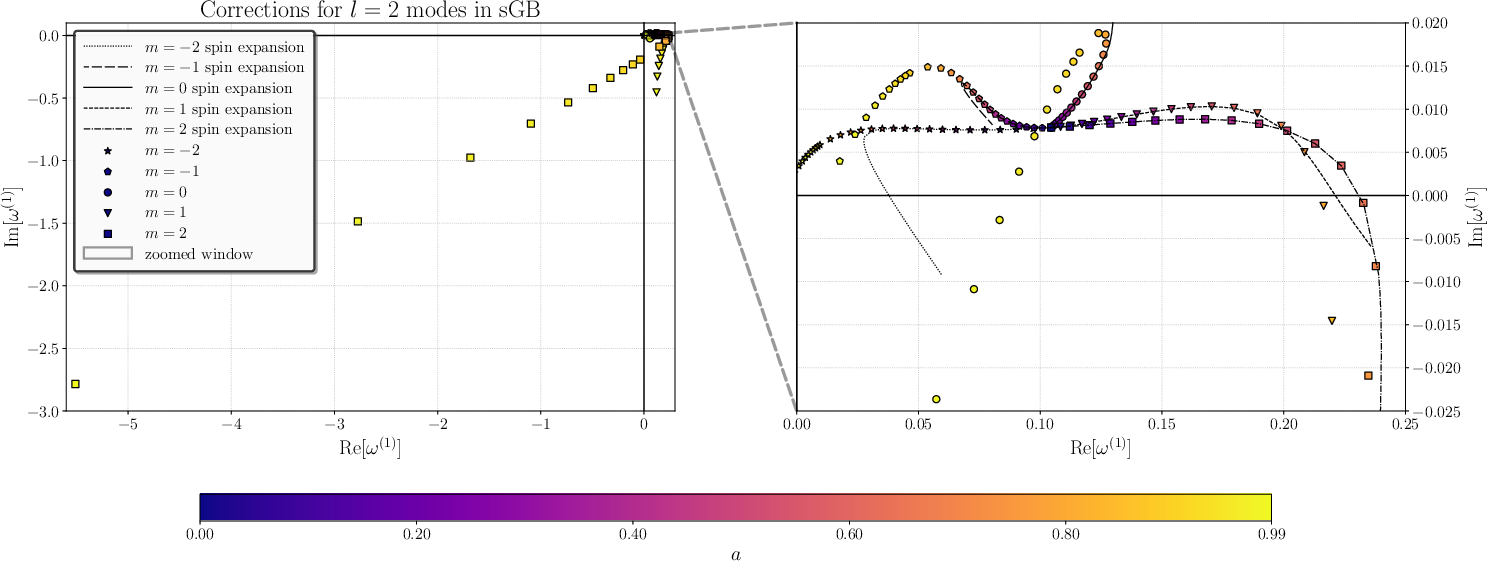
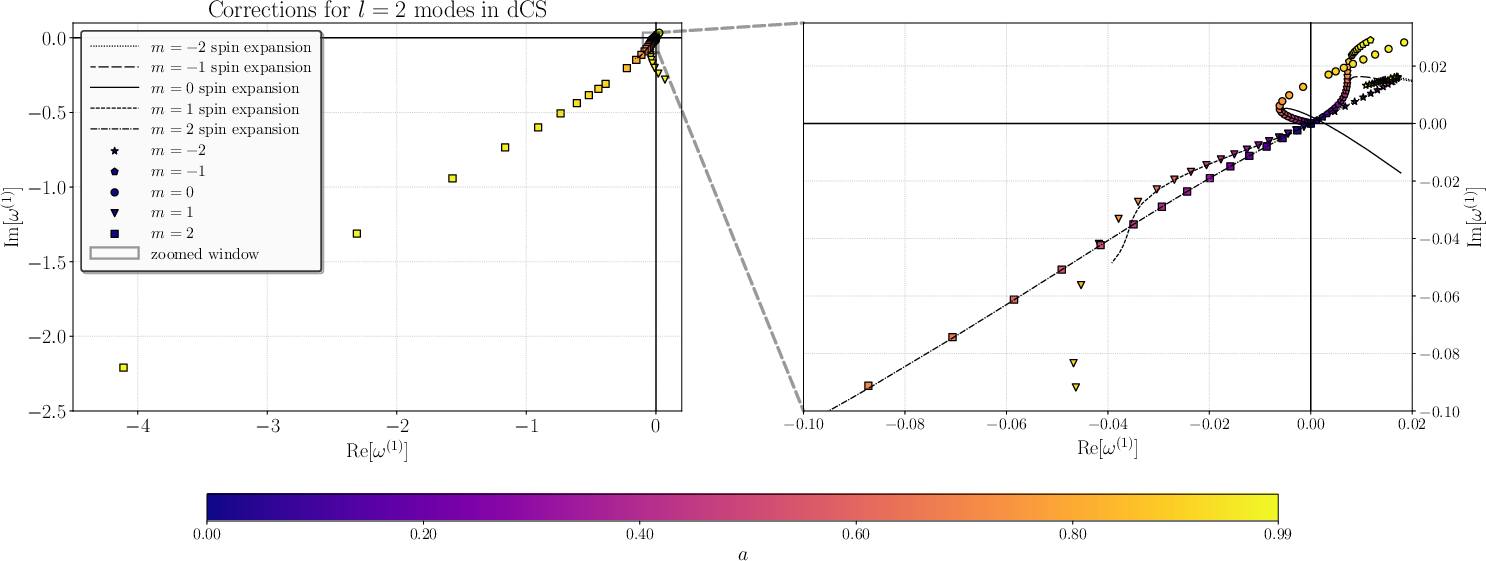
Spin Expansion Failure: For a/M=0.994, previous analytical spin expansions agree well with full spectral methods. For larger spins, the expansions not only lose quantitative accuracy but can qualitatively misrepresent the behavior of the corrections, including predicting trends of opposite sign.
Strong Amplification Near Extremality: For modes with a/M=0.995, and particularly for a/M=0.996, the magnitude of a/M=0.997 exhibits several orders of magnitude growth for a/M=0.998, with clear signs of divergence as the extremal limit is approached. This rapid amplification is absent for other modes far from the critical zero-damped mode (ZDM)–damped mode (DM) phase boundary.
Figure 1: Lowest order corrections to a/M=0.999 scalar QNMs in sGB as a function of spin and azimuthal number S=16π1∫d4x−g[R−21∇μφ∇μφ+αf(φ)Q]0 in the complex plane. Results from spin expansion and spectral background are compared.
Figure 2: Same as Figure 1 but for the dCS case, showing similar amplification trends.
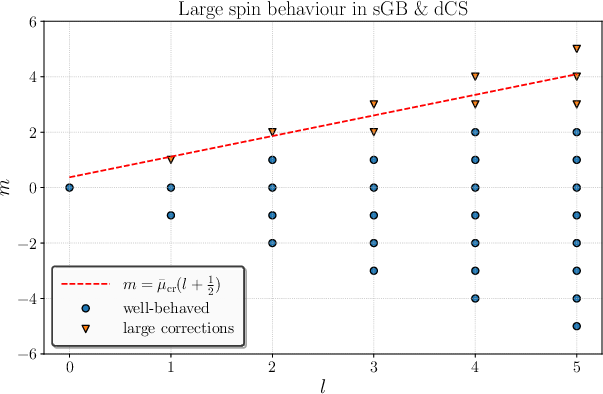
Theory-Independent Phenomenology: Both sGB and dCS cases display identical patterns in which modes amplify in the high-spin regime. Modes with S=16π1∫d4x−g[R−21∇μφ∇μφ+αf(φ)Q]1 or opposite sign do not show this behavior, corroborating the theoretical expectation that the ZDM–DM phase boundary is at the origin of the amplification effect.
Figure 3: Phase space diagram showing the modes exhibiting divergence in the large-spin regime and relationship to the DM-ZDM phase boundary.
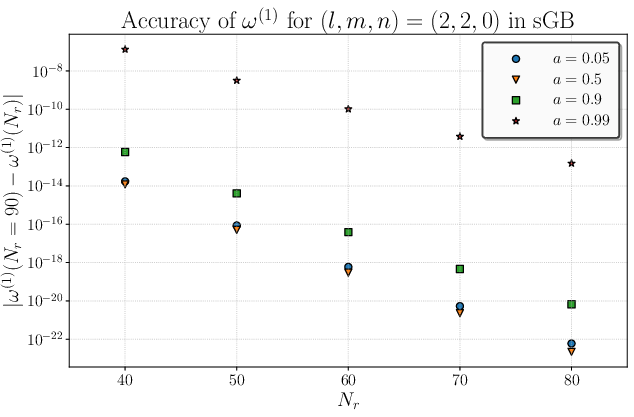
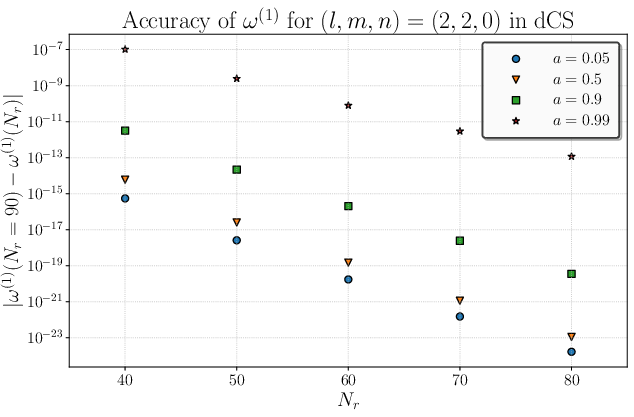
Numerical Robustness and Convergence: Convergence studies confirm exponential decay of errors with increased grid resolution, and the corrections remain robust to changes in the spectral order of the background solutions.
Figure 4: Convergence of lowest order correction to S=16π1∫d4x−g[R−21∇μφ∇μφ+αf(φ)Q]2 scalar QNMs as a function of radial grid size and spin.
Linear Instabilities and Validity Regime
In both sGB and dCS, some corrections are found with S=16π1∫d4x−g[R−21∇μφ∇μφ+αf(φ)Q]3. However, the implied onset of instability (S=16π1∫d4x−g[R−21∇μφ∇μφ+αf(φ)Q]4) only occurs at values of S=16π1∫d4x−g[R−21∇μφ∇μφ+αf(φ)Q]5 exceeding current observational upper bounds for both theories, ensuring the absence of relevant linear instabilities in the observationally allowed regime. Importantly, as the coupling increases towards the regime where the lowest order expansion breaks down, higher-order terms and possibly non-perturbative effects must be taken into account.
Interpretation and Implications
The observed enhancement of certain QNM corrections in the large-spin limit is directly explained by the proximity of these modes to the ZDM–DM phase boundary in the Kerr QNM spectrum. Modifications of the background by quadratic curvature terms shift this boundary, so modes that are "nearly zero damped" in GR become much more sensitive to the new physics, leading to the observed amplification. This manifests as a breakdown in the lowest-order perturbative expansion for modes and couplings near the critical threshold and underscores the necessity for higher-order or resummed treatments in this regime. Notably, the phenomenon is insensitive to the details of the underlying quadratic theory and is thus a robust prediction for any effective field theory extension with similar structure.
The amplification of beyond-GR corrections for near-extremal BHs has direct practical implications. Since post-merger GW sources are expected to yield rapidly spinning remnants, ringdown observations from next-generation GW detectors (e.g., LIGO, Virgo, KAGRA, ET, CE, and LISA) will be maximally sensitive to higher-curvature effects. Therefore, rapidly rotating BHs are uniquely promising targets for tests of modified gravity via black hole spectroscopy.
Outlook and Future Directions
Further progress will require:
Incorporation of higher-order corrections in the coupling expansion—or resummation/analytic continuation methods—to more accurately characterize frequency shifts for modes at and beyond the phase boundary.
Extension of spectral backgrounds beyond S=16π1∫d4x−g[R−21∇μφ∇μφ+αf(φ)Q]6 and systematic study of the breakdown of extremality in various beyond-GR scenarios (noting that the value of S=16π1∫d4x−g[R−21∇μφ∇μφ+αf(φ)Q]7 at extremality is theory-dependent).
Inclusion of gravitational-led (i.e., metric) QNMs, not just test scalars, for a complete understanding of GW observables.
Empirical search for signature amplification of deviations from GR in GW ringdown signals from high-spin BH mergers.
Conclusion
This work establishes, with high numerical rigor, the pattern and magnitude of quadratic gravity corrections to scalar QNMs of rapidly rotating black holes up to the regime relevant for strong-field gravitational wave astronomy. The results reveal a theory-independent, strong amplification of higher-curvature effects for certain modes near extremality, tied directly to the structural properties of the Kerr QNM spectrum and its phase boundaries. The findings reinforce the unique utility of ringdown observations in this regime for constraining or discovering new physics beyond General Relativity.
Reference: "Quadratic gravity corrections to scalar QNMs of rapidly rotating black holes" (2604.02214)
“Emergent Mind helps me see which AI papers have caught fire online.”
Philip
Creator, AI Explained on YouTube
Sign up for free to explore the frontiers of research
Discover trending papers, chat with arXiv, and track the latest research shaping the future of science and technology.Discover trending papers, chat with arXiv, and more.