- The paper introduces the multiplex synchrony alignment function (MSAF) to unify intra- and inter-layer dynamics in directed multiplex networks.
- It derives optimal and perfect frequency sets that enable maximal and exact synchronization, validated through extensive simulations on diverse network models.
- The study highlights topology and frequency assignment optimizations that enhance network stability, with applications in power grids, neural circuits, and communication systems.
Synchronization Optimization in Directed Multiplex Networks: A Unified Analytical Framework
Introduction and Motivation
Directed multiplex networks provide a principled substrate for modeling real-world interacting systems where entities engage in multiple types of directed interactions. Examples span critical domains such as financial infrastructures, neural circuits, and engineered communication systems. The inherent directionality and multiplexity (multiple coupled layers) pose unique challenges for collective phenomena such as synchronization—particularly when dynamical frustration or phase lags are present. Despite extensive literature covering synchronization on undirected and single-layer networks, the joint optimization of synchronization in the presence of directionality, multiplex structure, and frustrated dynamics remains theoretically unresolved.
This paper introduces a unified analytical and computational framework for optimizing synchronization in directed multiplex (specifically, duplex) networks of Sakaguchi-Kuramoto-type phase oscillators. Central contributions include the formulation of a multiplex synchrony alignment function (MSAF) that fuses intra- and inter-layer structural and dynamical features; derivation of both optimal and "perfect" frequency sets enabling, respectively, maximal and exact synchronization; and a systematic exploration of network- and frequency-level optimization strategies. The work ultimately reveals robust structural-dynamical motifs underpinning synchrony in complex architectures, with immediate implications for power grids, neural dynamics, and communications.
The system under study is a directed duplex network composed of two layers, each defined by its own adjacency (and thus Laplacian) matrix. Each node in each layer is a Kuramoto oscillator with a layer-specific frustration (phase-lag) parameter. Mirror nodes connect across layers, coupling the respective oscillator phases. The model generalizes the Sakaguchi-Kuramoto dynamics to the multiplex, directed setting:
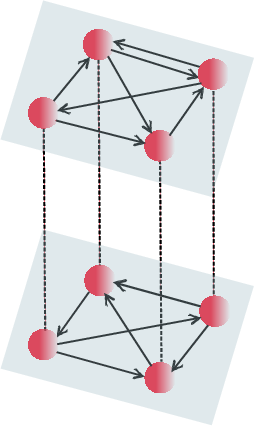
Figure 1: Schematic of a duplex directed network—dashed lines are interlayer mirror-node couplings.
The synchronization state is quantified for each layer and globally via Kuramoto-type order parameters. The theoretical advance centers on the multiplex synchrony alignment function (MSAF), constructed by linearly expanding the dynamics in the coherent regime (small phase differences). The resulting vector forms specify effective frequencies and composite Laplacians incorporating both intra- and interlayer couplings and directionality.
MSAF for each layer is mathematically defined as
J(ω~m(l),Lm(l))=N1j=2∑N(σj(l))2⟨uj(l),ω~m(l)⟩2
where Lm(l) are the modified multiplex Laplacians for each layer, encoding both layers' directed connectivity and phase lags, and ω~m(l) are effective multiplexed frequencies. The minimization of J(.,.) for both layers simultaneously is central to achieving optimal synchronization.
Analytical Results: Frequency Optimization
Two classes of frequency vectors are derived analytically:
- Perfect Synchronization Frequencies: For prescribed coupling Kp and nonzero frustration parameters, setting all effective multiplexed frequencies to zero yields a set of natural frequencies that guarantees R1=R2=R=1 (full synchrony) at Kp. These depend linearly on the out-degree and the frustration.
- Optimal Frequencies: For a broad range of K, minimizing the MSAF (subject to zero mean and fixed variance constraints) yields frequency sets which maximize the order parameters across all K, thus improving the transition to synchronization and reducing required coupling.
Derivation leverages singular value decompositions of the composite Laplacians, ensuring full generality with respect to topological asymmetry and multiplex structure.
Numerical Validation and Synchronization Transitions
Extensive simulations on directed SF-SF, SF-ER, and ER-ER duplexes—each with 1000-node strongly connected layers—validate the analytical predictions.
- Non-frustrated regime: Networks employing the "optimal" frequency sets synchronize at substantially lower coupling strengths compared with networks assigned standard uniform, normal, or Lorentzian frequencies. This demonstrates strong improvements in collective behavior attributable purely to optimized alignment (as measured by the MSAF).
- Frustrated regime: Both the perfect and optimal frequency sets, computed for targeted Kp or a desired optimal Lm(l)0, yield high or exact synchronization (Lm(l)1), outperforming all random frequency allocations.
The study implements high-precision RK4 integrators and quantifies results via order parameters for both layers and the global network, conclusively showing the efficacy of the MSAF-based optimization.
Network- and Frequency-Level Design
Two complementary optimization problems are addressed:
- Topology Optimization with Fixed Frequencies: A concurrent accept–reject rewiring strategy is applied to both layers, minimizing the MSAF and thus the order parameter cost. Significant improvements in Lm(l)2 are observed for all three network classes post-optimization.
- Frequency Assignment on Fixed Topology: With topology fixed, a greedy pairwise swapping algorithm is used to assign fixed frequency pools to oscillators, minimizing the MSAF. The result is notably enhanced synchronization compared to random assignments for all tested architectures.
These sections highlight the practical utility of the MSAF as a guiding objective for both network design and allocation of oscillator parameters.
Structural-Dynamical Correlations in Optimal Synchronization
Key findings on the correlations emergent in synchrony-optimized networks are:
- Positive Frequency–Out-degree Correlation: Across ER-ER and SF-SF networks, the absolute oscillator frequency is strongly correlated with its out-degree (Lm(l)3), much more so than with its in-degree. This aligns with theoretical predictions for directed synchronization optimization.
- Negative Neighbor-Frequency Correlation: Both in- and out-neighborhood mean frequencies are negatively correlated with oscillator frequency across all network types, revealing a preference for local frequency "balancing" in the optimal states.
- Negative Mirror-Node Frequency Correlation: After optimization (by arrangement or topology), mirror node frequencies across layers are anti-correlated (Lm(l)4 ranges from Lm(l)5 to Lm(l)6), a robust cross-layer feature not present in random assignments.
These motifs underscore a unifying structural–dynamical synergy required for multiplex synchrony under complex constraints.
Implications, Limitations, and Future Directions
The MSAF framework unifies previous disparate results for undirected, monolayer, or unfrustrated networks, providing an explicit pathway to engineer synchrony through structure and dynamics in highly general settings. The strong frequency–out-degree alignment and cross-layer anti-correlation prescribe actionable strategies for designing or rewiring critical systems—applicable to power grid stability, neural phase control, and regulated communication in resilient infrastructures.
The findings also suggest theoretical extensions: scaling to more than two layers (multiplexes with Lm(l)7 layers), higher-order network structures (simplicial complexes, directed hypergraphs), and the interaction with non-Kuramoto dynamics. The formalism could underpin analytic studies of explosive synchronization and chimera phenomena in highly structured multi-agent systems.
Conclusion
This work introduces and systematically analyzes a multiplex synchrony alignment function (MSAF) for directed multiplex networks, providing both theoretical and numerical grounding for the joint optimization of synchronization via network topology, frequency assignment, and their interplay. The framework yields analytical forms for "optimal" and "perfect" frequency sets in both frustrated and non-frustrated regimes; supports practical design algorithms for topology and frequency arrangement; and uncovers robust correlation structures as the underlying fingerprints of synchrony in complex directed multiplexes. Future generalizations to higher-order, multi-interaction, and time-varying systems are immediate research avenues. The optimal design principles identified here have broad utility for the engineering and stabilization of real-world coordination networks.

