- The paper introduces an innovative projection-aware ensemble that directs CXRs to specialized branches for optimized multi-label classification.
- It details a dual-branch architecture combining contrastive and asymmetric losses to enhance zero-shot detection of rare pathologies.
- Empirical results demonstrate significant gains in mAP, AUC, and F1 with minimal computational overhead, supporting clinical deployment.
CXR-LT 2026 Challenge: Projection-Aware Multi-Label and Zero-Shot Chest X-Ray Classification
Introduction
This work presents a comprehensive framework addressing two critical tasks defined by the CXR-LT 2026 Challenge: projection-aware multi-label classification and zero-shot classification for chest X-rays (CXRs). The long-tailed nature of clinical datasets, combined with the inherent heterogeneity of projections (AP/PA and Lateral), requires specialized architecture and loss design. Additionally, the demand for recognizing rare or previously unseen pathologies without explicit supervision necessitates advanced zero-shot generalization strategies leveraging vision-LLMs (VLMs) and deep prompt engineering. This paper provides both architectural innovations and empirical insights on those problems (2604.02185).
Projection-Aware Multi-Label Classification
The authors introduce a modular pipeline consisting of a projection classifier (EfficientNet Router) to direct CXR images to specialized ensemble branches, each optimized for either AP/PA or Lateral projections.
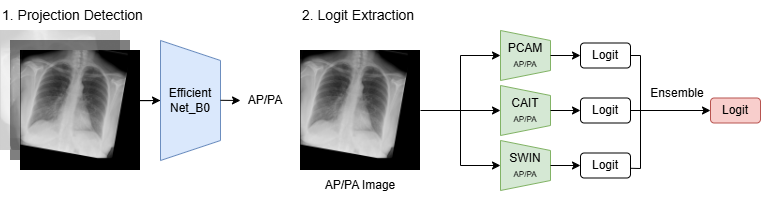
Figure 1: Multi-label classification diagram. The framework routes images to projection-specific ensembles, each predicting 30 pathologies.
The projection branches ensemble:
- ConvNeXt-v2 with PCAM pooling for spatially localized lesion attention,
- ConvNeXt-v2 + CaiT transformer for hierarchical feature modeling,
- Swin Transformer for scalable, locality-preserving computation in high-resolution images.
Extensive data augmentation, test-time augmentation (TTA), and grid search-based ensemble weighting ensure robustness. Notably, the approach preserves view-specific representations, mitigating bias where AP/PA views dominate the training distribution. Across the validation split, the integrated routing-ensemble framework achieves an mAP of 0.39456 (AP/PA) and 0.3586 (Lateral). On the CXR-LT test set, the method achieves mAP 0.4827, mAUC 0.9186, F1 0.3162, confirming the benefit of explicit projection handling for both in-distribution and external datasets.
Ablation analyses establish that while mixed-projection training can improve AP/PA accuracy, projection-aware routing markedly enhances robustness, particularly for the under-represented Lateral view. The computational overhead is minimal (77 ms/image), permitting practical deployment.
Zero-Shot Classification with Dual-Branch Hybrid Architecture
The second task targets generalization to unseen pathologies, a prototypical zero-shot setting. The authors leverage and extend the CheXzero vision-language framework, proposing a dual-branch hybrid architecture integrating global contrastive alignment and class-imbalanced optimization.
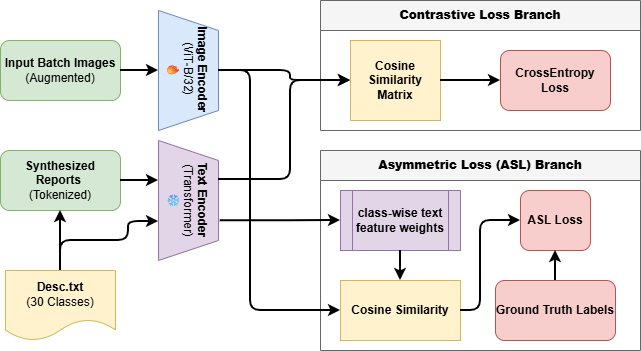
Figure 2: Dual-Branch Hybrid Architecture. Simultaneous contrastive and asymmetric losses stabilize representation learning and improve rare-class sensitivity.
The network merges two optimization objectives:
- Contrastive Loss Branch: Aligns high-level CXR representations with textual label descriptions, following a CLIP-style paradigm.
- Asymmetric Loss (ASL) Branch: Specifically addresses the severe imbalance and rarity of many CXR labels using class-specific focusing parameters and applies loss solely during training (no inference overhead).
The total loss function is
Ltotal=Lcon+αLASL
where α modulates ASL impact. Setting γ−>γ+ in ASL accentuates hard positives, crucial for rare disease sensitivity.
A notable innovation is the use of LLM-generated detailed prompts instead of plain class names, promoting fine-grained semantic alignment even for previously unseen concepts. During training, prompts for multi-label cases are dynamically shuffled to enforce semantic, not lexical, learning. During inference, an ensemble over class names and descriptions further enhances OOD robustness.
Validation incorporates a stringent leak-free strategy: 6 proxy "unseen" labels are held out during training, and performance is evaluated across three clinically relevant OOD groupings.
Empirical Results
Task 1: The projection-aware ensemble yields mAP 0.4827, mAUC 0.9186, F1 0.3162 on the challenge test set, with AP/PA consistently outperforming Lateral but the gap reduced compared to non-projection-aware bases. On the external MIMIC dataset, the framework exhibits strong cross-domain generalization, validating its robustness outside the in-distribution regime.
Task 2: The dual-branch model configured with α=1.5 for the ASL term delivers an average zero-shot mAP of 0.3391 on proxy OOD groups, outperforming standard CheXzero baselines (0.3186) and purely fine-tuned models. Consistent improvement is observed across structural, common, and rare/critical label subgroups. ECE analysis reveals improved calibration, with ASL reducing ECE from 0.2902 to 0.2417, further supporting reliability for clinical deployment. Model efficiency is practical, with per-image inference below 30 ms even with full TTA and prompt ensemble.
Implications and Future Directions
The explicit disentanglement of CXR projection type and the architectural marriage of ensemble vision backbones offer a viable path forward for long-tailed multi-label classification in medical imaging, where data acquisition and annotation are perpetually imbalanced. The dual-branch architecture addresses the vulnerability of existing VLMs/CLIP-based solutions to rare-class underfitting and semantic drift under OOD shifts. Integrating LLM-driven descriptive prompts into the classification pipeline bridged the gap between clinical granularity and learned representations, facilitating more reliable zero-shot inference.
Potential future extensions include unified joint multi-task models, application to multi-modal (e.g., CXR and clinical reports) and temporal data, and continuous prompt/label space adaptation driven by evolving clinical taxonomies or local lexicons. Efficient calibration and robustness under severe domain shift will remain critical for translational deployment.
Conclusion
This work delivers a modular and efficient solution to CXR long-tail and zero-shot classification, substantiated with strong mAP/AUC/F1 and ECE metrics, and demonstrates clinically feasible inference rates. The empirical evidence confirms that projection-aware architectures and dual-branch hybrid losses with descriptive prompt engineering lead to state-of-the-art OOD generalization and robust rare disease sensitivity. These methods constitute a substantive advance for both clinical and methodological research communities seeking scalable, reliable image-based diagnosis (2604.02185).

