- The paper presents FACET-DiMPC, which reduces computation and communication load by targeting true facet neighbors between critical regions.
- It leverages multiparametric programming to derive offline piecewise affine control laws, ensuring performance parity with centralized MPC.
- Simulations demonstrate a 98% reduction in computation time for large-scale systems, validating its scalability and efficiency.
Explicit Distributed MPC with Facet-Based Critical Region Exploration
Introduction
The paper "Explicit Distributed MPC: Reducing Computation and Communication Load by Exploiting Facet Properties" (2604.02177) presents a new explicit distributed model predictive control (DiMPC) architecture focusing on minimizing online computation and communication complexity. The work develops FACET-DiMPC, a variant of iteration-free DiMPC that leverages facet properties of explicit controller critical regions for targeted search during online deployment. The approach draws on multiparametric programming to produce offline piecewise affine control laws, while facet-based neighbor detection enables significant reductions in both the number of online computations and inter-controller communications without compromising centralized performance.
Background: Distributed and Explicit MPC
Classical centralized MPC (CMPC) successfully handles constraints in process control but becomes computationally prohibitive in large-scale settings due to its monolithic online QP solution. DeMPC improves scalability by decoupling the process, yet at the expense of failing to address subsystem coupling. DiMPC architectures—especially the cooperative class—balance these trade-offs by distributing optimization over subsystems, with controllers exchanging information to achieve plant-wide optimality.
Explicit MPC (mpMPC) brings offline multiparametric programming to bear, yielding a partition of the parameter (state) space into critical regions, each with an associated affine control law. In the distributed context, iterative explicit DiMPC (I-mpDiMPC) and iteration-free explicit DiMPC (IF-mpDiMPC) have been proposed, with the latter removing online iterative updates at the cost of increased critical region management complexity.
FACET-DiMPC: Facet-Driven Exploration
The key innovation of FACET-DiMPC is the replacement of hyperplane-based neighbor detection with facet-based exploration between critical regions in the explicit solution. In previous IF-mpDiMPC approaches, the online search for the appropriate region at each timestep included not only the region containing the current operating point but also all adjacent regions sharing a hyperplane. However, many such "neighbors" do not share a true facet; they may be non-intersecting or only meet at a point, resulting in unnecessary computational effort.
FACET-DiMPC introduces a rigorous method for determining whether two regions share a facet, solving a linear program to confirm true adjacency. For solution space polyhedra, only regions that share a facet are considered neighbors when searching for the next active region as the system evolves. This substantially prunes the online search set for region transitions, as shown in the simulation study.
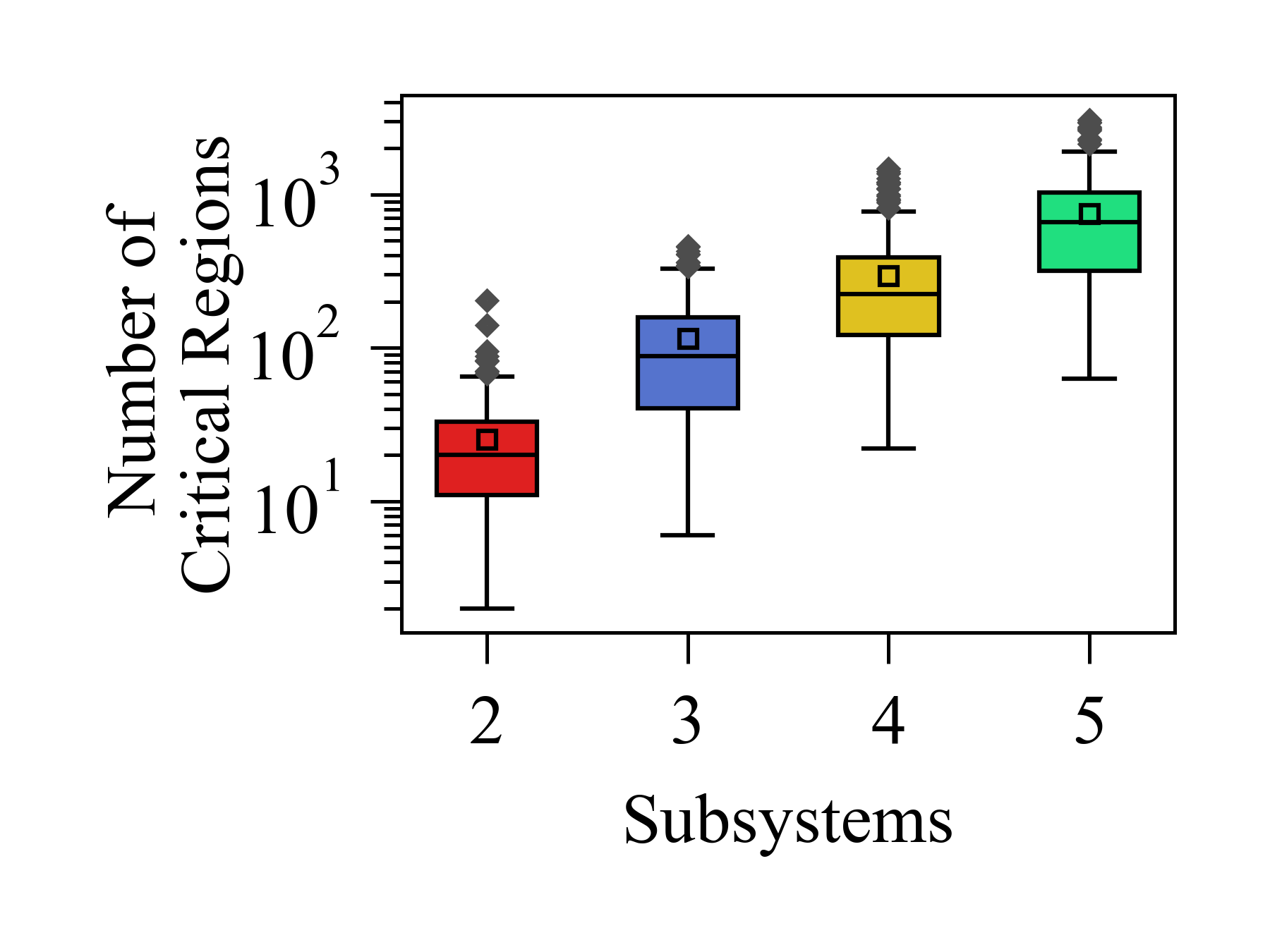
Figure 1: The total number of critical regions is unchanged across distributed mpMPC variants; differences arise in the efficiency of region exploration.
The proposed architecture is evaluated on randomly generated networked plants with varying subsystem counts (M=2 to $5$), each subsystem featuring $2$ states and $1$ input. Performance is assessed on metrics including control fidelity, communication burden (number of data exchanges), and computation time.
Across all compared methods (CMPC, DiMPC, I-mpDiMPC, IF-mpDiMPC, FACET-DiMPC), state trajectories and achieved setpoint tracking are statistically indistinguishable due to stringent convergence criteria (ϵ=10−8) and sufficient iteration budgets. This confirms that FACET-DiMPC does not sacrifice closed-loop performance for efficiency.
Communication Overhead
Iterative methods (I-mpDiMPC, DiMPC) have communication burdens scaling with both the plant size and convergence rate, as reflected in the number of inter-controller messages per sample period. Iteration-free approaches dramatically reduce communication instances by transmitting only once per sample period.
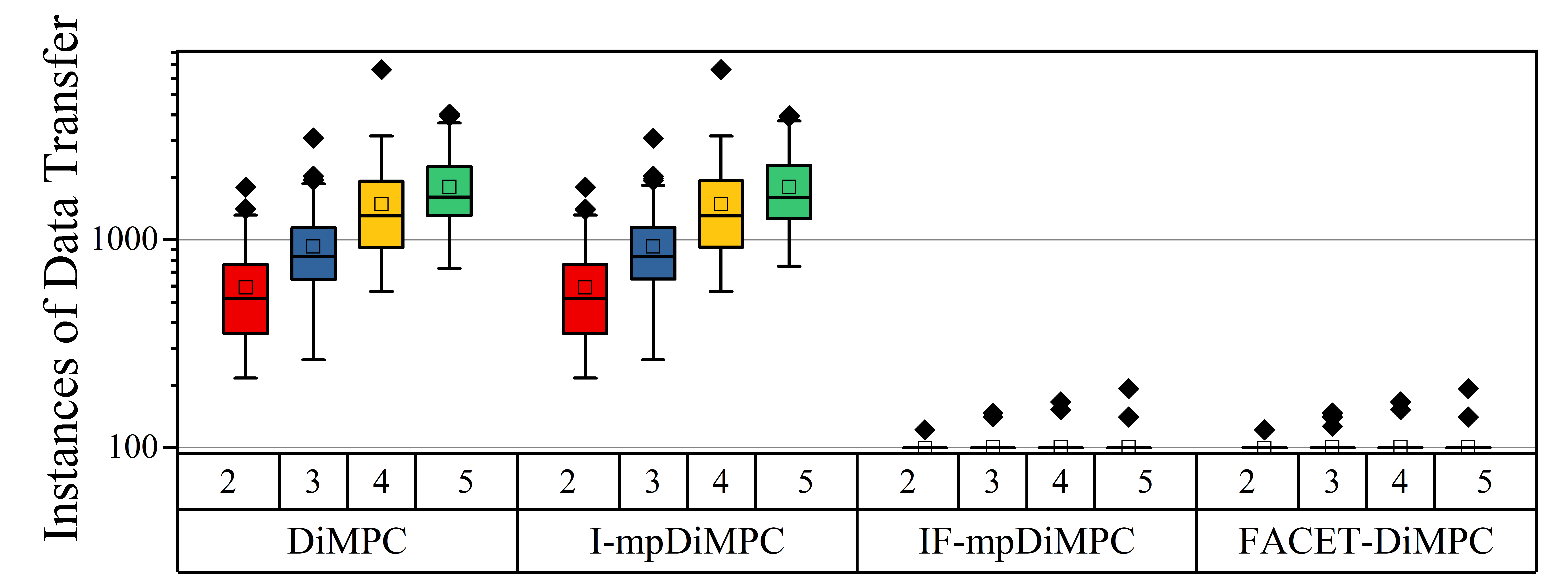
Figure 2: FACET-DiMPC and IF-mpDiMPC exhibit minimal, constant data transfers per sample, independent of subsystem count.
Computation Time
Classical DiMPC exhibits computation times that scale unfavorably with plant size due to the exponential growth in region combinations and iterative update requirements. IF-mpDiMPC eliminates iterations, but may still require solving a large set of region combinations at each timestep due to over-broad neighbor selection from hyperplane-based adjacency. FACET-DiMPC, by contrast, restricts the search space to truly adjacent regions, yielding significantly improved computational efficiency, most notably as the number of subsystems increases.
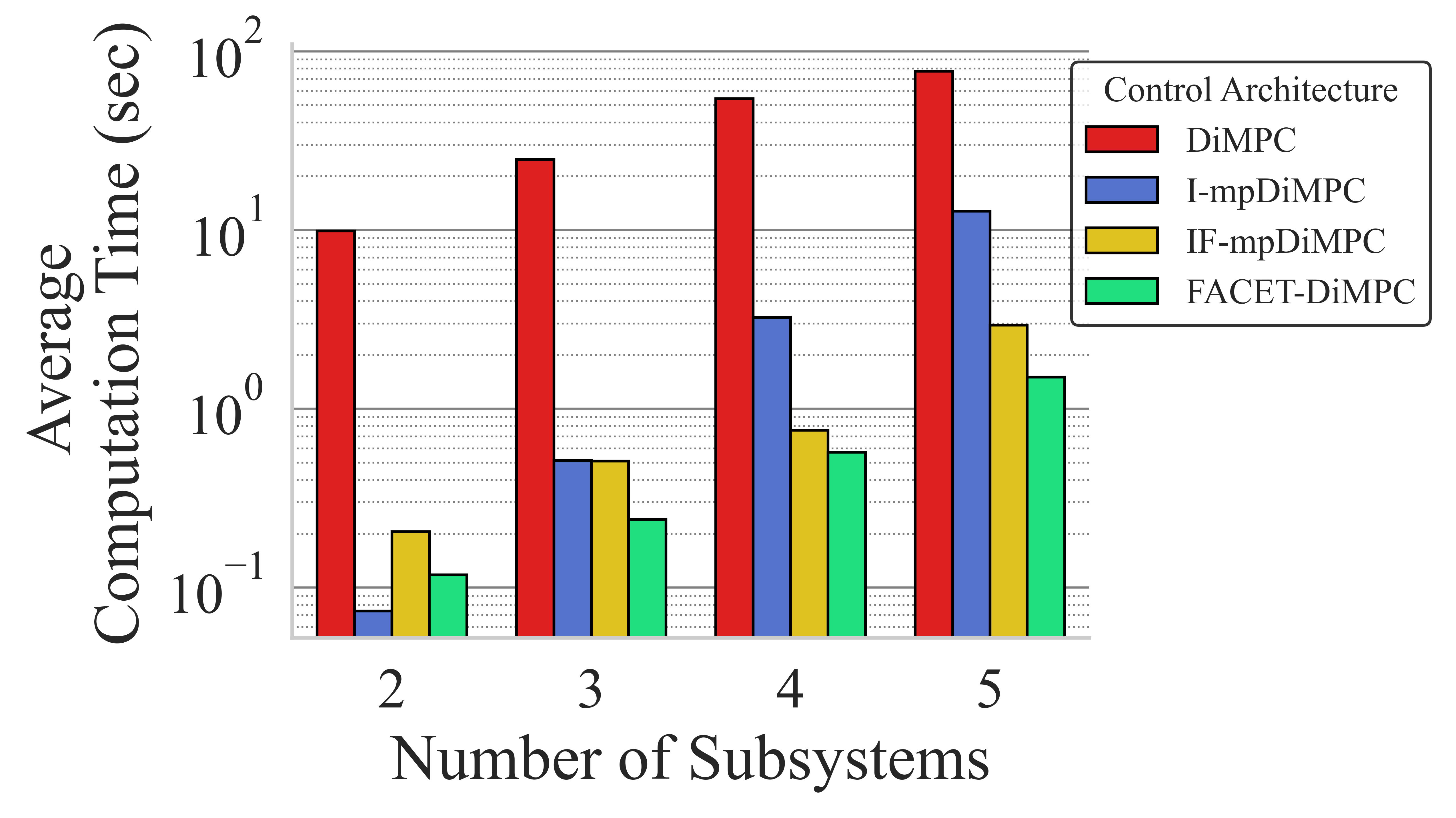
Figure 3: Average computation time (log-scale) for all control architectures; FACET-DiMPC achieves the best performance, especially for large-scale systems.
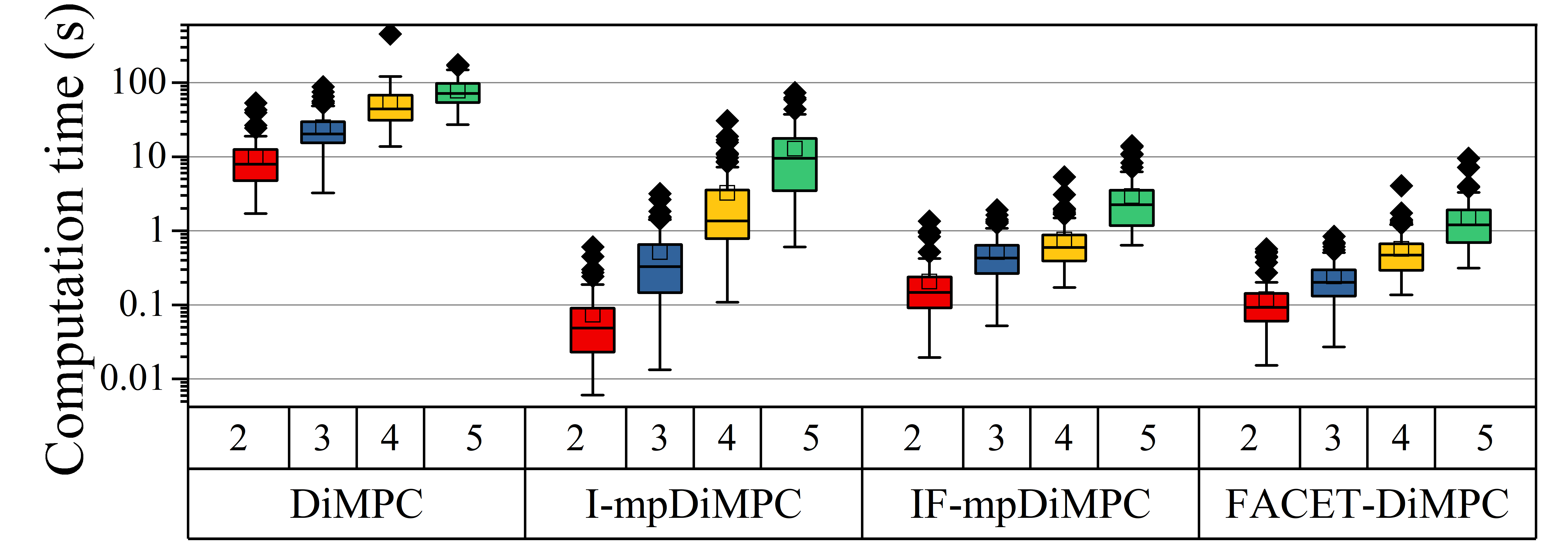
Figure 4: Relative computation times of competing DiMPC controllers, showing the computational advantage of facet-based exploration.
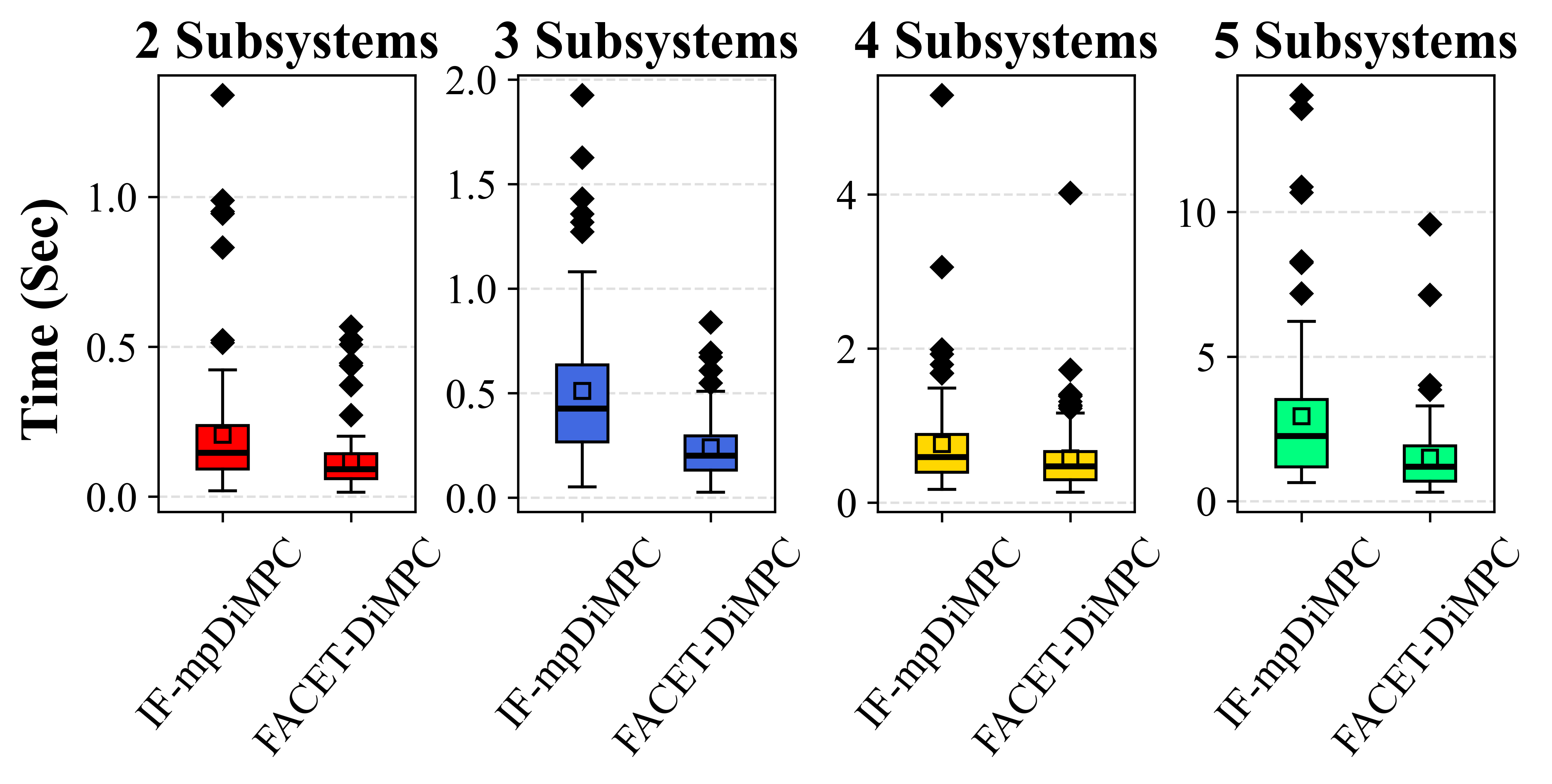
Figure 5: Linear-scale computation time comparison between IF-mpDiMPC and FACET-DiMPC as subsystem count increases, highlighting the scalability of the facet-based approach.
Quantitatively, for large-scale simulations, FACET-DiMPC reduces mean computation time by 98% compared to classic iterative DiMPC and by 42% relative to hyperplane-neighbor-based IF-mpDiMPC. This constitutes a practical improvement for fast-sampled or resource-constrained control platforms.
Theoretical and Practical Implications
FACET-DiMPC enhances the scalability and deployability of distributed explicit MPC, specifically addressing one of the central bottlenecks in existing explicit and distributed MPC formulations: the combinatorial explosion in online region search and coordination. The facet-exploration principle established here is directly applicable to other multiparametric programming-based distributed optimization schemes where the primary bottleneck is the management of polyhedral partitions.
While offline complexity in generating the full set of critical regions remains exponential in the system's parameter dimension, this is an inherited limitation of all explicit MPC schemes. However, the proposed approach is amenable to further parallelization and acceleration, e.g., via GPU-based batch region search or ML-based space partitioning, as discussed in the conclusion of the paper.
Future Directions
Potential future developments include practical extensions to nonlinear and unstable systems, application to industry-scale plants, and integration with advanced region evaluation strategies such as binary search trees or neural approximators. The balance between explicitness (speed, robustness) and tractability (offline storage, region explosion) represents an ongoing axis for theoretical research.
Conclusion
FACET-DiMPC sets a new benchmark for computational and communication efficiency in distributed explicit MPC by leveraging the true geometric adjacencies between critical regions. Its adoption can be expected to extend the practical viability of explicit distributed MPC to a broader range of large-scale, time-sensitive control problems, given the substantial empirical gains reported in both computation and communication observed in this study.

