- The paper introduces a layered terminal set design that decouples stability certification, feasibility enlargement, and motion-region monitoring in predictive control.
- It employs constrained zonotopes and constrained polynomial matrix zonotopes for exact set computations, reducing conservatism via scenario-based analysis.
- The approach achieves 100% feasibility in a building thermal control case study, offering certified safety and practical closed-loop stability under nonconvex constraints.
Data-Driven Tube-Based Zonotopic Predictive Control with Nonconvex Layered Terminal Sets
Introduction
This paper addresses the conservatism and feasibility limitations of data-driven tube-based zonotopic predictive control (DTZPC) schemes, particularly in systems where the admissible state set is nonconvex due to physical obstacles, interaction constraints, or similar factors. The authors propose a new DTZPC architecture that incorporates a layered terminal set design—explicitly decoupling stability certification, feasibility enlargement, and motion-region monitoring—enabling less conservative and more expressive constraint satisfaction. Notably, the framework eliminates the reliance on single ellipsoidal terminal sets, which are standard in prior works, and instead utilizes a composition of contractive constrained zonotopes and data-driven robust invariant set approximations.
Layered Terminal Set Construction
The terminal set structure comprises three distinct layers, each serving a different function in the receding-horizon predictive control algorithm:
- Contractive Local Terminal (Xst): Synthesized offline, this layer enforces local uniform exponential stability under a fixed state-feedback gain K. It is encoded as a constrained zonotope, avoiding the probabilistic conservatism and computational expense of high-dimensional gain optimization and providing a direct stability certificate.
- Nonconvex Inner Approximation (Scenario Terminal Set, Xsc): Built on scenario-based backward reachability analysis, the set is a data-driven, nonconvex inner approximation to the maximal robust positively invariant (MRPI) set for the closed-loop. It directly enlarges the feasible terminal region and is enforced as the online terminal constraint.
- Outer Envelope (Xout): An outer approximation of the MRPI set, constructed from the data-driven inverse model set. This layer provides tight certified descriptions of the state-space region possibly occupied by the closed loop and serves as a tool for efficient runtime monitoring and safety-screening, but does not enter the main feasibility argument.
These layers are constructed using advanced set representations—matrix and polynomial zonotopes—that preserve the algebraic dependencies induced by system identification from data and enable efficient implementation of set-based operations such as exact set multiplication and intersection.
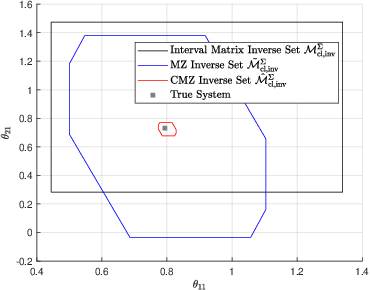
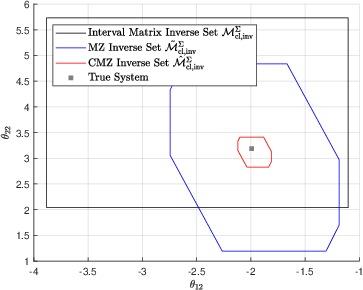
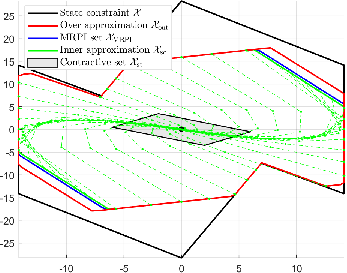
Figure 1: Projections of inverse closed-loop model enclosures and the resulting layered terminal sets, detailing the relative tightness and roles of the scenario inner and existential outer approximations on the true MRPI set.
Data-Driven Closed-Loop Inverse Set Computation
A primary challenge in DTZPC with robust guarantees is characterizing the admissible closed-loop model set from data, and more critically, its inverse under uncertainty. Previous interval-based relaxations are shown to introduce significant over-approximation. The paper advances the following:
- Exact Inverse Set Computation: Using closed-loop trajectory data under the fixed feedback gain K, the admissible set of closed-loop matrices (Θ) is first described as a matrix zonotope. The set of all possible inverses (Θ−1) is then tightly enclosed with set representations that preserve the algebraic coupling of uncertainties (constrained polynomial matrix zonotopes, CPMZ), greatly reducing conservatism compared to interval-based containment.
- Scenario-Based Inner Approximation: The scenario layer (Xsc) is formed by sampling admissible inverse realizations and computing the intersection of the corresponding MRPI sets (each a constrained polynomial zonotope), yielding a probabilistic guarantee of invariance and recursive feasibility with a-priori violation bounds certified via the Clopper-Pearson method.
The proposed terminal structure is embedded within a standard tube-based ZPC framework. The ancillary controller applies the control law ut=uˉt+K(xt−xˉt), where K and the local contractive set are designed offline. Online, the optimization is subject to the constraint K0, further tightening the constraints to respect the robust invariant tube. The outer set K1 is used exclusively for online safety certification and does not affect feasibility.
Closed-loop guarantees are rigorously established:
- Robust constraint satisfaction for all K2, given invariant tube feasibility.
- Probabilistic recursive feasibility for the online scheme over all but a small fraction (quantified with confidence) of admissible inverse model realizations.
- Practical closed-loop stability, ensured by the scenario-based invariance of the terminal layer and the robust tube.
Numerical Results
Inverse Set Tightness and Terminal Set Effects
The authors demonstrate on a canonical linear system that the CPMZ-based inverse set characterization is significantly less conservative than both the interval-matrix and unconstrained matrix-zonotope approaches. The resulting outer approximation K3 tightly encloses the reachable set, and the nonconvex scenario set K4 is observed to be nearly maximal, with high-probability invariance certifications (K5 violation probability at 95% confidence; K6 for K7, K8). This separation of layers yields enlarged feasibility margins and transparent, certified motion envelopes.
Building Thermal Control Case Study
A building thermal zone is used to benchmark the layered DTZPC against an established single-ellipsoidal terminal-set approach. Under matched data and system scenario conditions, the proposed construction achieves 100% feasibility for all considered horizons (K9 to Xsc0), in contrast to the baseline, which only achieves the same at Xsc1. The computational cost remains comparable, with only small increases in average solve time. The closed-loop trajectories show effective setpoint tracking and constraint adherence, empirically verifying the theoretical advancements.
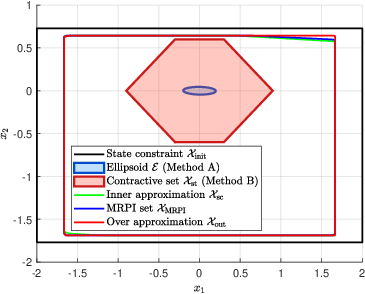
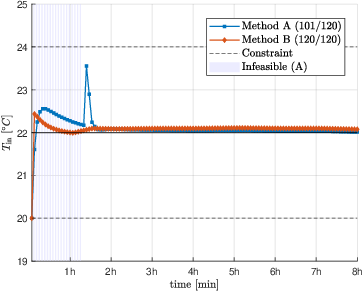
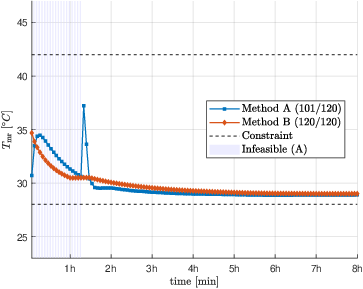
Figure 2: (a) Comparison of terminal set geometries; (b) Closed-loop indoor temperature trajectory under the proposed layered terminal set; (c) Optimal control input sequence demonstrating compliance with tightened constraints.
Implications and Future Directions
The layered terminal set methodology delivers substantially less conservative feasibility and certified safety in DTZPC, making it suitable for systems with complex or nonconvex operational regions, such as in autonomous robotics, distributed energy control, or interaction-rich settings. Motion-region descriptions decoupled from feasibility layers provide runtime interpretability and facilitate formal safety guarantees for external agents.
Theoretically, the work expands the scope of data-driven predictive control by showing how modern set representations and scenario-based techniques can yield less conservative invariant set approximations without sacrificing robustness, and it supplies tools for exact set-based computations under direct data-uncertainty propagation.
Potential future developments include generalization of the layer-based terminal certification to nonlinear systems, stochastic disturbance descriptions, or integration with machine learning-based identification techniques, aiming to further improve generality, tractability, and expressiveness of robust data-driven MPC architectures.
Conclusion
The paper systematically advances tube-based predictive control by replacing monolithic, convex terminal set constructs with a layered, data-driven architecture that individually addresses stability, feasibility, and motion-region certification. This enables less conservative, formally certified, and more adaptable constraint satisfaction, as supported by both theory and empirical evaluation. The proposed framework is especially attractive for practical safety-critical control applications requiring motion region certification and tight set-based guarantees, with natural extensions toward more general dynamical settings and richer forms of data-driven uncertainty (2604.02159).