- The paper introduces a novel two-phase, interpolated reachability analysis (IRA) that effectively tackles step-size sensitivity using coarse anchors and fine-resolution interpolation.
- The paper employs a Transformer-based encoder-decoder (TA-IRA) to predict intermediate reachable sets, significantly reducing computational costs while ensuring statistical safety via conformal calibration.
- The paper demonstrates empirical speedups of up to 8.7× on a five-dimensional system, offering promising applications in real-time safety-critical control and verification.
Introduction
The presented work introduces a comprehensive framework for data-driven reachability analysis that addresses scalability and step-size sensitivity issues inherent to existing approaches. The methodology fuses outer-approximation guarantees with computational acceleration by exploiting a multi-resolution structure and leveraging deep sequence models. The central contributions encompass a formal exposition of step-size sensitivity in data-driven reachable-set propagation, the design of a novel Interpolated Reachability Analysis (IRA) paradigm, and the development of a Transformer-Accelerated IRA (TA-IRA) variant that facilitates efficient and certified interpolation across temporal resolutions.
Step-Size Sensitivity in Data-Driven Reachability
Unlike model-based propagation, where the reachable sets computed at various discretization resolutions coalesce at shared physical times via the semigroup property, data-driven reachable sets strongly depend on the discretization step size. This dependence arises because the underlying set-valued model operators—constructed from noisy trajectory data and encoded as matrix zonotopes—inject independent uncertainty at every iteration. Thus, sets computed with distinct discretizations are generally non-equivalent, posing algorithmic and computational challenges for scalable reachability.
Multi-Resolution Interpolated Reachability Analysis (IRA)
IRA strategically leverages the intrinsic step-size sensitivity via a two-phase procedure:
- Phase 1—Coarse Anchor Computation: Reachable sets are sequentially computed at a coarse temporal resolution using the coarse model set and a data-driven over-approximation of accumulated disturbance, yielding certified anchors that outer-approximate the true reachable sets.
- Phase 2—Parallel Fine-Resolution Interpolation: Each coarse interval is further resolved in parallel. Starting from each anchor, fine-resolution reachable sets are constructed using the fine model set. This parallelizable structure dramatically reduces sequential computational depth.
Guarantees are established such that all interpolated sets deterministically outer-approximate the reachable set of the ground-truth system at every time index. Conditional tightness is also formalized: when anchors are contained in the fine-propagated chain, the interpolated sets are guaranteed to be no more conservative than standard sequential propagation.
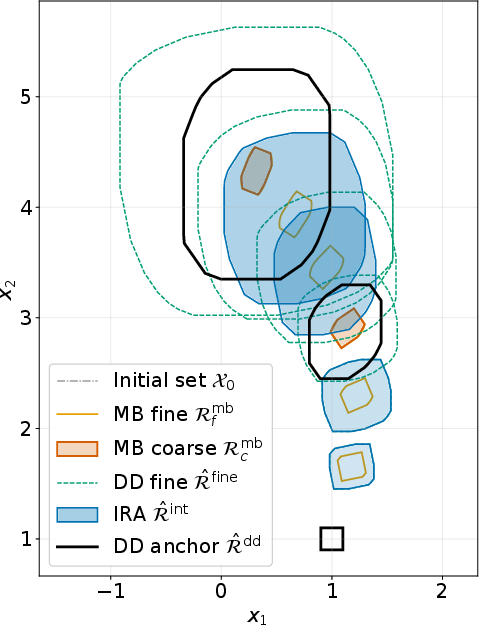
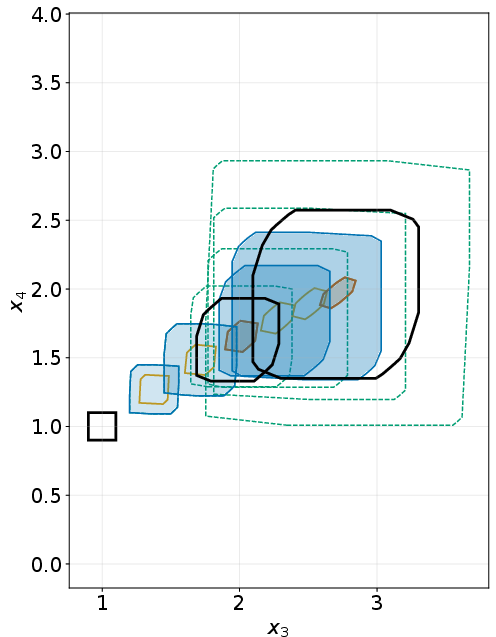
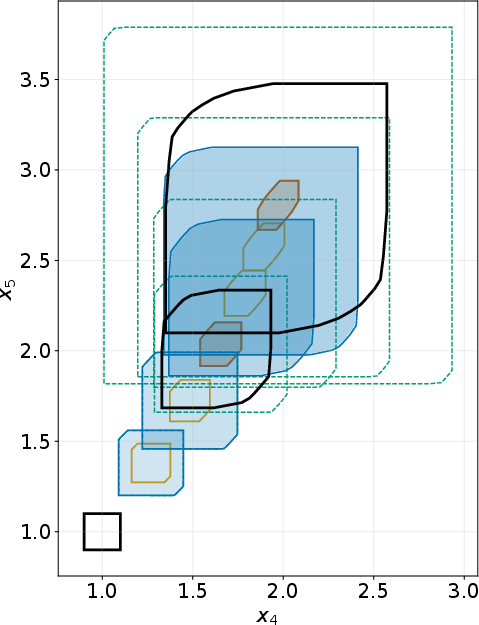
Figure 1: IRA interpolation with K=2, Ns=3 in different state-space projections, demonstrating divergence between data-driven and model-based reachable sets due to step-size mechanisms.
The figure highlights how model-based and data-driven sets diverge, motivating the need for a multi-resolution framework.
To further mitigate the complexity of fine-step matrix-zonotope multiplications, TA-IRA replaces explicit computation with a Transformer-based encoder-decoder, trained on tokenized zonotope representations. During inference, the network autoregressively predicts intermediate reachable sets between anchors. This surrogate is further calibrated with split conformal prediction, yielding finite-sample, distribution-free pointwise and path-wise statistical coverage. The calibration quantifies the correction required to ensure empirical coverage, inflating predicted zonotopes along coordinate axes to guarantee that, with high probability, the reachable sample paths are contained.
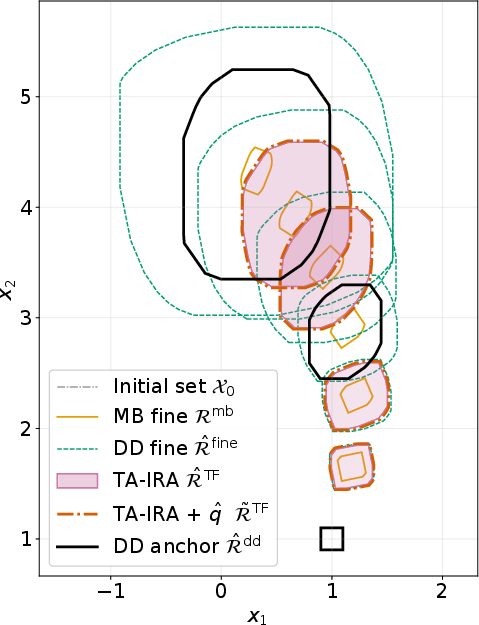
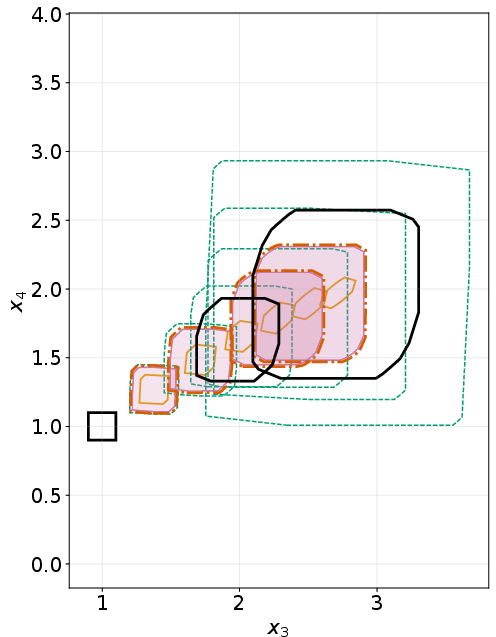
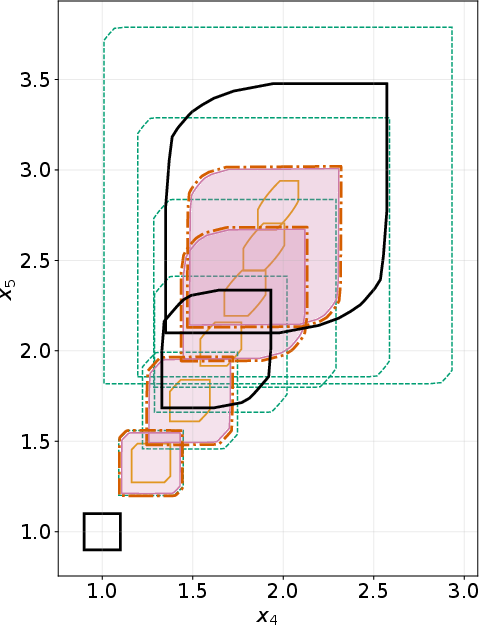
Figure 2: TA-IRA predictions and conformal calibration, showing empirical coverage of fine-resolution data-driven sets by conformally adjusted Transformer predictions.
This statistical approach enables a practical runtime-conservatism trade-off: TA-IRA achieves significantly lower computational cost with explicit statistical safety guarantees, while exact IRA provides deterministic containment at higher cost.
Computational Complexity and Empirical Analysis
Computationally, IRA splits the task into a sequential phase (anchors over K steps) and a parallel phase (Ns−1 fine steps per coarse interval), yielding a wall-clock speedup S≈Ns with sufficient parallelism. TA-IRA further amortizes fine-step cost, as Transformer inference per set is independent of zonotope complexity and fixed with respect to system dimension and set order.
Empirical demonstrations on a five-dimensional system using multi-projection visualizations and timing benchmarks confirm both the step-size sensitivity and scalability improvements. With TA-IRA, speedups up to 8.7× over the fully sequential baseline are reported for standard horizon parameters. Ablation studies clarify the contributions of parallelization and conformal calibration, highlighting the practical advantages of algorithmic design choices.
Implications and Future Directions
This methodological advancement generalizes zonotope-based set propagation for systems where true dynamics are unknown and only noisy input-state data are accessible. By decomposing the propagation along temporal resolutions and aligning statistical learning with set-theoretic robustness, the framework reaches new efficiency levels without forfeiting safety. Theoretically, the multi-resolution interpolation paradigm opens avenues for further reduction of conservatism and complexity in high-dimensional or nonlinear reachability, provided that generative surrogates can be reliably calibrated.
Practically, the method is amenable to large-scale control and verification applications requiring real-time guarantees, such as embedded systems, autonomous robotics, and safety-critical cyber-physical systems. The Transformer-accelerated approach is naturally extensible to more expressive set representations or systems with hybrid or nonlinear dynamics, pending advances in sequence modeling and invariance-aware tokenization for set representations.
Conclusion
This work formalizes and exploits the algorithmic structure imparted by step-size sensitivity in data-driven reachability. By introducing Interpolated Reachability Analysis and its Transformer-accelerated, conformally calibrated variant, the authors achieve outer-approximation and statistical guarantees with substantial reductions in computation, as confirmed in controlled experiments. The framework sets a precedent for data-driven formal analysis in uncertain dynamical systems and motivates subsequent research into adaptive, learning-accelerated verification methods (2604.02157).