- The paper introduces SEAL, a framework that integrates ethical compliance, auditability, and federated calibration to generate fair synthetic data for AI-native 6G networks.
- It employs a modular, closed-loop pipeline combining simulation, regulatory augmentation, and federated learning to reduce the gap between simulated and real data.
- Experimental results demonstrate a 25% sim-to-real gap reduction, a 12% fairness improvement, and a 10% boost in task accuracy.
SEAL: An Open, Auditable, and Fair Data Generation Framework for AI-Native 6G Networks
Motivation and Background
The emergence of AI-native 6G networks introduces unprecedented requirements for data-driven intelligence embedded across every layer of communication infrastructure. With the transition from 5G to 6G, the integration of intelligent orchestration, URLLC, and MMTC for scenarios such as autonomous vehicles, smart cities, and immersive XR exacerbates both the scarcity of empirical data and the risks associated with biased or non-compliant AI models. Synthetic data generation serves as a core enabler for prototyping, benchmarking, and deploying AI models under these constraints. Nonetheless, current approaches typically overlook the systematic enforcement of auditability, regulatory compliance, and fairness—key tenets for lawful and reliable AI system operation in high-stakes telecom environments.
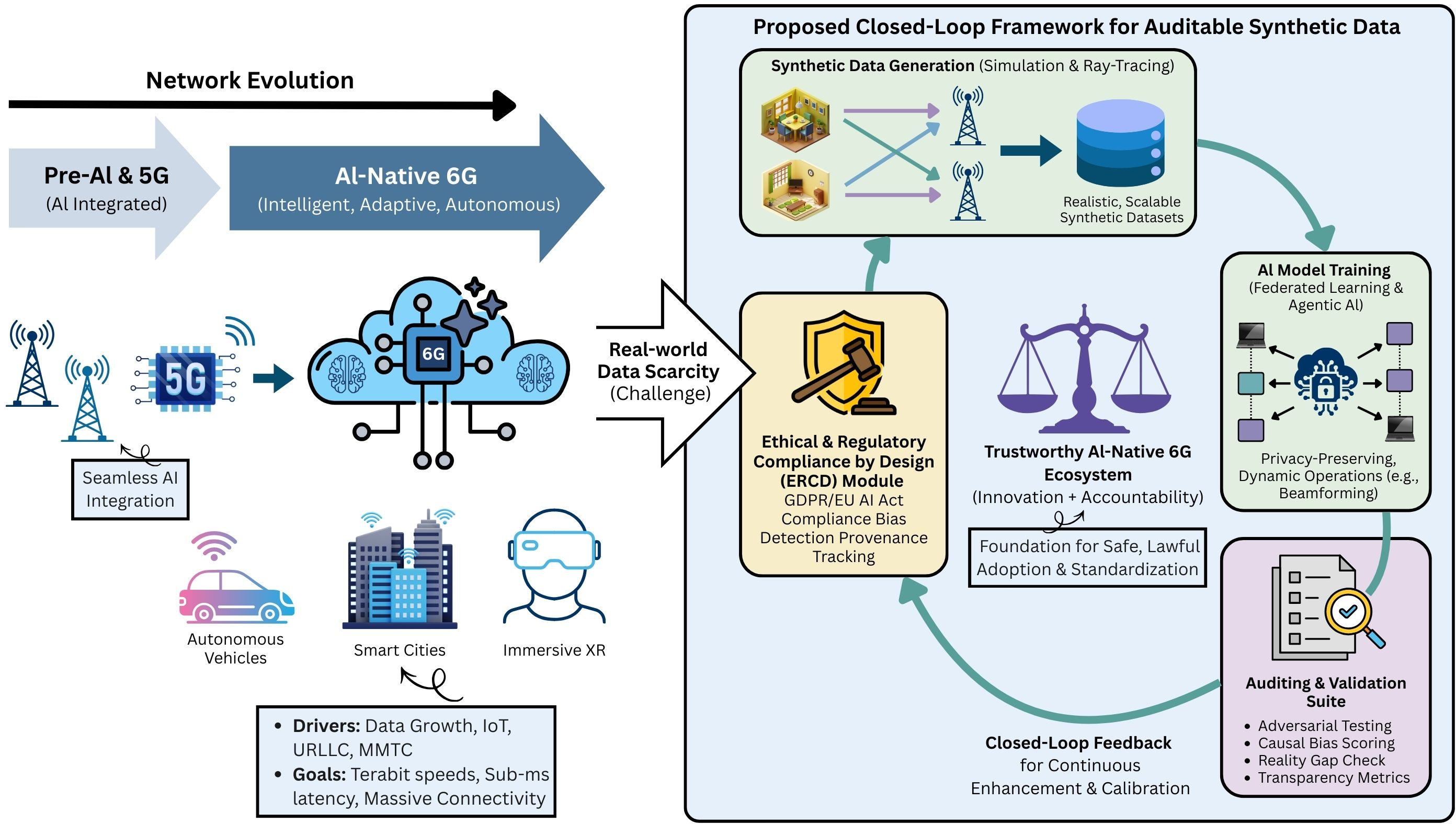
Figure 1: The network evolution from 5G to AI-native 6G embedded with auditable synthetic data.
The SEAL Framework Architecture
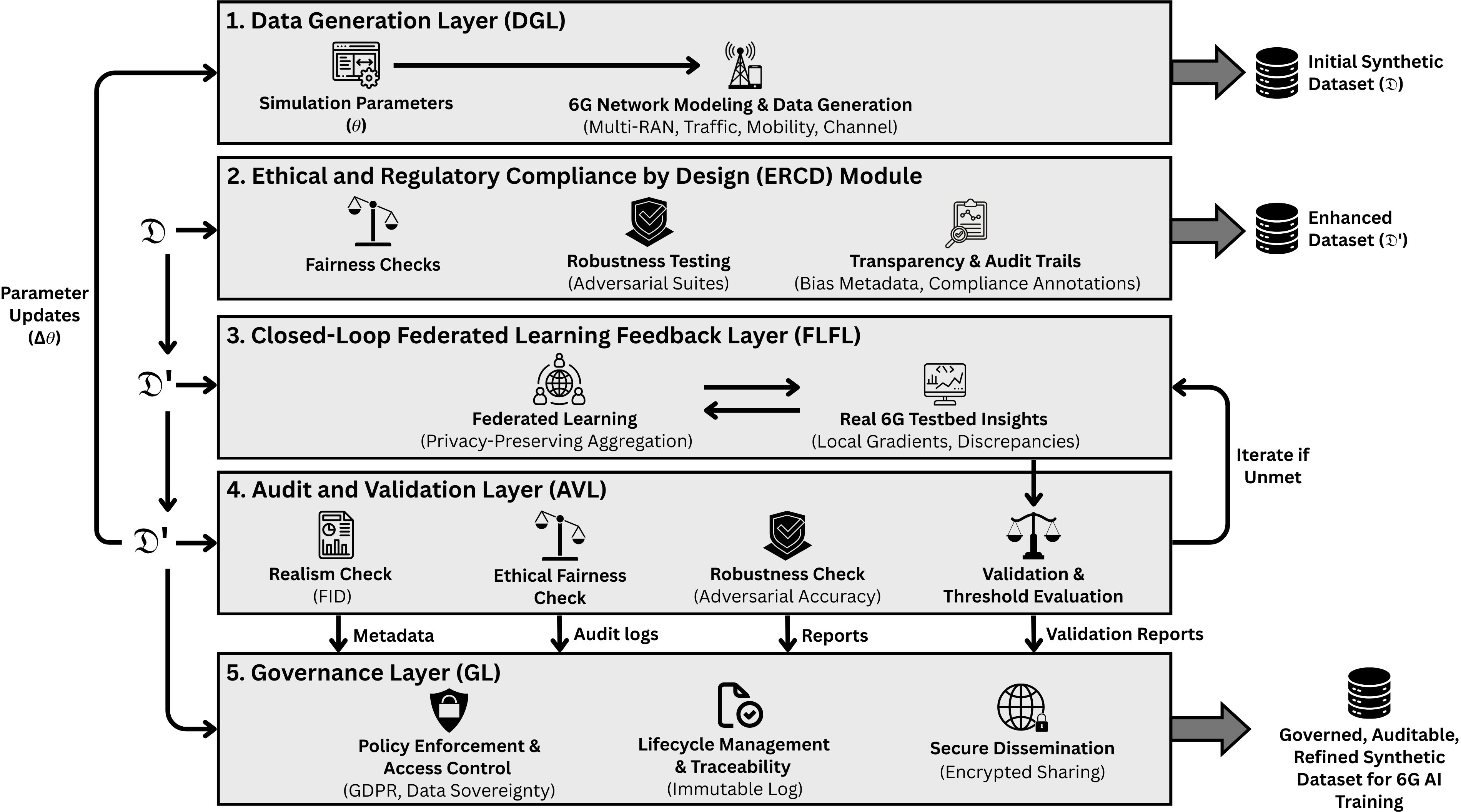
The SEAL (Synthetic data generation with Ethics Audit Loop) framework is proposed as a method-agnostic, closed-loop pipeline, systematically integrating synthetic data generation, ethical and regulatory augmentation, federated calibration, audit validation, and governance. Unlike prior approaches, SEAL operationalizes ethical compliance not as a post hoc check, but as a design invariant throughout the dataset and model lifecycle, informed by evolving regulatory regimes such as the EU AI Act and NIST RMF. The framework consists of the following interlocking layers:
Data Generation: SEAL supports scalable configuration via D=G(θ,M), where the simulation parameter vector θ and modeling suite M capture complexity such as traffic (Poisson process), channel characteristics (ray-tracing), and user mobility. Injection of distributional shifts (e.g., surges, interference, noise) enables robust scenario representation.
Ethical and Regulatory Augmentation: The ERCD module produces
D′=D∪T∪B∪A,
where T encapsulates adversarial tests, B encodes bias analysis and metadata, and A contains structured compliance mappings. Causal graphs, interventional do-calculus, and thresholds via bootstrapping are used to provide explicit auditability and bias quantification, tracking both provenance and regulatory clause-level mapping.
Federated Calibration: The FLFL quantifies the discrepancy
δCL=m1i=1∑m∥fθ(xi)−yi∥2
between simulation and observed testbed data, performing FedAvg aggregation, and maintaining DP guarantees (noise addition to local gradients). This recalibration adapts simulation parameters and aligns data distribution over multiple rounds, enabling iterative closure of the sim-to-real gap.
Audit and Validation: SEAL enforces checkpointing with FID, equalized odds, and adversarial accuracy, setting operational thresholds (e.g., D′0, D′1) to trigger recalibration until required quality and fairness properties are met. This process ensures readiness and regulatory defensibility of released datasets.
Governance: Lifecycle management tracks state transitions, ensures multi-criteria policy-based access control, and supports privacy-preserving dissemination (e.g., encrypted release contingent on all checks passing). Immutable logging (e.g., JSON-based traces) supports direct compliance verification and dispute resolution.
Experimental Validation and Numerical Results
Evaluation on a single-node RTX 4090 workstation, using open-source simulation (Sionna), fairness (AIF360), and graph (NetworkX) tools, demonstrates SEAL's feasibility for individual researchers and small federations. Simulation scenarios (10,000 samples, complex urban mobility, channel modeling, and adversarial injection) are operated with end-to-end ERCD and FLFL calibration against emulated real-data aggregates.
Key results obtained:
- Frechet Inception Distance (FID): SEAL reports D′2, reducing the sim-to-real gap by 25% over the Sionna baseline.
- Equalized Odds (EO): SEAL achieves D′3, demonstrating improved fairness (>20% over some prior synthetic pipelines) and outperforming AIF360-alone by 12%.
- Task Accuracy: The downstream neural resource allocation model reaches D′4, a 10% gain over non-ERCD baselines.
These results confirm that with integrated ethical audit and federated calibration, SEAL-generated datasets surpass previous approaches in both realism and fairness, albeit with modest performance tradeoffs incurred by privacy-preserving regularization.
Implications and Future Directions
The SEAL framework establishes a blueprint for the lawful, ethical, and auditable use of synthetic data in the AI-native 6G context. The method-agnostic, modular design enables rapid adaptation to evolving simulation tools, regulatory statutes, and federated learning protocols. From a practical perspective, SEAL facilitates trustworthy, auditable AI/ML pipelines for high-risk domains—essential for network operators, regulators, and vendors intent on AI-centric service assurance in 6G. Theoretically, it operationalizes end-to-end accountability, supporting the adoption of automated compliance verification and enabling formal certification of data pipelines.
Anticipated future directions include large-scale integration with real 6G testbeds, scaling beyond 100 federated clients, and exploring adaptive privacy-fairness tradeoff mechanisms. Addressing remaining limitations around dependence on emulated data and limited federation scale will be critical to move from early-stage prototyping to production-ready deployments.
Conclusion
SEAL constitutes a comprehensive, layered framework that directly addresses core issues in AI-native 6G data pipelines: auditability, fairness, and simulation-reality alignment. Integrating ethical and regulatory design with closed-loop federated calibration, SEAL delivers verifiable improvements over state-of-the-art baselines in data realism, bias mitigation, and model utility. The systematic layering of audit, compliance, and differential privacy within the end-to-end synthetic data pipeline provides a foundational architecture for responsible innovation and safe adoption of AI-native 6G systems.
[SEAL: An Open, Auditable, and Fair Data Generation Framework for AI-Native 6G Networks, (2604.02128)]