- The paper introduces a novel variationally mimetic operator network that embeds FEM weak forms into a deep learning architecture to solve unsteady viscous flow problems.
- The model achieves mean relative errors below 2% across multiple test cases such as cavity, cylinder, and contraction flows, demonstrating high accuracy.
- The approach offers a scalable, physics-consistent surrogate for transient fluid dynamics with potential applications in real-time modeling and uncertainty quantification.
Variationally Mimetic Operator Networks for Transient Viscous Flows
Introduction and Motivation
The paper "Variationally mimetic operator network approach to transient viscous flows" (2604.02124) extends the Variationally Mimetic Operator Network (VarMiON) methodology—originally formulated for elliptic PDEs—to time-dependent viscous fluid flows, specifically targeting the unsteady Stokes problem. VarMiON integrates operator learning with a variational structure, directly embedding the weak form of the equations into the network architecture. This approach accurately replicates the discrete solution operator associated with finite element methods (FEM), leveraging the structure of Galerkin schemes while utilizing high-capacity, learnable trunk and branch subnetworks.
The motivation stems from the demand for efficient surrogate models in fluid dynamics, where full-scale numerical simulation (e.g., via FEM) is computationally expensive and training datasets are subject to both experimental and simulation limitations. The structured and physically consistent architecture of VarMiON offers a hybrid between classical Deep Operator Networks (DeepONets) and Physics-Informed Neural Networks (PINNs), but goes beyond modifying the loss by directly reflecting the variational-discrete problem in the network design.
VarMiON Architecture and Problem Setting
A DeepONet parameterizes nonlinear operators with parallel "trunk" (basis construction) and "branch" (coefficient prediction) subnetworks, outputting the field solution via an inner product of trunk and branch responses.
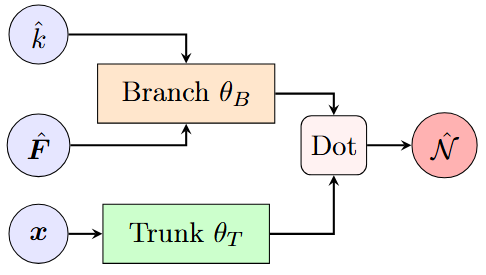
Figure 1: Schematic of a generic DeepONet showing the parallel trunk/branch structure for operator regression.
VarMiON inherits this paradigm but ensures the branch subnetwork is constructed from and parametrized akin to the weak Galerkin formulation of the governing PDE—here, the time-dependent Stokes equation. This involves carefully encoding the algebraic structure corresponding to the finite-dimensional discretization:
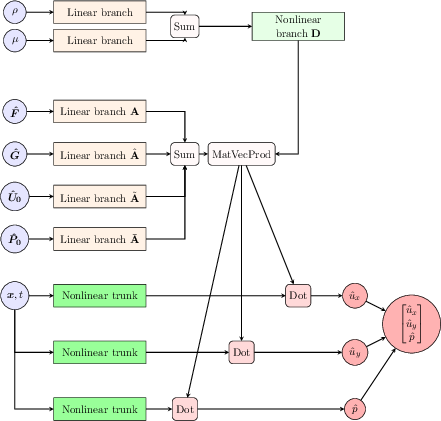
Figure 2: VarMiON scheme applied to the time-dependent Stokes equations, highlighting how sample-based input data are propagated through variationally-inspired branch/trunk networks.
VarMiON uses sensorized (nodal) input data for material parameters, forcing terms, and initial/boundary data, paralleling projected FEM right-hand inputs. The overall architecture features:
- Branch networks for composing weak-form parameter-dependent coefficient blocks, each matched to a term in the variational form (e.g., diffusion, advection, source, boundary conditions).
- Multiple trunk networks that define basis functions across space-time, acting as the argument for the operator regression.
- Matrix-valued blocks within branches, directly analogous to FEM matrices, but learnable.
- Outputs of branches are multiplied by the trunk outputs to yield field predictions.
This facilitates direct mapping from physical problem data and functional parameters to the space-time evolution of velocity and pressure fields under the time-dependent Stokes dynamics.
Discretization and Training Methodology
For numerical surrogate modeling, VarMiON is trained using data generated from high-resolution FEM simulations over a set of representative Stokes flow problems. The mesh structures considered include cavity, flow past a cylinder, and contraction geometries:
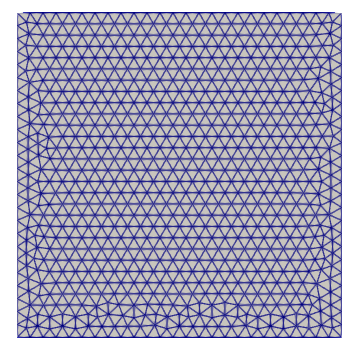
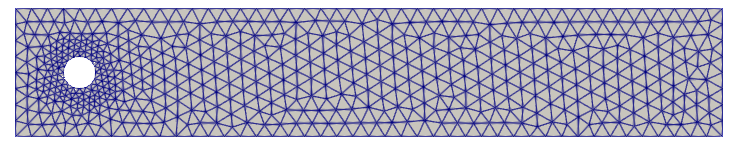
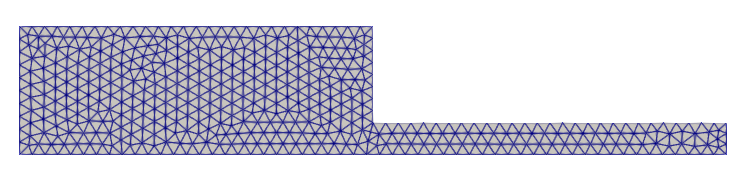
Figure 3: FEM meshes for (a) the driven cavity, (b) flow past a cylinder, and (c) contraction flows, establishing spatial discretizations for solution/reference data.
The training loss is the mean squared error between VarMiON predictions and FEM solutions on a discrete space-time grid. Sampling covers variations in viscosity and forcing parameters, and the sensors/inputs for VarMiON exactly match the FEM evaluation nodes, ensuring direct comparability.
Numerical Results and Evaluation
The performance of VarMiON is analyzed on three prototypical unsteady viscous flow problems. The architecture and number of trainable parameters are tailored to each use-case, but consistently align with the block-structured, weak-form-mimetic design.
1. Lid-Driven Cavity Flow
Training over $1,000$ instances with variable viscosity (μ∈(1.1,10)) and forcing (f∈(0.02,0.9)), the model achieves a mean relative error of 1.85% (standard deviation 0.67%). Losses and error distributions indicate rapid convergence and narrow spread around low error values.
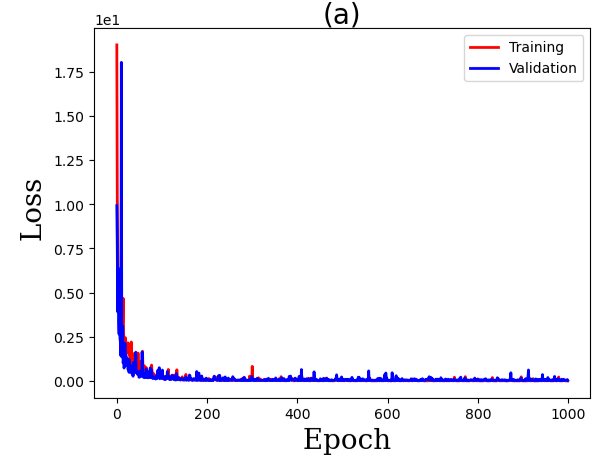
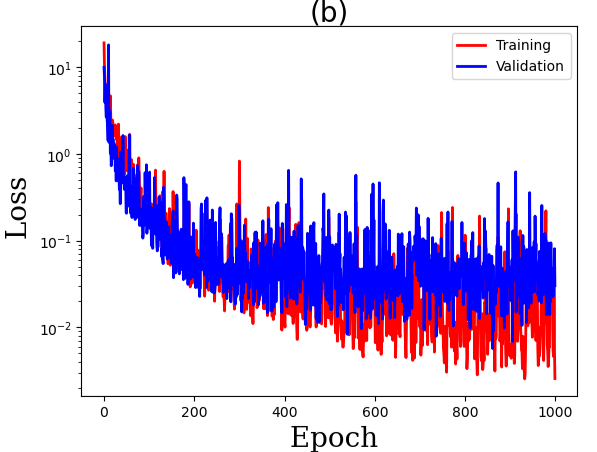
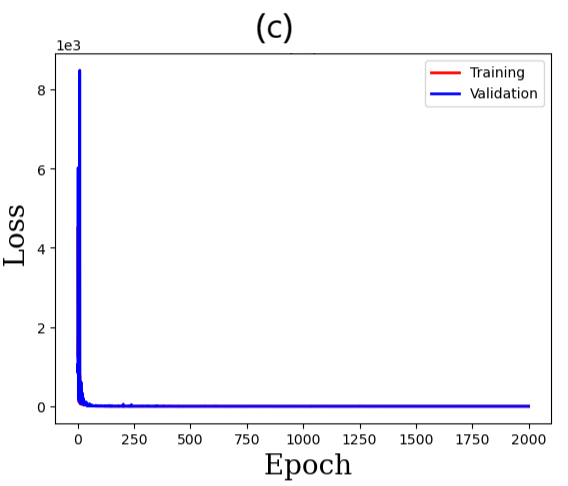
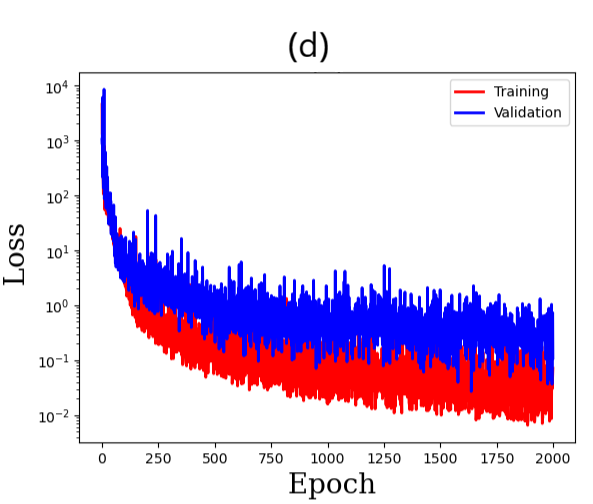
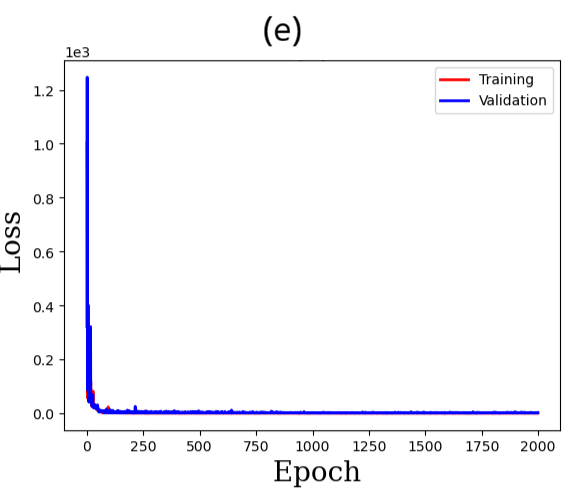
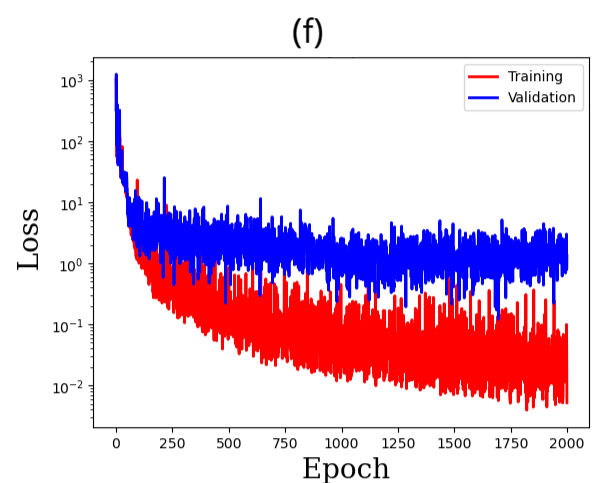
Figure 4: Training (red) and validation (blue) loss curves for the three test problems, shown in linear and semilog scale.
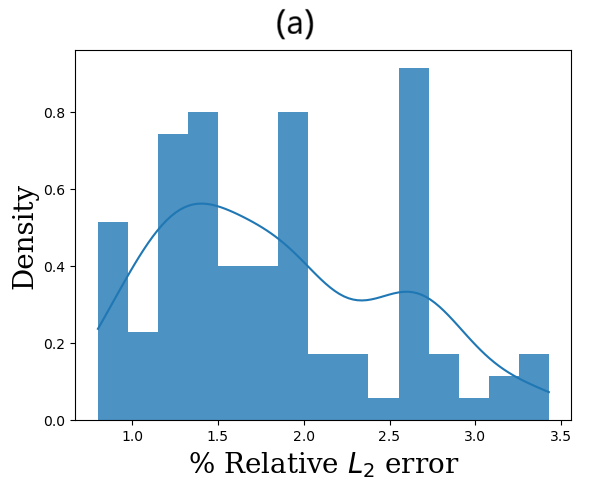
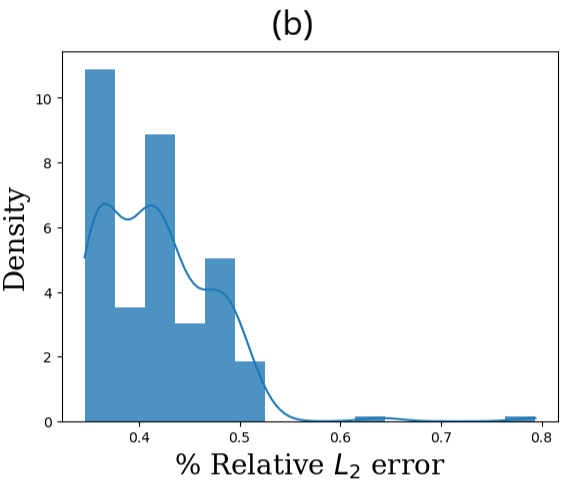
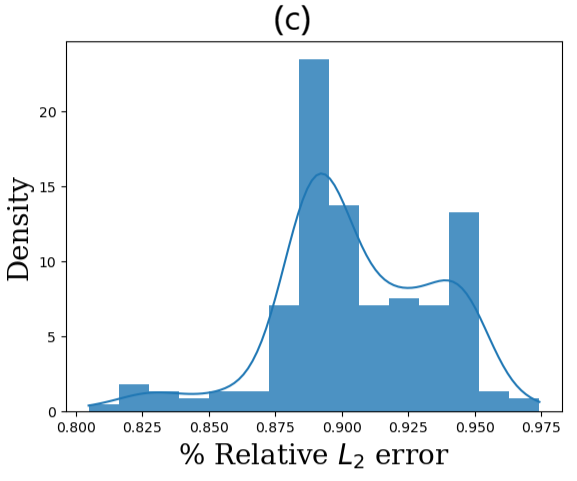
Figure 5: Probability density of the relative L2 error for cavity, cylinder, and contraction flow test sets.
2. Flow Past a Cylinder
With $2,000$ parameterized training instances, mean relative error on the test set is 0.42% (std. 0.06%). The spatial and temporal comparisons again demonstrate close agreement between the VarMiON surrogate and the FEM reference.
3. Contraction Flow
A similar setup yields a mean test error of 0.91% (std. μ∈(1.1,10)0).
In all cases, detailed field comparisons show not only low-integrated errors but striking alignment of physical features such as recirculation zones, pressure gradients, and transient development. For illustration, representative field comparisons for the cavity flow are shown below:
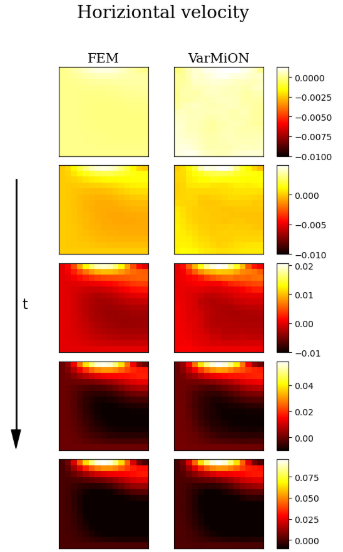
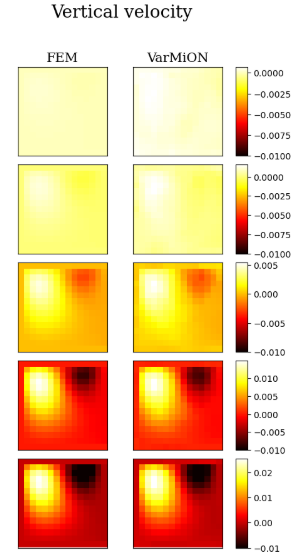
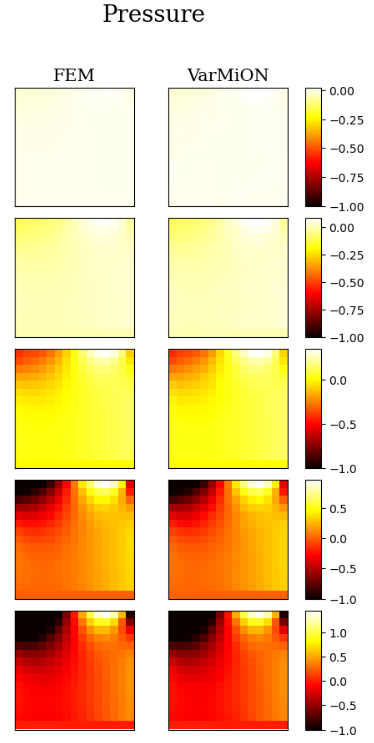
Figure 6: VarMiON (predicted) and FEM (reference) solution profiles for velocity (μ∈(1.1,10)1, μ∈(1.1,10)2) and pressure at selected times for the cavity flow.
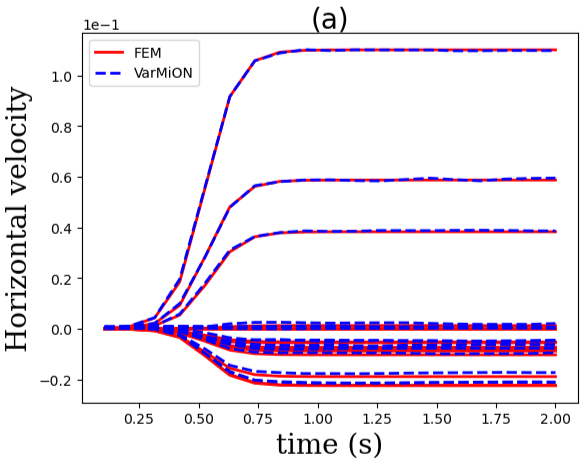
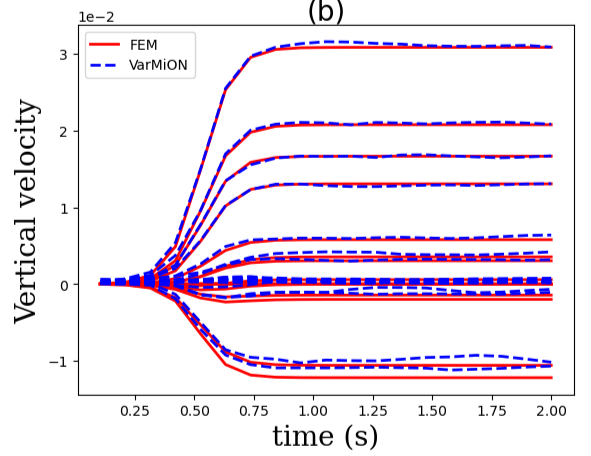
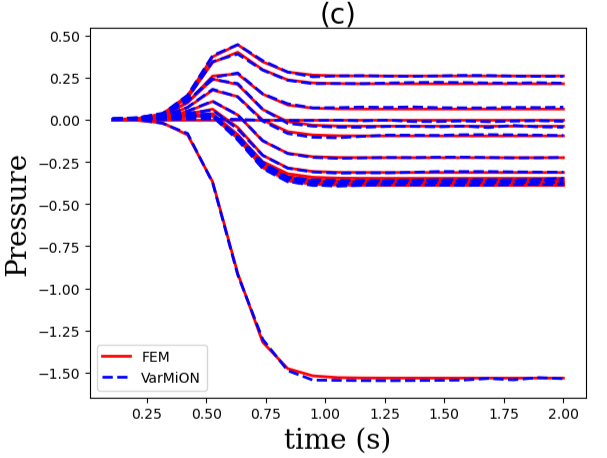
Figure 7: Time series at sample points—VarMiON predictions follow FEM evolution closely for both velocity and pressure.
Corresponding figures (8–11) present analogs for the cylinder and contraction flows, confirming robust accuracy and temporal trajectory fidelity.
Theoretical and Practical Implications
The VarMiON approach demonstrates that operator networks, properly structured according to the weak form, achieve high accuracy in mapping from physical parameters and forcings to entire space-time fields, not just single-timestep or steady-state outputs. The strong claims substantiated by numerical evidence include:
- Model errors are consistently below μ∈(1.1,10)3 relative μ∈(1.1,10)4 norm across diverse flow settings, for both velocity and pressure predictions.
- The loss curves saturate rapidly, indicating no overfitting and efficient utilization of training capacity.
- Field-level agreement extends to fine-scale structures, not just low-order statistics.
From a theoretical perspective, the VarMiON design strategy points to the advantage of aligning neural operator architectures with their corresponding Galerkin weak forms, capturing inductive bias and guaranteeing stability. As a result, the method acts as a hybrid between abstract operator regression and traditional physically structured solvers.
Outlook and Future Directions
The scalability of VarMiON to higher Reynolds numbers, more intricate geometries, and non-Newtonian constitutive models represents a promising extension, as the block-mimetic decomposition is general. On the practical front, the method's efficiency and accuracy point toward applications in real-time surrogate modeling, uncertainty quantification, and embedded model-optimization workflows.
Further developments may include:
- Extension to fully nonlinear (Navier-Stokes) or turbulence-resolving flows.
- Incorporation of adaptivity in sensor placements to minimize input dimension.
- Bridging with online experimental datasets, enabling data assimilation and control.
Conclusion
VarMiON provides a variationally structured operator regression framework for unsteady viscous flows, leveraging deep learning while embedding FEM-inspired weak forms in the network design. Empirical results indicate that this approach is competitive with established neural surrogates, offering strong accuracy, physical consistency, and adaptation potential for a range of challenging PDE-governed systems. The method paves the way for operator-based ML models that are both interpretable and highly effective for predictive modeling in computational fluid dynamics.
(2604.02124)