Non-perturbative Renormalization of the EMT in Full QCD
Published 2 Apr 2026 in hep-lat | (2604.02122v1)
Abstract: The energy-momentum tensor (EMT) is the conserved current corresponding to space-time translation symmetry. Its applications are remarkably diverse, ranging from the thermodynamics to the calculation of transport coefficients. While the EMT is well-defined in the continuum up to a total derivative, with its coefficients fixed by Ward identities, its extension to lattice QCD is not straightforward. The primary challenge arises from the breaking of continuous space-time symmetries by the discrete lattice regulator. Although the EMT can be constructed on the lattice in a way that yields the correct continuum limit, the operators are not uniquely defined. In this proceeding, we construct the EMT for both pure-gauge theory and full QCD, discussing its renormalization in the specific context of determining the coefficients required for shear viscosity. In this context, we present a comparative analysis of the trace anomaly, number density, pressure, energy density and enthalpy density with imaginary chemical potential for multiple $β$ values at approximately the same temperature, aimed for the continuum limit.
The paper presents a novel non-perturbative renormalization method using gradient flow and enthalpy matching to accurately determine the EMT in full (2+1)-flavor QCD.
It decouples gluonic and fermionic contributions by employing an imaginary isospin chemical potential, revealing that gluonic pressure deficit drives QGP behavior.
The study provides detailed continuum scaling and high-statistics lattice results that challenge perturbative expectations and inform QGP transport coefficient calculations.
Non-Perturbative Renormalization of the Energy-Momentum Tensor in Full QCD
Introduction and Motivation
The precise non-perturbative determination of the energy-momentum tensor (EMT) in lattice QCD is critical for accessing bulk and transport properties of the quark-gluon plasma (QGP), notably the shear and bulk viscosities. While the EMT is formally established in the continuum via Ward identities, this construction is ambiguous on the lattice due to the explicit breaking of continuous space-time symmetry by discretization. Renormalization of the EMT, especially in the presence of dynamical fermions, is thus a technically non-trivial problem with direct impact on phenomenologically vital QGP observables.
This work presents a systematic program for the non-perturbative renormalization of the EMT in (2+1)-flavor QCD, blending a gradient flow-based operator definition with an enthalpy matching procedure and exploiting the distinct response of gluonic and fermionic sectors under controlled modifications of the chemical potential. The results also provide a detailed continuum scaling study of relevant thermodynamic quantities.
Continuum and Lattice EMT Construction
The EMT in the continuum for QCD, schematically given by combinations of gluonic and fermionic terms, is uniquely fixed (up to total derivatives) by symmetries and Ward identities. On the lattice, the continuous SO(4) rotation and translation symmetries are explicitly broken to their discrete subgroups, leading to the proliferation of operator mixings among irreducible representations (irreps). Hence, independent renormalization factors must be determined for each lattice EMT irrep.
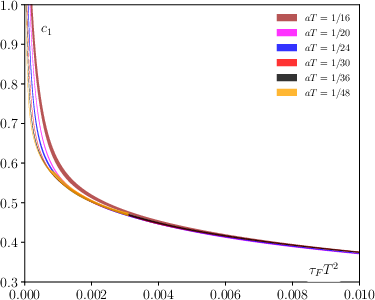
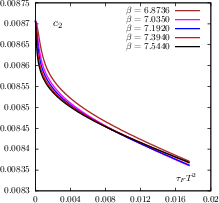
To address this, the EMT is constructed via the Yang-Mills gradient flow, which regularizes UV divergences by smearing gauge and fermion fields over a finite radius 8τF. In the pure-gauge sector, the flowed EMT decomposes into two irreps with renormalization coefficients c1(τF) and c2(τF). These coefficients exhibit divergent behavior as τF→0, but gradient flow renders finite and controllable quantities at nonzero flow time, enabling systematic studies of their scaling properties:
Figure 1: Renormalization coefficients c1 (left) and c2 (right) versus lattice spacing and temperature, illustrating flow-time dependence and scaling toward the continuum.
The methodology for fixing these coefficients leverages the physical constraints of thermodynamic identities, particularly the enthalpy density (ϵ+p), which—due to the structure of the EMT—isolates certain irreps and allows for a nonperturbative matching strategy.
Extension to Full QCD and Renormalization Strategy
In the presence of dynamical fermions, the EMT decomposition gains three additional irreps, associated with fermionic bilinear operators. For the purposes of shear viscosity extraction, attention is given to only the traceless irreps, but full thermodynamic consistency requires the renormalization of all five operators with associated factors Z1 through Z5.
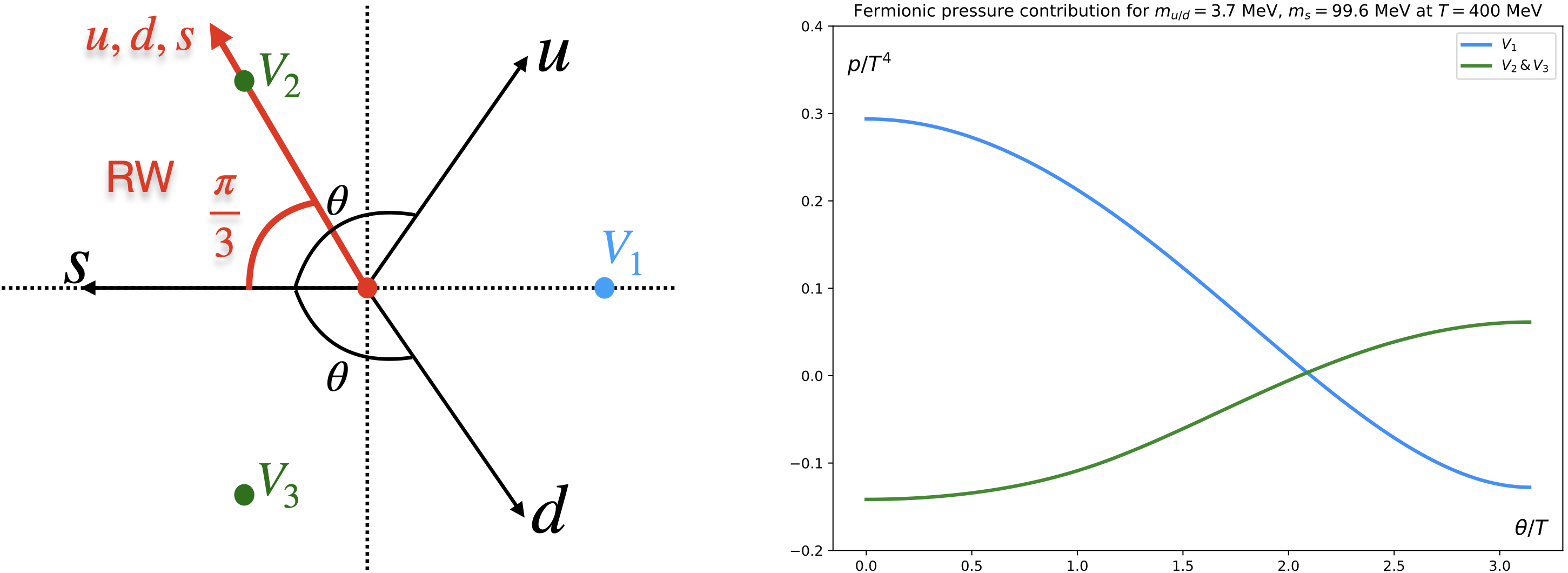
A central technical hurdle is the under-determined system for enthalpy matching due to the simultaneous presence of gluonic and fermionic operator contributions. The innovation in this study is to introduce ensembles with an imaginary isospin chemical potential to selectively suppress the fermionic contribution to thermodynamics. This exploits the center symmetry structure of QCD, notably the Roberge-Weiss transitions, and allows for differential analysis across ensembles to disentangle 8τF0 and 8τF1 with high statistical precision.
Figure 2: Polyakov loop structure and free-fermion pressure in different center vacua, underlining the chemical potential strategy for fermion suppression.
Thermodynamic Observables and Lattice Results
The study employs high-statistics measurements on (1+1+1)-flavor HISQ ensembles at 8τF2 and 8τF3, both at temperatures well above the pseudocritical value, ensuring thermal regime applicability. Thermodynamic observables are extracted with particular care: the interaction measure is derived from the gluonic and fermionic sectors, with explicit subtraction of zero-temperature contributions, and the pressure is obtained through precise integration of the number density with respect to the chemical potential.
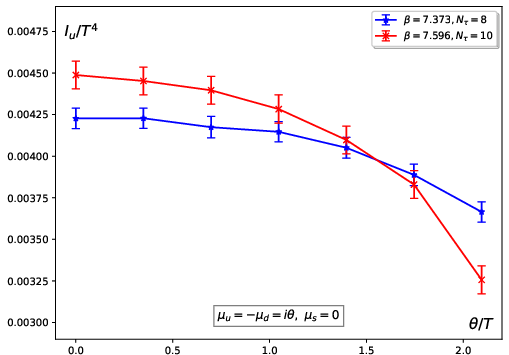
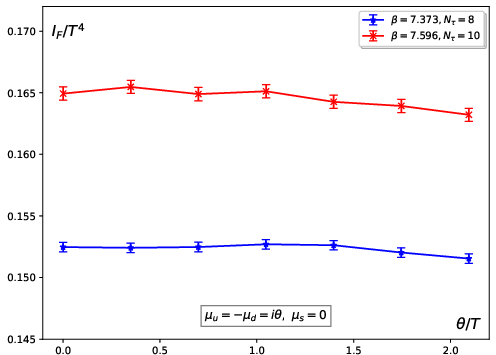
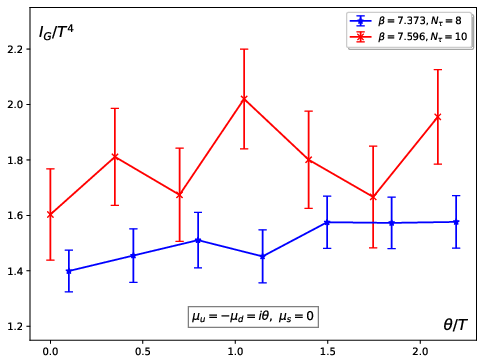
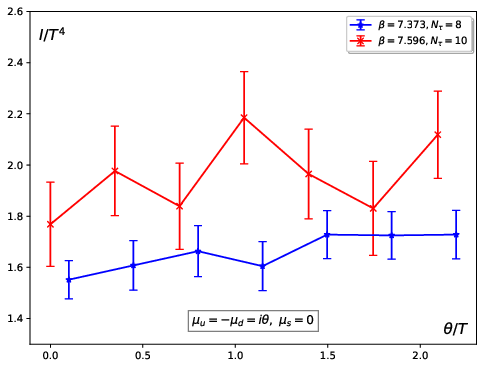
The decomposition of the interaction measure into flavor-specific quark and gluonic contributions reveals both the relative significance of each sector and the effect of imaginary chemical potential.
Figure 3: Up quark (left) and total fermion (right) contributions to the interaction measure as functions of chemical potential.
Figure 4: Gluonic (left) and cumulative (right) interaction measure, highlighting the contrasting behavior of gluons versus fermions at high 8τF4.
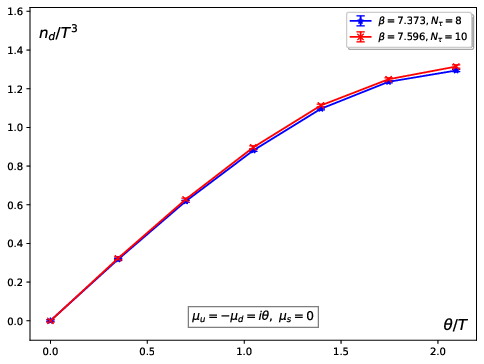
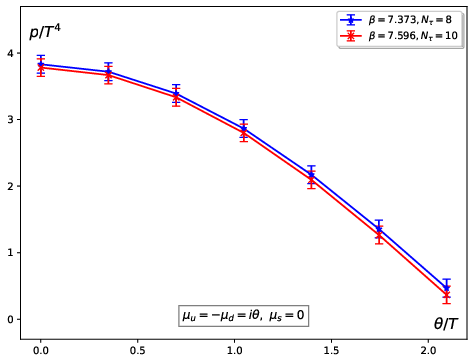
Number density and pressure are consistently suppressed for increasing imaginary chemical potential, and the decomposition elucidates how the QCD pressure deficit relative to the free limit is primarily attributable to the gluonic, not fermionic, sector.
Figure 5: Down-quark number density (left) and pressure (right) across chemical potential for both lattice spacings, demonstrating strong systematic control.
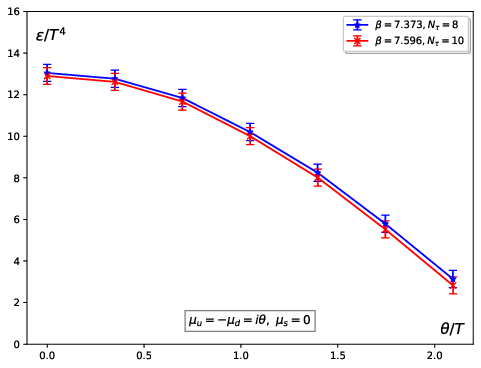
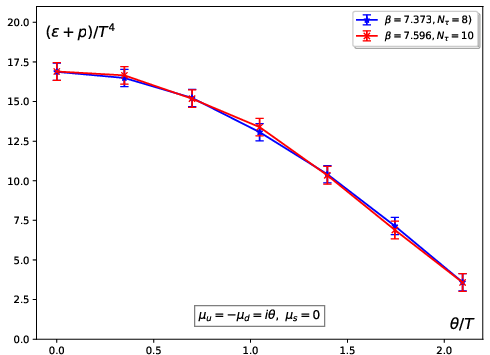
Figure 6: Energy density (left) and enthalpy density (right), confirming ensemble-wise consistency important for continuum extrapolation.
Numerically, the analysis finds that the empirical suppression of pressure near the Roberge-Weiss point is significantly stronger than naive degree-of-freedom counting expectations: a factor of 10, rather than the expected 3, indicating substantial nonperturbative gluonic dynamics even at 8τF5 MeV. The gluonic pressure does not approach the Stefan-Boltzmann (SB) limit at these temperatures, in contrast to the fermionic sector which nearly saturates the SB value.
Theoretical Implications and Prospects
This work demonstrates that combining enthalpy matching with flavor-dependent imaginary chemical potential is a robust strategy for nonperturbative renormalization of the EMT in realistic QCD ensembles. The ability to disentangle gluonic and fermionic renormalization coefficients with clean continuum scaling is essential for precision determination of viscosity and other transport coefficients.
Notably, the observation that the pressure deficit at high temperature arises almost entirely from gluonic suppression, with fermion contributions near their ideal-gas limit, directly challenges simple perturbative intuition and impacts phenomenological modelling of QGP equations of state. This finding highlights the persistent nonperturbative character of the gluonic sector well above 8τF6.
Further reduction of statistical and systematic uncertainty will require even finer lattice spacings and independent cross-validation of zero-8τF7 pressure determinations. The program outlined opens a clear path toward the first high-precision, nonperturbative lattice determination of the shear viscosity in full QCD—a longstanding challenge of critical importance for heavy-ion phenomenology.
Conclusion
The nonperturbative renormalization procedure advanced herein provides a comprehensive and scalable approach to the EMT in full QCD, leveraging enthalpy constraints and symmetry-based ensemble selection. The methodology achieves strong control over renormalization systematics and reveals novel insights into the origin of QCD thermodynamic deficits at high temperature. These developments set the stage for imminent, direct lattice calculations of transport coefficients relevant for QGP and continuum QCD phenomenology.
“Emergent Mind helps me see which AI papers have caught fire online.”
Philip
Creator, AI Explained on YouTube
Sign up for free to explore the frontiers of research
Discover trending papers, chat with arXiv, and track the latest research shaping the future of science and technology.Discover trending papers, chat with arXiv, and more.