The Bures metric and the quantum metric on the density space of a C*-algebra: the non-unital case
Published 2 Apr 2026 in math.OA and math.FA | (2604.02117v2)
Abstract: Building off work of Farenick and Rahaman, we extend the definition of the density space and the Bures metric to the setting of non-unital C*-algebras equipped with a faithful trace and prove that the Bures metric is also a metric in this case and show that its topology is weaker than the topology induced by the C*-norm. Furthermore, we prove a Heine-Borel type theorem for C*-algebras and the density space. In particular, we prove that for any C*-algebra (unital or non-unital) equipped with a faithful trace, the density space equipped with the Bures metric topology is not compact if and only if the C*-algebra is infinite dimensional. We also exhibit several examples of sequences that have no converging sequence in the unital and non-unital case including both commutative and noncommutative C*-algebras. Next, building off work from some of the authors, we extend the definition of the quantum metric on the density space to the non-unital C*-algebra case by introducing the notion of a quantum Lipschitz triple, which form a subclass of quantum locally compact metric spaces of Latrémolière that utilize Rieffel's notion of a quantum metric (we also introduce new classes of quantum locally compact metric spaces that include certain noncommutative homogeneous C*-algebras). Furthermore, we prove that this quantum metric topology is weaker than the topology of the one induced by the C*-norm and finish the article with an analysis of matrix-valued functions on the quantized interval, which provides commutative and noncommuataive examples where the quantum metric topology on the density space is not compact and is not uniformly equivalent to both the Bures metric and the metric induced by the C*-norm.
The paper extends the Bures metric to non-unital C*-algebras and rigorously verifies its true metric properties on density spaces using faithful trace extensions.
Detailed topological comparisons demonstrate that Bures, quantum, and C*-norm topologies are not uniformly equivalent, underscoring key distinctions in infinite-dimensional settings.
By introducing quantum Lipschitz triples, the paper provides a framework that ensures finite, totally bounded quantum metrics for density spaces in noncommutative geometry.
The Bures and Quantum Metrics on the Density Space of Non-Unital C*-Algebras
Introduction
This paper (2604.02117) delivers a systematic study of the Bures metric and the quantum metric on the space of density elements for non-unital C*-algebras with faithful traces. Extending foundational results from the unital case, the authors provide proofs of metric properties, a Heine–Borel-type characterization, explicit constructions of non-compactness, and a new framework for quantum metrics via Lipschitz triples adapted from quantum locally compact metric spaces. The work furnishes both commutative and noncommutative examples, and settles several foundational properties and topological comparisons between the Bures, quantum, and C*-norm metrics in this generalized setting.
The Bures Metric in the Non-Unital Setting
The Bures metric, defined for density elements x,y in a C*-algebra A with a faithful trace τ as
dBτ(x,y)=1−τ(∣xy∣),
is shown to be a bona fide metric even when A is non-unital. The extension leverages the minimal unitization of A and properties of trace-preserving extensions (Lemma \ref{l:unitize-root-abs}, Proposition \ref{p:faithful}). Non-unital C*-algebras, necessarily infinite-dimensional, are handled by considering their unitizations and by demonstrating that faithfulness and positivity propagate accordingly.
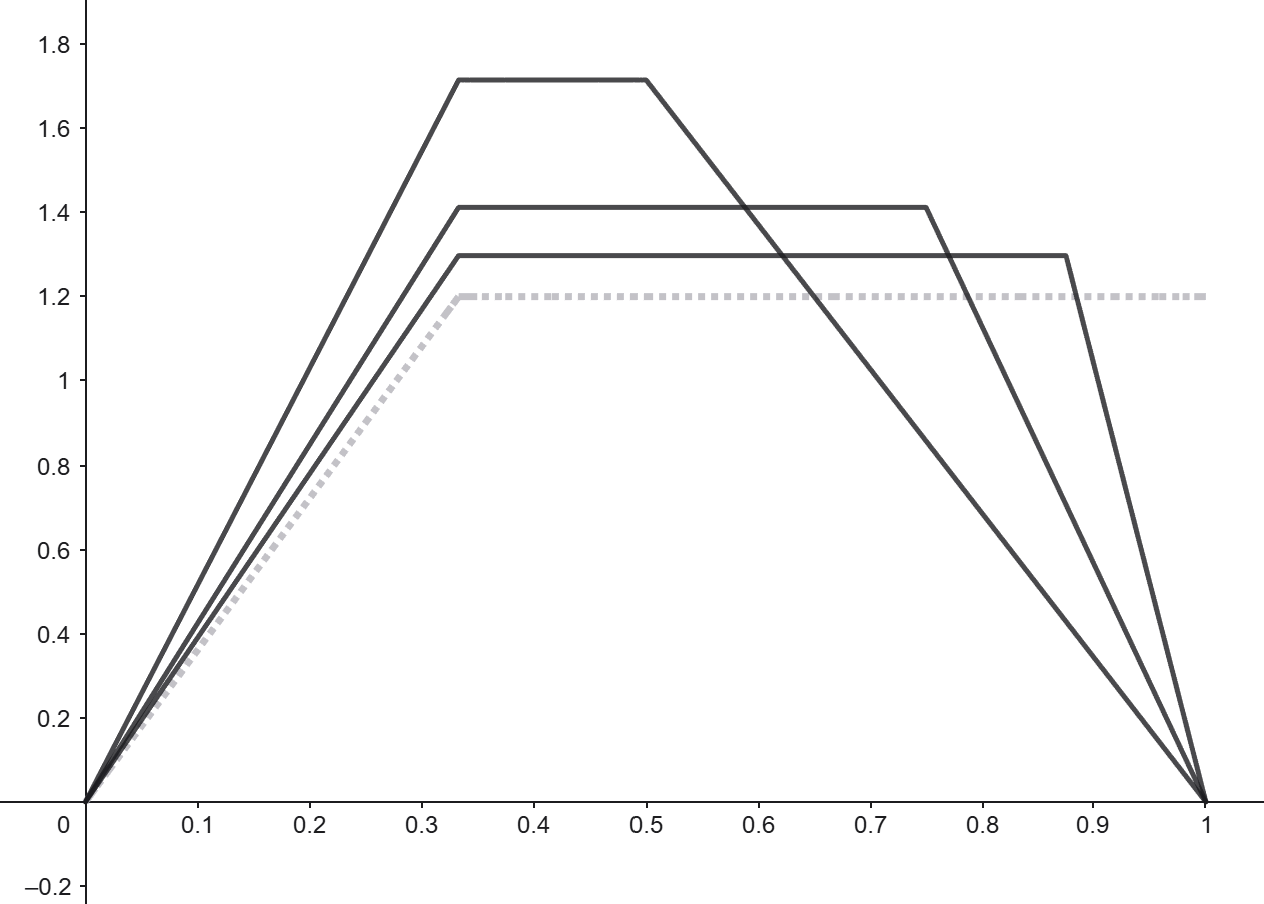
A central result is that the Bures topology coincides with the L1-topology induced by the trace, and both are strictly weaker than the topology induced by the C*-norm (Theorems \ref{t:l1-homeo}, \ref{t:c*-norm-bures}). The authors provide explicit Fuchs–van de Graaf-type inequalities in this context, solidifying the duality of the Bures and L1 metrics. For example, sequences convergent in Bures or L1 metrics need not converge in the C*-norm, as illustrated with functions in C0((0,1]).
Figure 1: Plots of A0 (dotted), A1, A2, and A3 explicitly demonstrate the difference between norm and Bures topologies.
Heine–Borel Compactness and Sequence Constructions
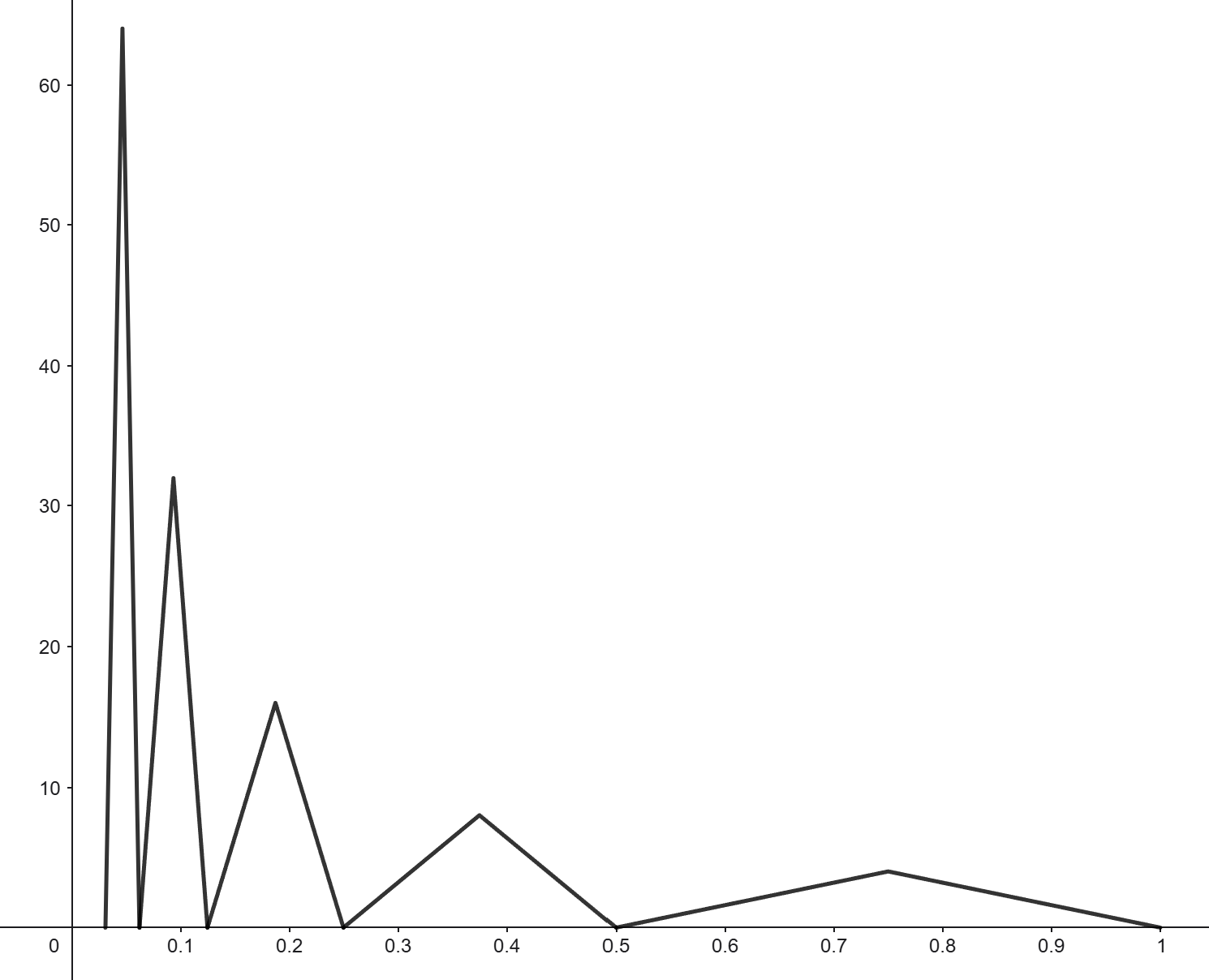
The paper proves a Heine–Borel-type theorem: A4 is compact if and only if A5 is finite-dimensional (Theorem \ref{t:hb-bures}). For all non-unital A6 (necessarily infinite-dimensional), the Bures density space is not compact. To illuminate this, sequences with norm-orthogonal supports, e.g., characteristic functions A7 (on a discrete or quantized interval), are constructed. These sequences' Bures distances are always 1, reflecting the maximal quantum distinguishability of orthogonal projections.
Figure 2: Plots of A8 illustrate explicit sequences in the density space with no convergent subsequence in Bures metric.
Analogous sequences are constructed for noncommutative cases, such as matrix-valued and approximately finite (AF) algebras, using faithful traces constructed via integration.
Quantum Metrics and Quantum Lipschitz Triples
Building on Rieffel and Latrémolière's frameworks for quantum (locally) compact metric spaces, the paper generalizes the construction of quantum metrics to the non-unital regime. A central technical innovation is the introduction of quantum Lipschitz triplesA9, with τ0 an extended C*-seminorm on the self-adjoint part of τ1, and τ2 a commutative subalgebra containing an approximate identity, under which the Monge–Kantorovich metric is finite and totally bounded on the set of states associated with density elements.
The quantum metric on the density space is given by:
τ3
When τ4 is a quantum Lipschitz triple, τ5 is a genuine metric (Theorem \ref{t:qlt-metric}), with a topology weaker than the C*-norm. However, the paper demonstrates via explicit counterexamples that the quantum metric may fail to be uniformly equivalent to the Bures metric or the C*-norm topology, particularly in infinite-dimensional or non-unital settings.
Non-Uniform Equivalence and Non-Compactness of Quantum Metric
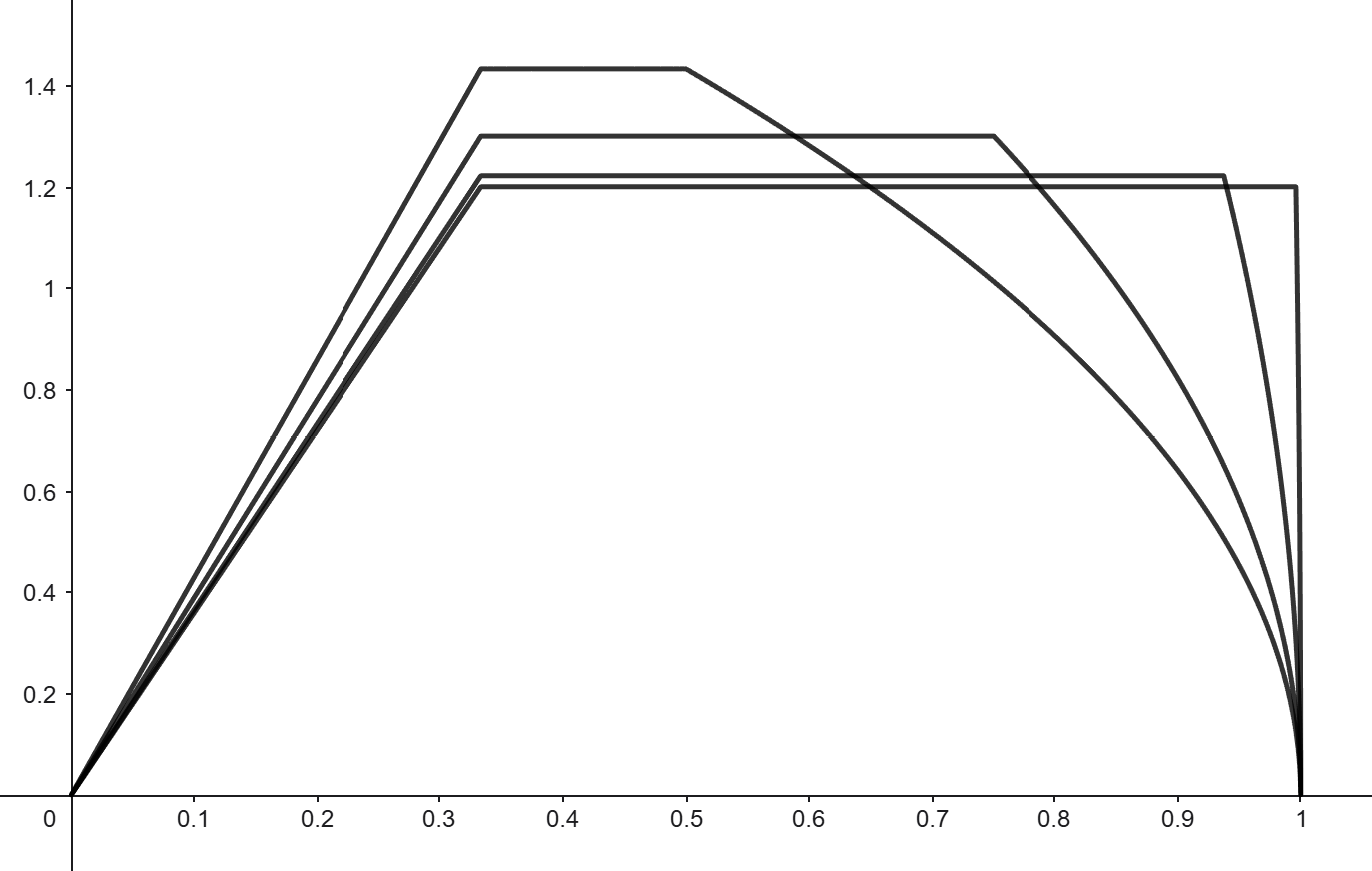
Using matrix-valued functions on the quantized interval (i.e., τ6), the authors construct sequences τ7 in the density space such that:
τ8 is Cauchy in the quantum metric (i.e., the difference vanishes as τ9),
but is an equidistant (distance-1) sequence in the Bures metric, and is not Cauchy in the C*-norm.
Figure 3: Plots of dBτ(x,y)=1−τ(∣xy∣),0, etc., illustrate the evolution of fidelity functions and the lack of uniform equivalence between the metrics.
This establishes that the identity map between these metric spaces is not uniformly continuous. Furthermore, dBτ(x,y)=1−τ(∣xy∣),1 is non-compact for such algebras, due not only to the non-unitality but also more subtle metric-topological effects (Theorem \ref{t:non-compact}). Theoretical analysis is supported by explicit calculations using conditional expectations, traces, and structure of projections in AF algebras.
Implications and Further Directions
The findings have multiple implications:
Metric Geometry of State Spaces: Characterizing the weakness and (non-)compactness of the Bures and quantum metric topologies in non-unital cases refines the understanding of quantum state geometry beyond finite-dimensional or unital algebras, which dominate quantum information theory.
Noncommutative Metric Geometry: The quantum Lipschitz triple construction offers a viable route for metric geometry in non-unital, even approximately homogeneous, C*-algebras, with possible applications in noncommutative geometry and mathematical physics.
Uniqueness and Limitations: The explicit non-equivalence and non-compactness results caution against naive transfers of results or intuitions from the unital/finite-dimensional setting.
Potential avenues for further research include a finer classification of quantum locally compact metric spaces not admitting quantum Lipschitz triple structures, exact conditions for uniform equivalence, and connections to quantum Markov semigroups, optimal transport, or quantum information-theoretic distinguishability in infinite-dimensional settings.
Conclusion
The paper establishes a detailed framework for the Bures and quantum metrics on density spaces of non-unital C*-algebras with faithful traces. The Bures metric is shown to be metrically well-posed, the quantum metric's domain is bounded under the quantum Lipschitz triple framework, and a precise characterization of compactness is obtained. Constructive examples illustrate the failure of uniform equivalence and provide templates for further analysis in both commutative and noncommutative settings. The results clarify the landscape of quantum state geometry outside the finite-dimensional/unital paradigm and invite further study in the rich terrain of noncommutative metric geometry.