- The paper introduces a declarative grammar extension to Vega-Lite that encapsulates progressive data analysis semantics for interactive visualization.
- It formalizes 64 PDAV requirements across progression, visualization, interaction, and guidance, ensuring modular and reproducible solution design.
- The practical implementation, Pro-Ex, demonstrates rapid prototyping across diverse use cases with stable update intervals and high compatibility.
ProVega: A Grammar for Progressive Data Analysis and Visualization Solutions
Motivation and Background
The proliferation of massive datasets in diverse domains has increased the need for responsive, interactive data analysis methodologies that can provide insight well before the completion of full-scale computations. Progressive Data Analysis and Visualization (PDAV) addresses this need by delivering partial, incrementally refined results to analysts, supporting hypothesis formation and steering on incomplete data with continuous feedback. Despite the recent maturity in progressive methods and a proliferation of research outputs, reproducibility, prototyping, and adoption of PDAV practices remain substantially hindered by implementation complexity and workflow fragmentation.
The “ProVega: A Grammar to Ease the Prototyping, Creation, and Reproducibility of Progressive Data Analysis and Visualization Solutions” (2604.02096) proposes a declarative grammar that systematically formalizes PDAV requirements, enabling rapid prototyping, reproducibility, and sharing of progressive visualization solutions. ProVega is architected as an extension to the established Vega-Lite grammar, encapsulating all progressive semantics into modular properties while retaining complete backward compatibility. An accompanying environment, Pro-Ex, operationalizes this grammar, providing both assisted exploration and interactive editor capacities to address the onboarding requirements of novice users and the extensibility expectations of experts.
Taxonomy of PDAV Requirements
A foundational aspect of ProVega is a comprehensive taxonomy capturing the functional range and theoretical underpinning of PDAV. The authors synthesize 64 distinct requirements—derived from seminal and contemporary literature—spanning data management, computation, visualization, user interaction, and guidance (cf. Angelini et al., 2018; Ulmer et al., 2024; Fekete, 2024). These are systematically organized into four main categories:
- Progression: Incremental computation, control, and monitoring.
- Visualization: Visual representation of data, metadata, and process state.
- Interaction: Fluid user-driven steering and structured intervention.
- Guidance: Mechanisms that enhance task orientation and analytic flow.
Each category is recursively structured into subcategories reflecting major functional breakpoints such as chunking strategy (data, process, mixed), control modality, and quality feedback. This taxonomy directly structures the grammar and informs coverage targets.
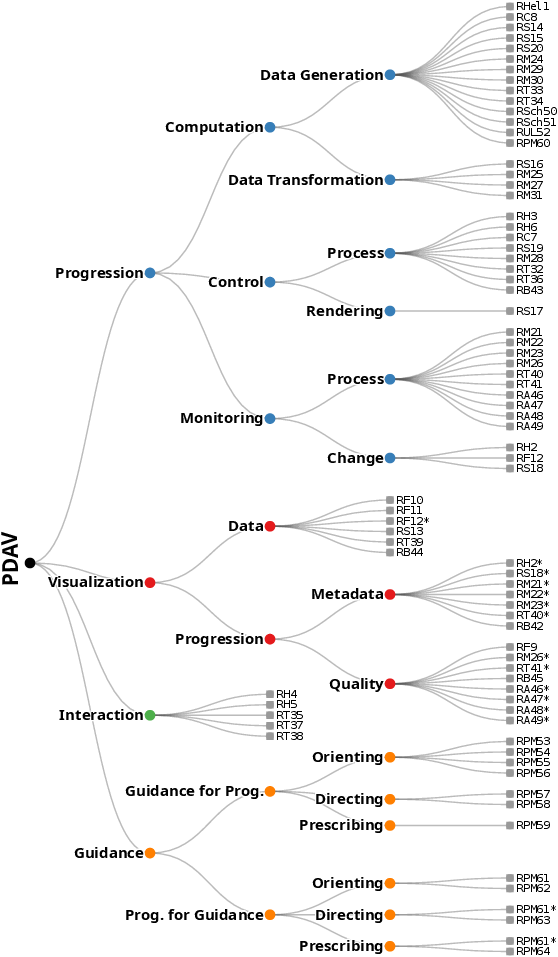
Figure 1: The PDAV requirements taxonomy, which organizes 64 requirements into Progression, Visualization, Interaction, and Guidance categories, forming the foundation for the ProVega grammar definition.
ProVega extends the Vega-Lite specification with a dedicated top-level property provega, within which PDAV features are hierarchically modularized. The grammar offers explicit blocks for progression strategies (including chunking modality and schedule), visualization constraints (e.g., feedback overlays, quality/confidence signals), user control primitives (pause/play/step/stop), and hooks for future interaction/guidance extensions. All progressive features are encapsulated so that instruments remain compatible with the underlying Vega-Lite ecosystem, facilitating seamless migration and integration with existing visualization assets.
- Progression is specified via chunking type (
data, process, mixed), chunk size, schedule, and control robustness. The grammar supports both internal chunk management for static datasets and streaming for dynamic, socket-driven environments. Quality metrics, aliveness signals, etc., are standardized.
- Visualization properties focus on spatial/visual stability, the communication of uncertainty, process progress, and change detection. Where Vega-Lite suffices, native constructs are leveraged directly; only explicit progressive needs are formalized at the grammar level.
- Interaction and Guidance blocks are reserved for future work, anticipating the upward trajectory of user-guided workflow research in PDAV.
- The implementation leverages interception at the embedding layer (
vega-embed), enabling progressive state management and orchestration—without requiring modifications to Vega-Lite or Vega runtimes.
Expressiveness and Coverage: Reimplementation and Use Cases
Validation emphasizes expressivity, fidelity, and extensibility. The ProVega gallery demonstrates reproduction of 11 archetypal PDAV solutions across a spectrum of complexity, type, and progression mode—many of which originally lacked accessible, reusable implementations. Examples span multivariate, geospatial, network, and categorical visualizations, encompassing each progression strategy (data, process, mixed).
- Data chunking is exemplified by progressive density mapping, demonstrating the ability to surface spatial patterns with controlled latency and continuous quality signaling, even at O(105) record cardinality.
- Process chunking is illustrated by progressive t-SNE embedding on Fashion-MNIST, syncing stepwise iterations with visual outputs via ProVega hooks.
- Mixed chunking is performed by interleaving incremental data arrival and process updates, with continuous reconciliation to maintain layout stability.
- Backend integration is validated by leveraging ProgressiVis as an upstream progressive engine, streaming data batches via Socket.IO and visualized incrementally with complete ProVega control and monitoring primitives.
The implementation benchmarked stable update intervals (250–500 ms) across use cases, even under combined high-volume and dual progression streams, demonstrating both robustness and responsiveness.
Assisted Workflow: The Pro-Ex Environment
Pro-Ex operationalizes the grammar with three major UI slices:
- Gallery View: Onboarding and exploration of implemented exemplars, filter/search, and code re-use.
- Inspector View: Specification inspection, toggle-based or advanced parameter manipulation, and snapshot/version management.
- Editor View: Unconstrained authoring and editing, with support for dataset ingestion and code injection.
User studies (n=39 for expressivity/fidelity assessment, with longitudinal evaluation for usability and support) showed high to moderate satisfaction across task complexity bands, with open feedback supporting further refinement, especially in user documentation and novice support. The median SUS score was 60, indicating usability levels within range for advanced research tools but highlighting paths for improvement in discoverability and guidance.
Practical and Theoretical Implications
ProVega reconceptualizes PDAV solution construction as a declarative, modular activity, substantially reducing engineering overhead, raising reproducibility, and supporting the research community’s efforts in benchmarking, extension, and pedagogy. Its design is explicitly future-oriented: integration points for advanced interaction, adaptive guidance, and generative code support are formalized within grammar namespaces, inviting rapid adoption of future innovations.
The system’s architecture also demonstrates compatibility with generative AI methods. LLMs (e.g., GPT-4/5-based Codex) can, from specification alone, generate ProVega-compliant code segments including progressive chunking and custom visual behaviors. This unlocks new pathways for human-in-the-loop and automated workflow synthesis within PDAV.
Limitations and Future Work
While ProVega achieves high compatibility, certain high-level VA operations—multi-view linking, advanced interaction choreography, or implicit semantic guidance—currently remain outside its declarative expressiveness. Limitations trace to analogous constraints in Vega-Lite and reflect research frontiers more than immediate engineering omission. Planned enhancements target guidance-for-progressiveness integration, further usability improvements, and continued coordination with the Vega-Lite ecosystem as the underlying grammar evolves.
Conclusion
ProVega establishes a formal, extensible grammar for progressive data analysis and visual analytics, fully capturing the state-of-the-art requirements landscape and operationalizing it within a pragmatic, open-source ecosystem. Its design and validation across literature benchmarks, real-world datasets, and practical user study underscore its relevance for both research and application in PDAV. The Pro-Ex environment and integration capabilities address both reproducibility and barrier reduction—critical for sustained field adoption. Future directions include explicit integration of AI-driven workflows and broader support for emergent patterns in analytic guidance and model interpretability.
Reference:
"ProVega: A Grammar to Ease the Prototyping, Creation, and Reproducibility of Progressive Data Analysis and Visualization Solutions" (2604.02096)
Figure 1: The taxonomy of PDAV requirements, structured into Progression, Visualization, Interaction, and Guidance categories, forming the basis of the ProVega grammar definition.