Published 2 Apr 2026 in math.OC and eess.SY | (2604.02069v1)
Abstract: Lasso problems arise in many areas, including signal processing, machine learning, and control, and are closely connected to sparse coding mechanisms observed in neuroscience. A continuous-time ordinary differential equation (ODE) representation of the Lasso problem not only enables its solution on analog computers but also provides a framework for interpreting neurophysiological phenomena. This article proposes a fixed-time-stable ODE representation of the Lasso problem by first transforming it into a smooth nonnegative quadratic program (QP) and then designing a projection-free Newton-based ODE representation of the Lasso problem by first transforming it into a smooth nonnegative quadratic program (QP) and then designing a projection-free Newton-based fixed-time-stable ODE system for solving the corresponding Karush-Kuhn-Tucker (KKT) conditions. Moreover, the settling time of the ODE is independent of the problem data and can be arbitrarily prescribed. Numerical experiments verify that the trajectory reaches the optimal solution within the prescribed time.
The paper introduces a fixed-time-stable ODE that transforms the non-smooth Lasso into a smooth, nonnegative QP, ensuring a prescribed settling time.
The methodology employs Lyapunov analysis and KKT conditions to secure global convergence, independent of initial conditions and problem data.
Empirical results confirm that the ODE reliably converges to the unique optimum, paving the way for analog hardware implementations in sparse optimization.
Fixed-Time-Stable ODE Representation for Lasso: Theory and Implications
Introduction
This work formalizes a novel fixed-time-stable ODE framework for the Lasso problem, leveraging the equivalence between non-smooth Lasso and a smooth, non-negative quadratic program (QP). Central to this methodology is the construction of a projection-free, Newton-style ODE whose settling time is explicitly prescribed and proven to be uniform across both initialization and problem data. This paradigm not only yields a theoretically robust solution for sparse optimization but also lays a foundation for efficient analog hardware implementations with strong guarantees of convergence and robustness in computation time.
Theoretical Framework
The core Lasso formulation minx∥Ax−b∥22+τ∥x∥1 is converted to an equivalent smooth QP by decomposing x=x+−x−, where x+,x−≥0, and embedding the ℓ1 regularization as a linear cone, reducing the original non-smooth problem into a non-negativity constrained QP with strictly convex objective provided ℓ2 regularization is present. The uniqueness of the solution is thus preserved under standard regularity assumptions.
The continuous-time representation of the optimization problem as an ODE provides a framework for hardware realization and draws direct analogies with neurodynamical coding. Unlike classical gradient flows, which only guarantee asymptotic stability and no explicit control over convergence time, the fixed-time-stable ODE built here exploits Lyapunov-based analysis with tight upper bounds that are independent of both the initial state and problem parameters. Specifically, with Lyapunov exponentsα1=1−1/μ, α2=1+1/μ, and an appropriately tuned rate k, the settling time satisfies Tmax=2k1k2μπ. Particularly, μ=2 is selected to directly align with the Euclidean norm, facilitating analog circuit design.
For the equivalent QP, the Karush-Kuhn-Tucker (KKT) conditions are encoded into the ODE using primal and dual variables—without the need for explicit projection—yielding a coupled dynamical system for x=x+−x−0 whose domain invariance and uniqueness are established by barrier arguments. The ODE is shown to converge to the optimal solution in worst-case time x=x+−x−1, tunable via system parameters.
Numerical Verification
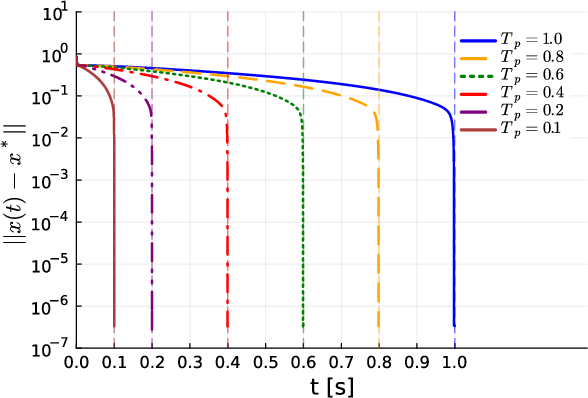
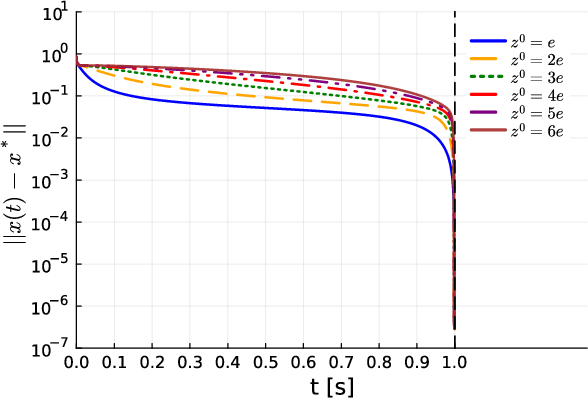
To empirically confirm the theoretical contributions, the proposed fixed-time-stable ODE was instantiated on sets of randomly generated Lasso problems. Multiple experiments were performed, varying both the prescribed settling time and initial condition. In all cases, as shown in the solution trajectory plots,
Figure 1: Left: Trajectory x=x+−x−2 for varying prescribed times x=x+−x−3; Right: Trajectory x=x+−x−4 for varying initializations, confirming independence from initial condition and data.
the ODE solution converged to the unique minimizer within the a priori prescribed time, regardless of the initialization or the coefficient matrix x=x+−x−5. The left panel demonstrates the direct control of convergence time across varying x=x+−x−6; the right panel establishes the global invariance of the convergence rate with respect to starting point. These trajectories underpin the main theoretical assertion: fixed-time convergence for high-dimensional, non-smooth sparse optimization is realizable through smooth, analog-friendly dynamics.
Practical and Theoretical Implications
The results have profound implications for both continuous optimization theory and physical computing. By eliminating dependence of the convergence time on initialization and data, the method enables “prescribed-time” optimization, a property currently unattainable in traditional digital algorithms for non-smooth problems.
On the practical frontier, the projection-free and smooth ODE can be efficiently mapped to programmable analog hardware, supporting the development of application-specific accelerators for sparse regression, compressed sensing, system identification, and neuro-inspired computation. The explicit use of non-negative variables aligns with voltage-domain constraints in analog circuits, further simplifying hardware realization.
In neuroscience, this framework provides a biophysically plausible candidate for rapid sparse coding mechanisms, enabling physical or simulated analogues of neural computation with certified robustness and efficiency. This connection could foster cross-pollination between sparse representation theory and computational neuroscience.
Future Directions
Future research directions include large-scale hardware implementation on custom printed circuit boards—critical for empirical analysis of robustness against analog imperfections such as device mismatch and quantization noise. The extension of fixed-time-stable ODE theory to cover the effects of non-idealities and further generalization to broader classes of non-smooth and constrained optimization is anticipated. Noise-aware Lyapunov synthesis methods will be necessary to guarantee practical stability in physical substrates.
Additionally, exploration of the implications for other paradigms in control, online optimization, and variational inequality problems is of interest, with potential integration into hybrid analog-digital systems where timing guarantees are otherwise difficult to certify.
Conclusion
This work establishes that fixed-time-stable continuous-time ODEs, leveraging smooth surrogate representations of non-smooth sparse optimization problems such as Lasso, deliver strong theoretical guarantees: uniquely optimal, data-independent and initialization-independent convergence within a prescribed horizon. The methodology is compatible with analog hardware constraints and holds promise for both scalable, energy-efficient computing and furthering our understanding of fast, sparse neural computation. Empirical evidence aligns with all main theorems, signaling a viable path forward for practical, certified alternative computing platforms.