Massive scalar field perturbations in noncommutative-geometry-inspired Schwarzschild black hole
Published 2 Apr 2026 in gr-qc and hep-th | (2604.02066v1)
Abstract: In this paper, based on noncommutative-geometry-inspired Schwarzschild black hole, we employ a third-order WKB approximation approach to systematically calculate the quasinormal mode frequencies (QNFs), greybody factors (GFs), and absorption cross section (ACS) under massive scalar field perturbations. The results show that the QNFs satisfy Im($ω$)<0, confirming the stability of the black hole under perturbations. Furthermore, increasing the noncommutative parameter $θ$ reduces the absolute values of both the real and imaginary parts of the frequency, while increasing mass $μ$ increases the real part and reduces the imaginary part. The GFs and ACS increase with increasing $θ$ and decrease with increasing $μ$, indicating opposite modulation effects of these two types of parameters. It is worth emphasizing that the QNFs of the extreme black hole approach the corresponding values of the classical Schwarzschild black hole at angular quantum number $\ell=1$ and large $μ$, suggesting that, the effects of mass and noncommutative geometry quantum corrections cancel each other out to some extent. It is hoped that these results provide a viable theoretical basis for both the theoretical and experimental aspects of the perturbative dynamics of black hole.
The paper demonstrates that noncommutative corrections and scalar field mass modulate quasinormal modes, with increased θ lowering oscillation frequencies and damping rates.
The paper finds that greybody factors and absorption cross sections are highly sensitive to the interplay between noncommutative geometry and field mass, impacting Hawking radiation spectra.
The paper employs a third-order WKB approach to ensure numerical stability across horizon and extremal regimes, offering valuable insights into quantum gravity phenomenology.
Massive Scalar Field Perturbations in Noncommutative-Geometry-Inspired Schwarzschild Black Hole
Introduction
The article rigorously investigates the response of noncommutative-geometry-inspired Schwarzschild black holes (NCG-Schwarzschild BHs) to external perturbations by massive scalar fields within the context of quantum gravity phenomenology. Noncommutative geometry introduces an effective ultraviolet cutoff characterized by the parameter θ, which removes curvature singularities at the Planck scale. The study systematically analyzes the black hole's quasinormal modes (QNMs), greybody factors (GFs), and absorption cross sections (ACS) under such scalar field perturbations, with a central focus on how the interplay between the mass of the field (μ) and the noncommutative parameter (θ) governs the perturbative dynamics. The third-order WKB approximation method serves as the principal computational framework due to its numerical stability in the relevant mass and parameter regimes.
Geometry and Perturbative Framework
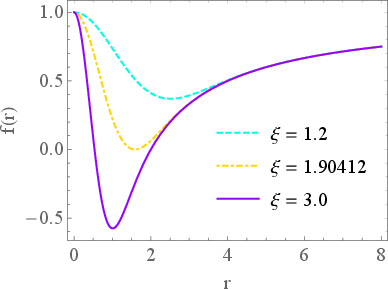
The NCG-Schwarzschild metric replaces the classical point-mass source with a Gaussian matter distribution, parameterized by θ, as the scale of nonlocality. The resulting solution exhibits a non-singular core with a modified horizon structure determined by the ratio ξ=M/θ. Depending on ξ, the spacetime admits: (1) a two-horizon black hole for ξ>ξc≈1.90412, (2) an extremal black hole for ξ=ξc, and (3) a regular horizonless geometry for ξ<ξc. For all cases with horizons, the standard Schwarzschild solution is recovered at large radii, and noncommutative corrections are localized near Planckian scales.
Figure 1: The metric function f(r) as a function of μ0 for distinct values of μ1 encapsulates the transition from non-singular regular cores to classical Schwarzschild behavior.
The propagation of a massive scalar field on the NCG-Schwarzschild background is governed by the Klein-Gordon equation, which in tortoise coordinates reduces to a Schrödinger-type equation with an effective potential:
μ2
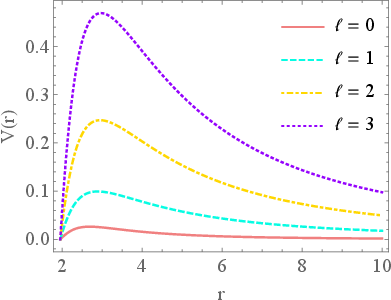
This potential exhibits a barrier dependent on the field's angular quantum number μ3, mass μ4, and μ5.
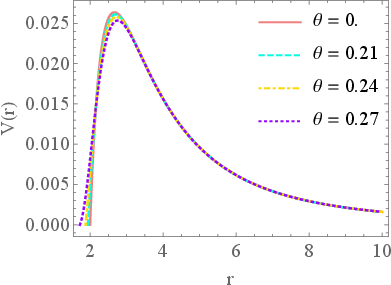
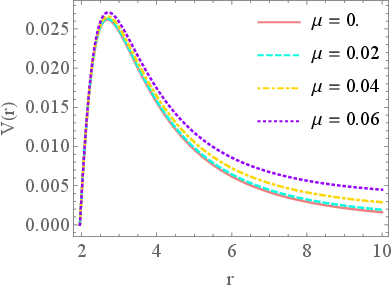
Figure 2: Effective potential μ6 as a function of μ7 revealing the effects of μ8, μ9, and θ0—notably the shift in barrier height and asymptotic behavior for increasing θ1.
Quasinormal Modes: Spectra and Stability
The QNM spectrum is computed using the third-order WKB method, enforcing purely ingoing boundary conditions at the horizon and outgoing conditions at infinity. For all explored parameter regimes, the fundamental result is:
The imaginary parts of all QN frequencies remain negative, confirming mode stability for the NCG-Schwarzschild BH under massive scalar field perturbations.
The spectra display systematic dependencies on the black hole and field parameters:
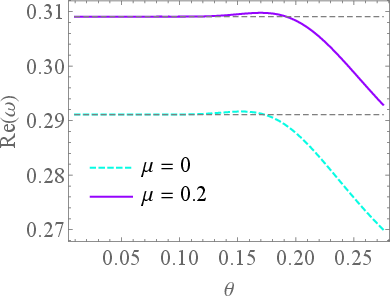
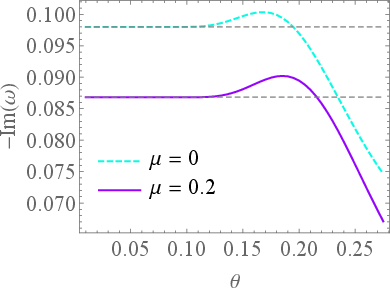
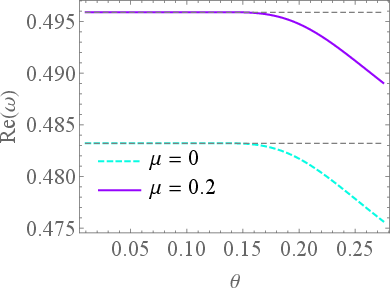
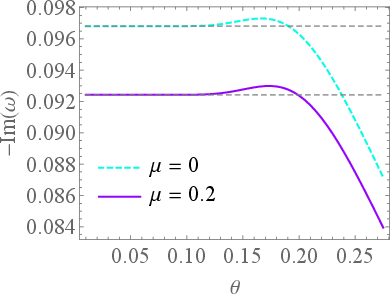
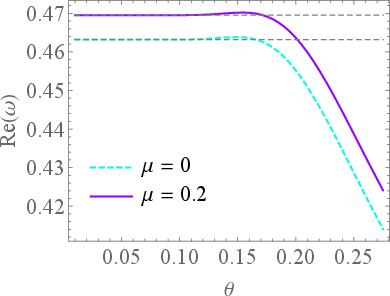
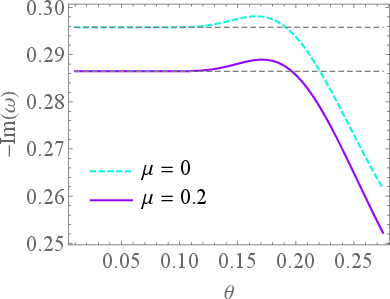
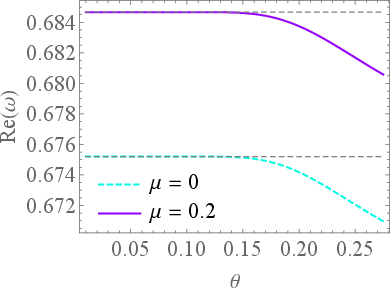
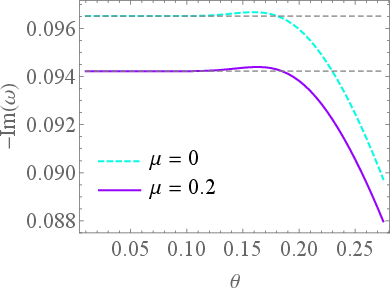
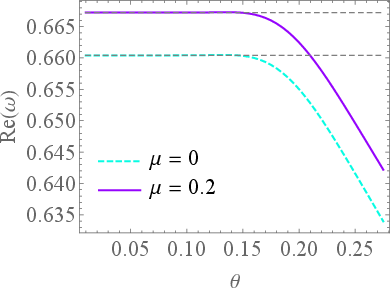
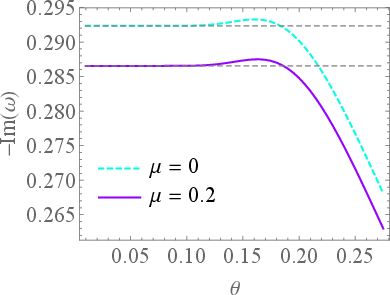
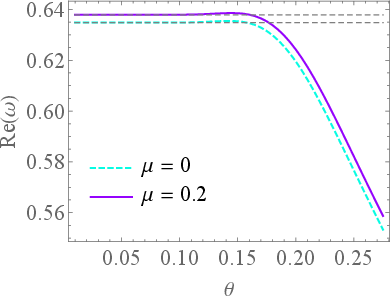
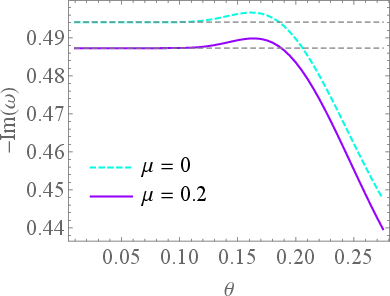
Noncommutative corrections (θ2): Increasing θ3 reduces both θ4 and θ5, most markedly near extremality, leading to longer-lived, more slowly oscillating modes.
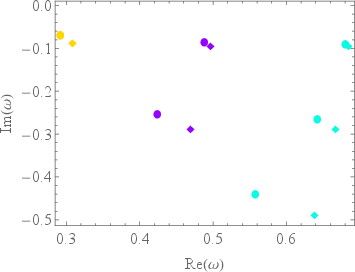
Scalar field mass (θ6): An increased mass monotonically raises θ7 while suppressing the imaginary part, indicating slower decay. For large θ8, low angular momentum modes of the extremal black hole strongly resemble the classical Schwarzschild spectrum, signifying partial cancellation between mass effects and noncommutative corrections.
Angular quantum number (θ9) and overtone θ0: The dependence follows standard patterns—higher θ1 increases the oscillation frequency, and higher overtones are more strongly damped.
Figure 3: Evolution of θ2 and θ3 as functions of θ4 for fixed θ5 and varying quantum numbers, encapsulating the modulation induced by noncommutative corrections.
Figure 4: QNF loci in the complex plane for various θ6 and θ7 at extremal and classical limits, illustrating the approach of the extremal spectrum toward the Schwarzschild result at large θ8.
Greybody Factors
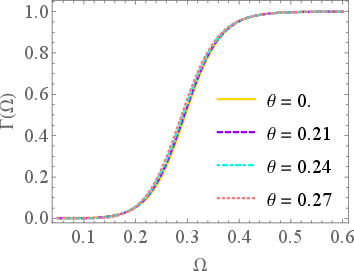
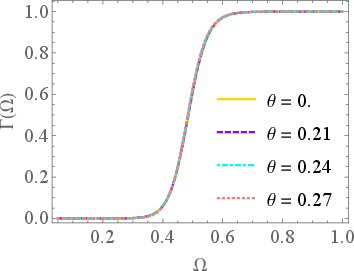
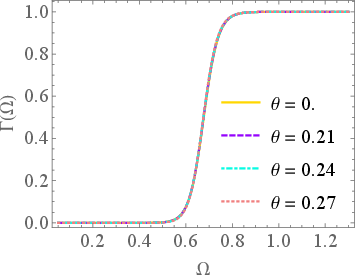
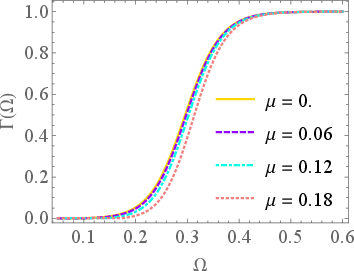
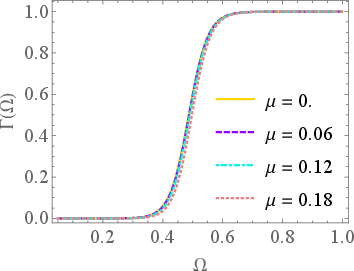
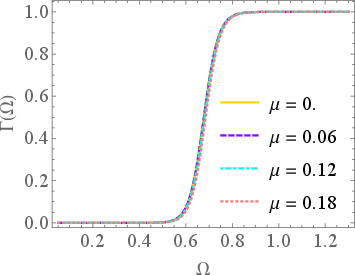
The GFs, which directly modulate Hawking emission spectra, are extracted using the same WKB formalism. The transmission probability θ9 exhibits canonical behavior: nearly vanishing at low frequencies, rising monotonically, and asymptoting to unity. Parameter dependencies are quantified as follows:
Increasing ξ=M/θ0: Shifts the GF turn-on to higher frequencies due to the increased barrier.
Increasing ξ=M/θ1: Shifts the onset to lower frequencies and increases the transmission for fixed frequency—noncommutative corrections lower the effective barrier.
Increasing ξ=M/θ2: Opposes the effect of ξ=M/θ3, requiring higher frequencies for significant transmission; mass increases the asymptotic value of the potential, suppressing low-frequency propagation.
Figure 5: Representative GFs as functions of frequency for various ξ=M/θ4 and ξ=M/θ5, exposing the opposite trends for quantum geometry and mass effects.
Absorption Cross Section
The ACS, essential for scalar field accretion and Hawking process modeling, is computed via partial wave sums:
ξ=M/θ6
Key results:
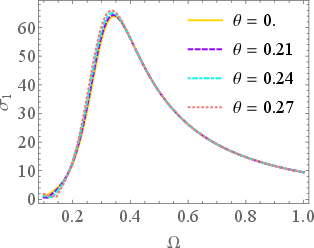
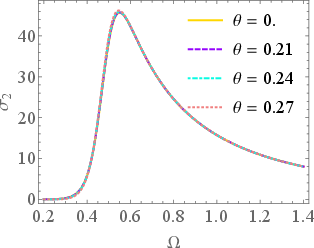
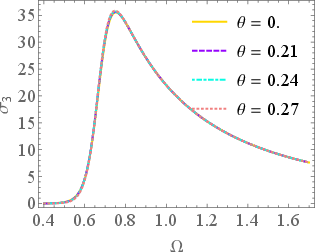
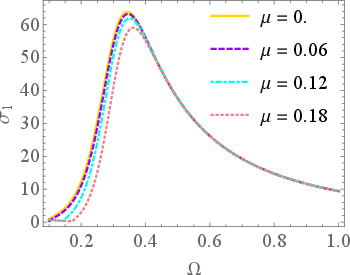
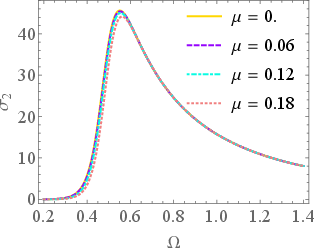
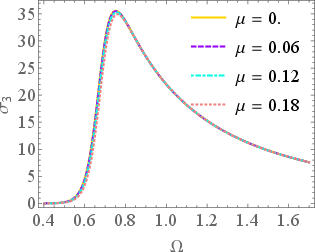
The ACS rises at low frequencies, peaks, and decays at high frequencies, with the position and amplitude of the peak governed by ξ=M/θ7, ξ=M/θ8, and ξ=M/θ9.
Increasing ξ0 enhances and shifts the peak to lower frequencies; increasing ξ1 diminishes and shifts the peak higher.
The interplay between ξ2 and ξ3 introduces nontrivial regulation of the observable spectra, highly relevant for primordial black hole evaporation phenomenology.
Figure 6: ACS as a function of frequency, revealing the parameter dependence on ξ4 and ξ5 for varying angular quantum number ξ6.
Methodological Remarks
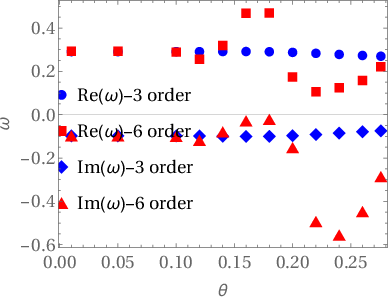
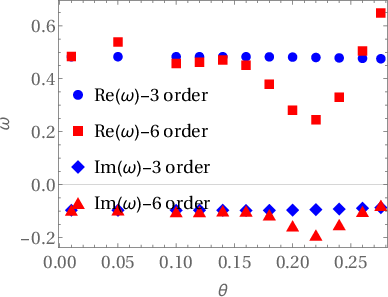
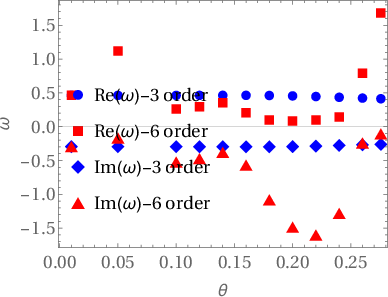
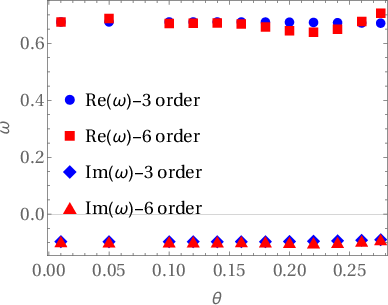
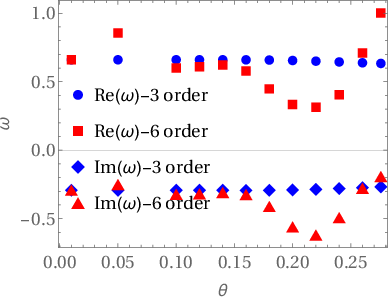
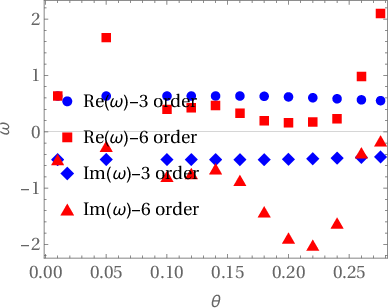
Convergence analysis between third- and sixth-order WKB calculations demonstrates that higher-order methods can develop pronounced numerical instability near the extremal regime (ξ7). The third-order approach, in contrast, ensures stable, physically meaningful results in the studied range. Future improvements may leverage spectral or Padé-improved WKB techniques for further robustness.
Figure 7: Convergence behavior of third- and sixth-order WKB approximations demonstrating breakdown in the latter as ξ8 increases.
Theoretical and Practical Implications
This comprehensive parameter study highlights several implications for quantum gravity and black hole observational signatures:
Partial Compensation: The cancellation between mass and noncommutative modulations in QNMs at low angular momentum implies the potential masking of quantum correction effects by massive fields, influencing gravitational wave templates.
Emission Spectra Regulation: Competition between mass and noncommutativity in the GFs and ACS points to nontrivial spectra during black hole evaporation, with low-mass fields being more sensitive to quantum geometry than their heavier counterparts.
Perturbative Stability: The demonstration of mode stability for all tested configurations underpins the viability of NCG black holes as quantum-gravity-corrected endpoints for gravitational collapse, subject to further tests for fields of higher spin and charge.
Conclusion
This work establishes a quantitative map of how noncommutative geometry and field mass modulate black hole perturbative observables, including QNMs, GFs, and ACS. The results suggest that for ξ9 and substantial mass, quantum corrections may be observationally elusive, while light fields can exhibit strong signatures of noncommutativity. The presented computational methodology can be adapted to more general backgrounds and higher-spin fields. Future research will benefit from comparative studies with high-precision spectral or Padé-resummed WKB methods and applications to rotating or charged noncommutative black hole solutions.
Reference: "Massive scalar field perturbations in noncommutative-geometry-inspired Schwarzschild black hole" (2604.02066)
“Emergent Mind helps me see which AI papers have caught fire online.”
Philip
Creator, AI Explained on YouTube
Sign up for free to explore the frontiers of research
Discover trending papers, chat with arXiv, and track the latest research shaping the future of science and technology.Discover trending papers, chat with arXiv, and more.