Quantitative Universal Approximation for Noisy Quantum Neural Networks
Published 2 Apr 2026 in quant-ph, math.NA, and q-fin.PR | (2604.02064v1)
Abstract: We provide here a universal approximation theorem with precise quantitative error bounds for noisy quantum neural networks. We focus on applications to Quantitative Finance, where target functions are often given as expectations. We further provide a detailed numerical analysis, testing our results on actual noisy quantum hardware.
The paper introduces a universal approximation theorem for QNNs that quantifies errors from noise, circuit depth, and architecture.
It derives non-asymptotic error bounds for expectation functions, linking statistical, systematic, and bias errors directly to hardware parameters.
Empirical validations on simulators and IBM hardware confirm the theoretical predictions, highlighting controlled error rates in high-dimensional finance tasks.
Quantitative Universal Approximation for Noisy Quantum Neural Networks
Context and Motivation
This paper establishes a quantitative universal approximation theorem (UAT) for quantum neural networks (QNNs) in realistic noisy settings, with precise non-asymptotic error bounds that explicitly incorporate the impact of noise, circuit depth, and architecture. Whereas prior quantitative UATs have assumed noiseless quantum environments, near-term quantum devices operate under NISQ constraints, where non-unital noise and decoherence induce exponential signal decay, and function approximation is potentially unattainable. These limitations are particularly acute in applications such as quantitative finance, where target functions are expectations (e.g., option prices), high-dimensionality is common, and both speed and precision are critical.
The paper rigorously characterizes which classes of expectation functions are representable by QNNs under general noisy quantum channels (Kraus noise), quantifies the effect of depolarizing noise and readout errors, and validates its bounds with numerical experiments on both simulators and actual hardware (IBM Heron). Results demonstrate both the practical expressivity of QNN architectures on NISQ devices and the tightness of the derived approximation bounds.
Theoretical Results: Quantitative Universal Approximation under Noise
The key theoretical contribution is a non-asymptotic universal approximation bound for QNNs approximating expectation-type target functions in the presence of arbitrary CPTP quantum noise channels. The paper extends earlier results on quantum UATs by Gonon and Jacquier to expectation functions of the form f(x)=E[Φ1(x+L)] over a probability measure μ, where L is a random variable (e.g., a Lévy process in finance). For Fourier-integrable f, the following holds: there exists a QNN with n accuracy blocks and O(logn) qubits such that
(∫∣f(x)−fn,θR(x)∣2dμ(x))1/2≤nB
where B is an explicit constant depending on the Fourier norm of f (e.g., for a Gaussian, B=1/(σ2π)), and μ0 is the (noiseless) QNN output. For expectation structured payoffs (e.g., Black-Scholes, exponential Lévy models), explicit μ1 are derived via Fourier analysis and characteristic function bounds.
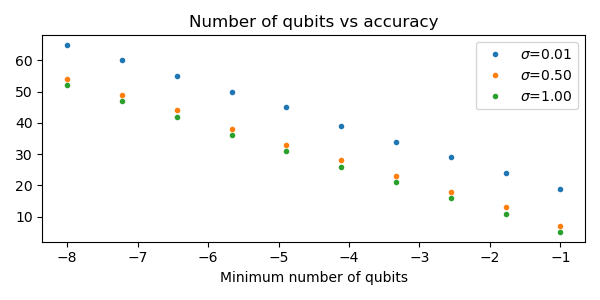
Figure 1: Minimal number of required qubits as a function of target accuracy for the Gaussian density; demonstrates the fundamental μ2 scaling.
The main result in the noisy regime (Theorem 3.8), for QNNs subjected to general quantum noise channels μ3, μ4, states:
μ5
where μ6 is the noisy QNN output, μ7 is the worst-case fidelity between noise-perturbed and ideal states, and μ8 bounds the output range. In the explicit case of depolarizing noise, the QNN output reduces to a convex combination of the ideal QNN and a bias term computable from hardware parameters (gate infidelities, decoherence times, etc.).
Explicit Error Contributions in the NISQ Environment
For depolarizing noise rates μ9 (state prep) and L0 (unitary), the noisy QNN output is analytically shown to be
L1
with fidelity factor L2. The resulting total squared error comprises three distinct terms:
Statistical: L3 -- decays as L4, but is diminished by hardware fidelity;
Systematic: L5 -- reflects the irreducible loss due to noise;
Offset: L6 -- a hardware-dependent bias.
Readout (classical bit-flip) errors of probability L7 are incorporated by convolving the output with a confusion matrix; their worst-case effect enters as an additional L8 additive error in the total bound.
Detailed derivation of the effective L9, f0 for realistic backends (IBM Heron, Quantinuum H2, Rigetti Cepheus) is presented by explicitly relating the hardware calibration parameters (single- and two-qubit gate errors, f1, f2, gate durations, etc.) to error rates.
Numerical Experiments: Validation and Practical Regime Assessment
The theoretical bounds are validated empirically via comprehensive experiments on both simulators and actual hardware.
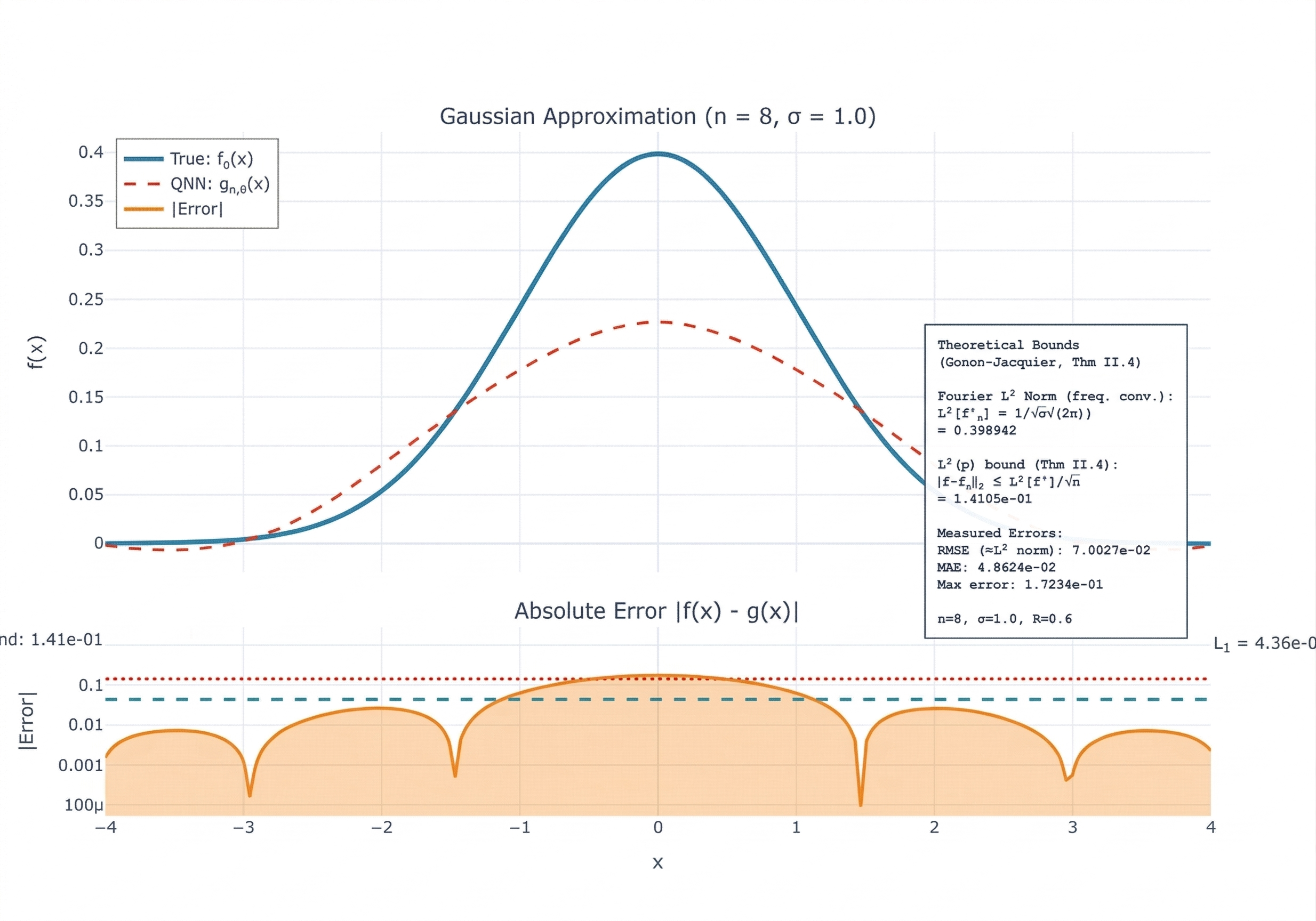
For target functions (e.g., the one-dimensional Gaussian), the QNN achieves RMSE below the theoretical f3 Fourier bound across a wide range of f4 and f5 (standard deviation).
Figure 2: Comparison of QNN approximation to true Gaussian density and pointwise error (log scale); empirical errors tightly bounded by theory.
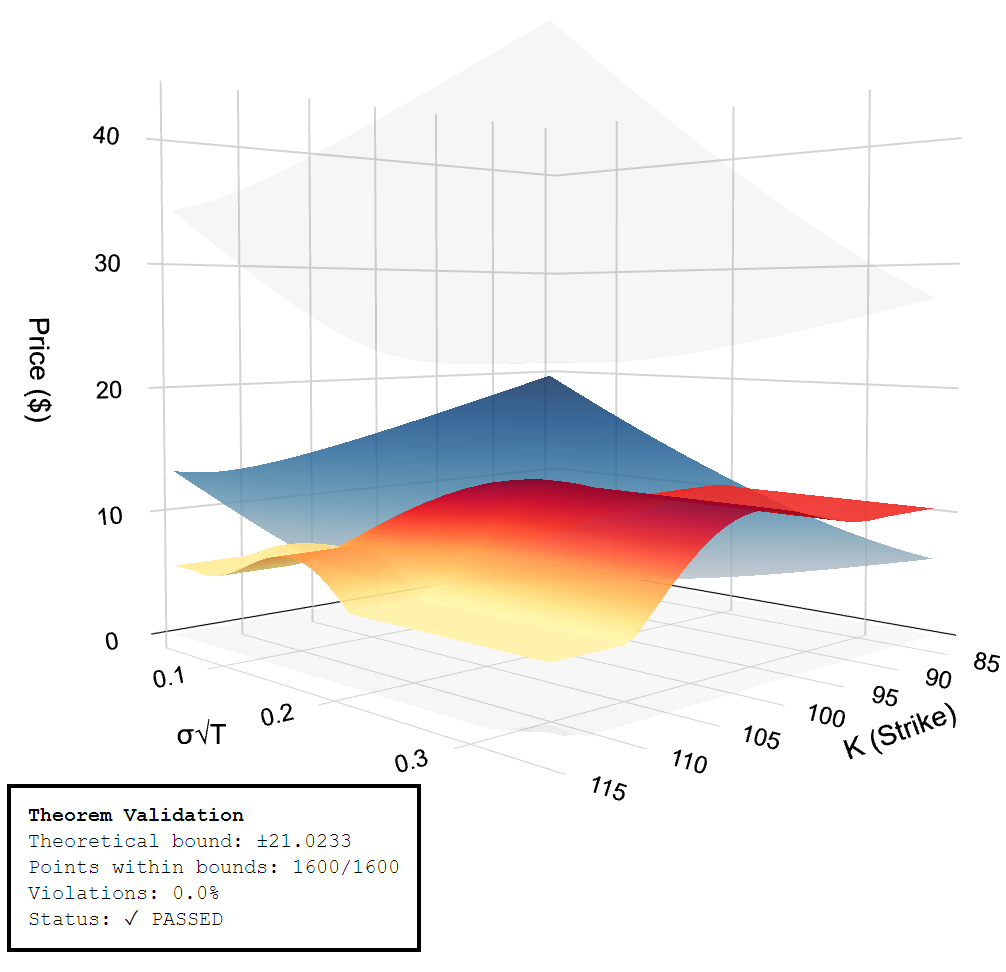
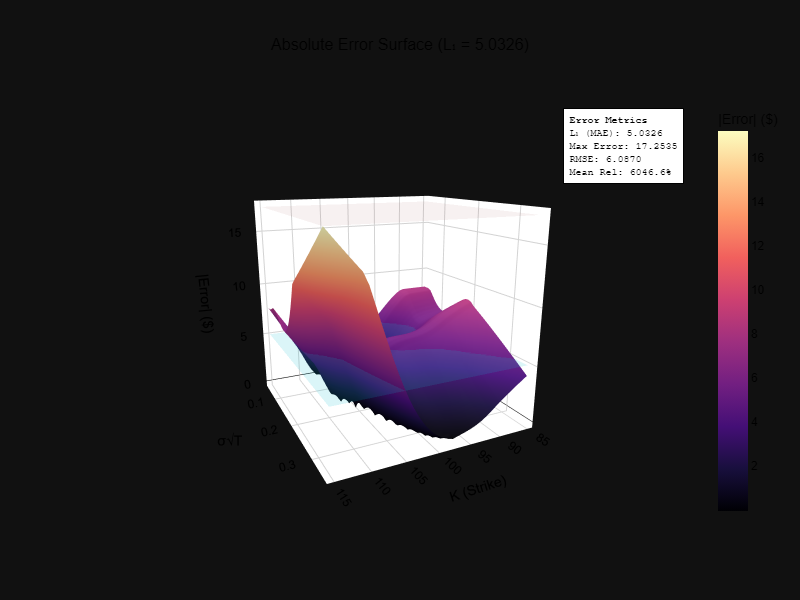
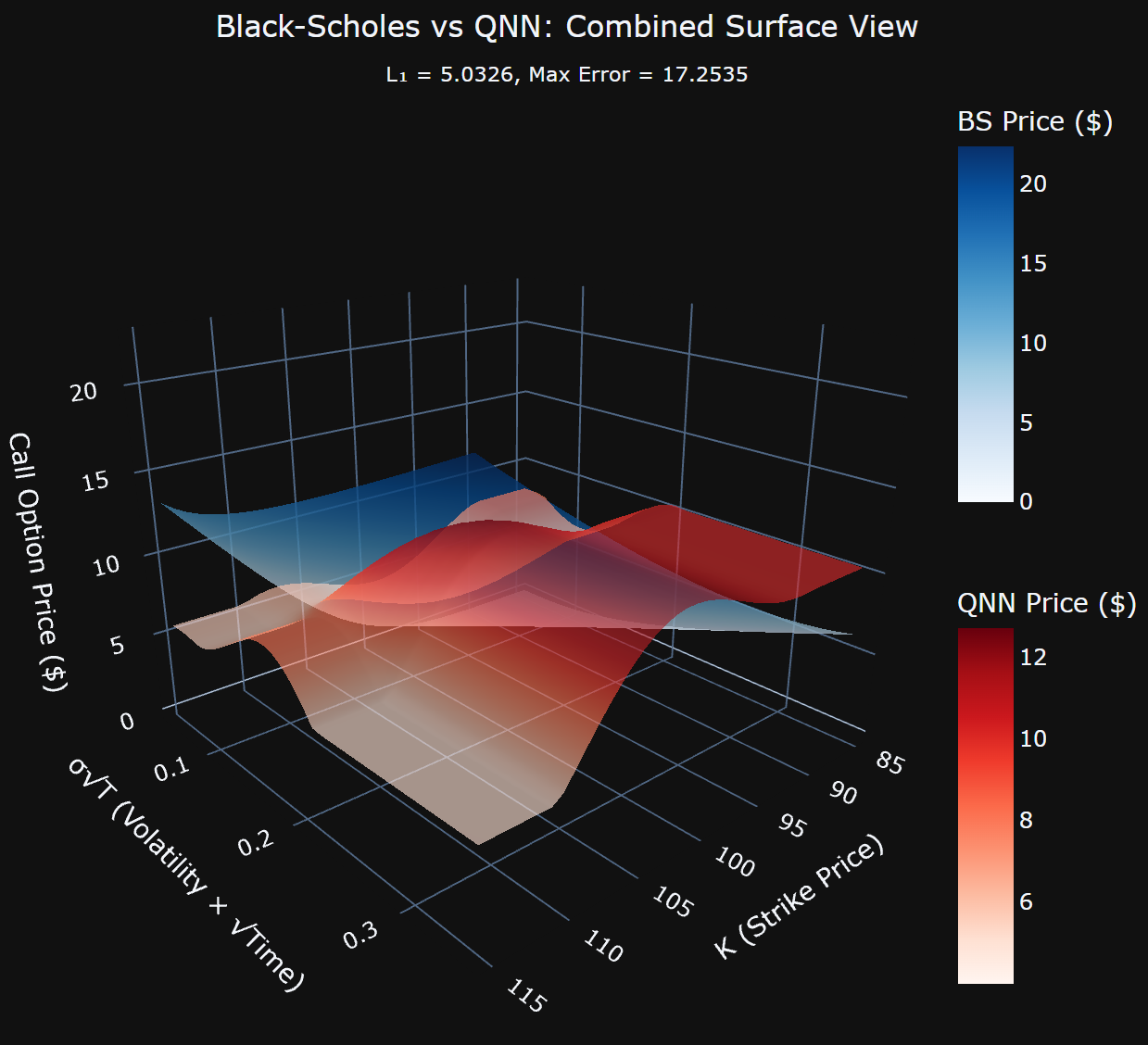
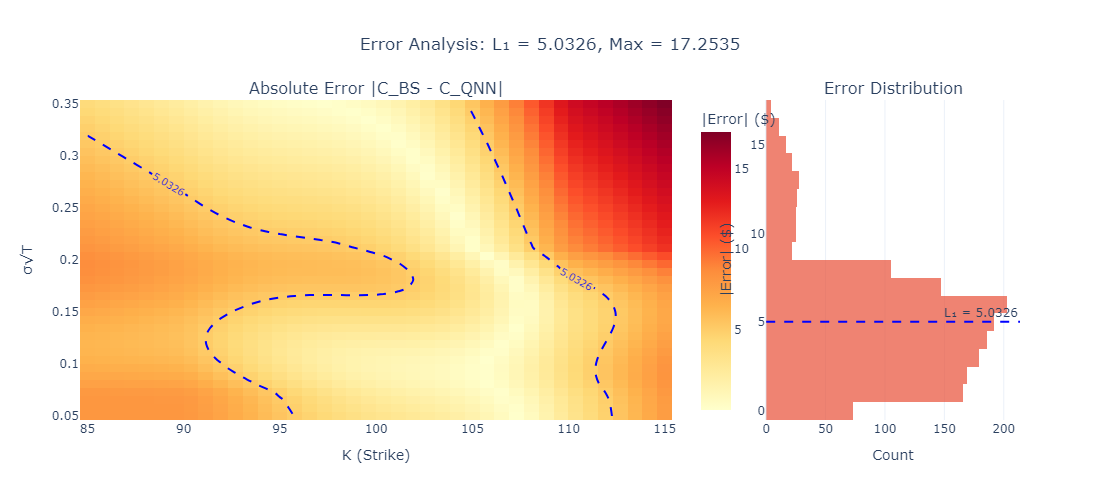
In high-dimensional finance tasks (e.g., 5d Black-Scholes Put pricing), the QNN converges (in the noiseless case) to the classical option price with precise control by the f6 rate and explicit constants.
Figure 3: True Black-Scholes price surface and theoretical error envelope, illustrating that empirical errors remain well below the rigorous bound.
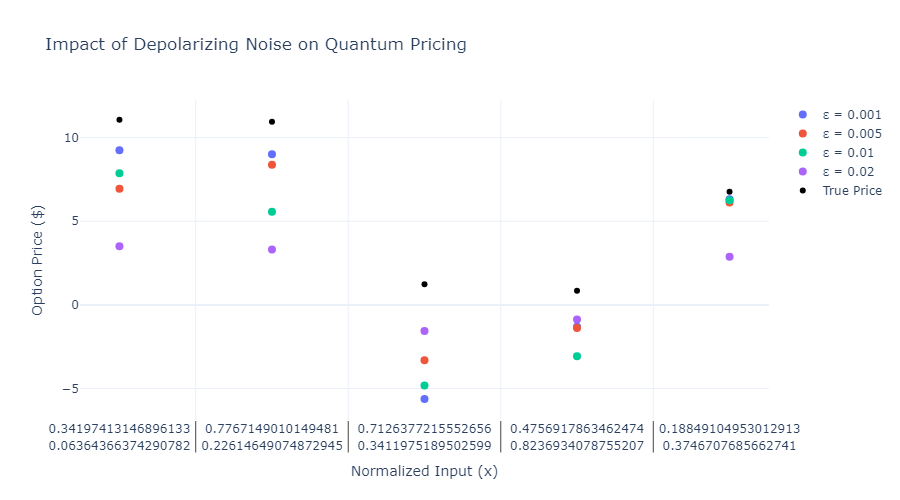
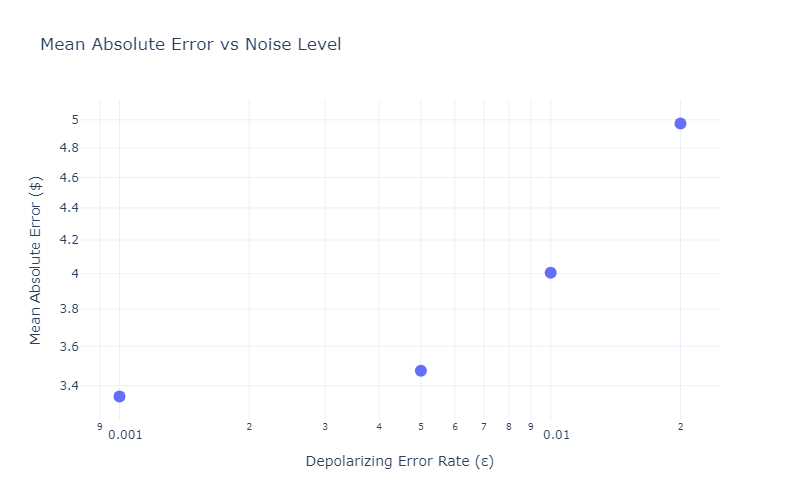
Under simulated and real depolarizing noise, the quantitative contraction and bias predicted by the theory is exactly matched, with approximation error decomposing as predicted into statistical, systematic, and bias contributions.
Figure 4: QNN output distribution under increasing depolarizing noise; output contracts towards bias as given by the analytical formula for f7.
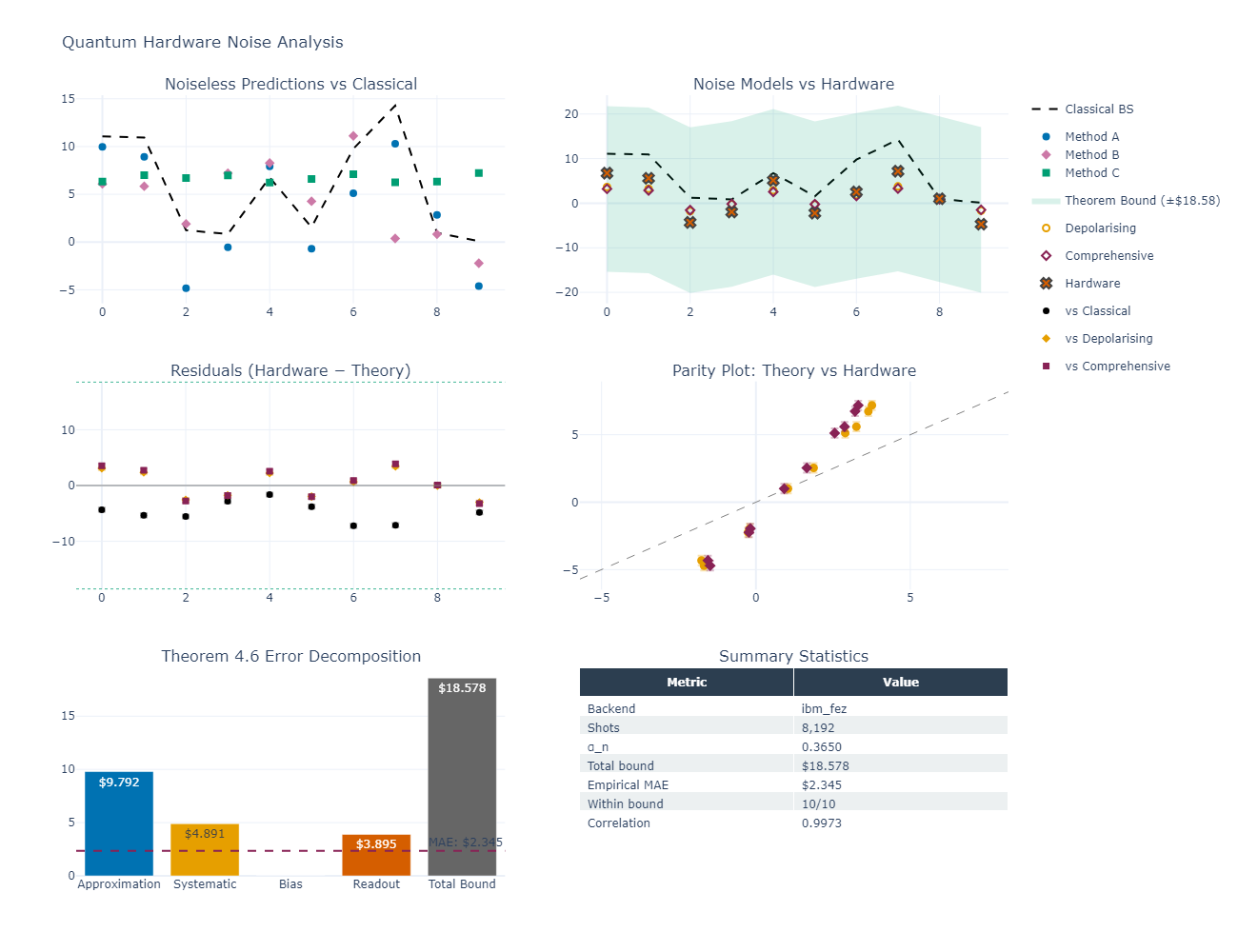
Full-stack demonstrations on IBM Heron hardware (ibm_fez) reveal the dominant error terms, showing that at current NISQ noise rates, the systematic (irreducible) component prevails, but QNN accuracy remains within theoretical total error bounds in all observed cases.
Figure 5: Experimental results from actual hardware runs (ibm_fez); empirical MAE and error distribution match theoretical prediction, separating contributions from statistical, systematic, bias, and readout error.
Implications and Outlook
This work delivers the first non-asymptotic, hardware-parameterized universal approximation theorems for QNNs under realistic noise, linking hardware error rates directly to representational power and approximation capability. The results clarify:
The achievable expressivity of QNNs in the NISQ regime for expectation-valued target functions, including explicit application to Lévy models and Black-Scholes option pricing.
The explicit trade-offs between circuit depth, qubit number, target error, and hardware noise rates, which place practical limits on function class, achievable error, and resource scaling.
The capacity to “de-bias” QNN outputs through postprocessing regression layers, provided proper calibration and noise characterization is available.
The alignment of rigorous bounds with empirical performance, supporting trust in QNN-based approaches on near-term hardware for problems admitting expectation-based formulations.
Conclusion
The quantitative bounds and rigorous error decompositions advanced in this work form a foundation for practical deployment of QNNs in noisy quantum environments, especially for high-dimensional, expectation-valued tasks typical in applied probability and quantitative finance. Explicit connection to hardware parameters fundamentally informs architectural and algorithmic choices in future QNN design and deployment, for both simulation and real hardware contexts. Extensions to more general noise models and broader function classes are natural future directions, as quantum hardware matures and QNNs are applied to increasingly complex real-world problems.