- The paper introduces a novel diffusion-based generative distillation process that refines local features for robust semantic recovery.
- It employs a two-stage approach with progressive denoising and adaptive gated fusion to mitigate sensor and communication corruptions.
- Experiments on OPV2V and DAIR-V2X benchmarks demonstrate superior 3D AP and resilience under severe corruption scenarios.
Diff-KD: Diffusion-based Knowledge Distillation for Robust Collaborative Perception
Introduction
Collaborative perception among multiple autonomous agents has established itself as a fundamental paradigm for extending the perceptual range and reliability beyond single-agent limitations. However, practical deployment exposes such systems to multifaceted sensor and communication corruptions, severely undermining consistency and safety. Conventional collaborative perception methods either rely on prior robust fusion strategies or employ teacher-student frameworks that passively mimic the teacher output, lacking mechanisms for active semantic recovery. The Diff-KD framework addresses this shortcoming by formulating knowledge transfer as an active generative feature restoration task, leveraging diffusion models to refine local representations prior to collaborative fusion, and proposing a fusion module responsive to input uncertainty.
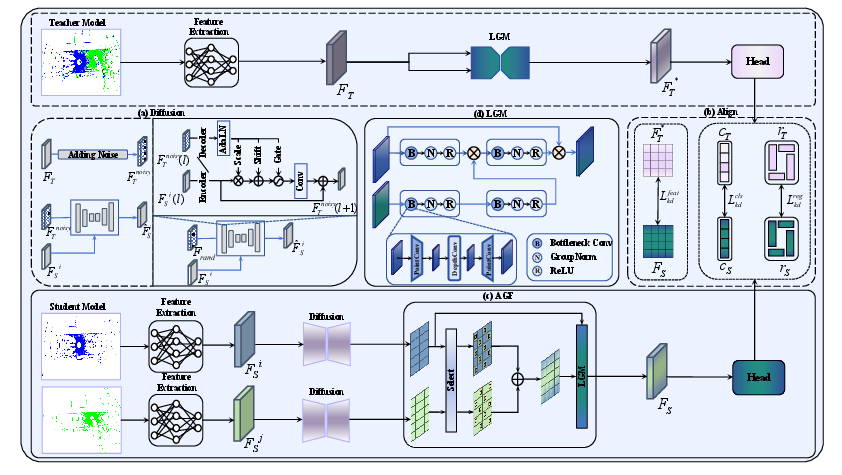
Figure 1: Overall pipeline of Diff-KD, showing diffusion-based feature restoration, progressive alignment, and adaptive gated fusion in the teacher-student framework.
Methodology
Progressive Knowledge Distillation via Diffusion-based Feature Restoration
Diff-KD reformulates knowledge distillation as a two-stage process: (1) generative pre-fusion denoising, and (2) post-fusion alignment. For each agent, the local Bird's Eye View (BEV) feature is refined by a conditional diffusion model. The teacher's global BEV feature, derived from holistically fused point clouds, serves as the clean target. During training, noise is injected into the teacher feature, and a denoising network—conditioned on the noisy local agent feature—learns to recover the global clean semantics. Conditioning is implemented via Conditional Adaptive Modulation (CAM), integrating information at each hierarchy layer via dynamic scale, shift, and gate modulation.
At inference, only the student model is active, and the diffusion module operates as a generative optimizer that synthesizes robust features directly from the local corrupted observation. This generative pre-fusion strategy is fundamentally distinct from classical direct distillation protocols, supporting more robust semantic completion and denoising.
Adaptive Gated Fusion for Multi-Agent Aggregation
To aggregate refined local features, Diff-KD employs Adaptive Gated Fusion (AGF), which computes agent- and pixel-wise importance weights through a lightweight convolutional network. Importantly, AGF preserves ego-centric dominance while modulating collaborative information via spatial-channel gating. A lightweight gated modulation block (LGM), also present in the teacher, provides fine-grained, low-complexity feature fusion by combining spatial group normalization and depthwise separable convolutions. This mechanism allows selective transmission of collaborative context, suppressing artifacts that can arise from diffusion-based generative restoration, especially under strong input corruptions.
Experimental Results
A comprehensive evaluation is performed on the OPV2V and DAIR-V2X benchmarks, each augmented with seven physically realistic sensor corruption types. Diff-KD is trained solely on clean data and evaluated without fine-tuning on corrupted inputs, setting a rigorous protocol for robustness assessment. The main metric is 3D AP at IoU thresholds 0.5 and 0.7; robustness is further quantified by the mean Relative Calibration Error (mRCE).
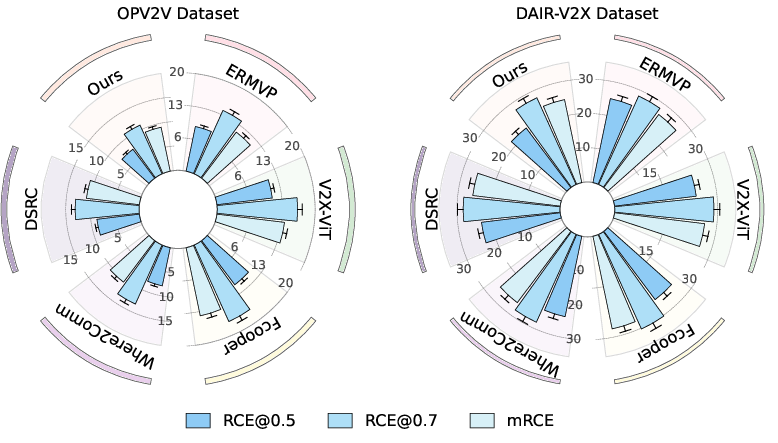
Figure 2: mRCE comparison highlights Diff-KD’s minimum performance drop under corruption across OPV2V and DAIR-V2X.
Diff-KD reports superior AP under both clean and all corrupted regimes—for example, on OPV2V ([email protected]), it scores 87.81% clean and maintains 64.57–87.67% across corruptions, a marked gain over prior works. On DAIR-V2X, it achieves the highest scores in every tested scenario, reflecting consistent resilience to real-world variabilities.
Robustness to Pose and Sensor Corruptions
Pose perturbations are simulated by injecting Gaussian noise into both localization and heading of all collaborating agents. As the noise variance escalates, all methods' performance deteriorates, but Diff-KD’s accuracy remains systematically higher and exhibits the slowest decay rate. At high noise (std=0.4), Diff-KD outperforms the next best approach by over 6 AP points on OPV2V.
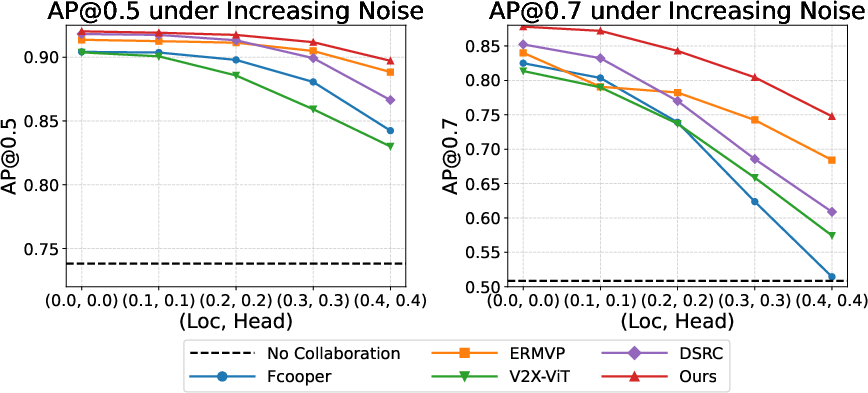
Figure 3: Detection accuracy remains robust for Diff-KD under severe pose noise; performance drop is notably smaller compared to baselines.
Qualitative Results
Prediction visualizations under multiple corruptions (echo, motion blur, cross talk) show that Diff-KD produces more spatially complete and accurate 3D bounding boxes relative to both non-collaborative and prior collaborative perception systems.
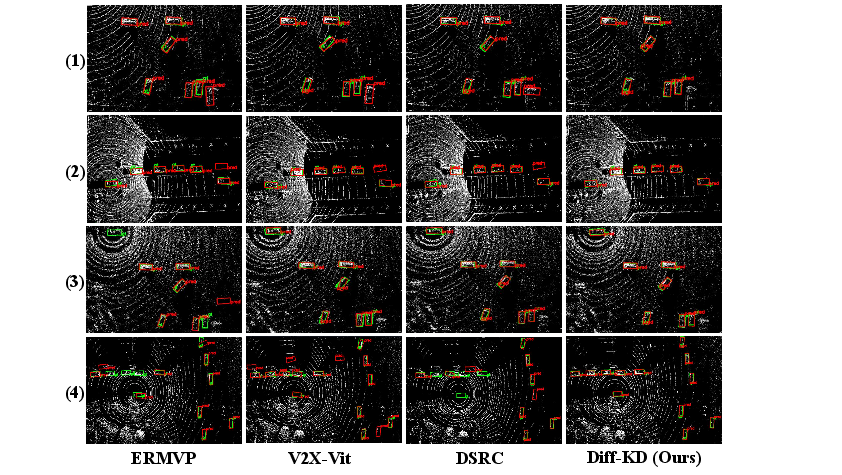
Figure 4: Under varied sensor corruptions, Diff-KD yields cleaner, more complete detections (red), maintaining alignment with ground-truth (green) across conditions.
Ablation Study
Component-wise analysis on DAIR-V2X confirms that: (i) The integration of LGM in the teacher augments the expressiveness of target features; (ii) PKD alone improves semantic consistency; (iii) AGF alone elevates robustness by controlling inter-agent context injection; and (iv) both modules together yield the highest AP, with the student surpassing the (static) teacher, highlighting the efficacy of generative distillation and dynamic fusion.
Implications and Future Directions
Diff-KD grounds collaborative perception in generative paradigms rather than static feature mimicry, enabling dynamic adaptation to input corruptions and unobserved noise distributions. This shift has multi-fold implications:
- Practical Reliability: Robust performance without retraining or fine-tuning under unforeseen real-world scenes directly advances the deployment of safety-critical autonomous systems in uncontrolled or degraded sensing environments.
- Model Generalization: By casting knowledge transfer as a conditional generative transformation, Diff-KD opens a trajectory toward more domain-invariant multi-agent learning, potentially extensible to other multi-modal and distributed scenarios.
- Theoretical Insights: The dual-stage distillation and uncertainty-aware fusion suggest a formal grounding for generative teacher-student systems, bridging the gap between discriminative perception and generative restoration.
Anticipated future research directions include scaling to larger, heterogeneous agent sets, fine-grained decomposition of corruption types, and adapting generative distillation for federated and privacy-preserving collaborative contexts.
Conclusion
Diff-KD establishes an effective generative knowledge distillation framework for collaborative perception by uniting progressive, diffusion-based semantic recovery with adaptive, uncertainty-aware fusion. The framework sets a new standard for robustness in autonomous sensing, validating that active feature restoration mechanisms are critical for resilient multi-agent systems under real-world corruptions. The empirical evidence substantiates both the theoretical motivation and practical utility of diffusion-based distillation in collaborative perception architectures.

