- The paper's main contribution is the development of a high-threshold JIT decoder for non-Pauli codes that enables universal 2D quantum fault tolerance.
- It employs a path-integral and cohomological formalism to manage correlated 'twisted' errors, crucially linking X and Z error corrections.
- Monte Carlo simulations reveal near-toric code thresholds (≈2.5%), underscoring the practicality of real-time correction in non-Clifford circuit architectures.
High-Threshold Decoding in Non-Pauli Codes for 2D Fault-Tolerant Universality
Introduction and Context
The paper "High-threshold decoding of non-Pauli codes for 2D universality" (2604.02033) addresses the central challenge of integrating non-Clifford gates into planar, low-overhead, 2D topological quantum error-correcting codes (QECCs). While topological codes such as surface and toric codes provide robust fault-tolerance with efficient decoding for Clifford gates, implementing a universal gate set has necessitated costly magic-state distillation or higher-dimensional constructions. This work focuses on a non-Pauli stabilizer code capable of realising universal 2D quantum computation without distillation, using only strictly 2D layouts. The focus is on rigorous analysis of decoding procedures—especially for the non-Clifford (non-Pauli) phases—and the realistic performance parameters they enable.
Non-Pauli Stabilizer Codes and Twisted Quantum Double Circuits
The key object of study is a twisted quantum double (TQD) code, which departs from the usual Pauli-only stabilizer framework. In the TQD, each edge of the underlying square lattice carries three physical qubits (one for each "color"), and the stabilizer generators are both Pauli and non-Pauli (Clifford) operators. Particularly, vertex stabilizers include multi-qubit CZ terms in addition to local X operations, resulting in a non-commuting stabilizer group.
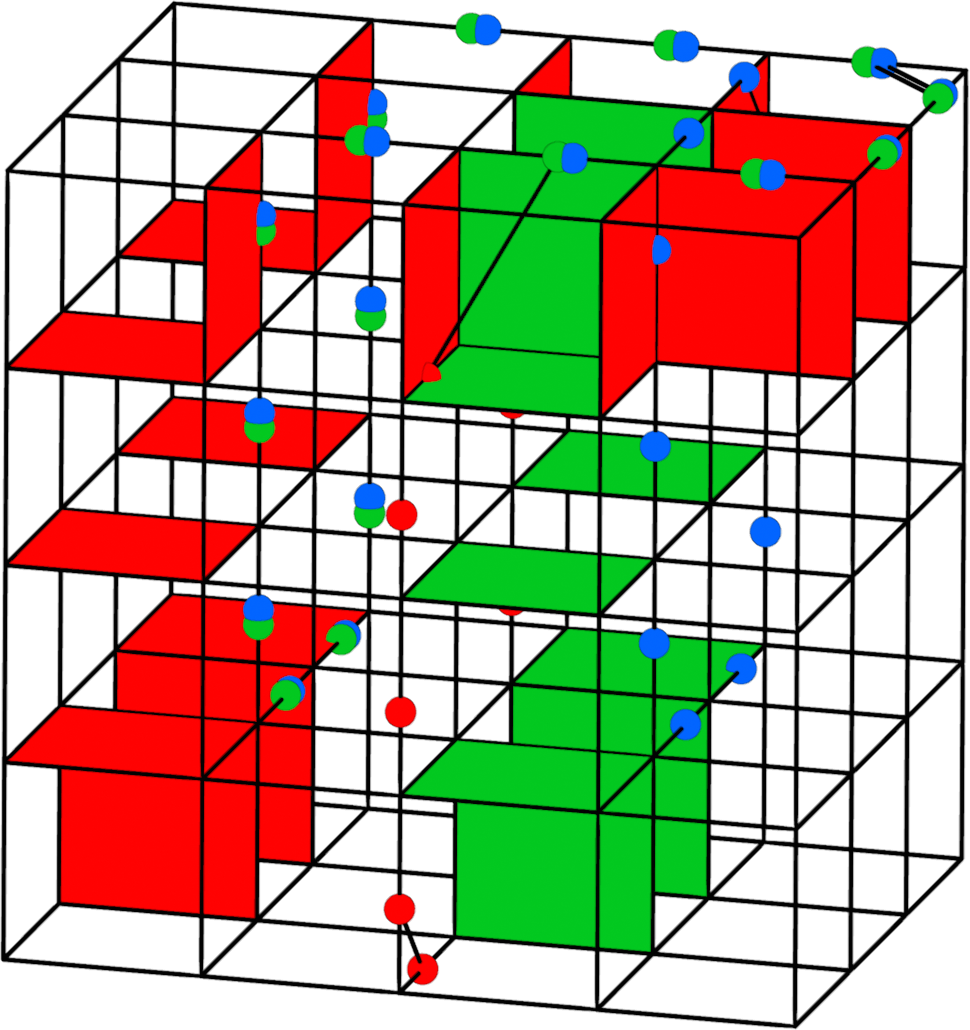
Figure 1: An illustration of "twisted errors" in the flux configuration b for the TQD circuit, showing how correlated errors arise near fluxes and affect the decoding problem.
Within this framework, the measurement circuit repeatedly extracts syndromes of non-commuting stabilizers. The non-commuting property prevents deferring Pauli corrections to the end of the circuit, as is standard for Clifford circuits, and requires that X-type corrections be applied "just-in-time" (JIT), based on only the available, potentially noisy, syndrome record. A phenomenological noise model is adopted, with i.i.d. X and Z errors as well as measurement errors.
This physical architecture is motivated by recent progress in directly realizing non-Clifford gates (e.g., T, CCZ) on 2D codes by software mapping into non-Pauli "twisted" code spaces. These constructions generically induce correlated errors—"twisted errors"—whose structure and propagation through syndrome circuits fundamentally alter the decoding task.
Decoding Structure and Constraints
The authors employ a path-integral and cohomological formalism to systematically characterize constraints and equivalences on error chains in the space-time lattice, generalizing classical arguments for Pauli stabilizer codes. For the TQD code, the main technical observation is that the X and Z error decoding tasks are nonlocally and nonlinearly coupled by the circuit. In addition to the standard decoding graph, one must track configurations of "twisted" errors, which intervene as effective erasures or correlated high-weight errors near the support of fluxes.
The decoding problem thus bifurcates: first, X0 errors are corrected on the fly by a JIT decoder, aiming to avoid the formation of noncontractible error chains. Second, X1 errors are globally decoded, but with a syndrome graph and error equivalence structure that is "twisted"—i.e., dynamically altered—by the X2 error configuration. The authors explicitly characterize how this constraint lowering and the introduction of correlated error paths impact code distance and error floor, and show that naive treatment leads to a threshold substantially below that achievable for standard codes.
A central result is the construction of an efficient JIT matching decoder, which operates optimally under the limitations of partial syndrome access and local correction. The decoder is derived from known minimum-weight matching routines, with careful partitioning of timelike and spacelike edges to support correction "windows." The algorithm proceeds by:
- Computing a minimum-weight global error estimate based on the accessible syndrome,
- Merging previous corrections with new candidates via local matching in the current commit region,
- Iteratively shrinking residual syndrome endpoints to maintain topological triviality.
By leveraging maximum syndrome information at each step, the decoder achieves near-optimal performance for this constrained online decoding task.
Thresholds and Scaling Behavior
Extensive Monte Carlo simulations are performed using the cohomological decoding graph, simulating up to X3 system sizes. The logical error rate X4 is measured as a function of the physical error rate X5. Results reveal that the JIT decoder achieves a fault-tolerance threshold of X6—remarkably close to the X7 global matching threshold for the corresponding toric code under the same noise model. Below threshold, logical error rates are found to suppress exponentially in both X8 and system size X9, consistent with the expected scaling of fully topological codes.
The introduction of non-Clifford elements and the need for a second, global b0-decoding step reduces the b1-error threshold to b2 for a naive decoder. However, if one incorporates knowledge of the b3 corrections and partially heralded "twisted" errors, the b4-threshold can be improved to b5, again approaching the toric code's threshold. These results demonstrate that, with proper decoder design, the penalty for non-Pauli circuits is modest and universality can be achieved without severely sacrificing performance.
Practical and Theoretical Implications
These findings have substantial implications for architectural design in large-scale, low-overhead, 2D fault-tolerant quantum computation:
- Direct 2D Implementation of Universal Gates: Non-Clifford logic in 2D codes can achieve thresholds within striking range of top-performing 2D quantum memories, weakening the case for costly distillation and higher-dimensional approaches.
- Decoder Efficiency: Sophisticated online (JIT) decoders can approach the performance of idealized global (offline) decoders even under partial syndrome access. Efficient, scalable decoder implementations are critical for experimental realization.
- Error Modeling: The non-Pauli stabilization formalism and categorization of "twisted" errors provide a template for the analysis and simulation of a broad class of non-Pauli, non-Clifford QEC circuits, including those enriched by b6, b7, and b8 gates and their spacetime analogs.
On the theoretical side, this work generalizes the path-integral/cellular cohomology description of decoding graphs to accommodate dynamic syndrome constraints, correlated error formation, and time-local correction protocols—features inevitable in any practical realization of non-Clifford stabilizer codes.
Outlook and Future Research Directions
The groundwork laid here opens immediate paths for future investigation:
- Extension to Non-CSS Codes: The cohomological formalism and decoder architecture can be generalized to a wider class of stabilizer codes, including non-CSS and non-Abelian constructions.
- Architectural Integration: Practical integration with superconducting, ion trap, or neutral atom hardware will require further engineering of JIT decoding hardware and interfaces between Pauli and non-Pauli code regions.
- Adaptive/Neural Decoders: Machine learning or neural decoders tuned to the complex correlated error landscape may provide incremental performance gains.
- Analytical Thresholds for Realistic Noise Models: Assessing the persistence of high thresholds under more realistic circuit-level and spatially correlated error models remains an important open question.
Conclusion
This work rigorously demonstrates that high-threshold universal fault-tolerant computation is achievable in strictly 2D layouts using non-Pauli codes, provided that decoders are appropriately designed to handle temporally local corrections and syndrome-dependent error propagation. The theoretical construction and numerical evidence converge to strengthen the viability of non-distillation-based, scalable universal quantum computation in topologically protected 2D systems.