- The paper introduces a DP-tails fairness framework that enforces fairness only in the extreme predictions of regression models.
- It leverages optimal transport theory to adjust conditional quantiles via thresholding and averaging, achieving localized fairness.
- Empirical results on synthetic and real data demonstrate that the method balances risk and fairness with moderate calibration samples.
Demographic Parity Tails in Regression: Optimal Transport-Based Fairness Localization
Problem Motivation and Framework
The paper "Demographic Parity Tails for Regression" (2604.02017) proposes a framework for enforcing Demographic Parity (DP) fairness specifically in the tails of prediction distributions in regression models. Classical DP requires prediction independence from sensitive attributes across the entire distribution, often causing detrimental effects on predictive accuracy. However, many real-world scenarios—such as high-risk medical triage or resource assignment—prioritize fairness only among individuals with extreme (tail) predictions, e.g., those above a risk threshold.
The authors formalize (α,p)-DP-tails fairness: for a threshold α and proportion p, predictions above α across groups must exhibit identical conditional cumulative distributions, and the fraction p of predictions below α is fixed for each group. The problem is cast in the regression context as finding a function g minimizing mean squared risk, subject to (α,p)-DP-tails constraints.
Optimal Solution Characterization via Optimal Transport
Building on recent advances in regression fairness via Wasserstein barycenter methods, the authors provide a closed-form characterization of the optimal fair predictor under DP-tails constraints. The solution is inherently geometric: for each group, the conditional quantile function is altered such that below α, quantiles are thresholded; above α, quantiles are averaged across groups. The formal solution for the optimal quantile mapping α0 is:
- For α1 in α2: α3
- For α4 in α5: α6
where α7 is the quantile function for group α8 and α9 is group proportion.
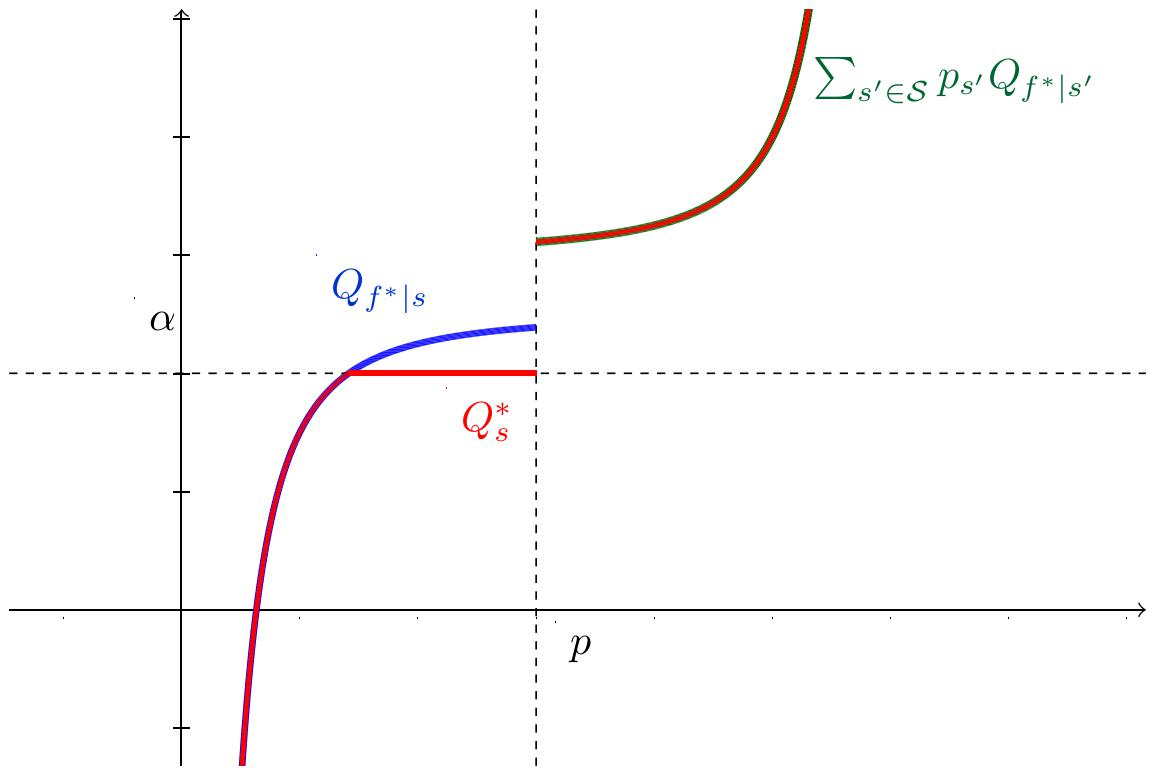
Figure 1: Illustration of p0 for a group p1, showing the thresholding and averaging behavior in the DP-tails solution.
The existence of an optimal solution depends on the relationship between the threshold p2 and the averaged group quantile at p3. If p4, a minimizer exists; otherwise, only approximate minimizers (with small perturbations p5) are attainable.
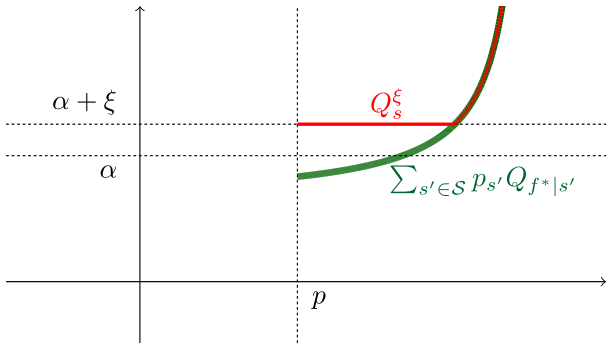
Figure 2: Illustration of p6, depicting the p7-optimal quantile solution used when the threshold constraint cannot be perfectly satisfied.
Data-Driven Post-Processing Algorithm
The practical algorithm is a post-processing step that applies the derived quantile and CDF mappings to a pre-trained (potentially unfair) regression model. Calibration relies on both labeled and unlabeled data: the base predictor is trained on labeled data, while group-wise quantiles and CDFs are estimated using the unlabeled pool. Jittering is introduced for regularity. The flexibility allows deployment where labels are scarce but covariates and sensitive attributes are accessible.
Theoretical Guarantees
Rigorous distribution-free guarantees support the approach. The DP-tails unfairness is controlled via empirical process bounds, decaying with the square root of the calibration sample size. For prediction risk, under standard density and regularity assumptions, excess risk of the DP-tails estimator is upper-bounded by terms depending on: (i) the estimation quality of the base regressor, and (ii) the quantile/CDF estimation error, both scaling optimally in sample size. The algorithm's risk approaches that of the unfair Bayes predictor as the fairness region shrinks to the tails.
Empirical Validation: Synthetic and Real-World Data
Extensive experiments demonstrate the approach on both synthetic and real data (Law School, CRIME, California Housing datasets), using Random Forests as base predictors.
Key findings:
- Enforcing DP-tails fairness results in localized adjustment: group CDFs become indistinguishable in the tail, while the rest of the distribution retains predictive accuracy.
- The method provides a continuum between full unfairness and global DP enforcement: as p8 is decreased, the risk increases and global unfairness declines (measured via Kolmogorov-Smirnov).
- Calibration requires only moderate unlabeled sample sizes to reach low tail unfairness.
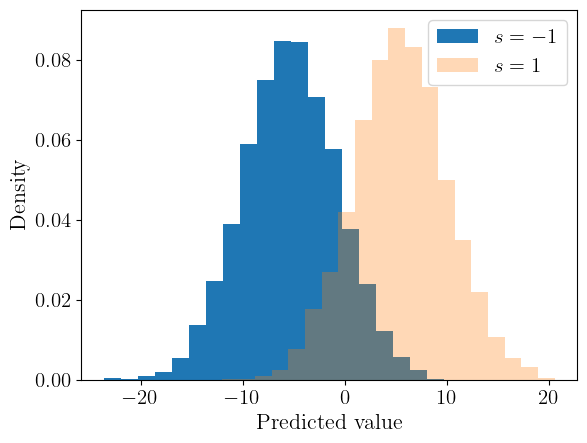
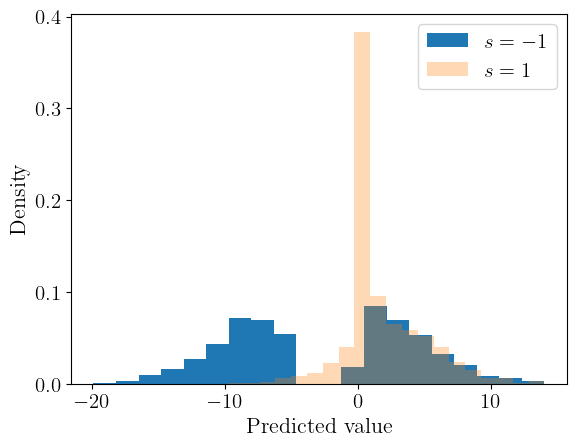
Figure 3: Histograms illustrating prediction distributions before (left) and after (right) enforcing p9-DP-tails fairness, showing redistribution mainly in the tail region.
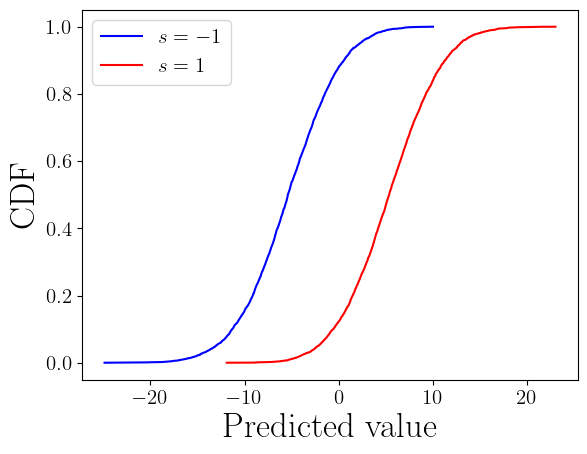
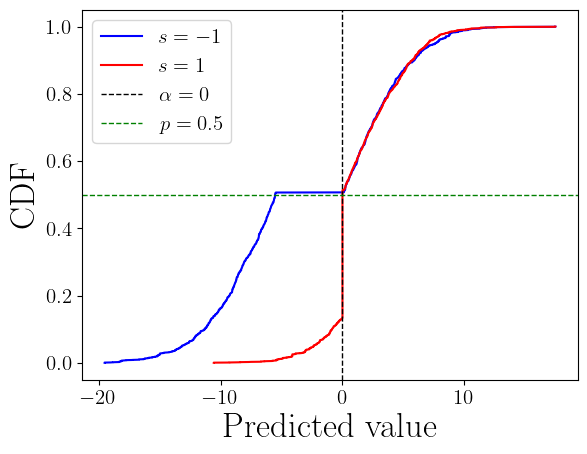
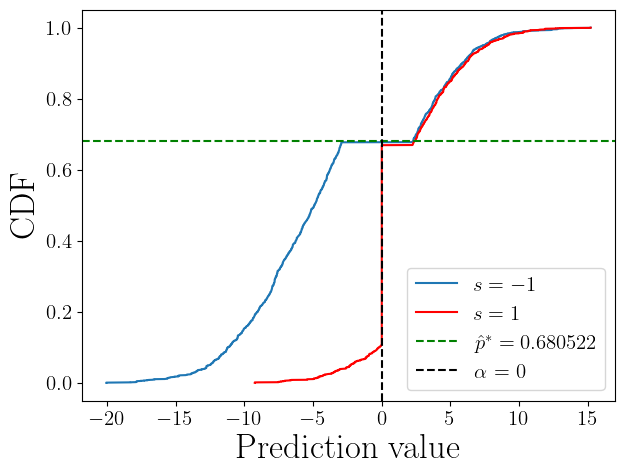
Figure 4: Empirical CDFs of predictions before and after DP-tails enforcement on synthetic data, with CDFs matching past the threshold α0.
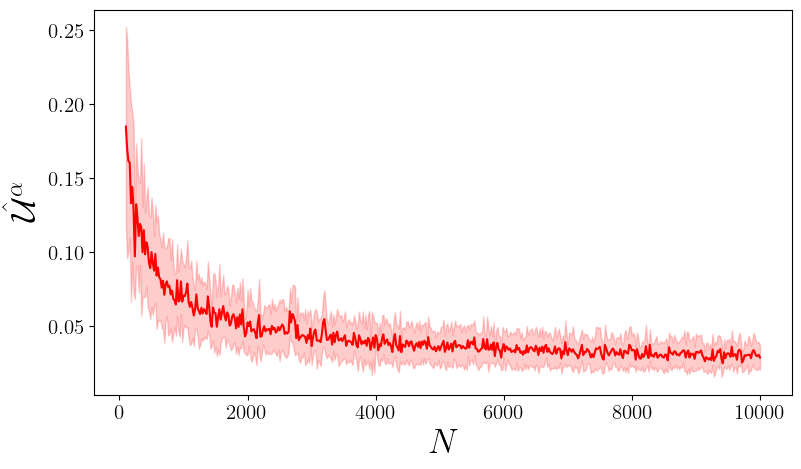
Figure 5: Evolution of tail unfairness with increasing unlabeled calibration set size; diminishes rapidly with sample size.
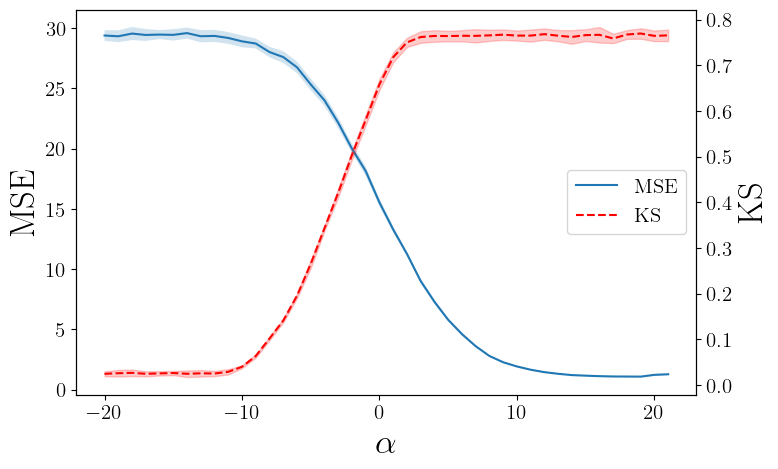
Figure 6: MSE and KS-distance profiles as a function of α1 for DP-tails estimators, illustrating risk-unfairness trade-off.
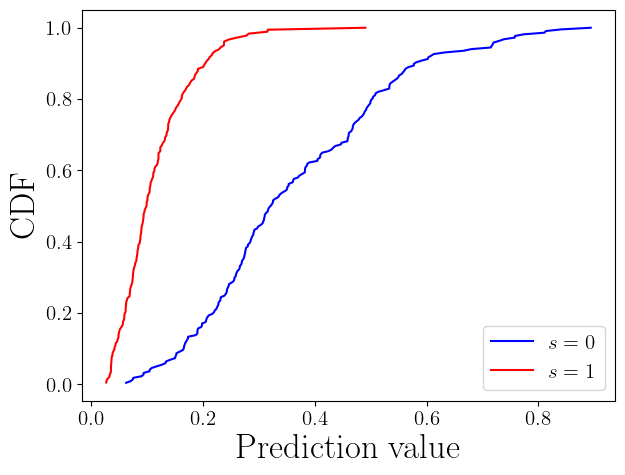
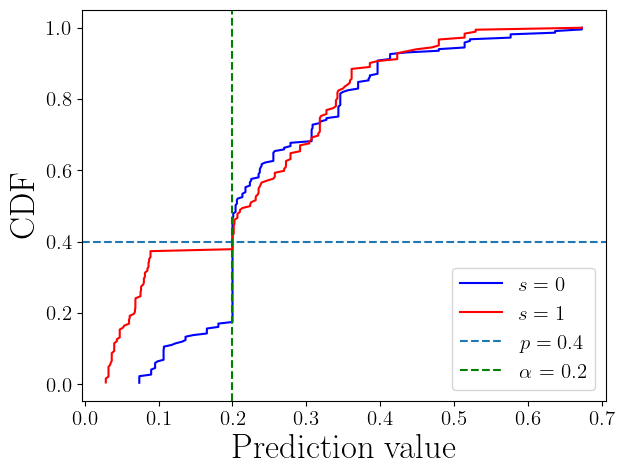
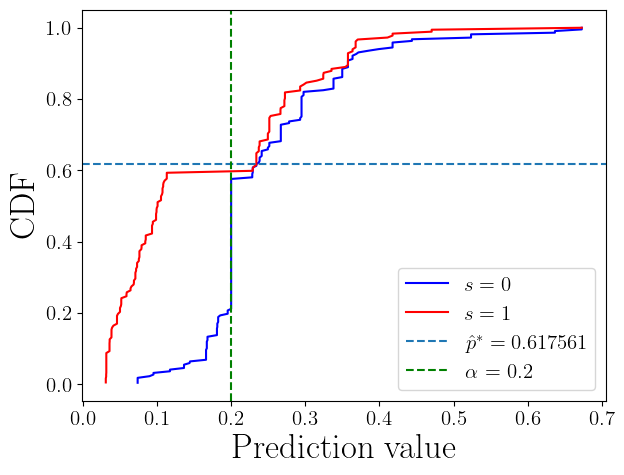
Figure 7: Empirical CDFs for CRIME dataset predictions, before/after DP-tails fairness; tail CDFs match precisely.
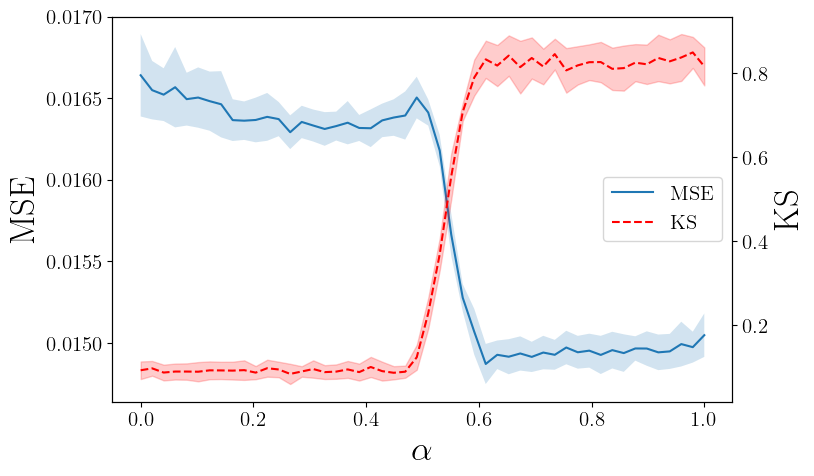
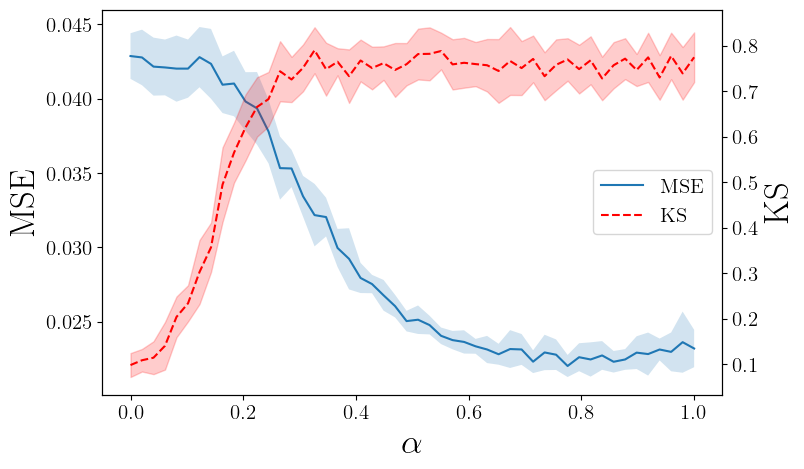
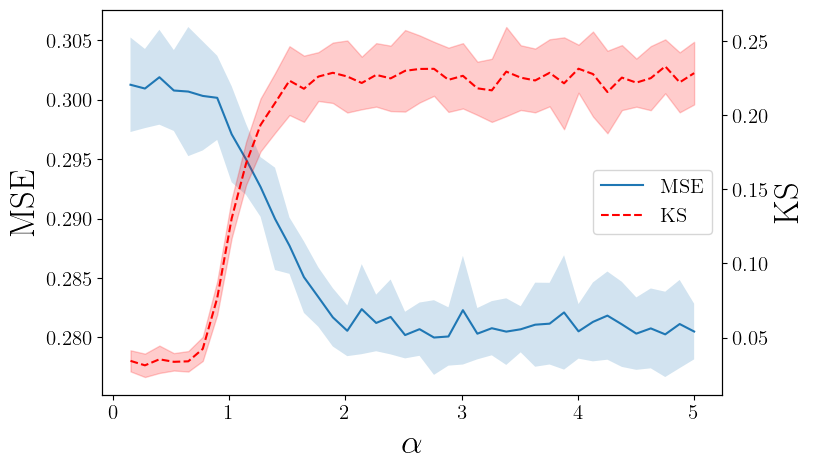
Figure 8: MSE and KS-distance evolution for DP-tails predictors across real datasets (Law School, CRIME, California Housing); local fairness leads to improved trade-offs.
Practical and Theoretical Implications
This work enables precise fairness interventions targeted to meaningful subpopulations in regression contexts. It addresses the practical necessity of fairness in high-impact tail decisions and provides a formal mechanism for controlling the trade-off between risk and fairness. The closed-form mappings and post-processing adaptability open applications to legacy models and settings with limited labels. Theoretically, the optimal transport perspective enriches analysis of partial fairness constraints and motivates further exploration of interval-based fairness or approximate constraints.
Future Directions
Potential extensions include:
- Enforcing fairness across unions of intervals (not just tails), allowing domain-specific localization.
- Relaxing to approximate DP-tails constraints, trading strict parity for practical flexibility.
- Integrating partial DP notions in sequential or adaptive decision-making contexts.
Conclusion
The paper develops a mathematically principled framework for localized regression fairness via DP-tails, leveraging optimal transport theory. The resulting algorithms offer interpretable, theoretically grounded, and empirically validated methods for tailoring fairness to critical regions of the prediction space, with quantifiable trade-offs and broad applicability in sensitive domains.