- The paper presents interactive tracking as a human-in-the-loop paradigm integrating adaptive memory with multimodal cues.
- It introduces InteractTrack, a benchmark covering diverse scenarios like surveillance, sports, UAV tracking, and wildlife monitoring.
- IMAT, the proposed model, fuses vision-language grounding with dual memory banks and cognitive arbitration to enhance target adaptation.
Interactive Visual Tracking with Memory-Augmented Human-in-the-Loop Adaptation
Introduction and Motivation
Human-in-the-loop interaction remains underexplored in visual object tracking (VOT), despite real-world tasks—such as surveillance, sports analysis, and robotics—demanding systems that not only track autonomously but also respond adaptively to evolving human intent. The paper "Interactive Tracking: A Human-in-the-Loop Paradigm with Memory-Augmented Adaptation" (2604.01974) establishes a formal framework and evaluation protocol for this task. This includes the introduction of InteractTrack, a large-scale, multimodal benchmark for interactive tracking, and the proposal of Interactive Memory-Augmented Tracking (IMAT), a baseline model that fuses visual, linguistic, and reasoning capabilities with adaptive memory.
Interactive Tracking Benchmark: InteractTrack
Conventional VOT benchmarks assume a single, static target and a fire-and-forget protocol, which does not reflect actual user requirements. InteractTrack departs from this paradigm by capturing dynamic interaction through explicit user-guided prompts that allow switching, refocusing, or recovering from drift in real-time. The dataset spans 150 videos, over 140K frames, and includes more than 700 timestamped natural language instructions annotated across six heterogenous scenarios: daily activities, sports analysis, UAV tracking, surveillance, wildlife monitoring, and other complex environments.

Figure 1: Overview of the interactive evaluation protocol distinguishing user-directed transitions, ground-truth, and tracker predictions—highlighting system responses to both correct and erroneous guidance.
This benchmark is constructed to mandate interaction at critical moments, such as occlusion, target switch, and loss recovery. The rigorous protocol assesses trackers along four primary dimensions: Perception (grounded target localization under instruction), Responsiveness (accuracy in switching targets), Tracking robustness (classical metrics such as AUC and precision), and Interactiveness (aggregate system-user collaboration effectiveness).
Representative Scenarios and Dataset Characteristics
InteractTrack offers broad coverage of context-rich, dynamic visual environments, each designed to surface unique tracking challenges:
- Daily Activities: Moderate viewpoint shifts, moderate motion, frequent contextual cues.
- Sports Analysis: Fast-moving objects, frequent occlusion, rapid user-driven focus shifts.
- UAV Tracking: Extreme scale variation, perspective changes, low-resolution targets.
- Surveillance: Dense crowds, severe occlusion, frequent attention reallocation.
- Wildlife Monitoring: Small objects, camouflaged backgrounds, object reidentification.
- Other: Industry, lab, and uncontrolled indoor settings.
Sample sequences from these scenarios elucidate the real-world complexity and the diversity of user-tracker interaction demands.
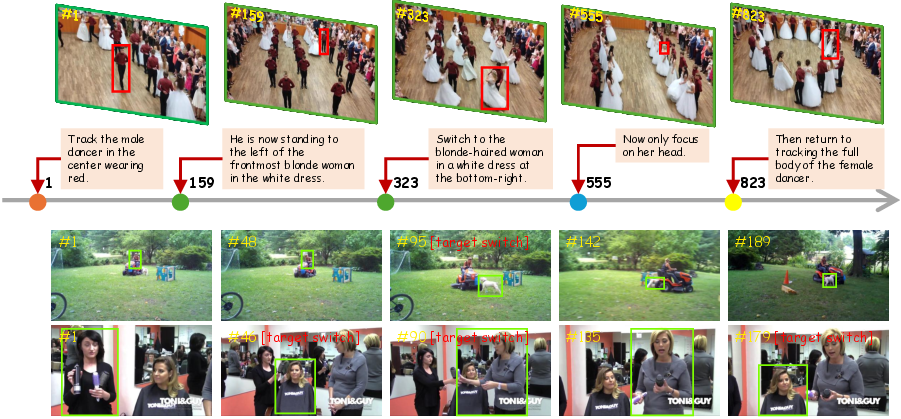
Figure 2: Example sequences from the daily activities scenario, illustrating prompt-triggered target switches under real-world conditions.
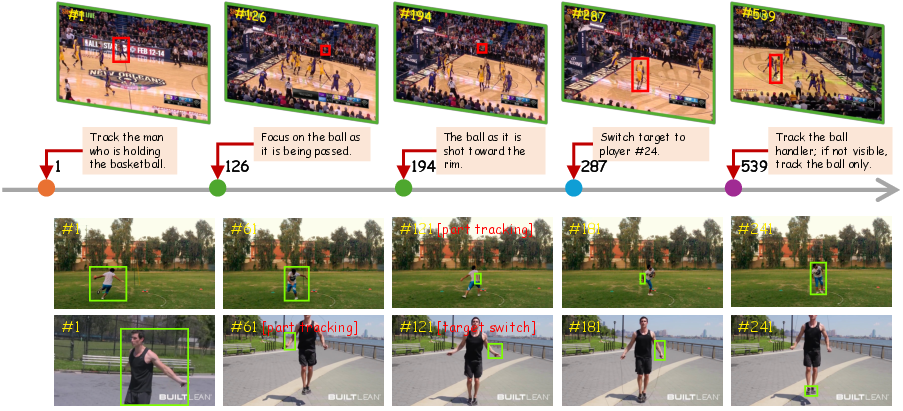
Figure 3: Qualitative examples from sports analysis showing dynamic transitions in user focus between players and the ball via sequential natural-language prompts.
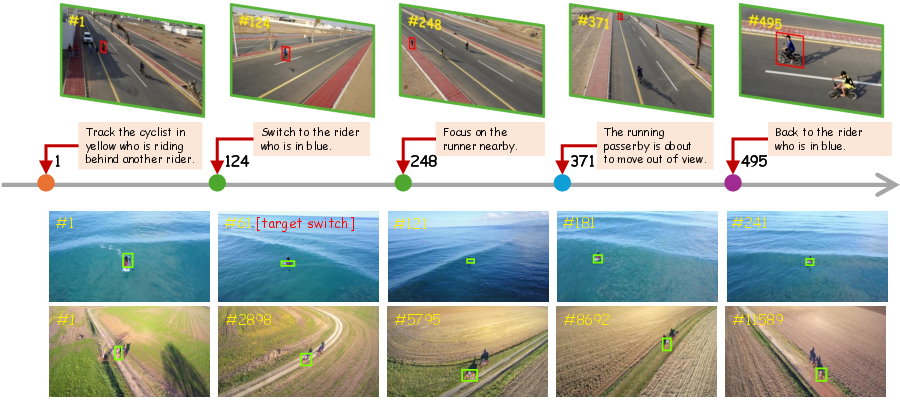
Figure 4: UAV tracking scenario visualizations exposing challenges such as scalable changes, object reentry, and transitions between multiple moving and static distractors.
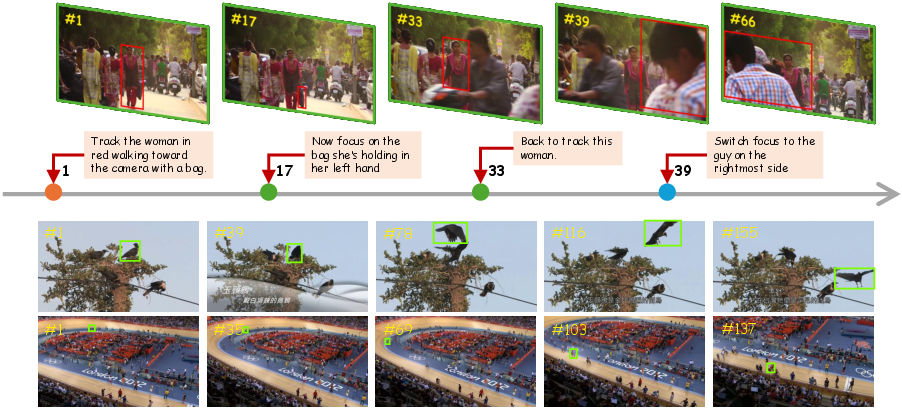
Figure 5: Surveillance environments exhibiting dense crowds, complex reinitialization, and concurrent target monitoring.
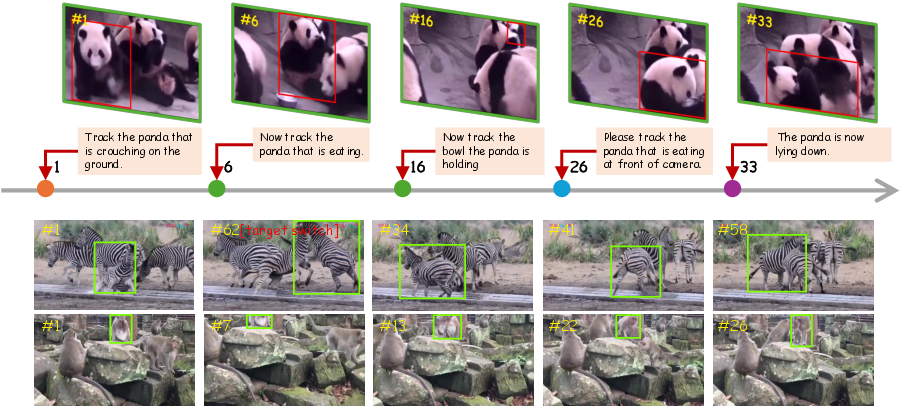
Figure 6: Wildlife monitoring sequences depicting multi-animal interactions, occlusion, and continuous viewpoint shift.
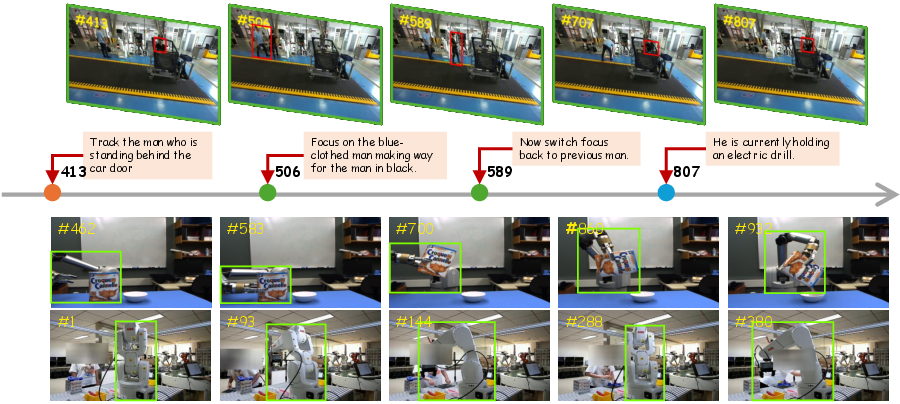
Figure 7: Sequences from diverse "other" domains (industrial, lab) illustrating the versatility and annotation detail of InteractTrack.
Interactive Memory-Augmented Tracking (IMAT): Model Architecture
IMAT is devised as a baseline for interactive tracking, integrating three core modules: the Interactive Perception Module (IPM, vision-language grounding using MLLMs), the Memory-Augmented Visual Tracker (MAVT, building on SAM2), and the Cognitive Arbitration Module (CAM, logic for arbitration and memory update). Key innovations include:
- Semantic grounding: Vision-language module aligns visual frames to rich, natural-language queries, enabling context-aware reinitialization or focus refinement.
- Dual memory banks: IMAT maintains dynamic positive and negative feature memories. The positive bank accumulates validated appearance cues across time; the negative bank collects distractors or mislocalizations, suppressing erroneous tracking.
- Cognitive arbitration: CAM compares current predictions against IPM outputs, resolving discrepancies via IoU-based logic; updates propagate dynamically based on user feedback or model drift, imprinting context and semantic corrections to memory.
This architecture creates a feedback-driven system that tightly couples language understanding with robust spatiotemporal object tracking.
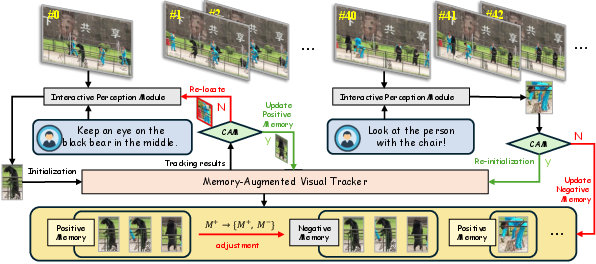
Figure 8: Structural overview of IMAT, detailing user-guided semantic grounding, dynamic arbitration, and adaptive memory in the human-in-the-loop tracking system.
Benchmarking and Empirical Results
Evaluation across 25 representative trackers (VOT, VOS, VLT, and RVOS families) on InteractTrack demonstrates that state-of-the-art models optimized for classical, static tracking tasks generalize poorly to interactive scenarios despite strong results in their original domains. IMAT, in contrast, achieves the best interactiveness (45.25%) and responsiveness (41.20%) scores, with strong leading precision and success rates across all scenarios.
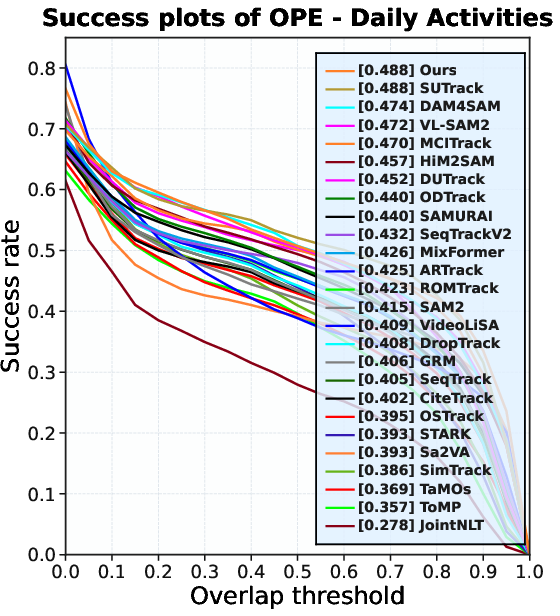
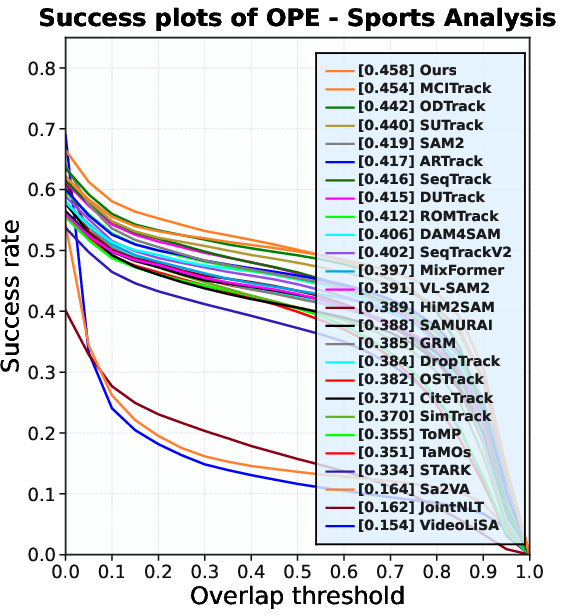
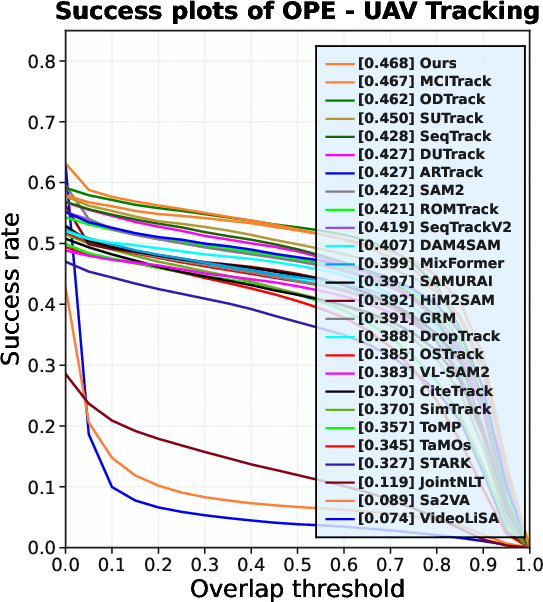
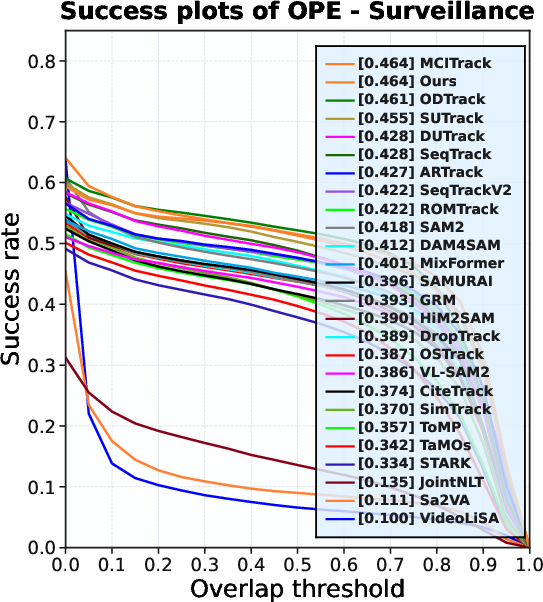
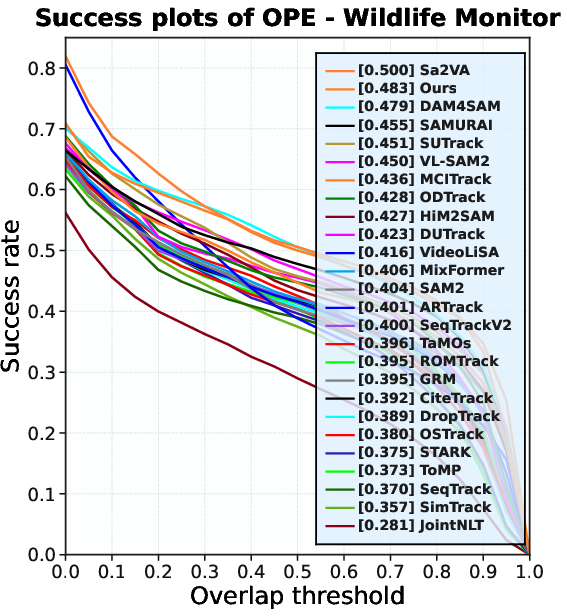
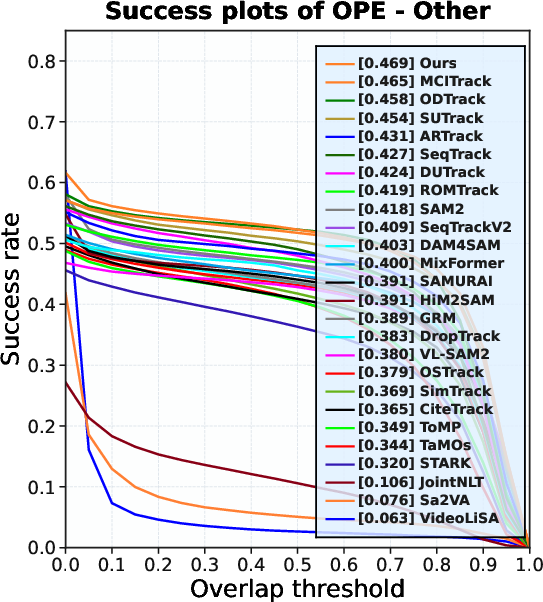
Figure 9: Success evaluation of IMAT versus strong baselines for each scenario, confirming robust, scenario-agnostic human-in-the-loop adaptation.
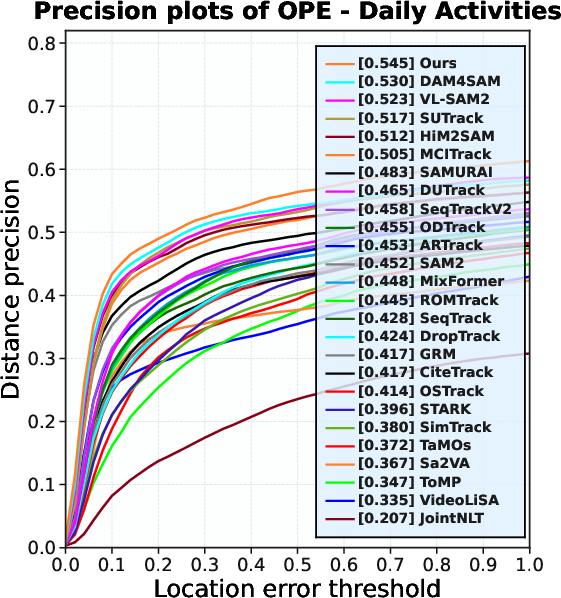
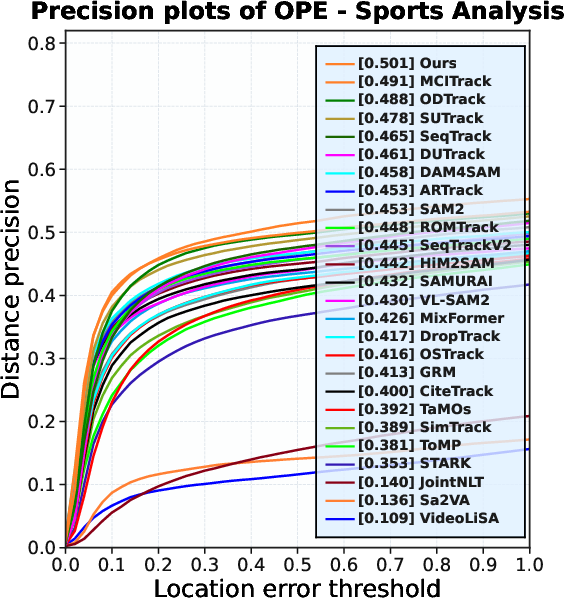
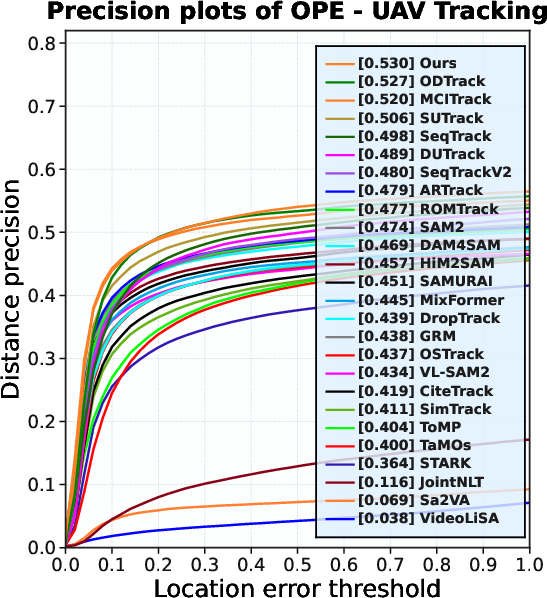
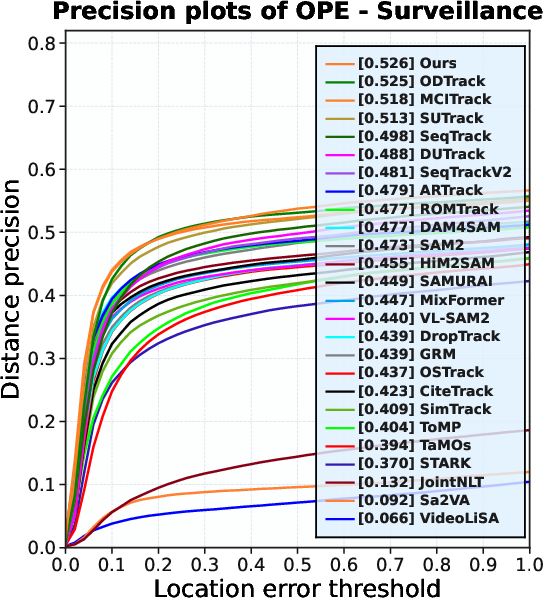
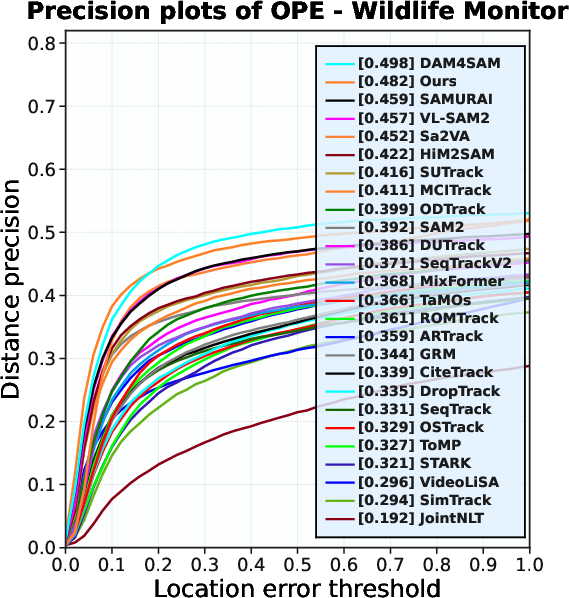
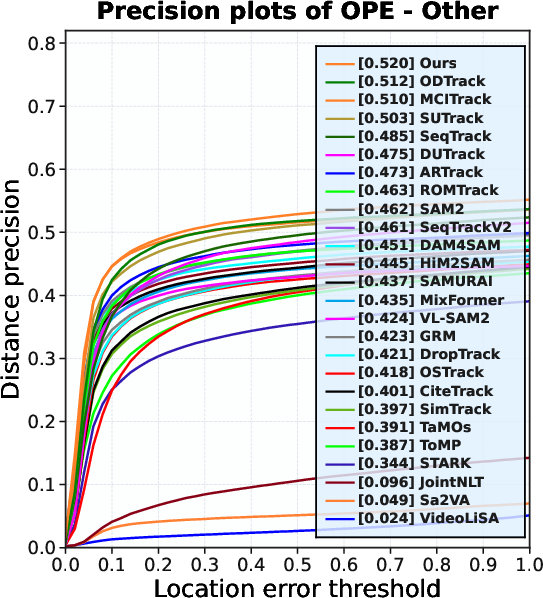
Figure 10: Scenario-based precision results highlighting the consistency of IMAT's localization under varying environmental and interactional pressures.
Visualization of challenging and failure cases exposes current model limits: IMAT surpasses traditional trackers in recovering from occlusion or loss, but complex combination scenarios (e.g., rapid motion + heavy occlusion + high clutter) remain open problems even with user guidance.
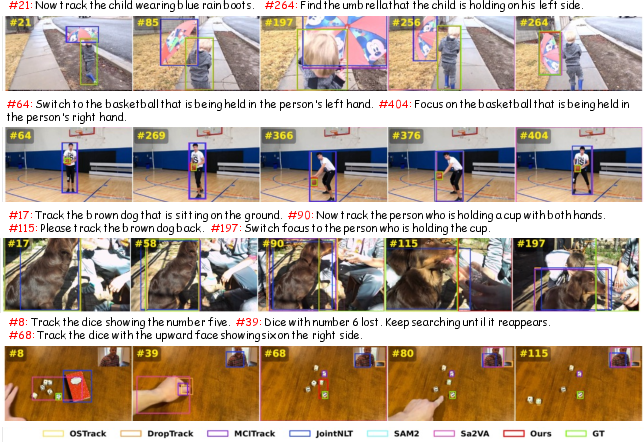
Figure 11: Illustrative comparison of IMAT and traditional trackers on challenging interactive cases (occlusion, target switch, reidentification, heavy clutter).
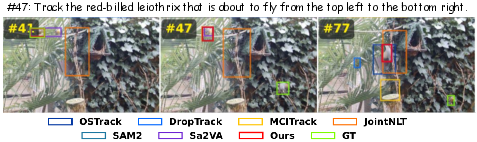
Figure 12: Failure analysis showing residual limitations of vision-language-guided trackers in highly adverse tracking regimes.
Theoretical and Practical Implications
The formalization of interactive tracking and the design of InteractTrack address a critical gap in bridging classical VOT and practical visual analytics systems. Specifically:
- Theoretical advances: The paradigm compels community-wide progress toward multimodal context awareness, robust spatial-temporal reasoning, and lifelong adaptation, all at the intersection of perception, natural language, and learning from corrective feedback.
- Practical impact: IMAT and InteractTrack specify minimum requirements for next-generation analytics in surveillance, sports, robotics, and scientific observation, where end-users must continuously steer and adapt algorithmic focus during analysis.
Critically, strong performance on conventional tracking does not imply effectiveness under interactive constraints, highlighting the necessity of benchmarks and protocols that directly evaluate human-machine collaborative adaptation.
Future Directions
Future progress will involve:
- Integration of more powerful MLLMs for enhanced scene and instruction understanding.
- Unified object-level tracking/segmentation for more fine-grained user feedback and action.
- Exploration of lifelong and continual learning under streaming interaction conditions (resilience to catastrophic forgetting).
- Robustness to ambiguous or contradictory user instructions and real user interface studies.
Conclusion
This work rigorously reframes object tracking as a dynamic, multimodal, and human-guided process rather than a static perception task. InteractTrack and IMAT supply the foundation and strong baselines for the evaluation and development of future adaptive, collaborative perception systems that incorporate both semantic reasoning and robust long-term state management (2604.01974).

