- The paper demonstrates that non-conservative PINNs systematically fail to capture correct shock speeds in fluid dynamics.
- It introduces a path-integral remedy based on DLM theory to enforce conservativeness and obtain accurate shock propagation.
- Empirical results comparing PINNs-AWV with traditional solvers reveal lower L1 errors and improved physical fidelity when conservation is maintained.
Revisiting Conservativeness in Fluid Dynamics: PINN Failure Modes and a Path-Integral Remedy
Introduction
This paper systematically investigates the importance of conservativeness in the context of computational fluid dynamics (CFD), with specific focus on how different formulations—conservative versus non-conservative—affect the accuracy of both classical numerical schemes and Physics-Informed Neural Networks (PINNs). The authors analyze the behavior of PINNs with adaptive weight and viscosity (PINNs-AWV) when applied to canonical test cases in fluid dynamics, highlighting failure modes inherent to non-conservative forms and introducing a path-integral remedy grounded in Dal Maso–LeFloch–Murat (DLM) theory. Through rigorous empirical studies and direct comparison with traditional solvers, this work delineates the limits of non-conservative PINNs and demonstrates a mathematically consistent strategy to recover physically correct shock propagation.
The discussion is anchored on a hierarchical view of conservativeness:
- Mathematical conservativeness is rooted in the divergence (flux) form of a PDE, ensuring the existence of weak solutions and enabling the application of the Rankine–Hugoniot (RH) conditions for shock speed.
- Numerical conservativeness pertains to discrete schemes accurately preserving integral balances, which is critical for correct shock propagation and long-term stability.
- Physical conservativeness demands positivity, entropy consistency, and equilibrium preservation, preventing schemes from collapsing into non-physical or unstable regimes.
The Burgers and shallow water equations serve as didactic vehicles, illustrating how mathematically equivalent conservative and non-conservative forms can yield fundamentally different numerical behavior regarding shock speeds and preservation of invariants.
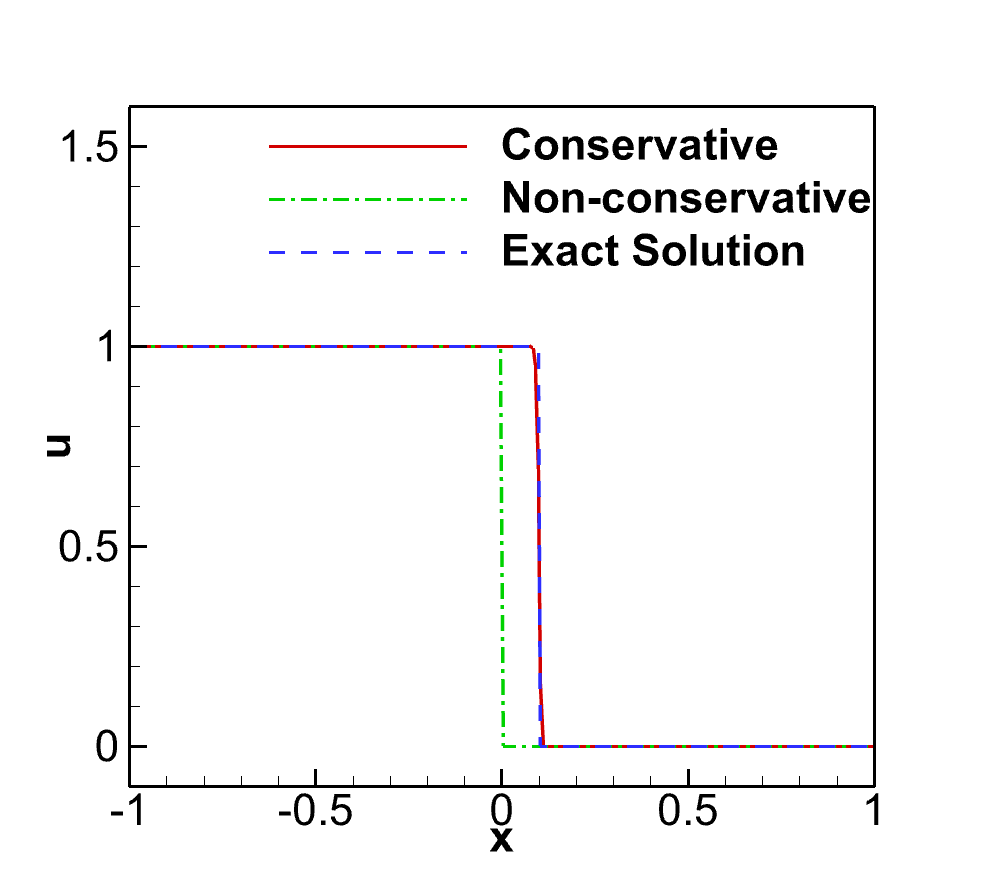
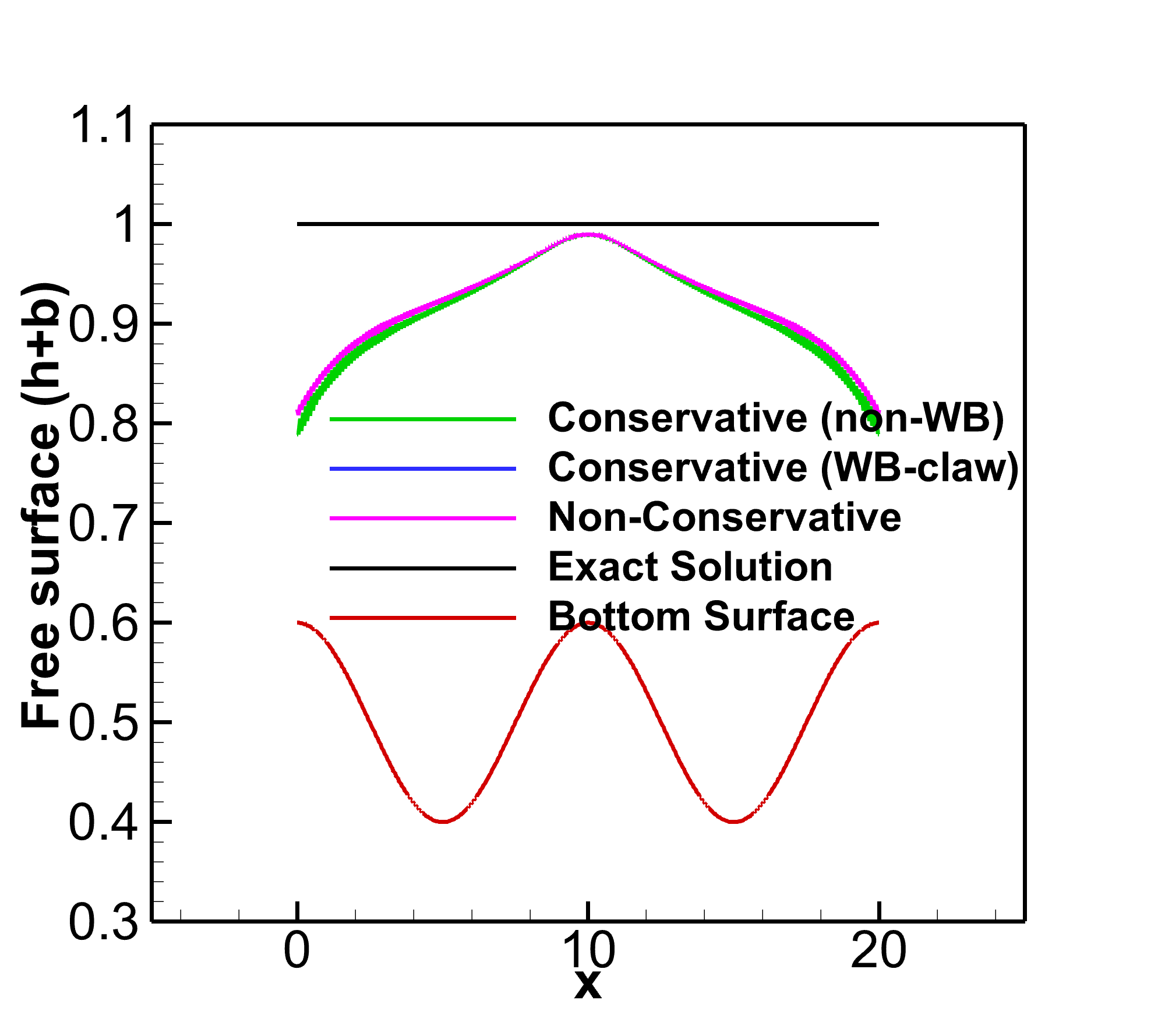
Figure 1: Burgers equation and its solution via conservative and non-conservative schemes illustrating the divergence in shock speed prediction.
Impact on Numerical Discretizations
Canonical test problems illuminate the consequences of form choice:
- For the Burgers equation, classical conservative discretizations converge to the admissible weak solution correctly capturing shock migration, as dictated by RH conditions. Non-conservative schemes, while sometimes stable, yield incorrect shock propagation—even with consistent discretization and stability.
- The shallow water equations (SWE) exemplify the necessity for both conservativeness and well-balancedness to avoid spurious motions and to preserve precisely static equilibria, especially in the presence of non-flat bottom topography.
Cases with variable bathymetry underscore that even conservative schemes can destroy physical equilibria if not designed as well-balanced. The need for a physically meaningful conserved variable in the mathematical formulation is further clarified via comparative analysis of physically and mathematically conservative forms.
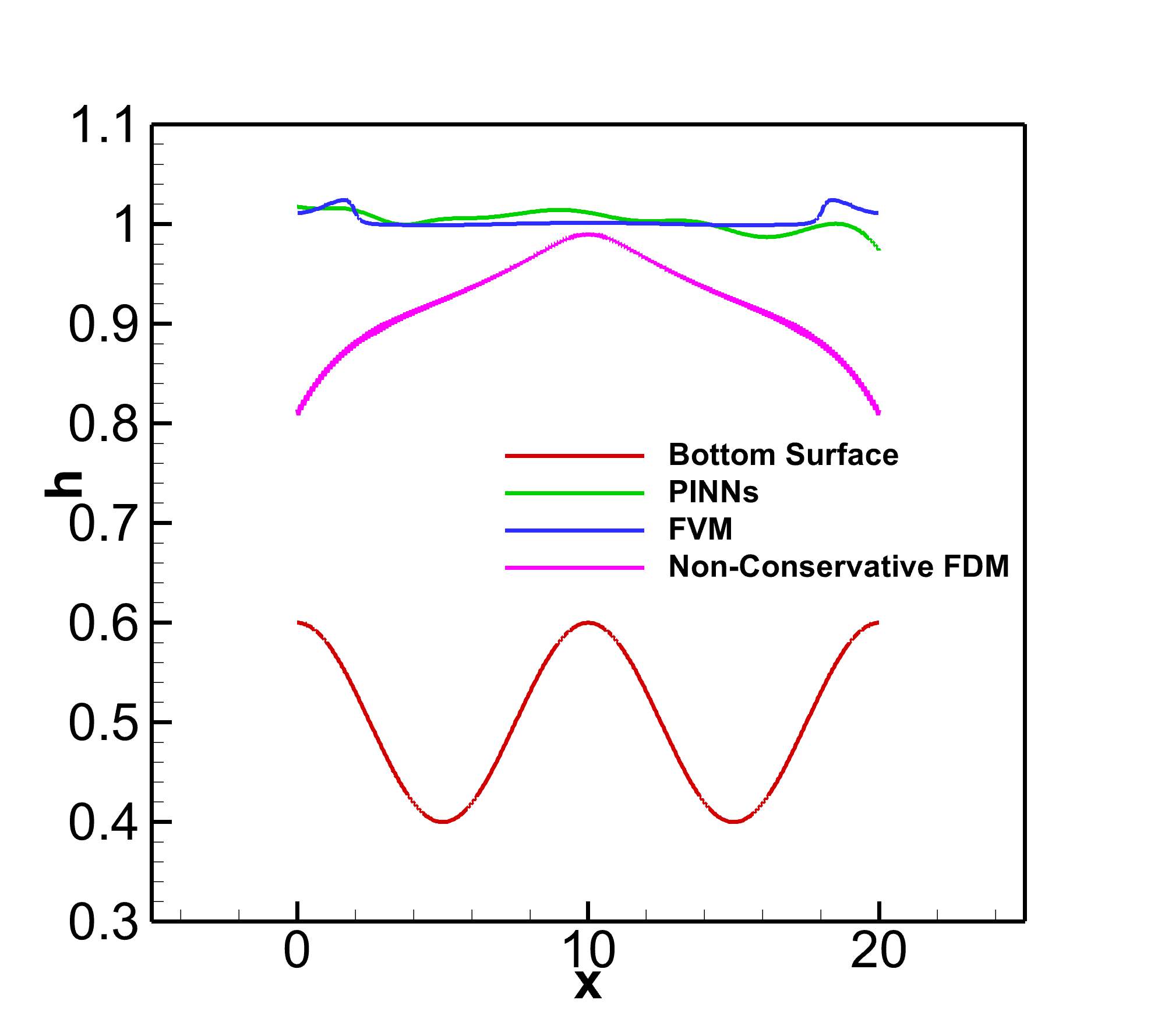
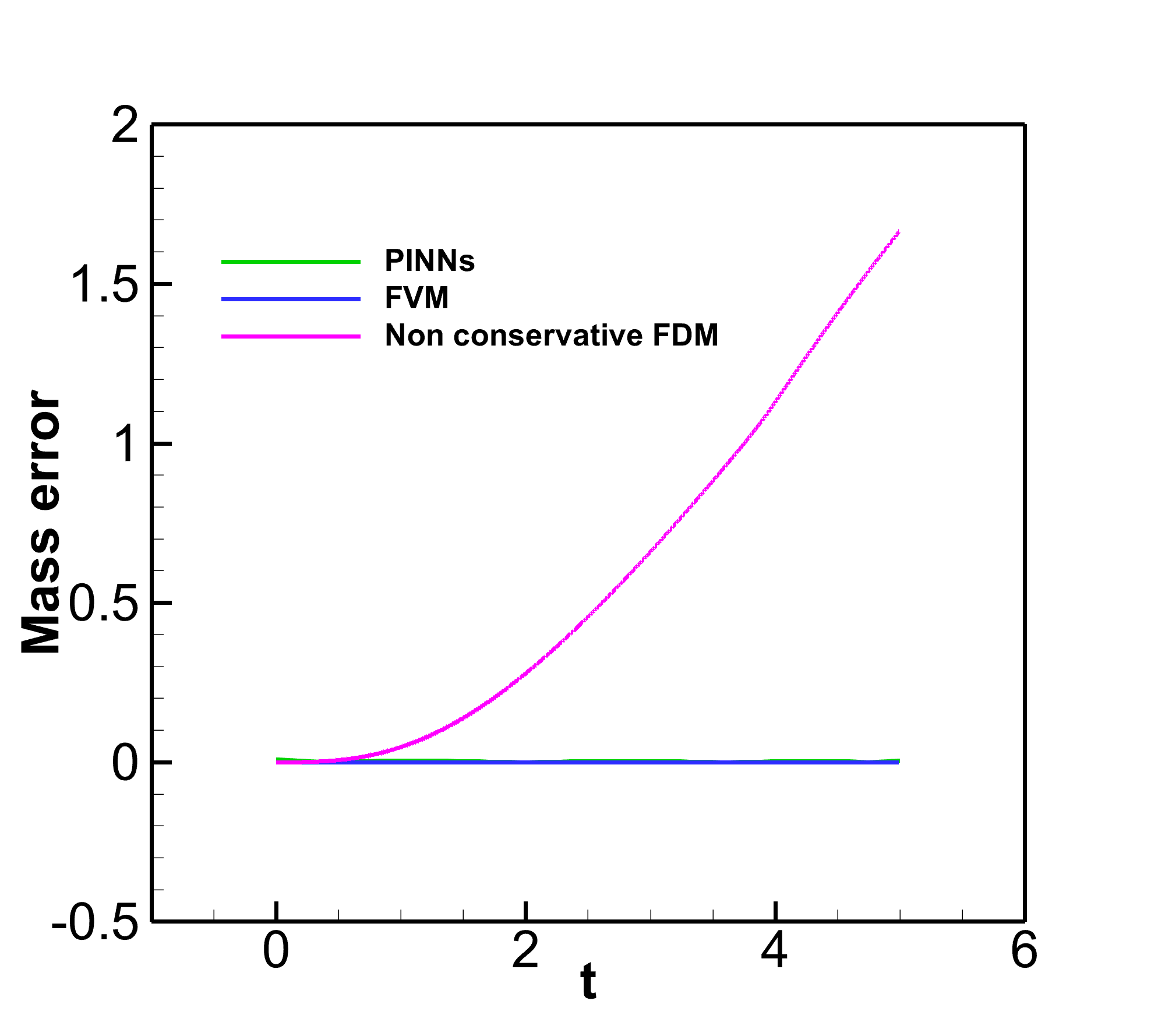
Figure 2: Free-surface elevation in the Shallow Water Equations for different numerical treatments, showing the criticality of well-balanced schemes for physical fidelity.
PINNs and Shock/Discontinuity Propagation
The application of PINNs—particularly with adaptive viscosity and loss weighting (PINNs-AWV)—extends these findings to machine learning solvers. The paper demonstrates:
- For nearly smooth problems (e.g., shallow water without strong discontinuities), both conservative and non-conservative PINNs can yield satisfactory solutions when global conservation is imposed, even without explicit discretization of fluxes.
- For problems with strong discontinuities (e.g., Burgers equation with a Riemann initial condition, Sod shock tube problem), non-conservative PINNs, even with adaptive/artificial viscosity regularization, systematically fail to identify the correct shock speeds. The underlying origin is traced to non-vanishing source terms from the adopted regularization, which violate the necessary RH jump conditions.
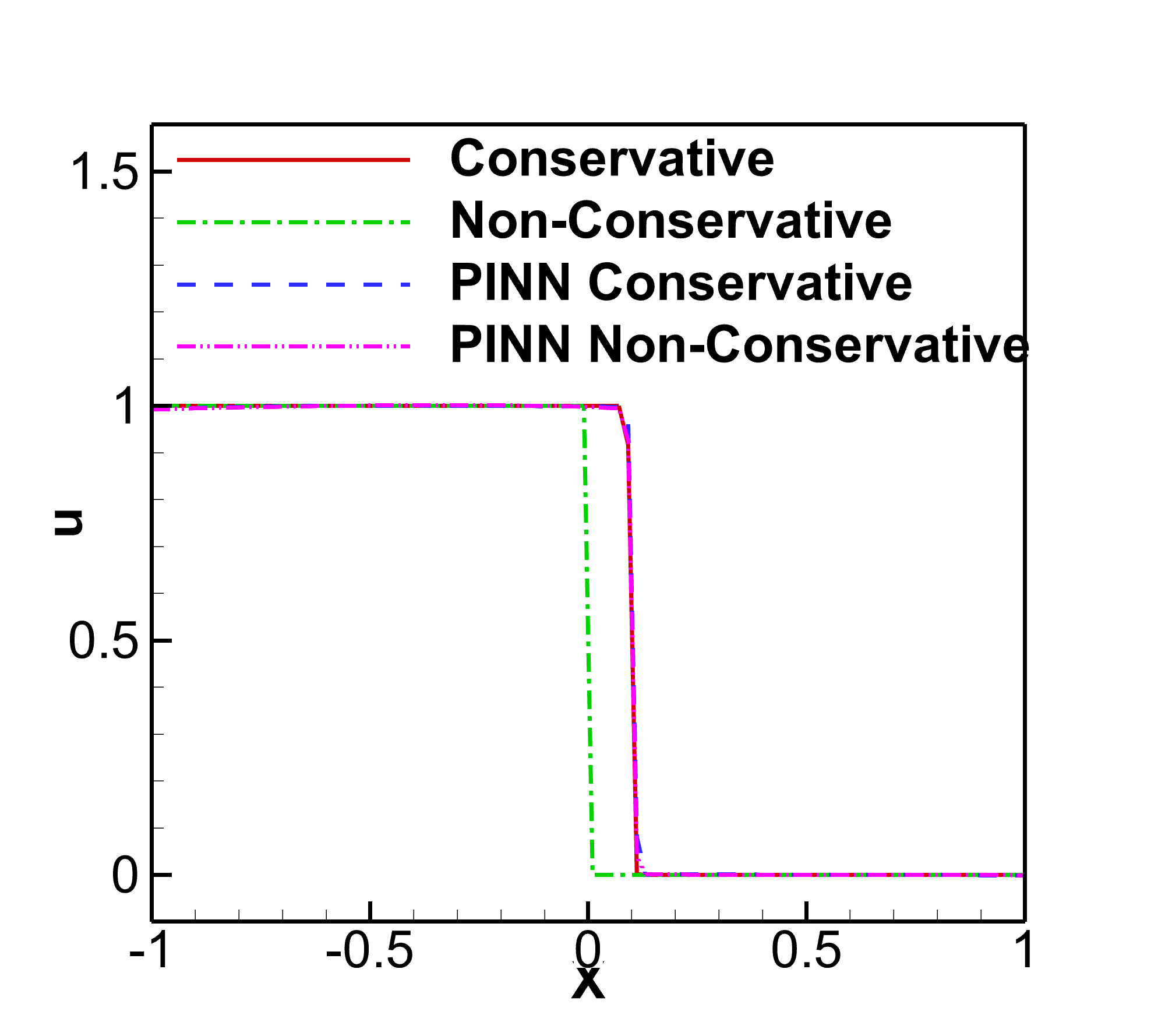
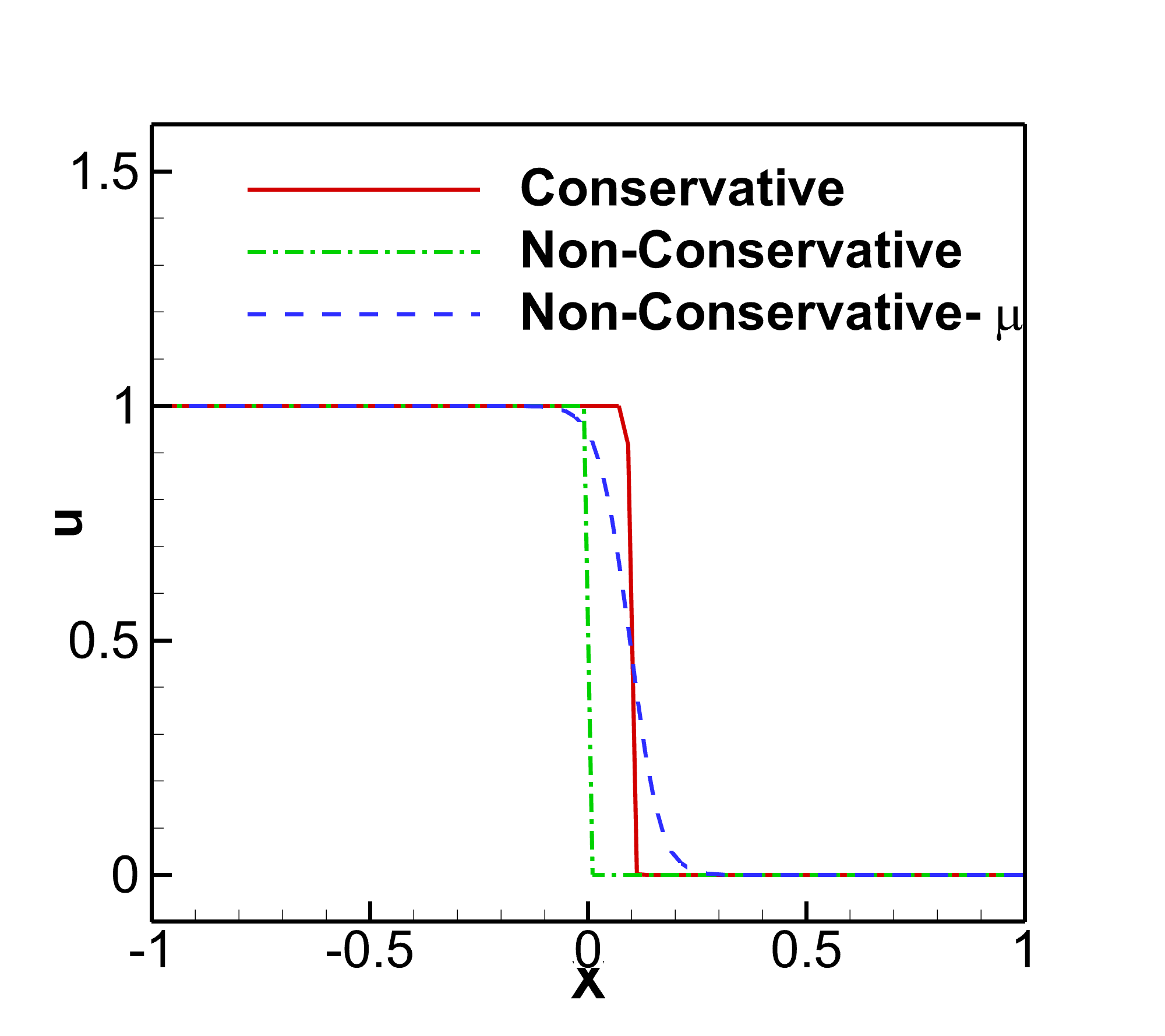
Figure 3: Side-by-side comparison of numerical and PINNs solutions for the Burgers equation, highlighting the failure of non-conservative discretizations and PINNs in capturing correct shock motion.
Path-Integral Remedy for Non-Conservative PINNs
To overcome the intrinsic limitation of non-conservative formulations, the authors implement a path-integral correction as prescribed by DLM theory. The proposed Path-Integral PINN (PI-PINN) framework integrates the system Jacobian along a state-space path between left and right states, enforcing a path-consistent loss term that restores well-posedness and the admissibility of shocks in the non-conservative setting.
Empirical results are notable: PI-PINN and corresponding path-conservative numerical schemes fully recover the correct shock speeds and discontinuity structure, even for transient high-speed flows (i.e., Euler equations in Sod's shock tube). The path-integral term rectifies the regularization-induced deficiencies, synchronizing the neural solver with the correct weak solution manifold.
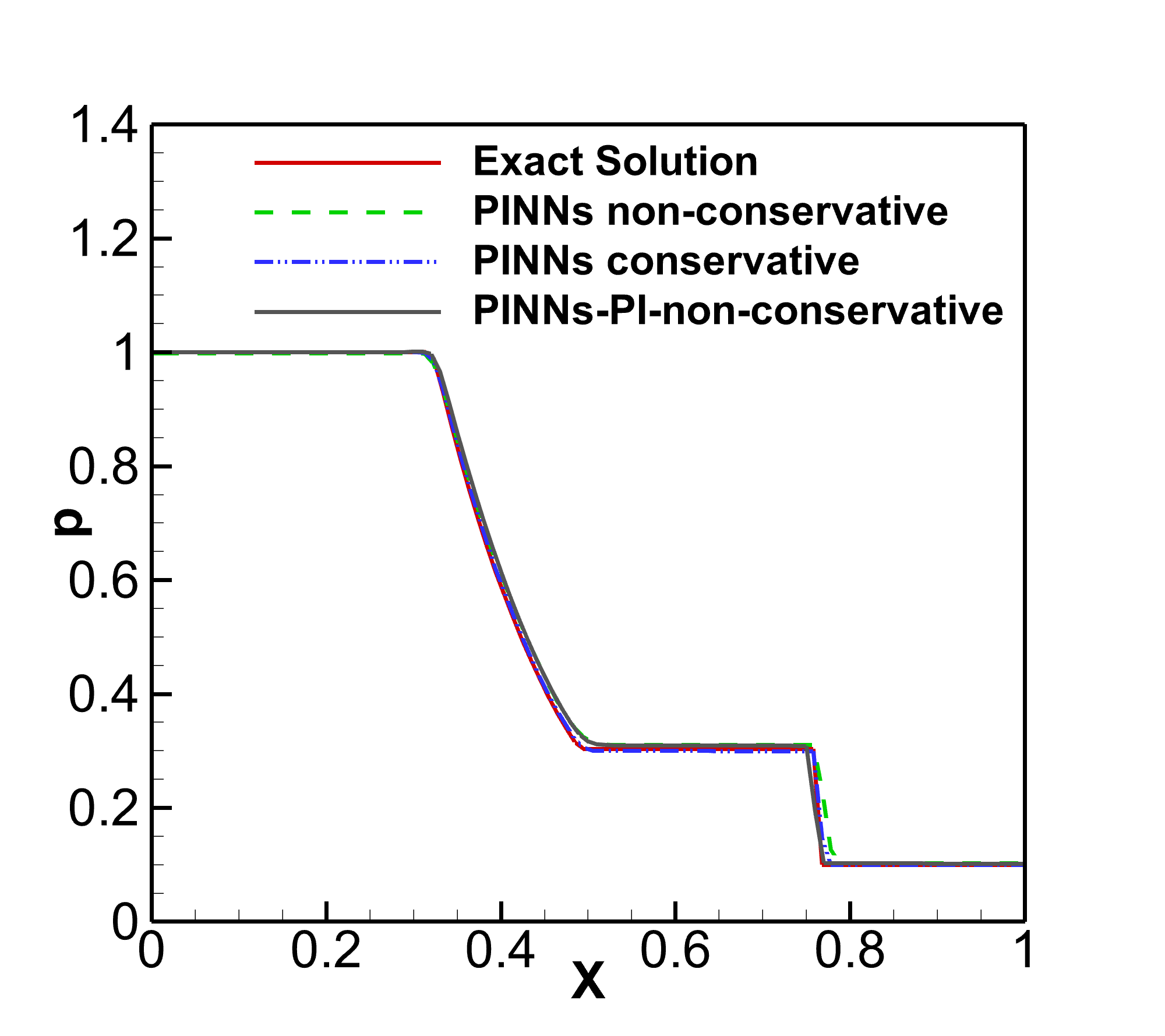
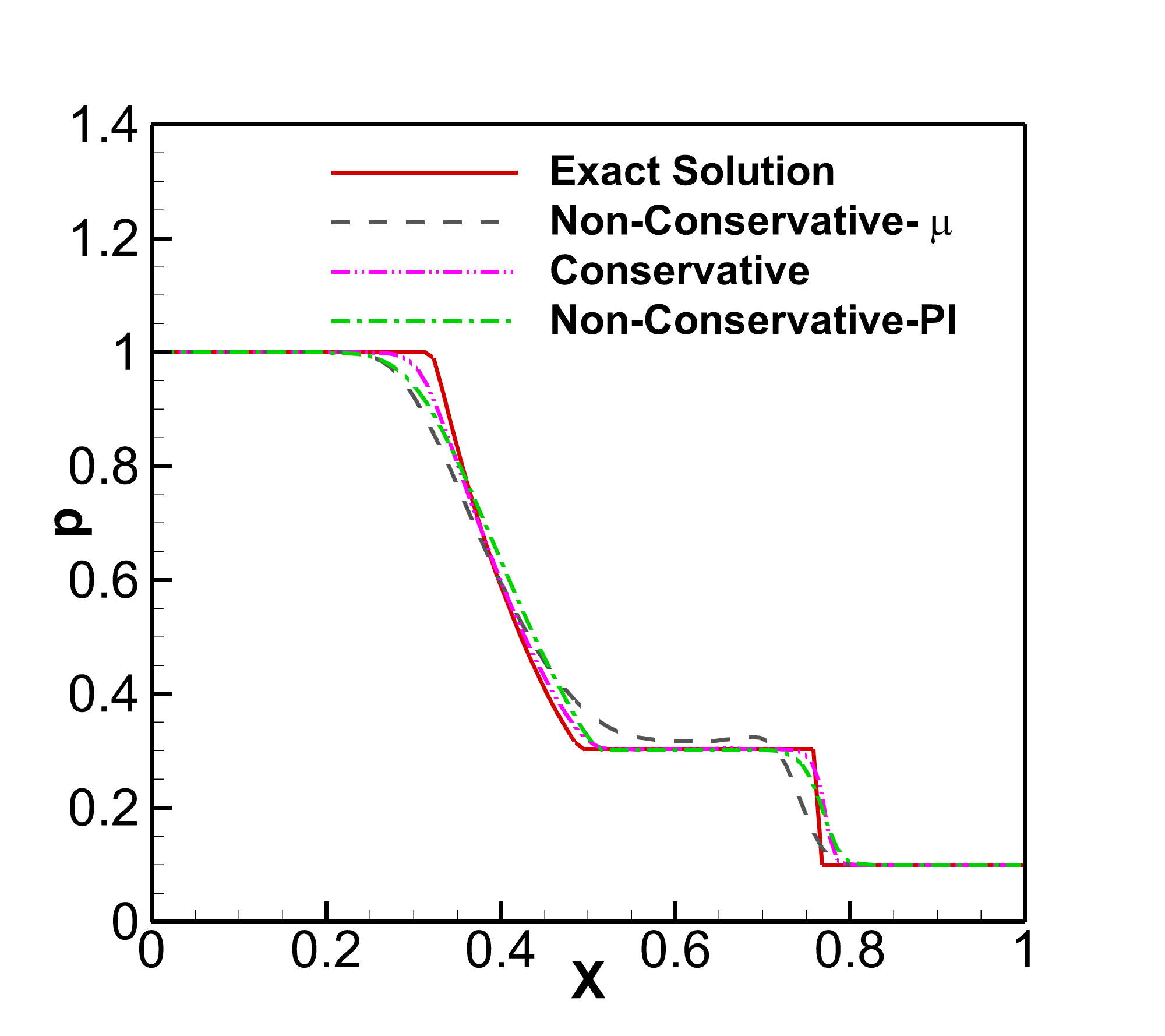
Figure 4: PINN variants and numerical schemes applied to Sod's shock tube exhibiting correct/incorrect shock capturing depending on the use of path-integral correction.
Extension to Steady High-Speed Flows
The analysis is extended to steady-state supersonic flow over a wedge, where the importance of shock speed propagation is reduced. In such contexts, both conservative and non-conservative PINNs can capture the shock structure and position adequately, though strict mass conservation is only enforced by the conservative formulation.
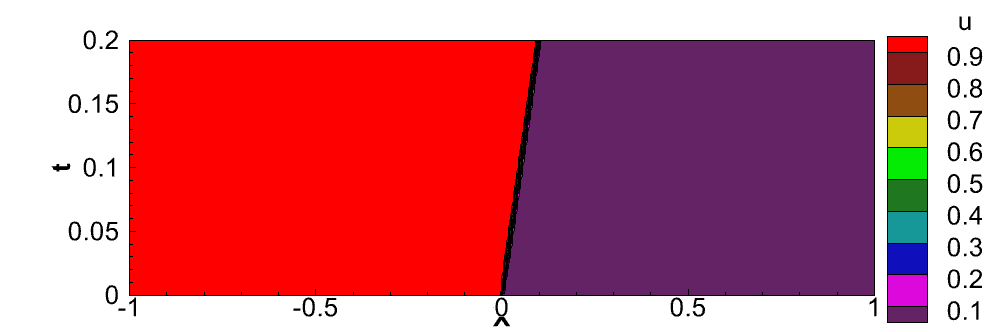
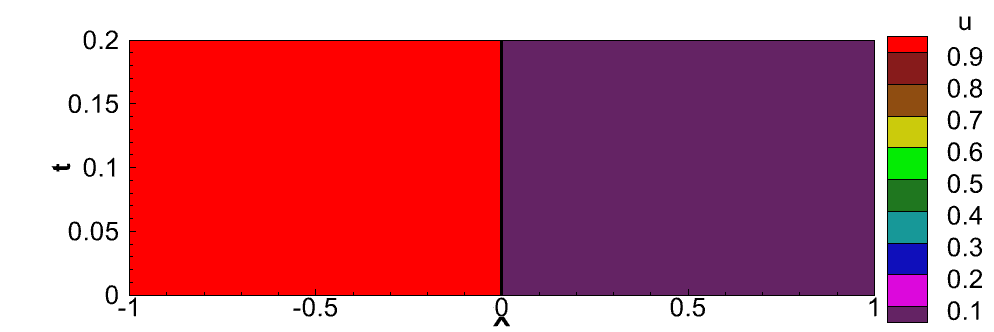
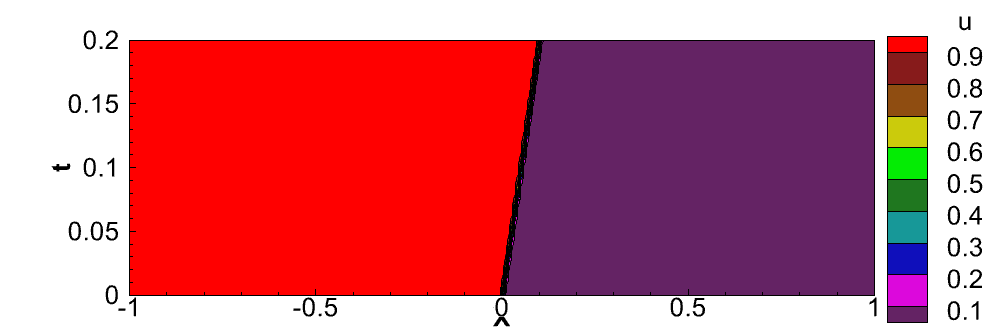
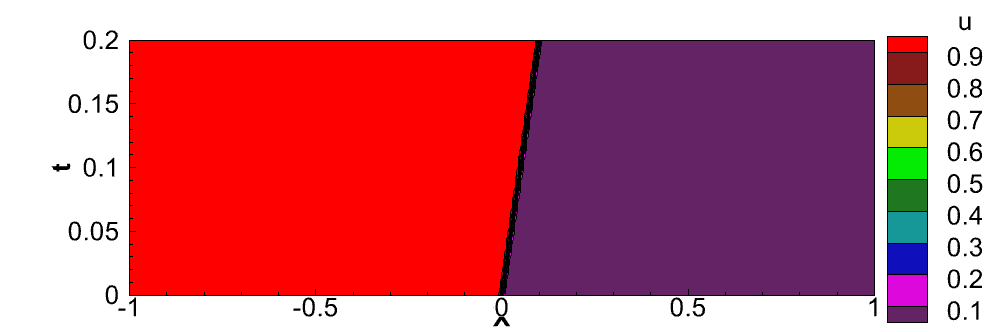
Figure 5: Representative result from a conservative scheme displaying faithful conservation and shock resolution.
Quantitative Results
Key diagnostics (e.g., L1 error, mass defect) support the qualitative findings, with PINNs-PI and conservative approaches always demonstrating lower errors and physically consistent behavior in transient, shock-dominated problems.
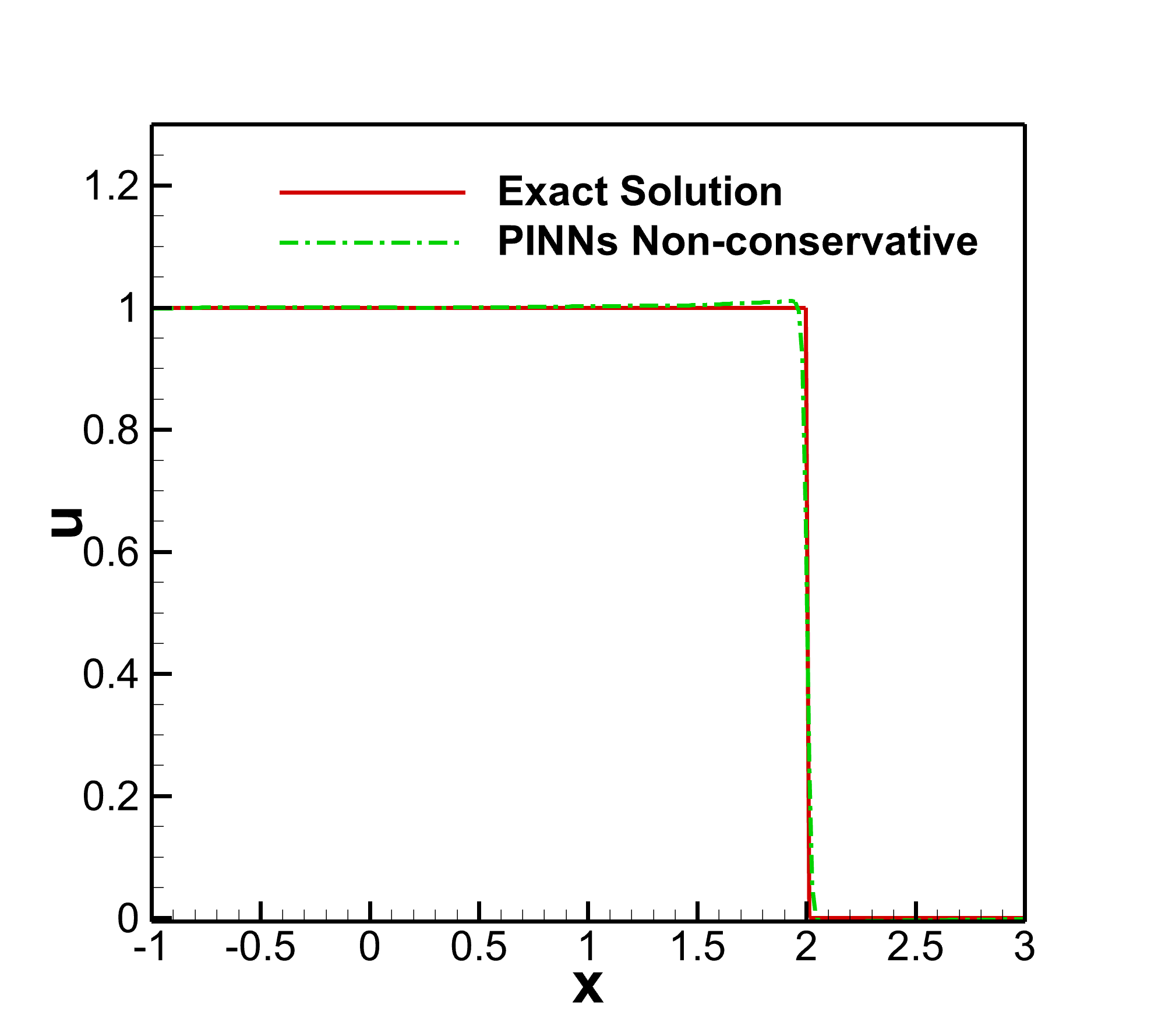
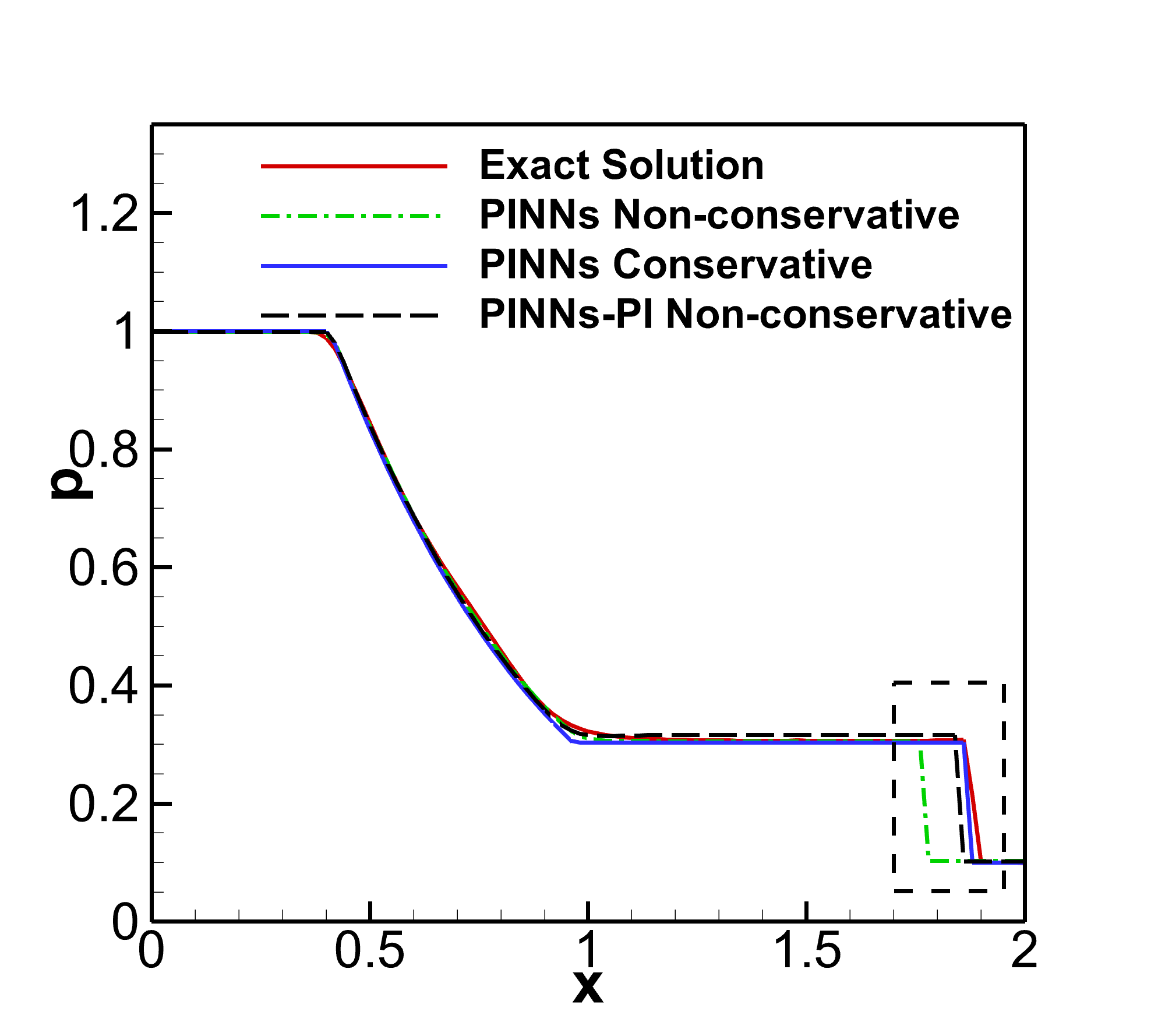
Figure 6: Burgers equation solution at T=4s showing the time persistence of PINNs' conservative solution and the breakdown in non-conservative settings.
Implications and Future Directions
The results have several profound implications:
- The strict requirement for conservativeness in transient, discontinuous regimes must be honored by both classical and neural solvers. Neural networks, if naively furnished with non-conservative forms—even with sophisticated regularization—can learn wrong shock speeds, a failure mode not easily detectable from loss trends alone.
- The path-integral formulation paves the way for robust data-driven and hybrid solvers applicable to multiphase, multiphysics, or otherwise analytically intractable systems expressible only in primitive or non-conservative variables.
- This methodology readily generalizes to operator learning settings, PINO/DeepONets, and other machine learning frameworks, provided the path-integral loss is leveraged where PDE regularization implicitly determines the weak solution class.
Conclusion
The analysis presented rigorously delineates the conditions under which conservative and non-conservative forms are admissible for both numerical and PINN-based solvers. The principal finding is the inescapable failure of standard non-conservative PINNs to propagate shocks physically, traceable to the structural properties of the governing equations and their regularizations. The path-integral remedy (following DLM theory) establishes a mathematically consistent bridge restoring physical conservation laws for neural solvers using non-conservative PDEs. This development significantly enlarges the applicability of data-driven solvers to challenging domains in CFD and offers clear guidance for the formulation and deployment of PINN-based surrogates in scientific computing.

