- The paper demonstrates that applied magnetic fields in 2D d-wave altermagnets trigger tunable valley-resolved topological transitions via Dirac mass inversion.
- It employs a four-band tight-binding model on a Lieb lattice incorporating Rashba SOC and altermagnetic spin splitting to control Berry curvature and edge states.
- The study reveals implications for magnetization-free topological electronics, enabling ultrafast switching and robust quantum information processing.
Quantum Anomalous Hall Conductivity in Altermagnets under Magnetic Field: Symmetry, Valleytronics, and Topological Transition
Introduction and Context
The study addresses the realization of the quantum anomalous Hall effect (QAHE) in two-dimensional (2D) altermagnets, focusing on systems with vanishing net magnetization but symmetry-protected spin-momentum locking. Utilizing a d-wave altermagnetic order on a Lieb lattice, the analysis pinpoints how the interplay between momentum-dependent spin textures and external magnetic fields leads to tunable topological phases. The unique Lieb-lattice band topology enables robust valley-contrasting topological phenomena, with the external magnetic field serving as a tunable handle to break crystalline rotational symmetry without introducing conventional ferromagnetism. This approach distinguishes itself from prior works, which achieved QAHE in altermagnets only via symmetry-lowering perturbations such as strain or engineered stacking (2604.01948).
Model Hamiltonian and Symmetry Landscape
A four-band tight-binding Hamiltonian is formulated on the Lieb lattice in the tensor-product space of sublattice and spin, incorporating hopping, d-wave altermagnetic spin splitting (Δ), and Rashba-type spin-orbit coupling (SOC):
- Hopping terms d0, d1, d3 control inter- and intra-sublattice couplings, with d3(k) inheriting dx2−y2 symmetry that is contingent on parameter M1eff.
- The spin-resolved Rashba coupling λR(k) and Kane-Mele SOC generate finite Berry curvatures away from high-symmetry points.
- The model ensures zero net magnetization in the non-relativistic limit, maintaining the defining signature of pure altermagnets.
In the absence of an external field, valley and spin Chern numbers are constrained by fourfold rotation and time-reversal combination, enforcing d0 globally but allowing finite spin and valley Chern numbers. When an external magnetic field parameterized by d1 is applied, d2 symmetry is explicitly broken between the two valleys (X/Y), decoupling their contributions and enabling a finite Chern number with carefully tuned parameters.
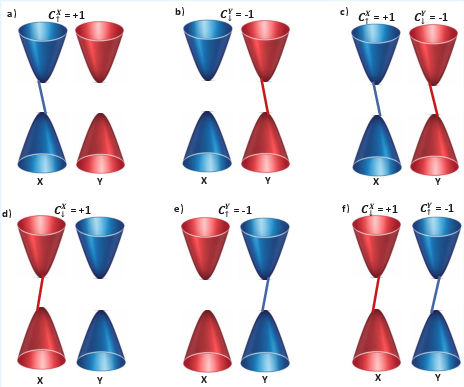
Figure 1: Topological surface state connections between valence and conduction bands for distinct spin-resolved Chern numbers and valleys in various phases.
Topological Phases and Dirac Mass Inversions
Phase Diagram and Band Topology
The topological phase diagram features four primary phases:
- Normal Insulator: Both valley Chern numbers trivial.
- Spin Chern Insulator: Opposite spin channels realize equal-magnitude, opposite-sign Chern numbers (global d3, spin Chern invariant d4).
- Chern Insulator: One valley undergoes a mass inversion, generating d5 controlled by the sign of the Dirac mass at the true Dirac point, not simply at X or Y.
- Accidental Dirac Semimetal: Fine-tuned parameters yield massless Dirac cones moving continuously along the d6--d7--d8 boundary, a non-generic metallic regime separating insulating topological sectors.
Analytical calculation reveals that the band topology is dictated by the sign structure of parameter-dependent masses in the effective Dirac Hamiltonian, which is sensitive to both d9 and altermagnetic anisotropy Δ0. Notably, the Chern number changes only when the Dirac mass at the point of minimal band gap changes sign.
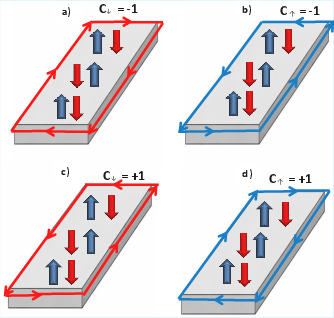
Figure 2: Real-space edge states in a monolayer QAH insulator for various spin-resolved Chern number scenarios.
Berry Curvature and Topological Structure
Numerical results demonstrate that, under finite SOC, the Berry curvature hot spots are always displaced from high-symmetry valleys and broadened, serving as a real-space manifestation of Dirac mass inversion. The QAH phase exhibits a quantized plateau in Hall conductivity whenever the Fermi energy lies inside the bulk gap—an unambiguous indicator of a Chern-insulating ground state.
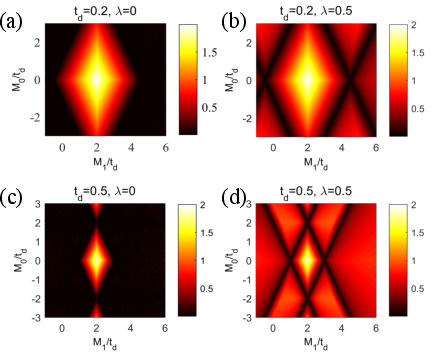
Figure 3: Global band gap Δ1 as a function of mass parameters, showing gap closures at topological phase transitions.
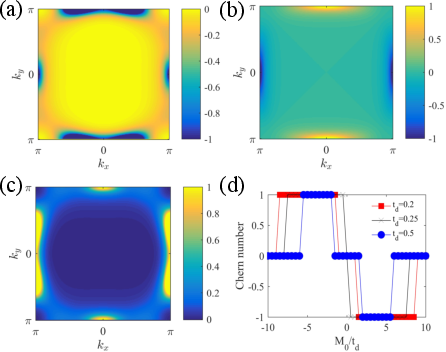
Figure 4: Berry curvature distributions and their connection to topological phase transitions.
Valleytronics Mechanism: Field-Controlled Topology
The primary novelty concerns the realization of the QAHE in pure altermagnets via explicit valley control:
- The applied magnetic field (Δ2) selectively modulates the mass inversion in one valley while maintaining zero net magnetization, contrasting with ferrovalleytronics and conventional QSH systems.
- Transitions between trivial, spin Chern insulator, and Chern insulator phases are triggered by the movement and gapping of Dirac cones along the Brillouin zone edge, where the Rashba SOC remains finite except at high-symmetry points.
- Phase boundaries for the topological transitions are directly associated with the movement of Dirac mass sign changes along the Δ3--Δ4--Δ5 boundary. Analytical and numerical phase boundaries align, confirming that the Δ6-wave structure allows fine control over valley-resolved topology.
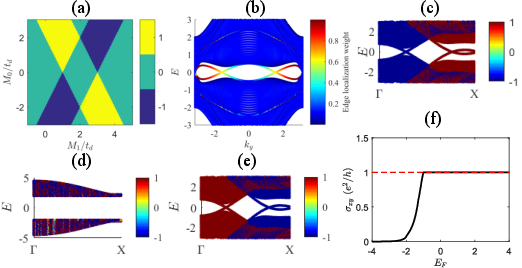
Figure 5: Phase diagram of Chern number as a function of dimensionless mass and anisotropy parameters, with corresponding chiral edge mode manifestations and quantized Hall conductivity.
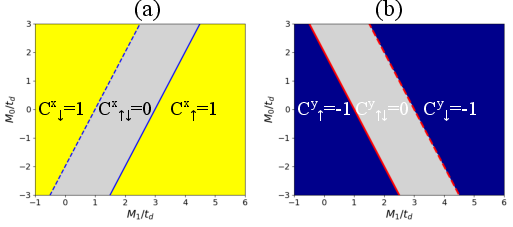
Figure 6: Spin-valley resolved gap closures delineating the topological transition lines in parameter space.
Implications and Future Prospects
This framework establishes that robust QAHE can be realized in altermagnets without net magnetization, leveraging the crystalline symmetry, SOC, and externally controllable valley contrast. This has several significant theoretical and practical implications:
- Magnetization-free Topological Electronics: Enables topological device operation without finite magnetization, reducing parasitic magnetic fields and crosstalk.
- Ultrafast Magnetic Control: Small magnetic fields can induce phase transitions due to the sensitivity of the Dirac mass inversion, facilitating rapid switching and potential THz operation.
- Bulk-Edge Correspondence in Altermagnets: Confirms that edge mode chirality directly correlates with the sign and magnitude of valley-resolved Chern numbers, even in zero-magnetization settings.
- Design of Van der Waals and Multilayer Altermagnets: The demonstrated tunability is extendable to few-layer or heterostructure systems, opening routes for further engineering of topological phase diagrams and proximity-induced phenomena [Sun et al., (Sun et al., 5 Feb 2025)].
- Valleytronics and Quantum Information: Selective valley control adds an extra degree of freedom for robust encoding in quantum and classical information processing.
Conclusion
The study establishes a minimal and tunable route to achieving QAHE in 2D Δ7-wave altermagnets on the Lieb lattice, distinct from previous approaches reliant on net magnetization. By exploiting magnetic-field-induced valley symmetry breaking, independent valley Chern numbers and controllable topological transitions are obtained. This mechanism enables robust quantized transport phases with potential for fast, magnetization-free topological electronics. The results motivate further theoretical and experimental exploration of altermagnetic valleytronics, quantum geometric effects, and device engineering targeting spin-valley-momentum-coupled systems.