- The paper demonstrates the design of lead-free Ba3MA3 antiperovskite derivatives with tunable bandgaps (1.23–2.17 eV) optimal for photovoltaic conversion.
- The paper employs advanced ab initio methods, including HSE06 and G0W0 with SOC, to quantify excitonic, optical, and polaronic properties that underlie high device performance.
- The paper establishes that certain compositions, like Ba3AsI3 and Ba3SbI3, exceed benchmark SLME values, supporting their potential for next-generation optoelectronic devices.
Lead-Free Ba-Based Antiperovskite Derivatives: Ab Initio Insights for Optoelectronics
Introduction and Motivation
This work thoroughly investigates Ba-based cubic antiperovskite derivatives, Ba3MA3 (M = P, As, Sb, Bi; A = Cl, Br, I), as next-generation optoelectronic materials. The motivation stems from the need to replace toxic, instability-prone lead halide perovskites with robust, environmentally benign alternatives. Antiperovskite derivatives, characterized by their cation–anion inverted lattice and flexible compositional design, offer an expanded tunability of structural and electronic properties compared to conventional perovskites. However, systematic elucidation of their excitonic and polaronic properties—critical for optoelectronic device performance—has remained scarce.
Structural and Electronic Properties
The cubic Pm3ˉm antiperovskite architecture is achieved by anion site splitting, resulting in structurally stable frameworks for all compositions investigated. Phonon dispersion, decomposition enthalpy, and elastic constant analyses confirm the dynamical, thermodynamic, and mechanical robustness of these compounds. The anti-site inversion preserves octahedral coordination, and the lattice constants scale predictably with the ionic radius of the halogen and pnictide elements.
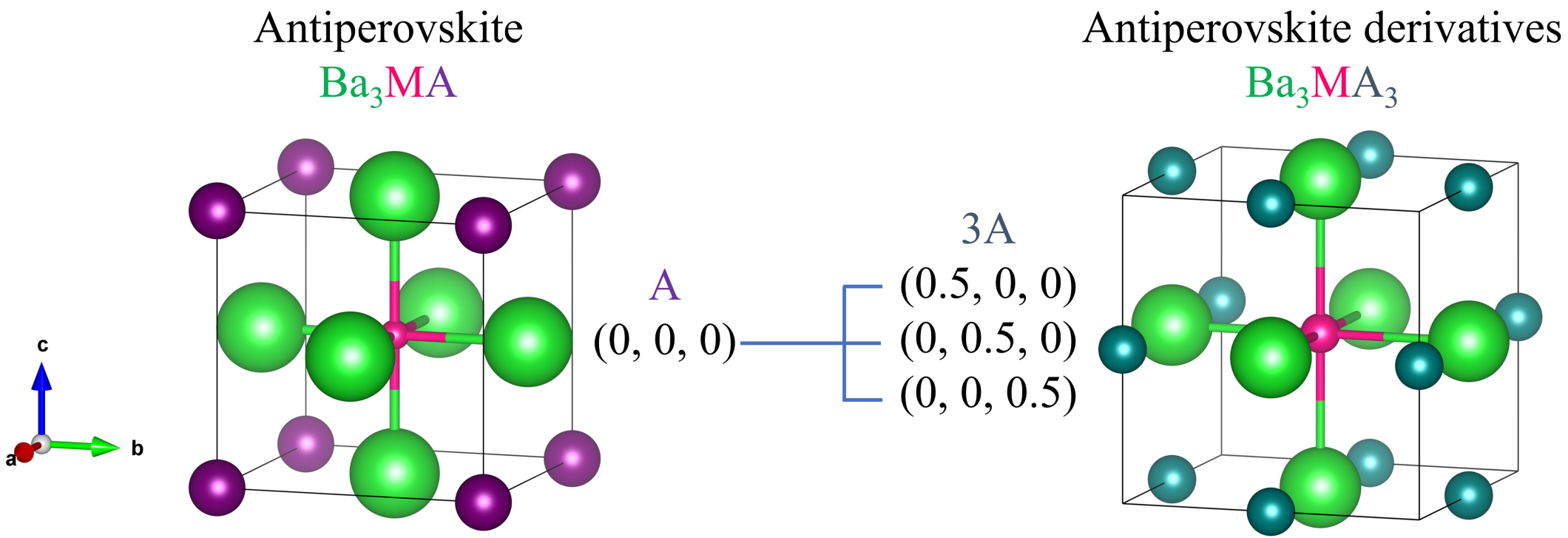
Figure 1: Design strategy for antiperovskite derivatives obtained by splitting the A-site position, yielding the distinct Ba3MA3 structure.
First-principles band structure computations—employing hybrid functional HSE06 with SOC and many-body perturbative G0W0@PBE+SOC—demonstrate that all Ba3MA3 systems are direct-gap semiconductors with the VBM and CBM at the Γ point. Bandgaps span 1.23–2.17 eV, placing them in the optimal range for photovoltaics and surpassing established lead perovskites such as MAPbI30. SOC effects are substantial, particularly for Bi- and Sb-containing variants.
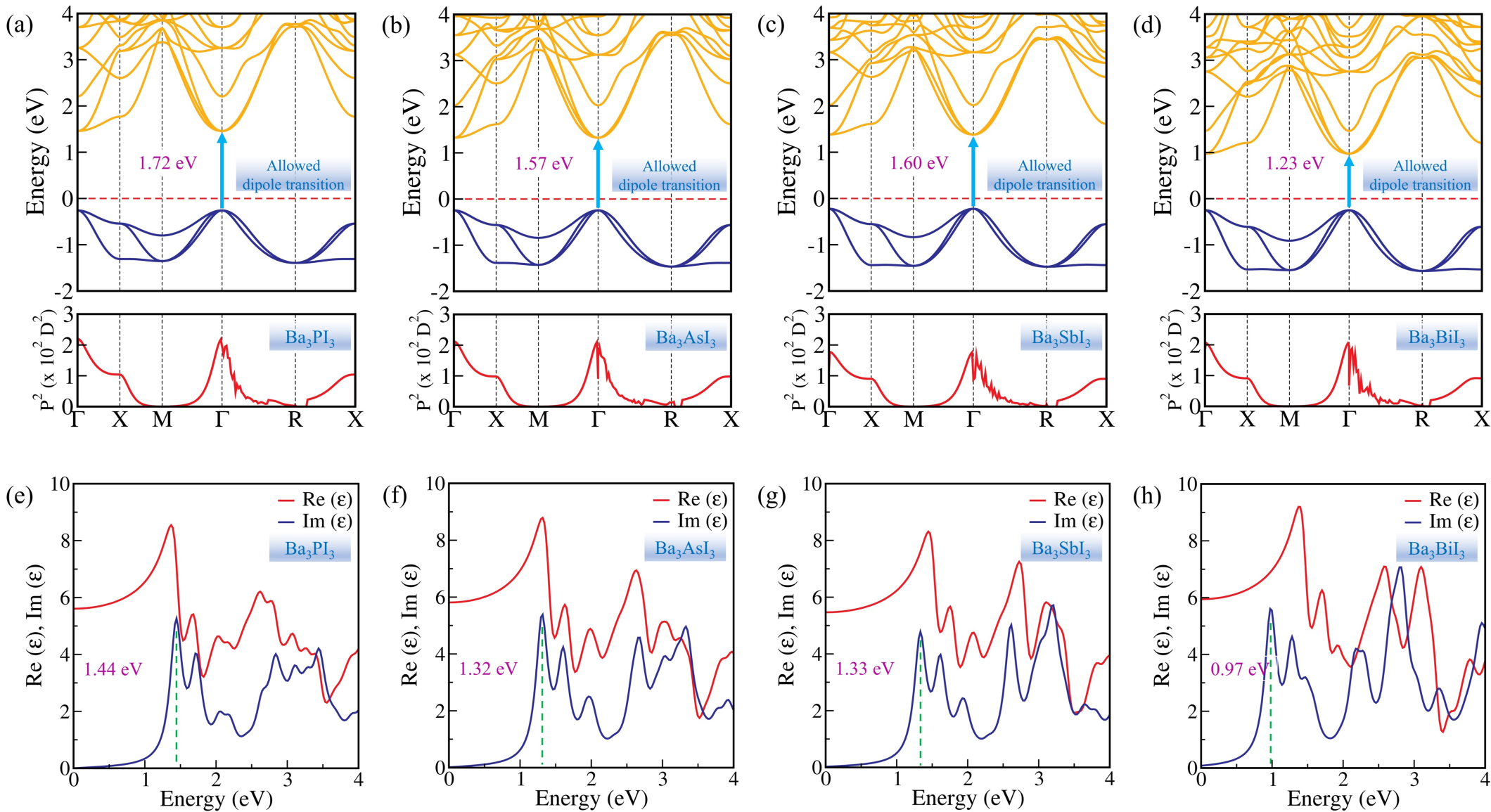
Figure 2: (a-d) Ba31MI32 (M = P, As, Sb, Bi): 33@PBE+SOC band structures and optical transition probabilities; (e-h) Real and imaginary parts of the dielectric function from BSE@GW+SOC.
Excitonic and Optical Response
A comprehensive analysis of optical properties is conducted by solving the Bethe-Salpeter equation atop the G34W35@PBE+SOC band structures, providing explicit inclusion of electron–hole interactions. Frequency-resolved dielectric functions reveal strong optical absorption with increasing dielectric constant from Cl to I, correlating to enhanced screening.
Key excitonic parameters—binding energy (36), exciton radius (37), and lifetime (38)—are quantitatively extracted. All compounds exhibit moderate 39 (0.254–0.352 eV). Exciton radii (0.90–1.95 nm) cover multiple unit cells, demonstrating intermediate character between localized Frenkel and delocalized Wannier–Mott regimes. Iodide variants yield longer exciton lifetimes and lower recombination rates, suggesting superior quantum efficiency for these compositions. Importantly, phonon screening reduces 3ˉ0 by only 1.8–2.9%, confirming that electronic screening dominates and that ionic contribution to exciton localization is minimal.
Polaronic Effects and Charge Transport
Carrier–phonon interactions are addressed via the Fröhlich model. All compounds fall into the intermediate coupling regime (3ˉ1 = 2.16–4.01), with polaron formation leading to an increase of 48–107% in effective carrier mass. Despite this renormalization, calculated mobilities remain technologically viable: up to 25.7 cm3ˉ2V3ˉ3s3ˉ4 for electrons and 75.1 cm3ˉ5V3ˉ6s3ˉ7 for holes. These results locate Ba3ˉ8MA3ˉ9 antiperovskites favorably relative to high-mobility perovskite and chalcohalide systems.
The spectroscopic limited maximum efficiency (SLME), a measure going beyond the Shockley–Queisser limit by incorporating the finite absorption tail and direct/forbidden transitions, is evaluated using the calculated BSE@GW absorption spectra.
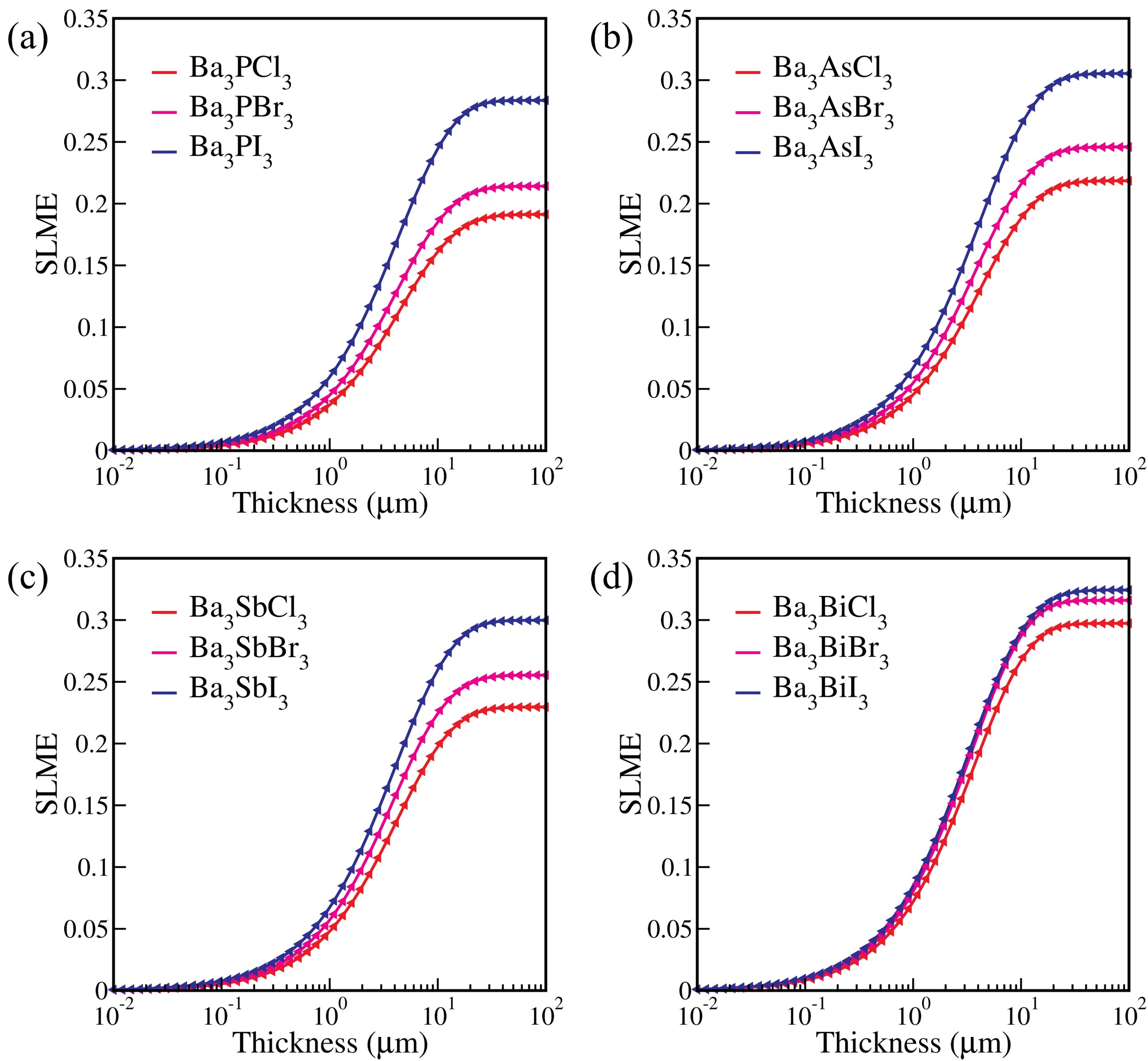
Figure 3: Thickness-dependent SLME for Ba30MA31: Iodide systems (Ba32AsI33, Ba34SbI35, Ba36BiA37) exhibit SLME values exceeding standard lead perovskites.
SLME analysis reveals that Ba38MA39 derivatives achieve maximum theoretical PCEs of 19.1% to 32.4%. Notably, compounds such as Ba30AsI31, Ba32SbI33, and Ba34BiA35 (A = Cl, Br, I) exceed the SLME of benchmark lead perovskites (e.g., CsPbI36, MAPbI37). These high values directly corroborate the excellent optoelectronic potential of this materials class and highlight the role of chemical flexibility in tuning the bandgap and absorption spectra.
Implications and Outlook
The unified ab initio treatment presented—explicitly including many-body electronic excitations, carrier–phonon coupling, and realistic device-relevant efficiency calculations—demonstrates that Ba38MA39 antiperovskite derivatives are competitive, lead-free candidates for optoelectronics and photovoltaics. The moderate exciton binding and intermediate-radius suggest a tunable balance between light emission and carrier extraction, while mobility analysis provides confidence in practical device architectures.
Several implications arise:
- Material Design: The pnictogen (M) and halide (A) selection provides a powerful handle to tailor bandgap, dielectric response, and transport.
- Device Applications: These findings directly motivate synthesis and integration of Ba00SbI01 or Ba02BiI03 in lead-free solar cells and photodetectors.
- Theoretical Expansion: Detailed modeling of polaron or exciton-exciton interactions and disorder effects can further guide application-specific optimization.
Advancing growth and processing techniques for these complex compositions will be necessary to realize the predicted efficiencies and leverage their structural stability.
Conclusion
This study provides a comprehensive, quantitative perspective on Ba04MA05 (M = P, As, Sb, Bi; A = Cl, Br, I) antiperovskites, revealing them as structurally robust, direct-gap semiconductors with favorable excitonic, polaronic, and optoelectronic properties. The demonstrated SLME exceeding lead-based analogs in certain cases, combined with dynamically stable frameworks and promising carrier mobility, position these derivatives at the forefront of lead-free photovoltaic and optoelectronic material design. This work establishes a firm ab initio foundation that will underpin both experimental efforts and further theoretical refinement in functional antiperovskite discovery.