Universal critical timescales in slow non-Hermitian dynamics
Published 2 Apr 2026 in quant-ph and cond-mat.other | (2604.01918v1)
Abstract: Non-Hermitian systems driven along slow parametric loops undergo non-adiabatic transitions whose outcome depends sensitively on the driving speed, yet no explicit formula has been available for the critical timescale $T_{\mathrm{cr}}$ at which these transitions develop. Using a $2\times 2$ Hamiltonian with circular parameter trajectories, we derive $T_{\mathrm{cr}} = \mathcal{G}\,\ln(1/|Δ|)$ in closed form for non-encircling loops, phase-shifted loops, offset loops, and loops encircling exceptional points, where $\mathcal{G}$ is a geometry-dependent growth factor and $Δ$ is the instability seed. This formula sharply separates the regime where the system remains in the averagely dominant eigenstate ($T< T_{\mathrm{cr}}$) from the superadiabatic regime where the instantaneous dominant eigenstate takes over ($T> T_{\mathrm{cr}}$), resolving the apparent tension between the previous literature. We identify two competing seeds: a geometric Stokes multiplier and the finite-precision floor. When the geometric seed vanishes, precision alone governs the transition, yielding $T_{\mathrm{cr}} \propto m\lnβ$, linear in the number of precision bits $m$. This provides a purely forward-evolution manifestation of precision-induced irreversibility (PIR)~\cite{PIR}, demonstrating that the fundamental limit identified through echo protocols also controls the outcome of slow non-Hermitian dynamics without requiring time reversal. For PT-symmetric energy spectra, $T_{\mathrm{cr}}$ additionally determines the onset of chirality: the dynamics is non-chiral for $T< T_{\mathrm{cr}}$ and chiral for $T> T_{\mathrm{cr}}$.
The paper provides a universal closed-form expression for the critical timescale T₍cr₎ that marks the onset of non-adiabatic transitions in slow non-Hermitian dynamics by linking geometric and finite-precision effects.
The paper employs both analytic and numerical methods to reveal how the interplay between Stokes multipliers and precision-induced seeds governs the breakdown of adiabatic following in PT-symmetric dimers.
The paper demonstrates that the emergence of chirality and irreversibility can be finely tuned, offering practical insights for experimental designs in photonics and quantum state control.
Universal Critical Timescales in Slow Non-Hermitian Dynamics
Overview and Context
The study "Universal critical timescales in slow non-Hermitian dynamics" (2604.01918) provides a comprehensive analytic and numerical treatment of the onset of non-adiabatic transitions (NATs) in slowly driven non-Hermitian two-level systems. The research formalizes, for the first time, a universal closed-form expression for the critical timescale Tcr at which exponential amplification of infinitesimal perturbations triggers a transition to irreversible, non-adiabatic dynamics. This formula bridges previous formalisms by incorporating both the geometric (Stokes multiplier) and computational/experimental (finite precision, PIR) sources of dynamical instability seeds Δ. The theoretical advances enable quantitative discrimination between regimes governed by topology, drive geometry, and precision, elucidating the nature of irreversibility in time-evolution generated by non-Hermitian Hamiltonians, especially those supporting exceptional points (EPs).
Model, Formalism, and Analytic Results
The system under study is a prototypical PT-symmetric dimer with a time-dependent complex parameter z(t) traversing closed loops in the complex plane:
H(t)=(iz(t)−1−1−iz(t))
with the dynamics governed by the Schrödinger equationψ˙=−iHψ. The parameter paths considered include symmetric and asymmetric non-EP-encircling loops, phase-shifted loops, and EP-encircling trajectories, encompassing diverse regimes where ImE(t), with E±=±1−z2(t), controls the local stability landscape.
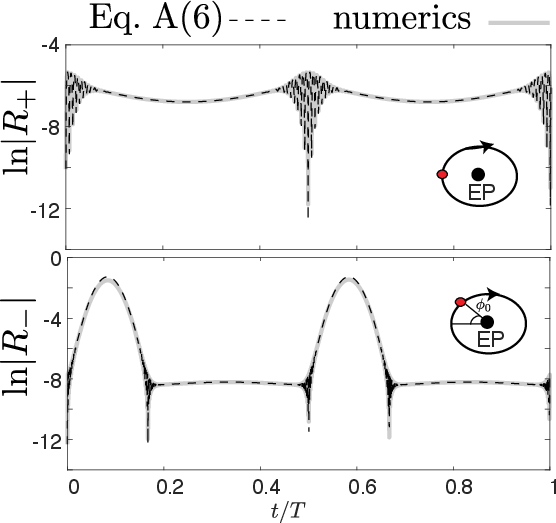
The population transfer is cast in terms of a Riccati variable R+(t)=c−(t)/c+(t), which obeys a nonlinear differential equation whose fixed points correspond to adiabatic (Rad) and non-adiabatic (Rnad) states. The critical question is determining when slow driving ceases to guarantee adiabatic following, i.e., the threshold Δ0 at which NATs ensue.
The central result is the universal form:
Δ1
where Δ2 encapsulates geometric and topological factors of the trajectory and Δ3 quantifies the minimal amplitude (seed) of instability. The analytic treatment pinpoints exact expressions for Δ4 across a taxonomy of loop geometries and establishes that two fundamentally distinct sources control the seed:
The geometric Stokes multiplierΔ5, associated with asymptotic structure and topological winding (e.g., Stokes lines crossed when encircling EPs).
The finite-precision floorΔ6, where Δ7 is the number of precision bits and Δ8 the base (commonly Δ9 for binary), standing for computational/experimental irreducibility in PIR.
This formula is validated across multiple families of trajectories:
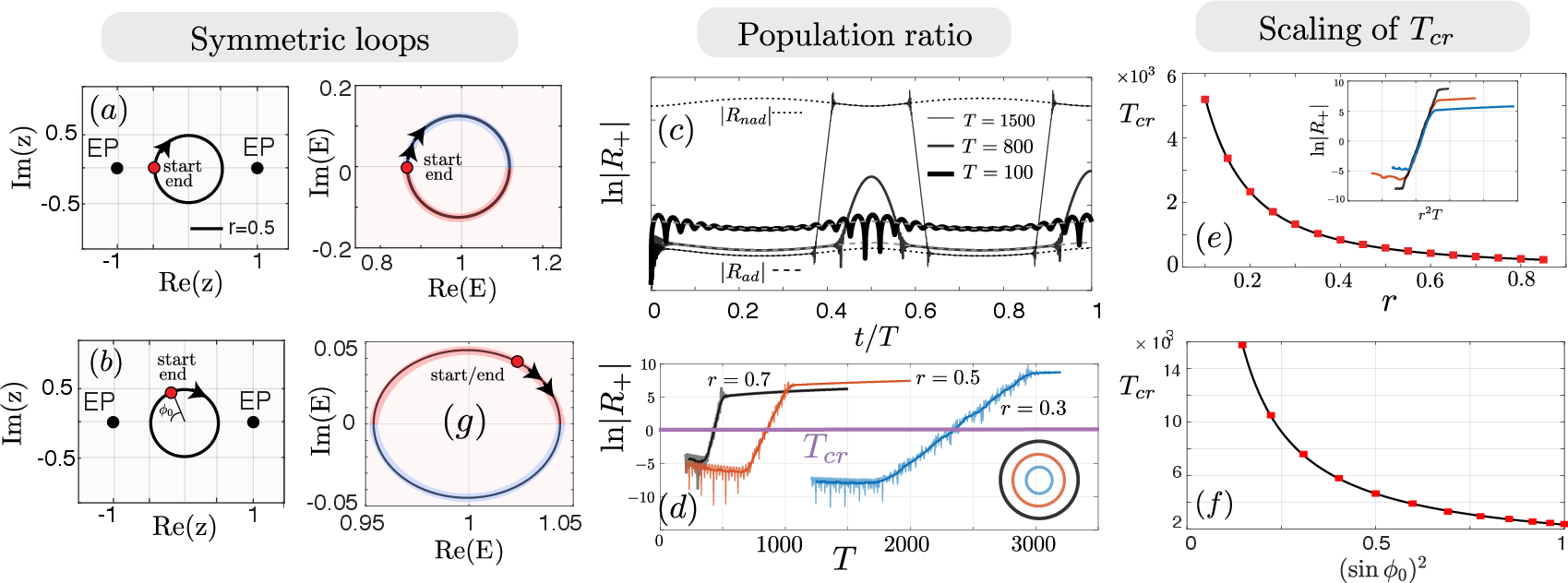
For symmetric, non-encircling loopsz(t)0, z(t)1 and thus z(t)2, directly manifesting PIR—irreversibility sourced purely in finite resolution.
For EP-encircling loops, the Stokes mechanism provides the dominant seed, yielding z(t)3 independent of z(t)4 until precision becomes the bottleneck.
Summary of scaling laws for z(t)5 for different geometries:
Geometry
Condition
z(t)6 Scaling
Symmetric loop
z(t)7
z(t)8
Phase-shifted symmetric
z(t)9
H(t)=(iz(t)−1−1−iz(t))0
Non-symmetric loop
H(t)=(iz(t)−1−1−iz(t))1
H(t)=(iz(t)−1−1−iz(t))2
Non-symmetric loop
H(t)=(iz(t)−1−1−iz(t))3
H(t)=(iz(t)−1−1−iz(t))4
Encircling loop
H(t)=(iz(t)−1−1−iz(t))5
H(t)=(iz(t)−1−1−iz(t))6
Figure 1: (a) Parameter loop H(t)=(iz(t)−1−1−iz(t))7 with EPs at H(t)=(iz(t)−1−1−iz(t))8; the corresponding energy trajectory and identification of stable/unstable segments are shown. (b-c) Time-evolution and critical-H(t)=(iz(t)−1−1−iz(t))9 crossing for ψ˙=−iHψ0.
For loops without any relevant symmetry or topological crossing, neither seed is active, so NATs are absent and the dynamics remain fully reversible.
Dynamics, Chirality, and the Role of ψ˙=−iHψ1
The analysis recovers and clarifies the crossover between two regimes: for ψ˙=−iHψ2, the averagely dominant eigenstate (ψ˙=−iHψ3) prevails at long times; for ψ˙=−iHψ4, the system transitions irreversibly to the instantaneous dominant eigenstate (ψ˙=−iHψ5), consistent with the "superadiabatic" limit.
A particularly significant corollary is that ψ˙=−iHψ6 determines the onset of chiral dynamics in parameter loops with PT-symmetric spectra. For ψ˙=−iHψ7, the final state is independent of the sense (clockwise or anticlockwise) in which the loop is traversed; for ψ˙=−iHψ8, chirality emerges, i.e., the final outcome is contingent on the directionality—a feature that underpins the use of such non-Hermitian loops for state control, interferometry, and measurement protocols.
Figure 3: ψ˙=−iHψ9 as a function of ImE(t)0 for clockwise (red) and anticlockwise (blue) evolution, confirming that chirality sets in only for ImE(t)1.
The connection between the universal transition at ImE(t)2 and the onset of chirality allows experimental identification and control of these dynamical regimes via tuning of driving speed or system geometry.
Role of the Instability Seed and Precision-Induced Irreversibility
The identification of the physical origin of the instability seed ImE(t)3 is a central contribution. For symmetric non-encircling trajectories, the absence of a Stokes multiplier means that the instability and the corresponding NAT are entirely consequences of finite precision:
Figure 2: The critical timescale ImE(t)4 scales linearly with the number of precision bits ImE(t)5 for symmetric non-encircling loops, as predicted for purely precision-limited, PIR-governed transitions.
For EP-encircling protocols, the Stokes multiplier sets a lower bound on ImE(t)6, with finite precision entering only at much longer timescales. The transition from the adiabatic to the non-adiabatic branch, triggered when the largest available seed is amplified beyond threshold, is directly linked to the breakdown of reversibility and the establishment of a "chronological barrier" to returning to the initial state. This realizes a forward-evolution manifestation of PIR—irreversibility that can be probed without time-reversal (echo) protocols.
Implications, Theory-Experiment Interface, and Future Directions
The results provide explicit, testable formulas for the design and diagnosis of non-Hermitian dynamical protocols in photonics, acoustics, and synthetic quantum systems. The identification of ImE(t)7 as the product of geometry and instability seed (with quantitative dependence on resolution/precision) offers a powerful tool for:
Experimental design:ImE(t)8 sets a critical device size (or protocol duration) separating reversible and irreversible behavior, and thus can be employed to optimize state conversion, chiral transfer, and dynamical state control.
Assessment of hardware limitations: On programmable platforms, altering ImE(t)9 (the number of bits or resolution) allows direct observation and characterization of PIR, potentially even allowing "tunable irreversibility."
Theoretical extension: The analytic methods (bifurcation, Riccati approach) and scaling results are readily generalizable to higher-dimensional non-Hermitian models and to intricate path geometries, including arbitrary parameter manifolds enclosing multiple EPs.
Furthermore, by making the connection between E±=±1−z2(t)0, chirality, and irreversibility explicit, the work provides a rigorous foundation upon which to study quantum measurement (via non-Hermitian loops) and exotic state-selection phenomena in open quantum systems.
Conclusion
This paper establishes a universal, analytic framework for predicting, understanding, and controlling the onset of non-adiabatic transitions and associated irreversibility in slow non-Hermitian dynamics. By deriving explicit scaling laws and exposing the dual geometric and precision origins of instability seeds, the research resolves longstanding ambiguities in the theory of non-Hermitian state conversion and irreversibility. The results are broadly applicable across experiment and theory, offering algorithmic tools and insights for both fundamental and applied research in driven open quantum systems.
“Emergent Mind helps me see which AI papers have caught fire online.”
Philip
Creator, AI Explained on YouTube
Sign up for free to explore the frontiers of research
Discover trending papers, chat with arXiv, and track the latest research shaping the future of science and technology.Discover trending papers, chat with arXiv, and more.