- The paper introduces a self-consistent ODE framework that predicts both steady-state and time-evolving emittances in advanced light sources subject to IBS and coupling effects.
- It rigorously incorporates betatron coupling, vertical dispersion, and damping partition redistribution to benchmark analytical predictions against numerical simulations.
- Numerical studies highlight that betatron coupling achieves lower horizontal emittance compared to vertical excitation, emphasizing optimal operational trade-offs.
Self-Consistent Treatment of Intra-Beam Scattering, Betatron Coupling, and Vertical Dispersion in Fourth-Generation Light Sources
Introduction
The paper presents an Ordinary Differential Equation (ODE) based formalism describing the steady-state and time evolution of projected transverse and longitudinal emittances under the simultaneous action of synchrotron radiation (SR), quantum excitation (QE), betatron coupling, vertical dispersion, and Intra-Beam Scattering (IBS). The motivation arises from the operational regime of fourth-generation storage ring light sources, which target sub-nanometer horizontal emittances and high beam currents, leading to regime where IBS is no longer a negligible perturbation but a performance-limiting factor. The work focuses on technical advances for predicting emittance budgets and their time-dependence in realistic machines, considering the impact of optics configurations, collective effects, and operational constraints.
Theoretical Framework
The work extends the classical ODE approach for equilibrium emittance prediction by incorporating self-consistent treatment of betatron coupling and dispersion—effects previously neglected or handled approximately in IBS calculations for light sources. The mathematical formulation describes the four-dimensional phase space via the covariance matrix Σ, with analytical equilibrium solutions for projected emittances as functions of the coupling coefficient ∣C−∣, tune separation Δ, and local and global lattice parameters. Importantly, the framework allows for arbitrary redistribution of the SR damping partition numbers, accounting for modifications of radiation damping rates caused by lattice coupling knobs.
The model captures not only steady-state emittances but also their full time-evolution with contributions from relaxation (SR), energy excitation (QE), emittance partitioning (betatron coupling), and phase-space density blowup (IBS). Beam dynamics near linear difference resonance are accurately described, while quantitative limitations where sum resonance and strong coupling dominate are noted. The conversion between projected and mode (eigen-) emittances is rigorously formalized for benchmarking with simulation data (Figure 1).
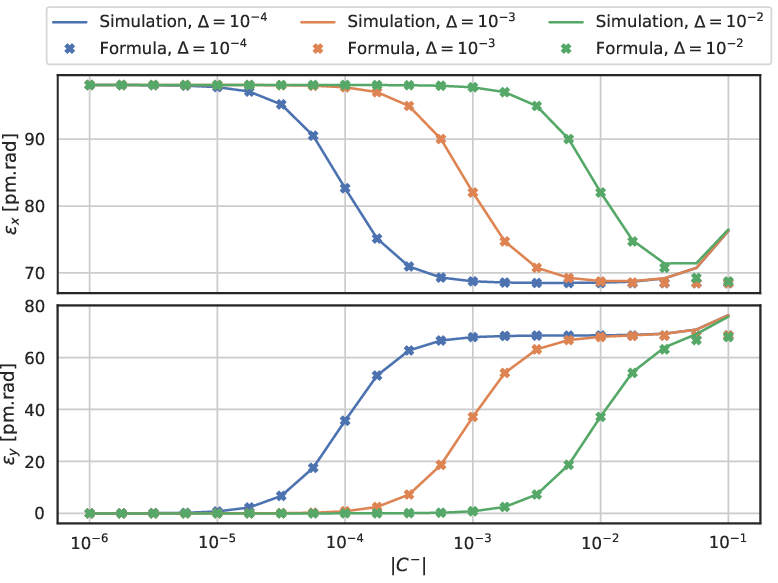
Figure 1: Simulated and calculated (using Eq.~\eqref{eq:eps_ss}) projected emittances versus coupling coefficient for different tune separations, benchmarking the analytical model.
Generation and Control of Vertical Emittance
Two physically distinct strategies for introducing vertical emittance are analyzed: betatron coupling and vertical dispersion. Their respective implementations via lattice knobs are detailed; coupling is achieved using skew quadrupoles with phase-weighting based on the optics, while vertical dispersion is generated via programmed vertical orbit offsets in dispersive sextupoles. The coupling approach allows emittance sharing without significant perturbation of the projected beta functions or vertical dispersion at insertion devices, facilitating well-controlled round beam configurations (Figure 2).
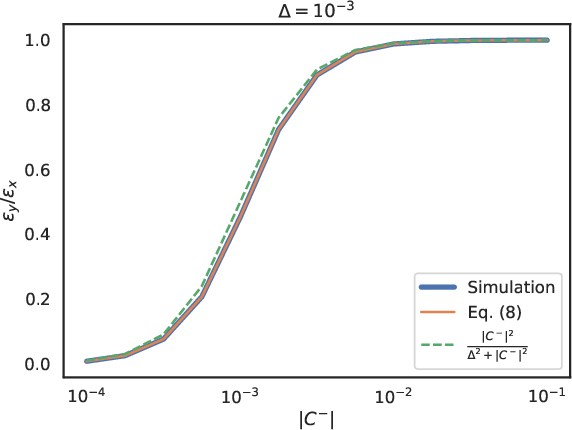
Figure 2: Simulated and calculated projected emittance ratios versus the coupling coefficient at fixed small tune separation, comparing with classical models.
The optical consequences of each method are contrasted. For example, vertical dispersion-generated emittance introduces more pronounced distortions and is operationally limited. The behavior of beta functions and dispersion under both strategies for selected emittance ratios is illustrated for the BESSY III lattice (Figures 3 and 4).
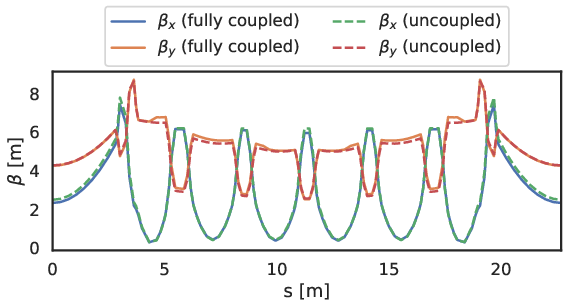
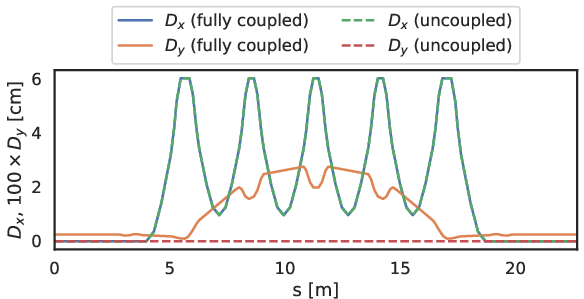
Figure 3: Beta functions and transverse dispersion along a superperiod in the uncoupled and fully coupled cases (betatron coupling knob), illustrating near-identical projected lattice functions in the coupled case.
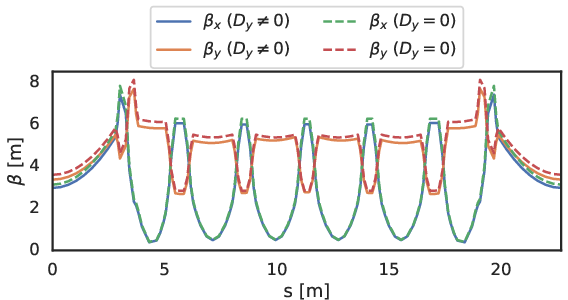
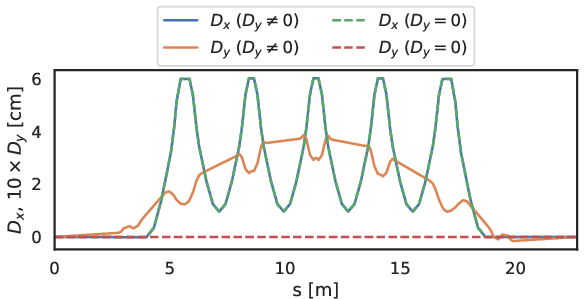
Figure 4: Beta functions and transverse dispersion in the uncoupled and lightly coupled cases (vertical dispersion knob), showing enhanced vertical dispersion and beta function perturbations at moderate emittance ratios.
Time Evolution and IBS Impact
The inclusion of IBS modifies the dynamical emittance behavior. The ODE formalism yields coupled differential equations incorporating time-dependent SR damping, quantum excitation, emittance sharing, and rate-dependent IBS blowup. In contrast to traditional implementations that assume instantaneous transverse equilibrium, the model provides the complete temporal relaxation, revealing that SR, IBS, and coupling operate on comparable timescales (Figures 5 and 6).
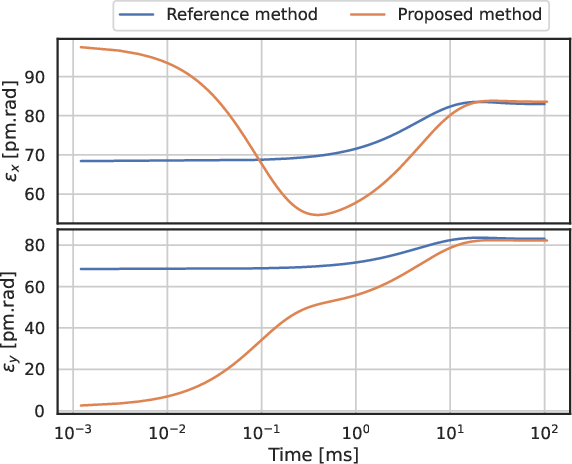
Figure 5: Time evolution of the transverse projected emittances with the reference (Xsuite-based) and proposed ODE-based methods, highlighting differences in transient behavior and convergence.
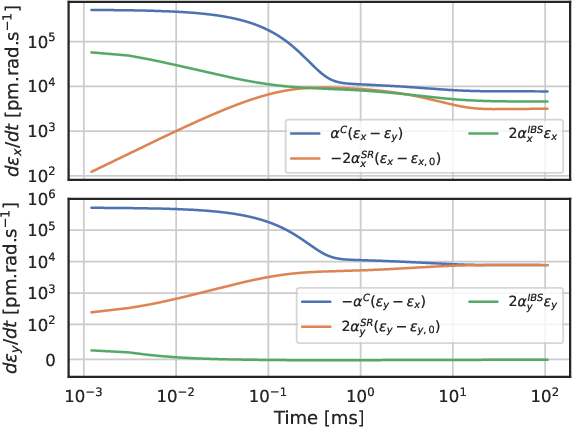
Figure 6: Individual contributions (SR, IBS, coupling) to the horizontal and vertical projected emittance rate equations, clarifying dominance and transitions during approach to equilibrium.
The validity of the analytical emittance/mode partitioning and the redistribution of damping partition numbers in the presence of betatron coupling are demonstrated through conversion formula benchmarking and direct comparison with numerical tracking (Figures 7 and 8).
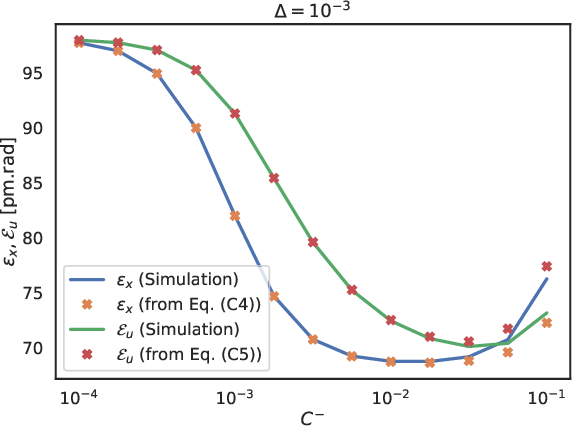
Figure 7: Validation of the mode-projected emittance conversion formulas as a function of coupling strength.
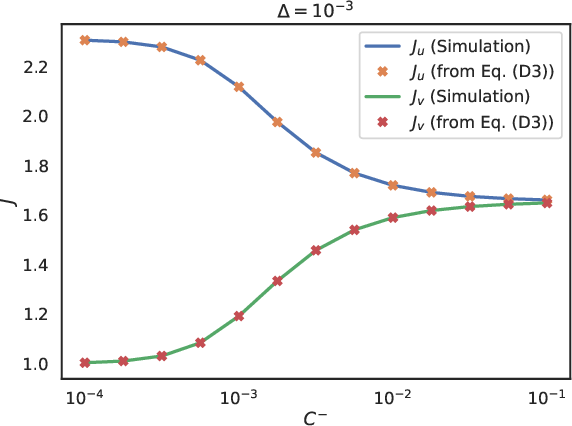
Figure 8: Validation of the redistribution formula for coupled damping partition numbers against simulation.
Quantitative Results and Trade-Off Analysis
Numerical studies for BESSY III reveal that all three vertical emittance generation techniques (vertical excitation, betatron coupling, vertical dispersion) produce similar horizontal steady-state emittances at low vertical-to-horizontal emittance ratio (κ), while differences emerge at larger ratios. Notably, betatron coupling enables a more substantial reduction in steady-state horizontal emittance compared with vertical excitation, given the constraint that the latter imposes vertical emittance as a fixed fraction of the horizontal one rather than allowing full self-consistent relaxation. Vertical dispersion is hampered by beamline optics distortions as increasing κ (see main text).
The implications for operational flexibility are clear: while betatron coupling is optimal in terms of minimum horizontal emittance at high κ, it imposes restrictions on the working point, dynamic aperture, and momentum acceptance, and may compromise resonance avoidance. Vertical excitation, by contrast, offers greater operational simplicity and is attractive for scenarios where a moderate vertical emittance ratio is sufficient.
Practical and Theoretical Implications
This self-consistent, comprehensive treatment enables precise prediction of time-resolved and steady-state emittance budgets for cutting-edge light sources. It resolves longstanding ambiguities in describing the competition between SR damping, IBS blowup, and the role of lattice optics manipulations for vertical emittance generation in the context of real-world operational constraints and machine imperfections.
The approach clarifies the necessity of including damping partition redistribution and self-consistent optics when predicting IBS-limited performance, especially as designs progress toward diffraction-limited storage rings. Notably, it sets the stage for more advanced models, including those incorporating space charge, higher-order collective effects, and longitudinal beam manipulations (e.g., with harmonic cavities), necessary for next-generation synchrotron and free electron laser projects.
Future developments may extend the ODE methodology to include macroparticle tracking, detailed impedance models, and non-Gaussian distribution effects. Improvements in measurement techniques for optics and emittance partitioning will also enable more rigorous benchmarking and validation of the theoretical framework.
Conclusion
The paper provides an advanced, technically comprehensive ODE-based framework for evaluating the impacts of IBS, betatron coupling, and vertical dispersion on beam emittance dynamics in fourth-generation storage rings (2604.01892). The model accurately predicts both steady-state and time evolution of projected emittances, facilitating better-informed design trade-offs and operational strategies for achieving ultralow emittance with high current. This work resolves key limitations of previous treatments regarding damping partition redistribution and coupling, and offers a foundation for further theoretical development and experimental validation in the high-brightness light source community.