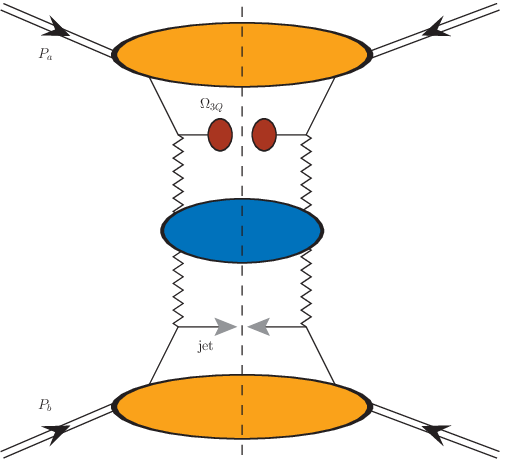
- The paper presents a diquark-inspired fragmentation approach for triply heavy Ω baryon production using full NLO calculations for both charm and bottom channels.
- It employs a hybrid high-energy factorization method that merges collinear PDFs/FFs with BFKL resummation to achieve stable predictions.
- Phenomenological results predict observable cross sections at HL-LHC and FCC with narrow uncertainty bands, highlighting robust theoretical control.
Triply Heavy Ω Baryons at High Energy: Structure, Fragmentation, and Collider Phenomenology
Introduction and Motivation
The study "Triply Heavy Ω Baryons with JETHAD: A High-Energy Viewpoint" (2604.01871) provides a comprehensive analysis of triply heavy baryons, focusing primarily on the Ω3c (ccc) and Ω3b (bbb) states, in the context of high-energy hadronic collisions. The work addresses the construction of variable-flavor number scheme (VFNS) fragmentation functions (FFs), their DGLAP evolution, and the impact of high-energy logarithmic resummation on phenomenological predictions at the HL-LHC and FCC. The theoretical framework combines a diquark-inspired proxy model for FFs, a detailed factorization approach, and a state-of-the-art computational infrastructure (JETHAD).
Fragmentation Functions for Triply Heavy Baryons
Theoretical Construction
Triply heavy baryon FFs, denoted as {\tt OMG3Q1.0}, are formulated within a diquark proxy model that captures the dominant nonperturbative dynamics of baryon formation. The model utilizes a two-step mechanism, where a constituent heavy quark fragments into a color-antitriplet diquark, which then hadronizes nonperturbatively into the final-state baryon. This theoretical construction allows for a consistent treatment of both quark- and gluon-initiated fragmentation channels:
- Quark channel: Leading-order and next-to-leading order SDCs are evaluated, combining perturbative kinematics with a phenomenological hadronization function (Peterson-type).
- Gluon channel: Initiated at higher perturbative order, the gluon fragmentation involves the formation of three heavy quarks via a gg→QQQ topology and is implemented at NLO.
The analytic structure of these FFs is governed by the convolution of partonic SDCs with the hadronization function. The hadronization parameter τP is fixed following scaling arguments for multi-heavy systems.
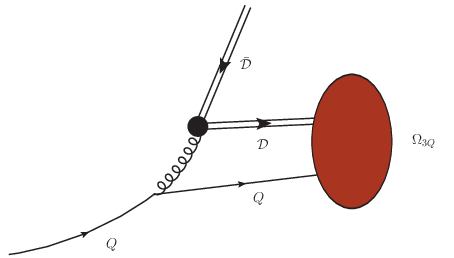
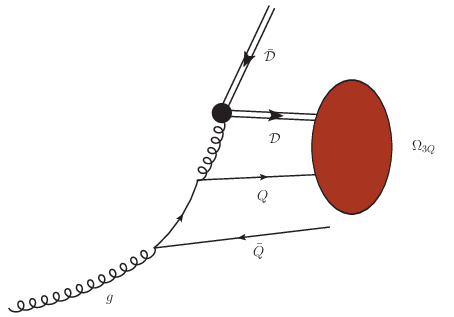
Figure 1: Representative leading-order diagrams for the diquarklike proxy model describing the initial-scale collinear fragmentation of a constituent heavy quark (left) and a gluon (right) into a triply heavy Ω3Q baryon.
DGLAP Evolution and Heavy-Flavor Thresholds
The initial-scale FFs are evolved to collider-relevant scales using the {\tt HF-NRevo} approach. This implements DGLAP evolution with explicit accounting for threshold effects and variable matching scales for the initiation of charm and gluon channels. The resulting {\tt OMG3Q1.0} grids are tabulated in {\tt LHAPDF6} format, optimized for direct phenomenological application.
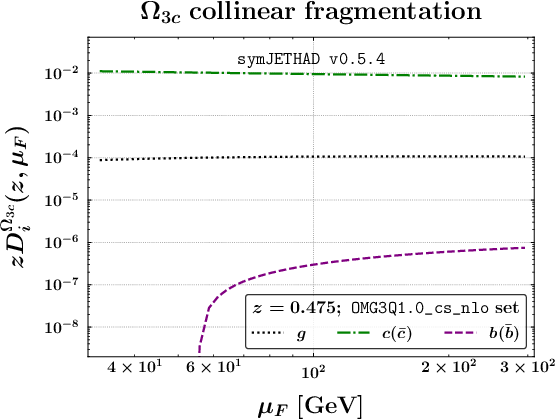
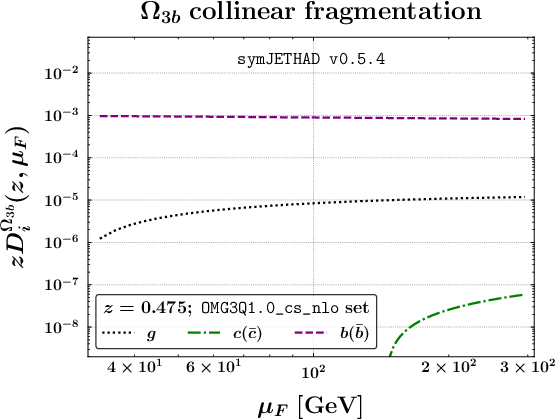
Figure 2: Factorization-scale dependence of the {\tt OMG3Q1.0} NLO FFs for Ω3c (left) and Ω0 (right) at fixed Ω1.
A key numerical result is the dominance of the constituent-heavy-quark FF over the gluon (and dynamically generated nonconstituent quark) channels throughout the relevant Ω2 range, with gluon contributions suppressed by two or more orders of magnitude.
High-Energy Hybrid Factorization and Resummation
For single and multi-differential cross section calculations involving semi-inclusive Ω3 plus jet final states, the paper employs a hybrid factorization scheme. This formalism consistently merges collinear (DGLAP) and high-energy (BFKL) resummation:
The factorization scale is set to the natural kinematic value Ω7, enabling control of MHOUs through scale variation.
Phenomenological Predictions: HL-LHC and FCC Sensitivity
Rapidity-Differential Distributions
The Ω8 distributions for Ω9jet and Ω3c0jet production are computed for HL-LHC (Ω3c1 TeV) and FCC (Ω3c2 TeV), for Ω3c3.
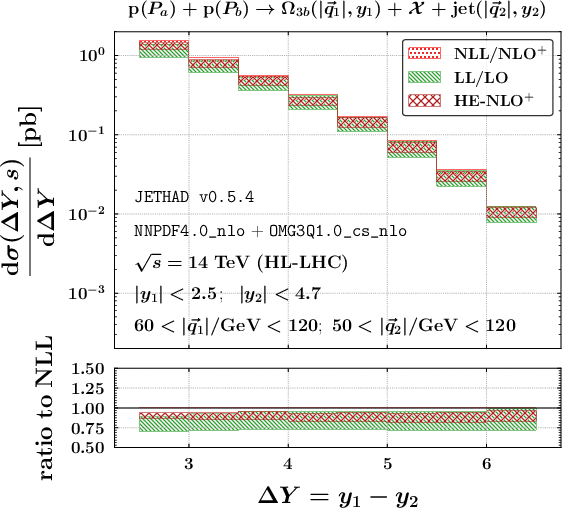
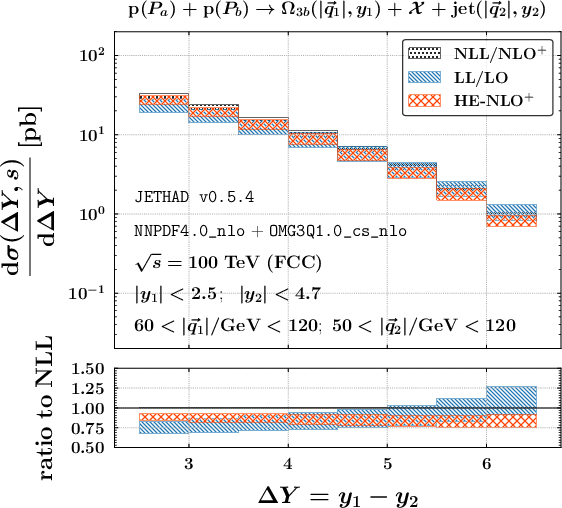
Figure 4: Rapidity-differential distribution of semi-inclusive Ω3c4 plus jet at HL-LHC (left) and FCC (right); shaded bands represent MHOU uncertainties.
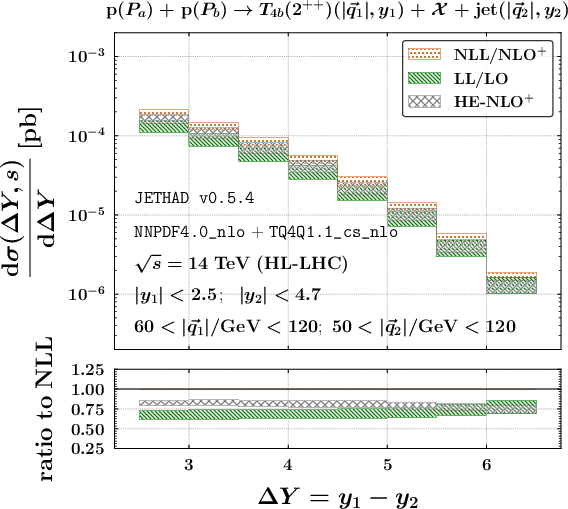
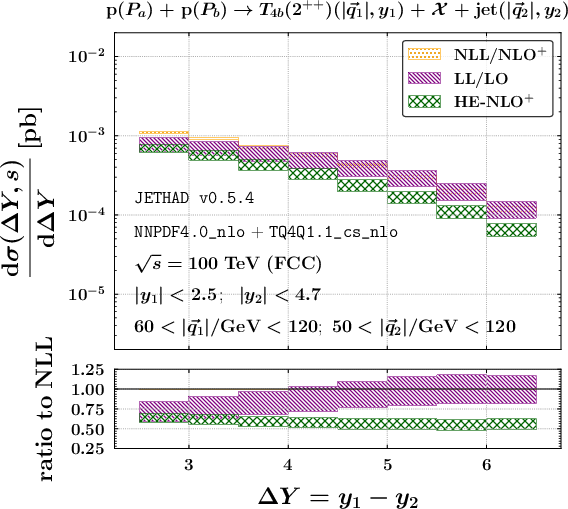
Figure 5: Rapidity-differential distribution for semi-inclusive 4b plus jet production, analogous cuts.
Strong enhancement—an order of magnitude or more—is observed in the cross section when moving from HL-LHC to FCC kinematics. The Ω3c5 cross section dominates over the tetraquark channel by 2–3 orders of magnitude, especially at large rapidity separations. The behavior is monotonic in Ω3c6, with high-energy resummation stabilizing theoretical predictions and reducing scale uncertainties compared to fixed-order.
Transverse-Momentum-Differential Observables
Differential distributions in Ω3c7 for Ω3c8 exhibit smooth monotonic decrease and persistently stable theoretical uncertainties across the explored phase space:
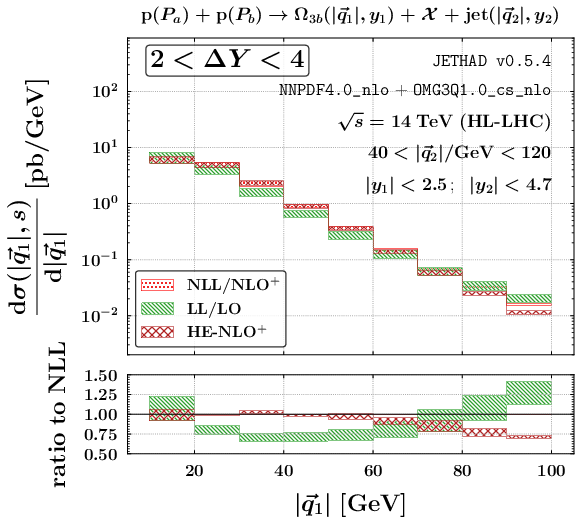
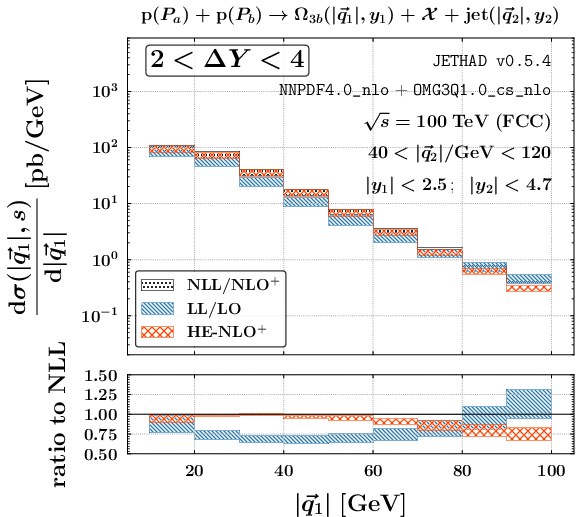
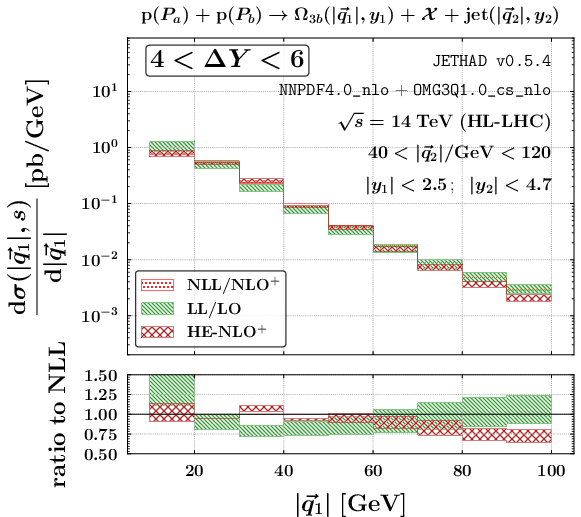
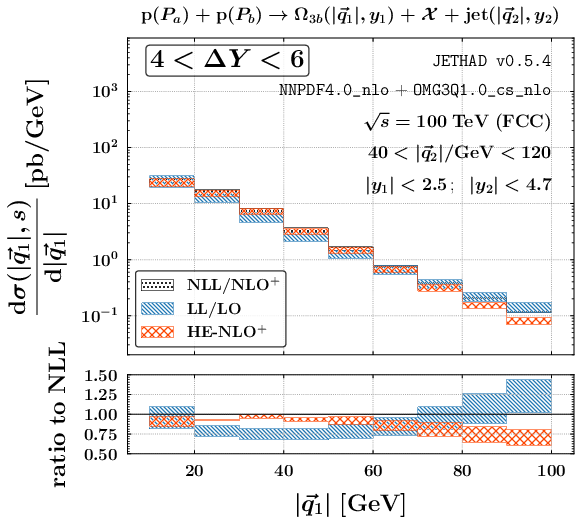
Figure 6: Transverse-momentum-differential spectra for Ω3c9jet at HL-LHC and FCC; top and bottom panels correspond to ccc0 and ccc1.
Resummation effects become more pronounced at high ccc2 as deviations from DGLAP fixed-order approximations grow, particularly at FCC energies.
Implications and Outlook
The comprehensive analysis shows that triply heavy ccc3 baryons—most notably ccc4—are robust probes for both the nonperturbative structure of cold QCD matter and the dynamics of the high-energy regime at future hadron colliders. The simultaneous inclusion of heavy-quark and gluon fragmentation channels allows for the examination of potential intrinsic heavy-flavor content and the assessment of competing color and threshold dynamics. The demonstrated "natural stability" of high-energy resummation when connected to VFNS-based FFs is a significant technical result, with the size of theoretical uncertainties under control even when varying MHOU-relevant scales.
Practically, the ccc5 channel will be pivotal for future experimental searches and could serve as an anchor for validating FF determinations against global fits, especially as heavy-flavor tagging and vertexing improve at the FCC. The framework and FF sets ({\tt OMG3Q1.0}) are provided in public repositories for future collider phenomenology studies.
Conclusion
This work establishes the theoretical and phenomenological framework for the production of triply heavy baryons in high-energy collisions. By constructing and evolving diquark-inspired, hadron-structure-sensitive fragmentation functions and embedding them in a hybrid high-energy/collinear resummed factorization scheme, the paper achieves precision predictions across LHC and FCC relevant kinematic domains. The strong sensitivity of semi-inclusive ccc6 observables to both perturbative and nonperturbative effects, together with the demonstrated numerical stability and the practical availability of FF grids, position these channels as benchmark probes for future experimental and theoretical QCD programs.