- The paper introduces a ranking-guided framework that leverages cross-domain ranking and continuous distribution alignment to address ordinal class ambiguity in severity classification.
- It employs a hierarchical model where a feature extractor feeds both a standard classifier and a ranking function, resulting in significant improvements in macro F1 and precision over existing SSDA methods.
- Ablation studies confirm that combining cross-domain ranking and soft distribution alignment effectively mitigates class boundary challenges in clinical imaging tasks.
Ranking-Guided Semi-Supervised Domain Adaptation for Severity Classification
Problem Setting and Limitations of Existing Approaches
Semi-supervised domain adaptation (SSDA) has become a primary tool for mitigating domain shift in medical image analysis, where labeled data from the target domain are scarce and unlabeled data abundant. Severity classification, a core task in clinical decision support, introduces further challenges owing to the ordinal and continuous nature of classes—disease severity rarely presents with sharply delimited categorical boundaries. Existing SSDA methods generally assume the existence of compact, separable clusters in the feature space for each class, an assumption that fails in the context of severity classification, resulting in suboptimal generalization and impaired class order transfer.
Methodology: Ranking-Guided Domain Alignment
To address the inherent ordinal structure and class boundary ambiguity, the paper proposes a framework leveraging learning to rank as a backbone for SSDA in severity classification. This approach fundamentally shifts the alignment process from discrete classes to a continuous ranking representation, more faithfully reflecting disease progression.
The architecture is a hierarchical model, with a feature extractor Fe that outputs representations to both a standard classifier Fc and a ranking function Fr. The framework is trained in two critical stages:
- Cross-Domain Ranking (CDR): Pairwise ranking operates on both intra- and inter-domain pairs, enforcing consistency in ordinal relationships across source and target. By minimizing a pairwise ranking loss (RankNet), CDR ensures rank scores corresponding to greater severity maintain order, effectively inducing a target severity scale aligned with the source.
- Continuous Distribution Alignment (CDA): To accommodate unlabeled target samples and mitigate class boundary ambiguity, CDA utilizes soft rank-based labels obtained from GMMs fitted to rank score distributions. Instead of attempting hard assignment, CDA minimizes the distance between sample rank scores and mean rank scores (prototypes) of source classes, weighted by the association probability—a design well-suited for ordinal and continuous domains.
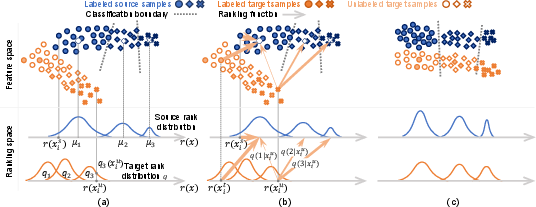
Figure 1: The method aligns features by transferring ordinal structure to a rank space, with CDR aligning labeled pairs across domains, and CDA matching soft distributions for unlabeled and labeled samples.
CDR and CDA are jointly optimized with classification loss, with a balancing hyperparameter λ regulating the influence of distributional alignment.
Visualization and Effect of Cross-Domain Ranking
The effectiveness of the CDR component is particularly visible in rank score distribution visualizations. Without CDR, learning to rank solely within domains results in domain-specific orderings that may not correspond—incorrectly aligning, for example, severe class samples in the target to moderate class samples in the source. CDR directly addresses this by aligning the ordinal escalation curve across both domains.
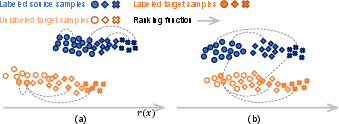
Figure 2: CDR ensures alignment of ordinal class distributions across source and target domains by introducing inter-domain ranking pairs.
Experimental Results
Extensive evaluation is conducted on two medical imaging challenges: ulcerative colitis (UC) classification using the LIMUC and a private hospital dataset, and diabetic retinopathy (DR) using DDR and FGADR. Both tasks are annotated on multi-level ordinal scales. The protocol involves limited labeled target samples (10/class) and 5-fold cross-validation.
The approach demonstrates improved macro F1 and macro Precision (mF1, mP) in both transfer scenarios compared to established SSDA baselines. Notably, in the LIMUC→Private setting, mF1 reaches 0.494, outperforming MME (0.477) and CDAC (0.430), with larger increases in macro Precision. In the DDR→FGADR experiment, the proposed framework is the only one exceeding 0.47 in macro Precision and 0.40 in macro F1, indicating robust transfer of not only overall accuracy but class order integrity as well.
Ablation analyses confirm the complementary impact of CDR and CDA: CDR primarily boosts precision via better ordered alignment, while CDA improves recall by soft-aligning distributions, resulting in maximal F1 when combined.
Visualization of Rank Score Distribution
The alignment efficacy is further corroborated by visualizing rank score distributions pre- and post-adaptation for both domains. The proposed method substantially reduces distributional mismatch, especially within ambiguous inter-class regions.
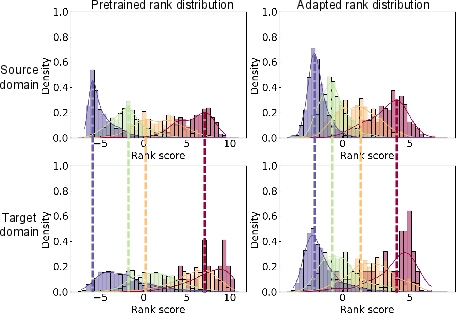
Figure 3: The rank score distributions before and after adaptation show class-conditional alignment in both the source and target domains achieved by the proposed method.
Theoretical Implications and Prospects
This work advances the conceptual toolkit for domain adaptation in ordinal and severity-aware tasks by explicitly representing class order and mitigating hard class assignment. Treating the alignment challenge in severity classification as one of continuous, rather than categorical, distribution alignment opens opportunities for robust transfer in other ordinal labeling regimes, such as lesion grading or progression prediction. The rank-guided alignment relaxes problematic cluster assumptions and can be extended to more complex ordinal tasks or multi-modal domains.
Future directions may include:
- Integrating advanced or learned similarity metrics in the ranking space for better capturing non-linear ordinal progression.
- Extending the framework to unsupervised or few-shot adaptation for even scarcer label regimes.
- Adapting to domains where inter-annotator variability induces further uncertainty in severity boundaries.
Conclusion
The paper presents a ranking-guided SSDA framework tailored for severity classification under domain shifts, systematically addressing the pitfalls of cluster-based adaptation in ordinal tasks. By leveraging cross-domain ranking and continuous distribution alignment, the method offers consistent performance boosts on clinically relevant benchmarks, establishing a principled template for robust domain adaptation in settings with ambiguous class boundaries and inherent class order (2604.01834).