- The paper introduces a unified multiphase cross-diffusion model for tissue by deriving nonlinear PDEs from mass conservation and force balance.
- It rigorously establishes global weak solution existence, uniqueness, and exponential entropy decay under specific symmetric and positivity conditions.
- Numerical experiments validate convergence and reveal dynamic tumor-ECM interfaces, offering insights into tumor growth and tissue segregation.
Multiphase Cross-Diffusion Models for Tissue Structures: Modeling, Analysis, and Numerics
Introduction and Modeling Framework
The paper "Multiphase cross-diffusion models for tissue structures: modeling, analysis, numerics" (2604.01827) establishes a broad and unified class of nonlinear cross-diffusion PDE models governing volume fractions of constituent phases in tissue, grounded in mass conservation and force balance with detailed energetics. The framework extends classical multiphase models by systematically deriving the governing equations from compressible Navier-Stokes-type balances under the volume-filling (saturated mixture) constraint, with the mixture composed of cells, extracellular matrix (ECM), and solvent.
The authors generalize the force interactions to include quadratic (degenerate) pressure-like terms and nondegenerate symmetric drag, yielding a family of cross-diffusion systems encapsulating Maxwell-Stefan, thin-film, volume-filling population, Busenberg–Travis, and advanced tumor growth models. Notably, novel entropy structures—both Boltzmann-type and Rao-type—are rigorously derived and play a central role in proving existence and qualitative behavior of solutions, including boundedness, exponential decay, and uniqueness under specific symmetry and positivity conditions of the model coefficients.
Analytical Results: Existence, Uniqueness, and Long-time Behavior
A key theoretical advancement is the rigorous establishment of global in time, bounded weak solutions for systems with equal drag coefficients and symmetric, positive definite pressure matrices. The approach leverages the boundedness-by-entropy methodology via the Boltzmann entropy, leading to an a priori L∞ bound and an entropy dissipation inequality. Specifically, if the pressure matrix Q+R remains uniformly positive definite, weak solutions not only exist globally but their entropy decays exponentially to the spatial average steady state.
Moreover, in the subclass where intraphase and interphase pressures coincide and symmetric drag is present, weak-strong uniqueness is proven for a regularized problem using the relative Rao entropy. This foundational result indicates solution stability and continuous dependence on initial data in the compatible entropy regime.
Conversely, if drag coefficients differ, the standard entropy methods break down generically due to the lack of compatible degeneracies, and existence theory requires either perturbative analysis (with drag close to unity) or careful case analysis (fully characterized for n=2). The positively stable property of the resulting diffusion operator in this setting, however, still guarantees short-time existence of classical solutions.
Tumor Growth and Multiphase Model Analysis
The framework explicitly encompasses and extends the cross-diffusion tumor growth models in the sense of Jackson and Byrne, describing interfaces between tumor cells and ECM under "volume-filling" and nonlinear cross-interaction. In-depth spectral analysis reveals that for supercritical parameters, positivity or parabolic character of the operator can break down, precluding well-posedness—a concrete illustration of the necessity of entropy structure compatibility for global theory.
Numerical Investigation and Solution Structure
Numerical experiments are conducted on the derived multiphase cross-diffusion systems using structure-preserving finite-volume schemes. Detailed convergence studies confirm accuracy and demonstrate the preservation of maximum principles and total mass. The authors investigate the dynamic evolution of tumor-ECM interfaces for varying cross-diffusion parameters, capturing sharp moving fronts and spatial segregation effects characteristic of tumor invasion.
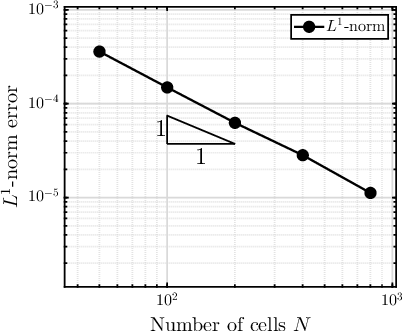
Figure 1: Convergence rate in the discrete L1 norm for the tumor-growth model (β=0.0015,θ=100).
The volume-filling property enforces the saturation constraint, while the strongly degenerate cross-diffusion yields heterogeneous, segregated profiles even absent explicit reaction or proliferation terms. The formation and propagation of ECM peaks, as well as sharp tumor cell fronts, are documented under supercritical and subcritical regimes.
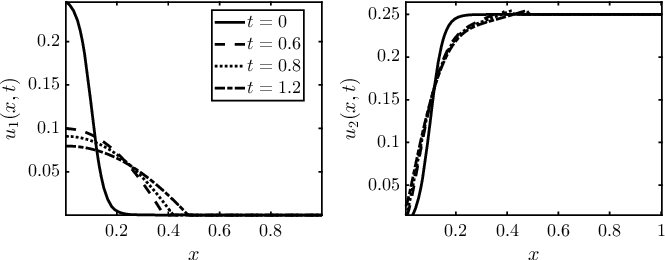
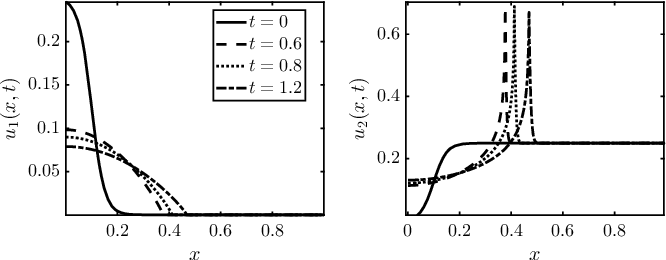
Figure 2: Volume fractions of tumor cells (left) and ECM (right); θ=30 (top, subcritical), θ=1000 (bottom, supercritical); cell front and ECM peaks migrate in time.
The numerical results display nontrivial behaviors: for strong cross-interactions (supercritical θ), the system shows ECM accumulation and persistence phenomena, with relative entropy exhibiting linear or even convex decay phases, indicating transient non-exponential dynamics due to the underlying degeneracies.
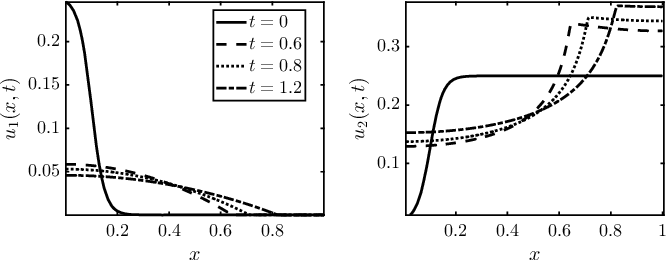
Figure 3: Volume fractions for symmetric pressure parameters (βc=βm=1, θ=100); sustained ECM peaks post-transition.
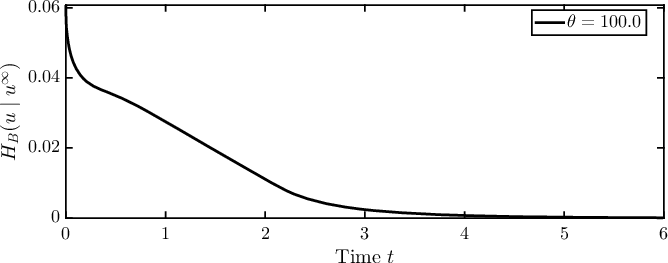
Figure 4: Relative entropy decay for tumor-growth model (Q+R0, Q+R1); the behavior is monotone but not universally exponential.
Extension to a general multiphase setting—where interactions are parametrized by two cross-coupling strengths—demonstrates that certain parameter choices recover classical SKT-type segregation but in a rigorously volume-bounded fashion, while higher order cross-interactions can generate complex interface and decay dynamics.
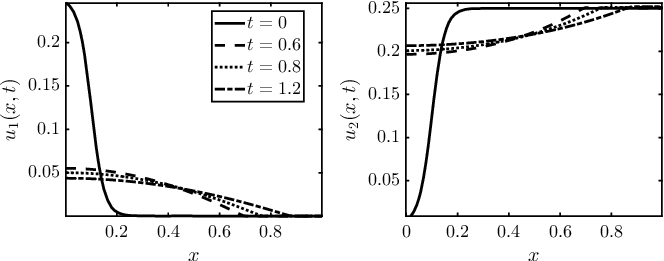
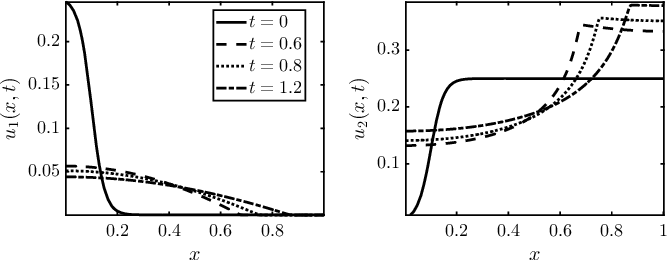
Figure 5: Volume fractions of the multiphase model with Q+R2, Q+R3 (top) and Q+R4 (bottom); increased cross-diffusion sharpens ECM transitions.
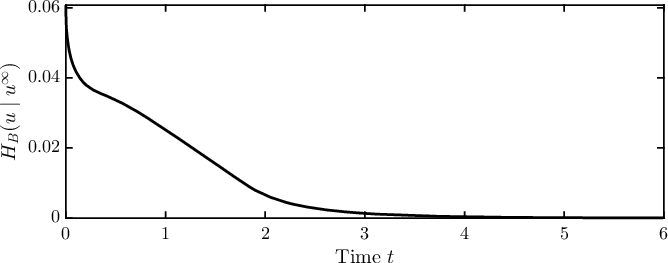
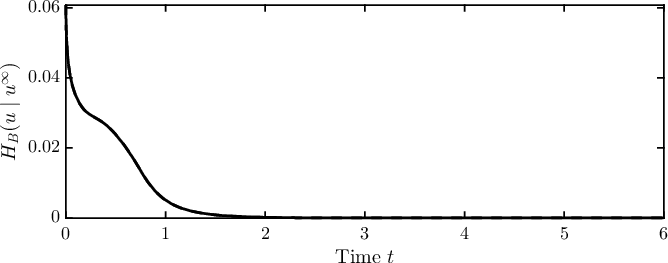
Figure 6: Relative entropy in the multiphase model for increasing cross-interaction strength; stronger coupling yields faster, potentially non-exponential decay.
Implications and Theoretical Insights
The systematic derivation and entropy analysis underscore that the degenerate structure of pressure and drag terms governs not only well-posedness and stability but also the qualitative spatiotemporal patterns seen in tissue composition models and morphogenetic processes. Entropy-compatible cross-diffusion models give rise to genuine saturation constraints and composition bounds, critical for realistic biological modeling where voids or over-concentration are unphysical.
Practically, the results indicate that biological patterning and tumor invasion phenomena are deeply tied to the algebraic structure of mechanical and adhesive interactions—parameters that correspond to experimentally accessible tissue properties. Moreover, the positive results for perturbed drag coefficients and the explicit critical parameter thresholds provide guidance for robust model calibration, numerical analysis, and experimental validation in continuous tissue modeling.
Conclusions
This work provides a comprehensive theoretical and numerical analysis of multiphase cross-diffusion systems modeling tissue structures, unified through an entropy-centered methodology. The results establish strong existence, uniqueness, stability, and dynamical behavior statements under precise structural conditions, and use them to analyze complex spatiotemporal phenomena in tumor and population segregation. The explicit identification of entropy compatibility as the central tool suggests future directions—including entropy-preserving numerical schemes, extension to full Navier-Stokes–based models, and application to multiscale biological pattern formation.

