- The paper shows that first-order phase transitions imprint distinctive signatures on the interior spacetime of AdS black holes.
- The authors employ a 3+1 dimensional AdS black hole model with a charged scalar field and nonlinear quartic interactions to extract Kasner exponents from near-singularity dynamics.
- The results indicate that distinct oscillatory and monotonic interior regimes serve as robust diagnostics for phase transitions, with implications for holographic dual theories.
Interior Geometry of Black Holes as a Diagnostic of First-Order Phase Transitions
Theoretical Framework and Motivation
Understanding the impact of black hole thermodynamics on the interior geometry has remained an open problem, particularly in the context of phase transitions in Anti-de Sitter (AdS) black holes with scalar hair. Traditionally, diagnostics of black hole phase transitions are predicated on external observables—thermodynamic quantities defined at the event horizon or at the asymptotic boundary. This work presents a significant advancement by demonstrating that macroscopic phase transitions imprint distinctive signatures on the near-singularity interior spacetime, offering a fundamentally new class of probes grounded in the Kasner metric description of the black hole interior.
In this setup, a 3+1 dimensional AdS black hole is coupled to a charged scalar field with a nonlinear quartic interaction. The nonlinear term, parameterized by a coupling λ, is engineered to support first-order phase transitions. By fixing the total charge density, the authors work in a canonical ensemble, with the action, metric ansatz, and temperature definitions providing the precise framework required for analyzing both the thermodynamics and the interior solutions.
First-Order Phase Transitions and Interior Geometric Response
The scalarized AdS black hole solutions exhibit a quintessential "swallowtail" form in the free energy G(T) diagram for sufficiently negative λ, signaling the presence of a first-order phase transition between two distinct stable branches. These branches correspond to different macroscopic thermodynamic phases, as characterized by the scalar hair and the associated order parameters.
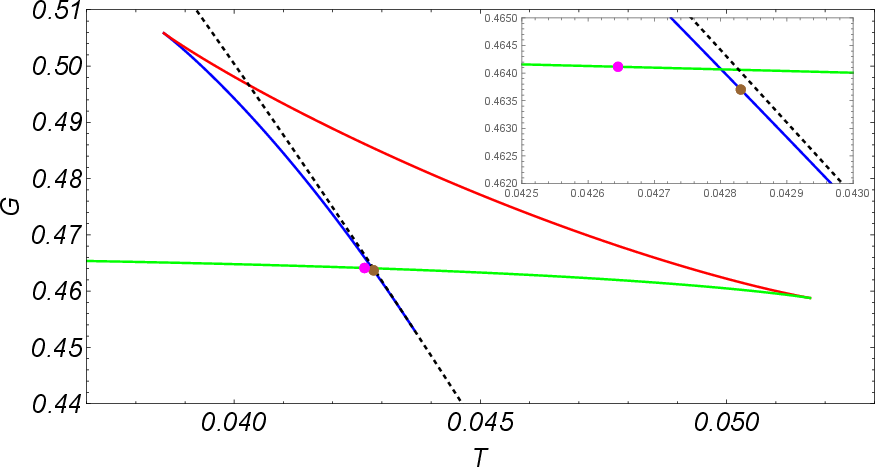
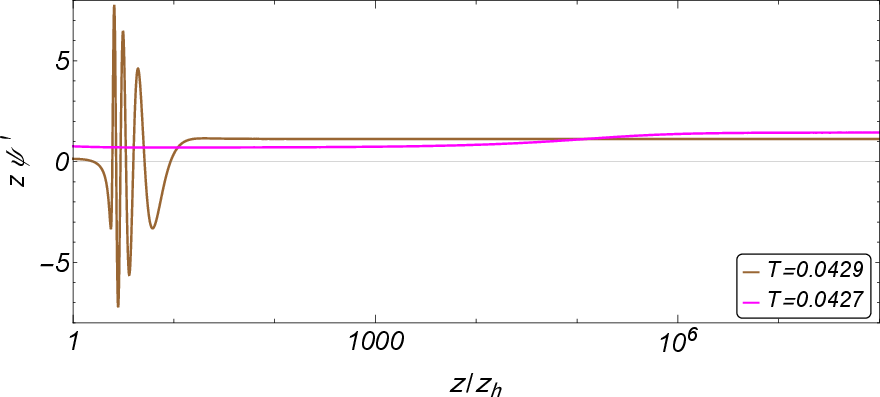
Figure 1: The free energy landscape for a first-order phase transition (top), and the corresponding scalar field profiles inside the black hole (bottom), highlighting oscillatory versus monotonic behaviors tied to the distinct thermodynamic branches.
The response of the scalar field ψ(z) inside the horizon is highly sensitive to the thermodynamic phase. On the high-temperature (upper) branch, the approach to the singularity is characterized by pronounced oscillatory behavior, while the low-temperature (lower) branch yields a smooth, monotonic decrease, as seen in the lower panel of Figure 1. This dichotomy extends to the geometric structure: the interior metric, asymptotically approaching a Kasner geometry, is parametrized by the Kasner exponent pt, which serves as a highly sensitive diagnostic of the underlying phase.
Kasner Exponents as Probes of Interior Dynamics
The Kasner exponents pt are extracted from the near-singularity form of the metric, utilizing analytical continuation and numerical integration of the coupled Einstein-matter equations. The behavior of pt as a function of temperature exhibits two sharply distinct regimes: oscillatory dynamics dominate on one side of the phase transition, while smooth, monotonic temperature dependence emerges on the other side. The convergence of these two regimes as the critical endpoint is approached is clearly illustrated in the top panel of Figure 2.
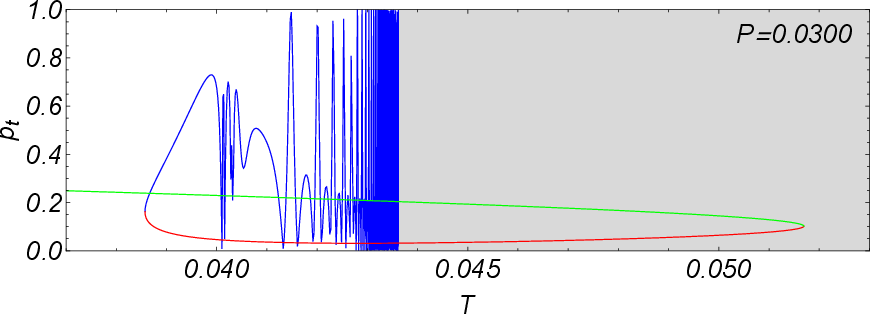
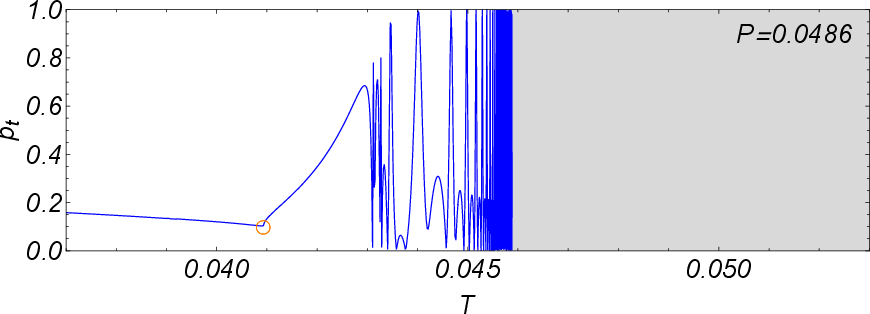
Figure 2: Temperature dependence of the Kasner exponent pt in both the first-order transition region (top) and the supercritical region (bottom), revealing oscillatory and monotonic regimes and the emergence of an extremum post-criticality.
Beyond the first-order phase boundary (i.e., in the supercritical region), the former thermodynamic discontinuity gives way to a distinct extremum in pt(T), which the authors identify as the "Kasner crossover line." This diagnostic is intrinsic to the interior geometry and is wholly independent of equilibrium thermodynamic lines such as the Widom line or dynamical indicators like the Frenkel line.
Phase Diagram and Supercritical Crossovers
By systematically charting the parameter space in pressure and temperature, the authors construct a detailed phase diagram for the interior Kasner exponent pt, thereby illuminating the structure of both the first-order phase boundary and the continuous crossovers in the supercritical regime.
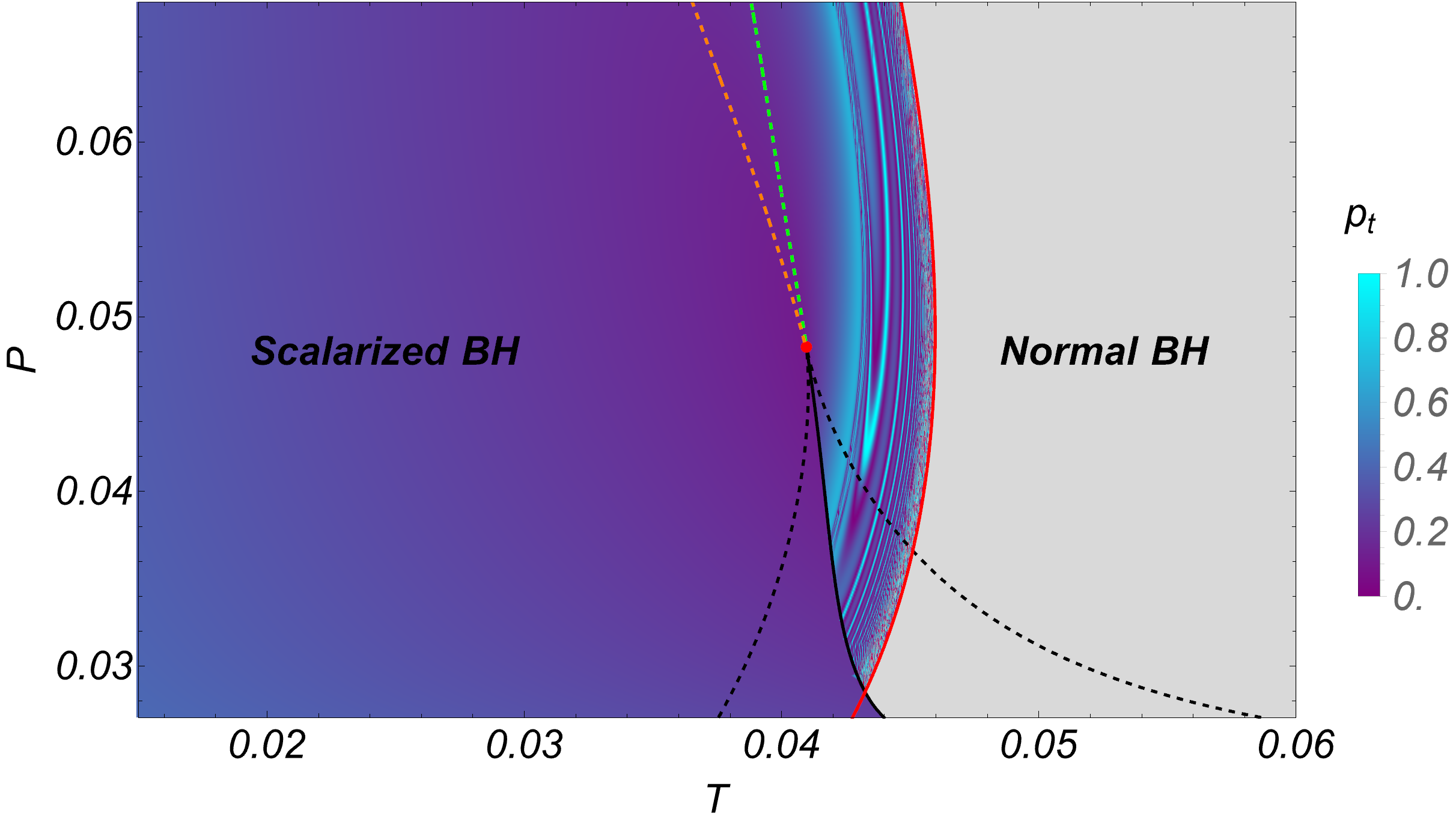
Figure 3: Phase diagram for the Kasner exponent G(T)0 as a function of temperature and pressure; the red line is the critical point, solid and dashed black lines denote first-order and spinodal boundaries, orange marks the Kasner crossover, and green delineates the Widom line.
The phase diagram, presented in Figure 3, highlights:
- The solid black line as the locus of first-order phase transition points, separating regions with fundamentally distinct interior oscillatory or monotonic dynamics.
- The orange dashed line, the "Kasner crossover line," representing abrupt changes in the slope or curvature of G(T)1 in the supercritical region.
- Traditional thermodynamic (Widom) and dynamic (Frenkel) crossover lines remain overlaid for comparative context, yet the Kasner crossover demarcates interior geometric transitions not captured by external observables.
This result substantiates that the internal structure of spacetime, as encapsulated by the Kasner exponent, is sharply reorganized by thermodynamic transitions and remains sensitive to crossovers deep into the supercritical regime, paralleling yet independent from standard external diagnostics.
Implications and Future Outlook
This work establishes the black hole singularity—traditionally regarded as causally disconnected and physically inaccessible—as a robust diagnostic of phase transitions. The sensitivity of the interior Kasner geometry to macroscopic thermodynamic states implies that the process of scalarization and phase change permeates all the way to the most fundamental interior scales. This finding invites new lines of inquiry into the correlation between horizon-scale statistical or quantum transitions and the geometric evolution near the singularity.
The introduction of the Kasner crossover line offers a novel, interior-centric perspective on supercriticality, extending potential applications to critical phenomena in other gravitational and holographic systems. In particular, the results suggest that the geometric response of the singularity could serve as a signature for dynamical transitions in strongly coupled, holographically dual quantum field theories, especially those lacking clear local order parameters or conventional diagnostic criteria.
Conclusion
This study rigorously demonstrates that first-order phase transitions and supercritical crossovers in scalarized AdS black holes induce profound and qualitatively distinct changes in the interior Kasner geometry, as quantified by the Kasner exponent G(T)2 (2604.01818). The division of oscillatory and monotonic interior regimes, and the subsequent emergence of the Kasner crossover line, reveal that the black hole singularity acts as a novel and independent class of diagnostic for phase transitions, complementing and transcending traditional, exterior-based probes. This insight opens new avenues in the interplay between gravitational thermodynamics and interior spacetime dynamics, with promising ramifications for the holographic modeling of strongly coupled systems.