- The paper demonstrates that impulsive heating to 25–50 MK, combined with NEI effects, is crucial for accurately modeling plasma sheet evolution.
- The analysis employs forward modeling with DEM inversion and chi-squared minimization to constrain thermal and nonthermal electron populations.
- Results indicate that continuous, yet subdominant, heating sustains observed EUV emissions despite rapid plasma cooling.
Heating of a Plasma Sheet in Nonequilibrium Ionization with Nonthermal Electrons
Overview and Motivation
This study rigorously examines the thermodynamics and ionization state of a plasma sheet observed during the 2017 September 10 solar eruption, focusing on the interplay of nonequilibrium ionization (NEI) and nonthermal (suprathermal) electron distributions. By tracking a single plasma blob within the sheet using high-cadence EUV observations from SDO/AIA, the authors leverage detailed temporal and spatial diagnostics to investigate the plasma heating and ionization evolution driven by magnetic reconnection beneath an erupting flux rope. The analysis implements a forward modeling framework that includes impulsive and continuous heating, adiabatic expansion, and kappa-distributed nonthermal electrons, providing strong constraints on the required thermal and suprathermal electron populations.
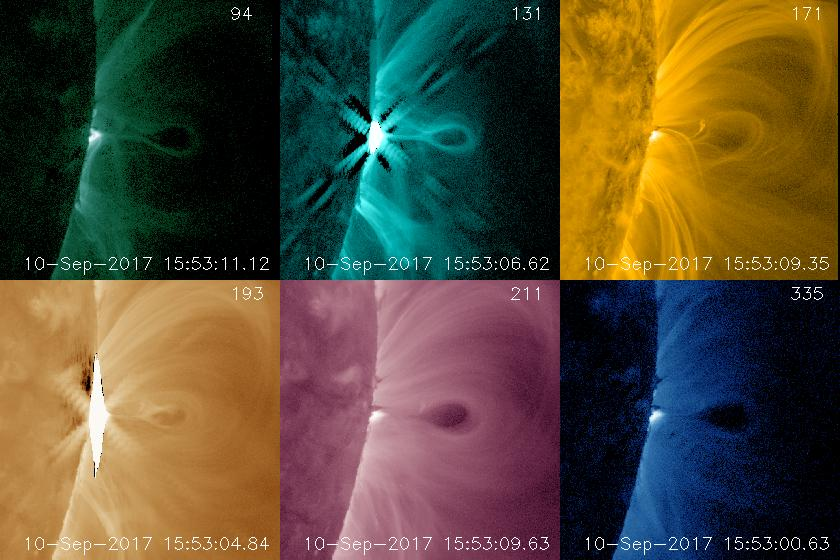
Figure 1: AIA observations of a flux rope eruption on 2017 September 10, revealing the well-defined plasma/current sheet and facilitating time-resolved analysis.
Density and Temperature Diagnostics
Blob tracking is conducted in multiple EUV passbands, following the trajectory through the plasma sheet structure and extracting time-resolved brightness data. The authors use regularized DEM inversion to estimate emission measure, electron density, and temperature for both the blob and the local background, deriving line-of-sight thickness from high-resolution imaging.
A representative DEM evolution illustrates the distinct thermal populations and associated uncertainties:
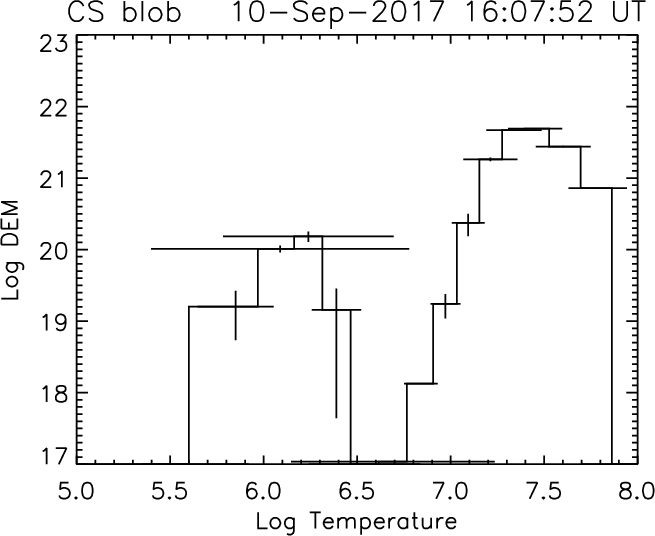
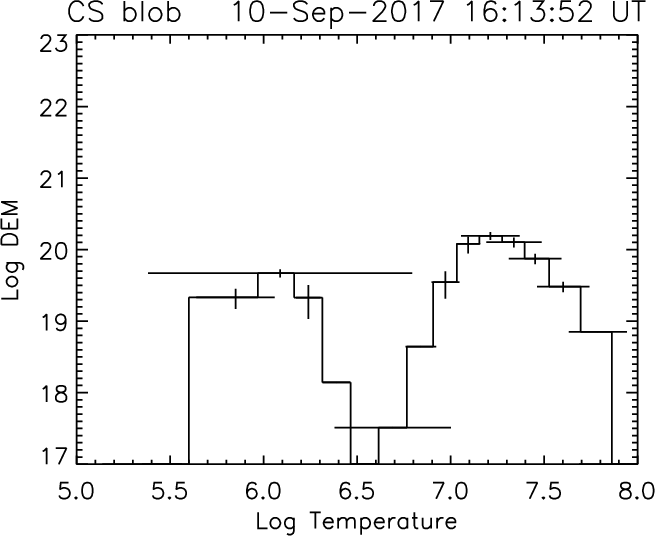
Figure 2: DEMs at the initial and final times, showing the distinct high-temperature component associated with the plasma blob and the persistent lower-temperature background.
The time series of plasma blob density and background temperature/density provide the empirical foundation for all subsequent NEI and energy partition modeling:
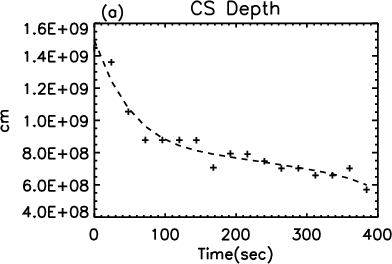
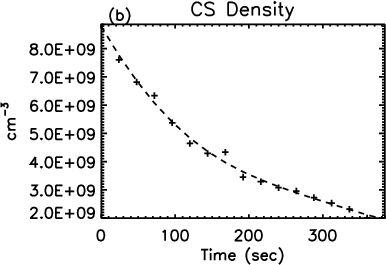
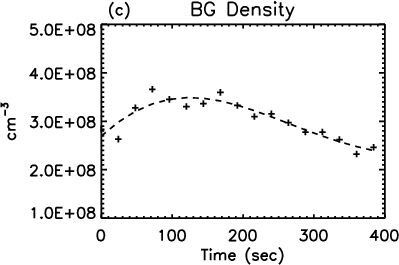
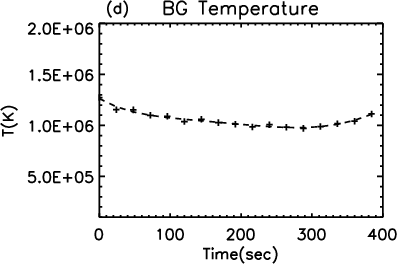
Figure 3: Temporal evolution of the blob line-of-sight depth and electron density (panels a, b), as well as background plasma parameters (panels c, d), confirming high plasma sheet densities ne∼8.8×109 cm−3.
Heating and Ionization Modeling
The model parameterizes thermal evolution as a combination of strong initial impulsive heating (to temperature THT), adiabatic cooling due to expansion, and a continuous heating rate HR (possibly associated with ongoing reconnection or turbulence). The effects of classical radiative losses are shown to be negligible over the <10-minute analyzed timescale, which is orders below the predicted cooling timescales at such densities and temperatures.
Multiple HR evolution scenarios are considered, corresponding to decreasing fractions of initial heating power over the blob’s propagation (10%, 66%, 80% reductions). The importance of continuous heating in maintaining observed temperature is illustrated:
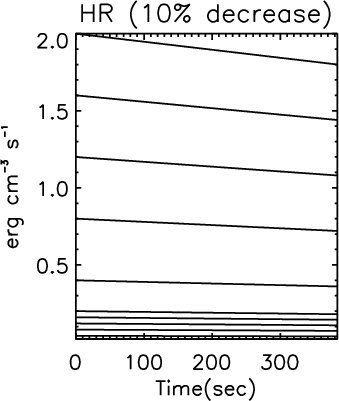
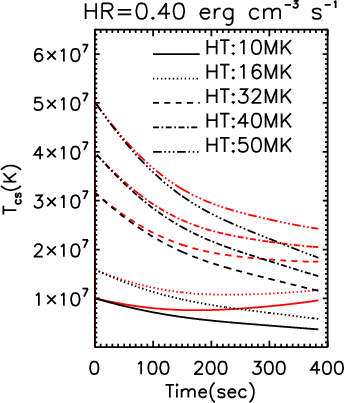
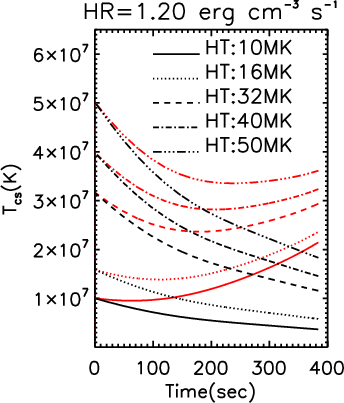
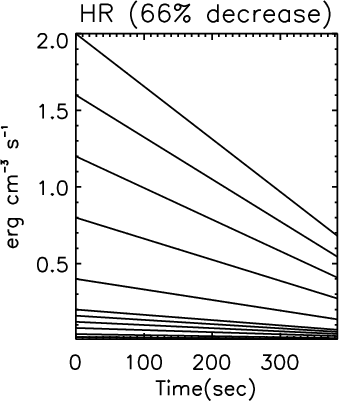
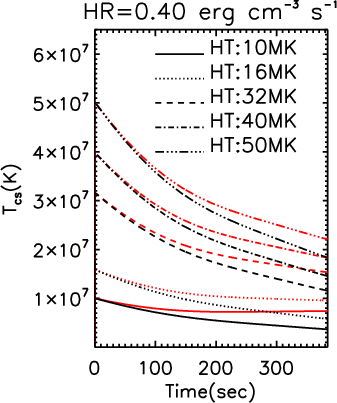
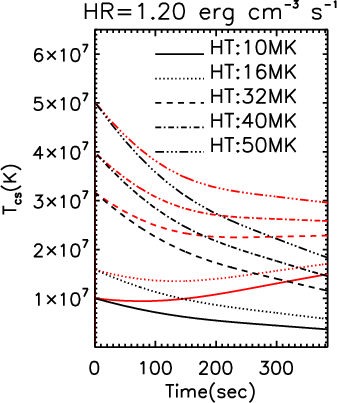
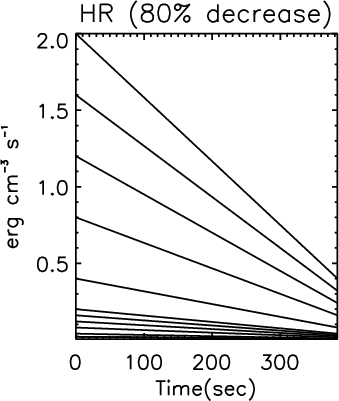
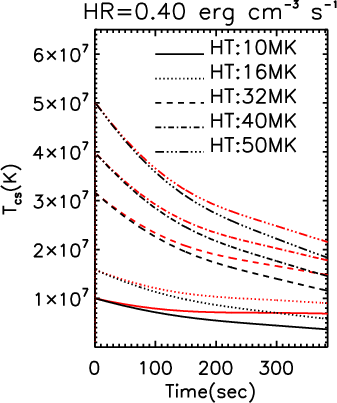
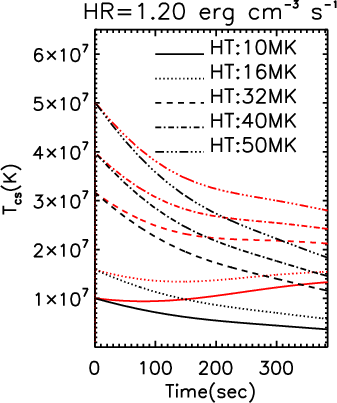
Figure 4: Modeled temperature histories for three continuous heating decay scenarios, highlighting the tension between rapid adiabatic cooling and observed temperature plateaus.
For computation of time-dependent ionic populations, the authors solve the coupled NEI system for 16 elements using pre-tabulated ionization/recombination rates for a wide grid of electron kappa indices (κ=2 up to 100), thus incorporating the effects of suprathermal electron tails. Synthetic AIA response functions (EUV count rates) are derived for both equilibrium and NEI/kappa models for direct comparison to observation.
Model Selection and Statistical Inference
The best-fit model parameters are identified using covariance-weighted χ2 minimization, incorporating multi-channel count rates and full error propagation including correlated instrumental and calibration uncertainties.
The reduced χ2 distribution as a function of impulsive temperature, heating rate, and electron kappa reveals the following significant results:
- Statistically preferred models require impulsive heating temperatures THT>20–25 MK across all scenarios.
- High-temperature solutions (THT∼50 MK) are only permitted for extremely low κ (−30–3), reflecting sensitivity of NEI charge state evolution to nonthermal electron populations.
- Continuous heating typically contributes only 6%–50% of the total (impulsive + continuous) energy.
- The electron kappa index is only weakly constrained except at the highest temperatures, where strong suprathermal tails (very low −31) are required.
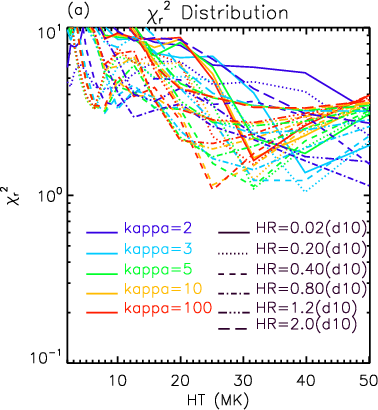
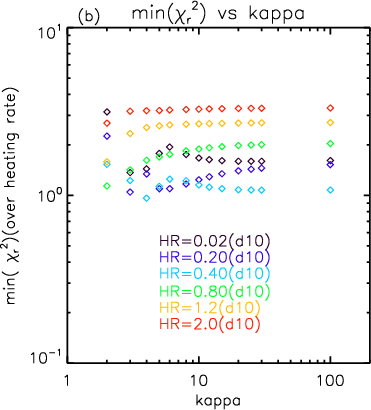
Figure 5: Distribution of reduced −32 across parameter space, indicating the narrow range of impulsive temperature permitted and the degeneracy between −33 and temperature.
Ion Fraction Evolution and NEI Signatures
The NEI modeling demonstrates that the evolution and persistence of key Fe ionization states (Fe XVIII–Fe XXIV) is highly sensitive to both the impulsive thermal history and suprathermal electron populations. In particular, low −34 values slow the rise of high ionization stages, enabling very high temperatures with comparable EUV emission.
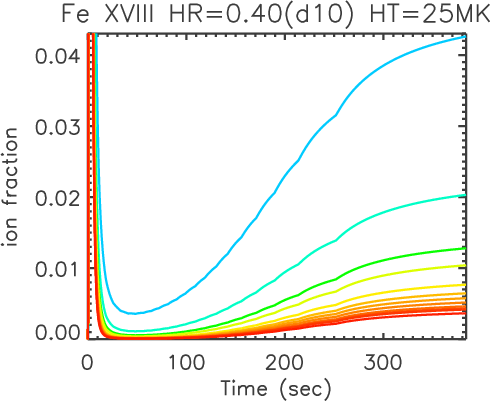
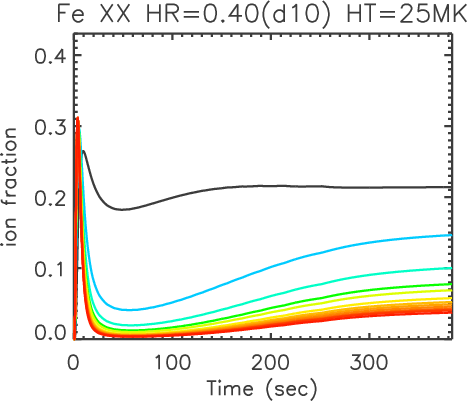
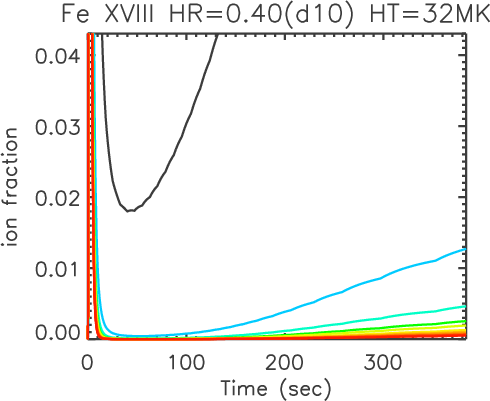
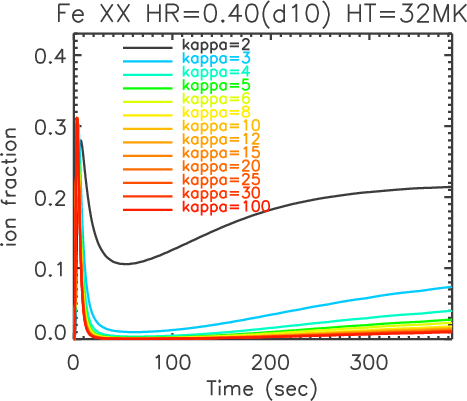
Figure 6: Time-dependent behavior of Fe XVIII and Fe XX for different −35 and impulsive temperature; suprathermal electrons delay the ionization evolution.
Representative observed and modeled AIA light curves illustrate the fidelity of the best-fit models, including allowance for cross-channel calibration uncertainties:
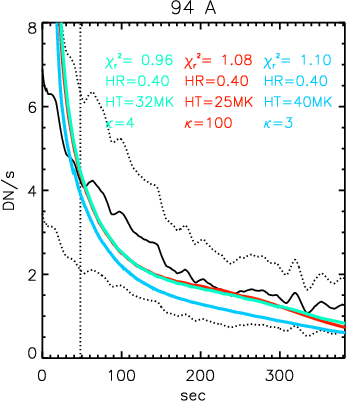
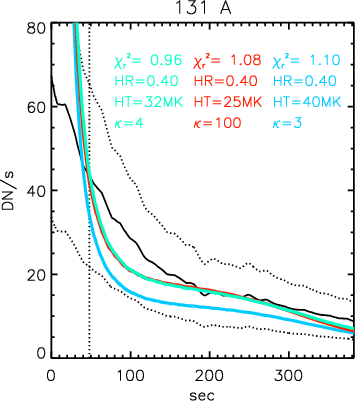
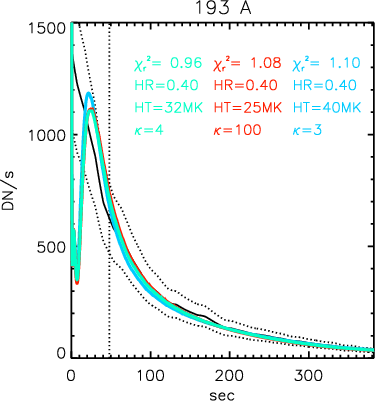
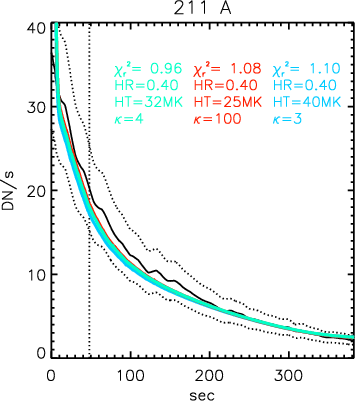
Figure 7: Comparison of observed light curves and model predictions; the agreement demonstrates the model’s ability to capture the multi-thermal, NEI-affected emission decay.
The analysis of accepted models (−36, 95.4% confidence) quantifies the degeneracies and tradeoffs between high-temperature, strongly suprathermal (low −37) solutions versus more Maxwellian-like distributions at lower temperature.
Implications for Reconnection and Particle Acceleration
The results robustly support a physical picture in which strongly impulsive reconnection heating dominates the plasma energy budget of the sheet, but significant ongoing heating (continuous rate) is required to maintain thermal conditions and observed NEI signatures over the observed time interval. Furthermore, the conditions necessary to produce the observed ionic evolution at high temperatures implicate the presence of a population of nonthermal, suprathermal electrons—a result in strong agreement with independent analyses of line broadening and parent kappa indices from EUV and X-ray spectroscopic methods.
These findings suggest that turbulence, plasmoid formation/merging, or stochastic wave-particle acceleration mechanisms contribute significantly to sustaining both the elevated thermal state and the suprathermal electron distributions. The requirement for strong nonthermal electron populations underlines the role of kinetic-scale processes in the macroscopic evolution of post-eruption current sheets.
Theoretical and Practical Consequences
- Any predictive modeling of high-temperature current sheets during eruptive events must self-consistently account for nonequilibrium ionization and nonthermal electronic distributions.
- Diagnostic inference based on steady-state, Maxwellian assumptions is systematically biased and incapable of reproducing observed EUV charge state ratios in these environments.
- Impulsive heating estimates should be interpreted as lower bounds when nonthermal populations are significant.
- The methodology provides a quantitative framework for interpreting future high-cadence, multi-channel EUV and X-ray observations of coronal currents sheets and reconnection outflows.
- NEI signatures combined with kappa diagnosis can serve as remote proxies for the partition of energy between thermal and suprathermal electrons in solar eruptive events.
Conclusion
This analysis provides robust, quantitative constraints on the thermal and nonthermal electron populations within a solar coronal current sheet observed beneath a major flux rope eruption. The necessity of impulsive heating to −3825–50 MK, and the allowance of highest temperatures only with strong suprathermal tails (−39) demonstrates the critical role of NEI and electron distributions. Continuous localized heating is needed but always subdominant energetically. The study highlights the complex interplay of impulsive reconnection, turbulent energy release, and particle acceleration processes in shaping both the thermodynamic and charge-state evolution of current sheet plasma, establishing a rigorous paradigm for interpreting related observations and for future kinetic–MHD modeling efforts.

