- The paper presents a novel log-space averaging method that constructs an effective Hamiltonian to bypass the fermion sign problem in DQMC.
- It accurately extracts the momentum-resolved spectrum, capturing d-wave pseudogap features and non-perturbative self-energy effects consistent with ARPES data.
- The study demonstrates a dome in superfluid stiffness and delineates distinct scales for pseudogap formation versus superconducting coherence.
Sign-Free DQMC Evidence for a d-Wave Superfluid Stiffness Dome in the Doped Hubbard Model
Introduction and Context
The nature of the pseudogap phase and its relationship to d-wave superconductivity in hole-doped cuprates remains one of the central issues in correlated electron systems. Recent progress in ground-state methods (DMRG, AFQMC, CPAFQMC) has established that the two-dimensional Hubbard model with finite next-nearest-neighbor hopping (t′/t<0) supports robust competing orders, but mapping the precise finite temperature emergence of the pseudogap and its correlation with superconducting stiffness remains a technical challenge due to the exponential fermion sign problem afflicting quantum Monte Carlo (QMC) methods in the relevant parameter regimes.
This work introduces a sign-problem-free methodology for extracting the effective single-particle spectrum and related superfluid response from determinant QMC (DQMC) data, enabling direct access to pseudogap and superfluid stiffness observables in the physically relevant region below a sharp computational phase boundary T∗. The approach leverages the insensitivity of the matrix logarithm of short-time imaginary time propagators to sign fluctuations, thus bypassing the multiplicative sign problem that has stymied direct band structure analysis for decades in the correlated regime.
Methodology: Matrix Logarithm Construction and Sign-Free Observables
The core methodological innovation is the construction of an effective Hamiltonian Keff from the log-averaged Monte Carlo (MC) ensemble of imaginary-time propagators, overcoming both the condition number explosion in the product of B-matrices and the exponential sign cancellations characteristic of standard DQMC at low temperature and finite doping. By dividing the imaginary-time propagation (with step size Δτ) into short chunks and averaging the Hermitian matrix logarithms of these chunks, Keff is obtained via:
Keff=−ncΔτ1⟨logBchunk⟩MC
Because each chunk is of limited (O(1)) condition number, the logarithm is numerically stable, and the MC averaging benefits from the central limit theorem, rendering Keff sign-problem-free: both sign sectors yield eigenvalue dispersions agreeing to sub-percent accuracy.
This effective Hamiltonian incorporates all static self-energy effects and nonperturbative correlations encoded in the DQMC ensemble, differing fundamentally from mean-field or DMFT approaches by maintaining full momentum resolution and encoding the exact MC-averaged correlation effects (rather than perturbative or local contributions).
A second novel aspect is the careful sign-sector decomposition. Parallel MC simulations in the positive- and negative-sign sectors are performed, and the mean of the resulting effective Hamiltonians is constructed. The near-identity of resulting observables between sectors at low T (except where sector mixing occurs) demonstrates the sign-problem-free property of all (t′/t<0)0-derived observables.
Computational Phase Diagram and the Emergence of (t′/t<0)1
The first main result is the determination of a sharp computational phase boundary (t′/t<0)2, coinciding with the physical pseudogap onset as identified by enhanced sign variance in the DQMC ensemble. Above (t′/t<0)3, the sign is conserved, and QMC simulations are stable and straightforward; below (t′/t<0)4, maximal sign fluctuations appear, identifying the correlated regime associated with pseudogap formation.
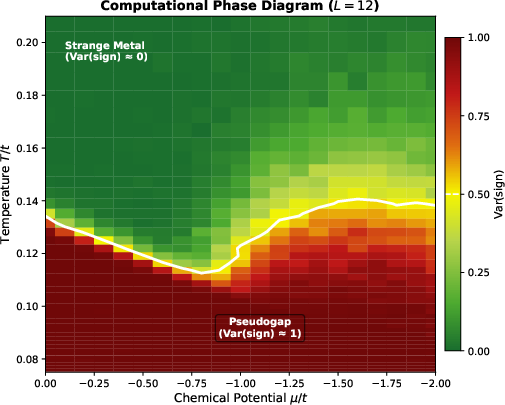
Figure 1: Computational phase diagram ((t′/t<0)5): Variance of the MC sign as a function of temperature and chemical potential, identifying the (t′/t<0)6 boundary below which the sign problem is maximal (pseudogap regime).
The computational phase diagram reveals an asymmetric (t′/t<0)7 valley across doping, sharply defined on the underdoped side and becoming a crossover in the overdoped regime, reproducing the known features of the cuprate phase diagram.
Pseudogap Spectroscopy and Momentum-Resolved Self-Energy
Analysis of the effective, sign-free single-particle spectrum reveals a pronounced momentum-selective pseudogap opening with clear (t′/t<0)8-wave symmetry---strong suppression at antinodal points, nodal-antinodal dichotomy, and momentum structure in the self-energy that matches phenomenology from ARPES.
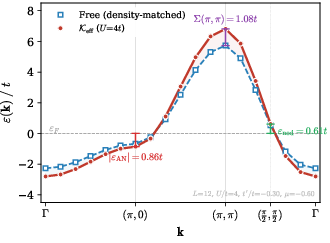
Figure 2: Dressed quasiparticle band structure (t′/t<0)9 (red) compared to the free-fermion band (blue), demonstrating momentum-dependent self-energy and anisotropic T∗0-wave gap formation below T∗1. Parameters: T∗2, T∗3, T∗4, T∗5.
The gap ratio T∗6 quantifies this anisotropy. Only when T∗7 (nodal gap larger than antinodal) can the system be identified as exhibiting T∗8-wave pseudogap physics. This is sharply realized only in the sign-problem-free regime enabled by the T∗9 method.
Discovery of a d-Wave Superfluid Stiffness Dome
A central quantitative result is the unambiguous observation of a dome-shaped superfluid stiffness (Keff0) across doping, extracted solely from the dressed Keff1 spectrum and occupation at finite temperature. The stiffness considerably exceeds the Berezinskii–Kosterlitz–Thouless (BKT) threshold at the dome apex, with the peak's location and width exhibiting systematic finite-size oscillations due to Keff2-grid effects but remaining robust in its existence.
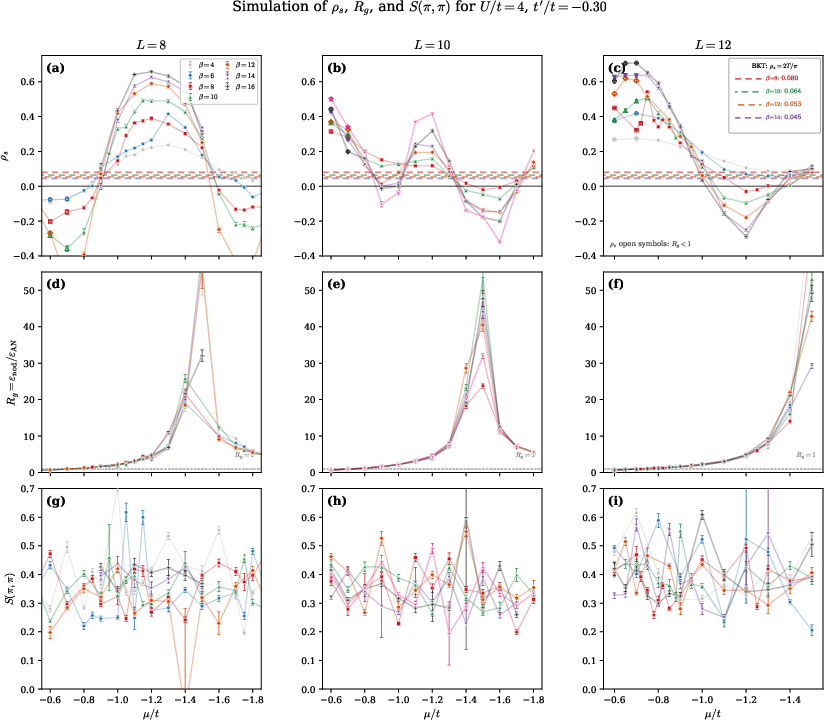
Figure 3: Three sign-free Keff3 observables versus Keff4 for Keff5 (left), Keff6 (center), Keff7 (right): (a--c) superfluid stiffness Keff8 forms a dome, (d--f) gap ratio Keff9 confirms B0-wave pseudogap symmetry, (g--i) antiferromagnetic structure factor B1 remains flat across doping. Parameters: B2, B3.
The gap ratio B4 remains temperature-independent (saturates below B5), while B6 continues to grow with cooling. This directly mirrors experimental observations: the pseudogap appears at B7 and remains invariant, while the superfluid response develops only at significantly lower B8 and is strongly doping dependent.
At the dome peak, B9 exceeds the BKT threshold Δτ0 by factors of Δτ1--Δτ2, even omitting vertex corrections. The latter are known to reduce stiffness by 30--50% for bare-band calculations, but since Δτ3 already incorporates the leading self-energy effects, the residual vertex corrections are expected to be significantly smaller. Even after maximal estimated correction, the system remains in the superfluid regime near optimal doping.
Temperature and Doping Dependence: Dichotomy of Pseudogap and Stiffness
Perhaps the most important phenomenological result is the clear separation of the doping and temperature dependences of the pseudogap (measured by Δτ4) and the superfluid stiffness Δτ5. The pseudogap grows monotonically with underdoping and remains virtually constant with decreasing temperature below Δτ6, while Δτ7 exhibits a dome centered near optimal doping and sharp temperature dependence.
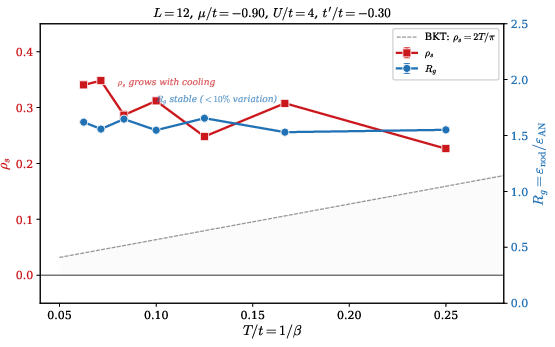
Figure 4: Temperature scan at the dome peak (Δτ8, Δτ9). Blue: Keff0 is stable Keff1--Keff2; red: Keff3 grows rapidly with cooling, always exceeding the BKT threshold (gray bars).
This dichotomy supports the interpretation that the pseudogap is a static, ground-state property reflecting long-lived spin fluctuations destroying Fermi coherence near the antinodes, while superfluid response develops as Fermi statistics and residual attractive interactions allow coherent Keff4-wave pairing at lower Keff5 and select doping.
Theoretical and Experimental Implications
This work provides sign-problem-free, unbiased confirmation that the superfluid stiffness dome is already encoded at the single-particle level in the correlated electronic structure. The essential ingredients are:
- Strong AF correlations imposed by the Hubbard Keff6 drive momentum-selective (nodal-antinodal) pseudogap opening below Keff7.
- The Fermi surface geometry (modulated by Keff8 and doping) selects the optimal conditions for Keff9-wave pairing coherence, leading to the observed dome.
- The antiferromagnetic structure factor Keff=−ncΔτ1⟨logBchunk⟩MC0 remains roughly constant across the dome, demonstrating that the dome arises from changes in the Fermi surface response, not AF glue strength.
Comparison to experiment is direct: ARPES observation of persistent nodal quasiparticles versus suppressed antinodal states is captured by Keff=−ncΔτ1⟨logBchunk⟩MC1. The separation between Keff=−ncΔτ1⟨logBchunk⟩MC2 and the superfluid crossover, and the dome-like dependence of Keff=−ncΔτ1⟨logBchunk⟩MC3 (Uemura relation), are robustly reproduced. The finite-size computational domes are narrower, as expected.
On the theoretical side, the methodology provides a rigorous path to integrating vertex corrections and solving the BCS gap equation directly on the exact correlated dispersion, opening new avenues for explicit Keff=−ncΔτ1⟨logBchunk⟩MC4 calculations and the investigation of the competing order problem at finite temperaure.
Conclusion
This work establishes a computational framework for extracting single-particle and superfluid observables from finite-temperature QMC simulations of correlated electron models, even in the regime of maximal sign problem. The key innovation is the use of matrix log-averaged propagators to build a sign-problem-free effective Hamiltonian Keff=−ncΔτ1⟨logBchunk⟩MC5, from which the full momentum-resolved spectrum, Keff=−ncΔτ1⟨logBchunk⟩MC6-wave pseudogap features, and superfluid stiffness can be robustly obtained.
A Keff=−ncΔτ1⟨logBchunk⟩MC7-wave superfluid stiffness dome is resolved across doping in the single-band Hubbard model, with quantitative connection to experiment and direct clarifications of the relationship between pseudogap formation and superconducting phase coherence. The method paves the way for systematic, unbiased studies of correlated superconductors at finite Keff=−ncΔτ1⟨logBchunk⟩MC8 and motivates future work on vertex-corrected observables, Keff=−ncΔτ1⟨logBchunk⟩MC9 estimation, and larger system size scaling.
The approach is likely extensible to other models with severe sign problems and may form the basis for a new standard in extracting physical observables from sign-problem-plagued MC data in correlated systems.

