- The paper presents a chemodynamical mapping of the Milky Way’s outer stellar halo using 64,000 K giants to detail radial biases and merger signatures.
- It applies Gaussian mixture models to decompose distinct metal-rich and metal-poor populations with varying anisotropies and net rotations.
- The analysis detects a non-equilibrium velocity field marked by contraction and dipole signals, indicating the dynamic influence of the LMC.
The Velocity Field of the Milky Way Outer Stellar Halo from DESI DR2
Introduction and Scientific Context
Understanding the chemo-dynamical structure of the Milky Way (MW) stellar halo provides critical constraints on galaxy formation and the dark matter potential. Recent advances, particularly from Gaia and large spectroscopic surveys, have enabled high-precision phase-space mapping of distant halo tracers, revealing the complex assembly history of the MW and its dynamical state. This paper presents a comprehensive analysis of the outer stellar halo (3 kpc<rGC<160 kpc) using 64,000 K giants from DESI DR2, with the goal of delineating the kinematic and chemical structure and quantifying disequilibrium features induced by the Large Magellanic Cloud (LMC).
Data and Methodology
The analysis leverages the DESI Milky Way Survey, which provides spectroscopic, photometric, and astrometric information, combined with Gaia proper motions. Stellar parameters and distances are derived via neural network models (SpecDis2), with extensive validation against globular clusters and dwarf galaxies, yielding typical distance uncertainties of ∼12–18% for K giants.
Sample selection includes effective temperature, absolute magnitude, metallicity, and spatial cuts to minimize disk contamination and remove known substructures (notably Sagittarius stream, globular clusters, and dwarf galaxies). Velocity uncertainties and the transformation to Galactocentric coordinates are stringently controlled.
The phase-space and chemical distributions are modeled predominantly with:
- Gaussian Mixture Model (GMM): Separating populations into metal-rich (MR) and metal-poor (MP) components, fit in [Vr,Vϕ,Vθ,[Fe/H]] space.
- Dipole velocity field modeling: To capture non-equilibrium features, particularly the LMC-induced reflex motion in the outer halo, a dipole-plus-contraction model is applied to the radial velocity distribution as a function of sky position.
Single-Component Halo Properties
Marginalized posterior distributions from the single-component fit highlight the global properties of the halo K giant population:
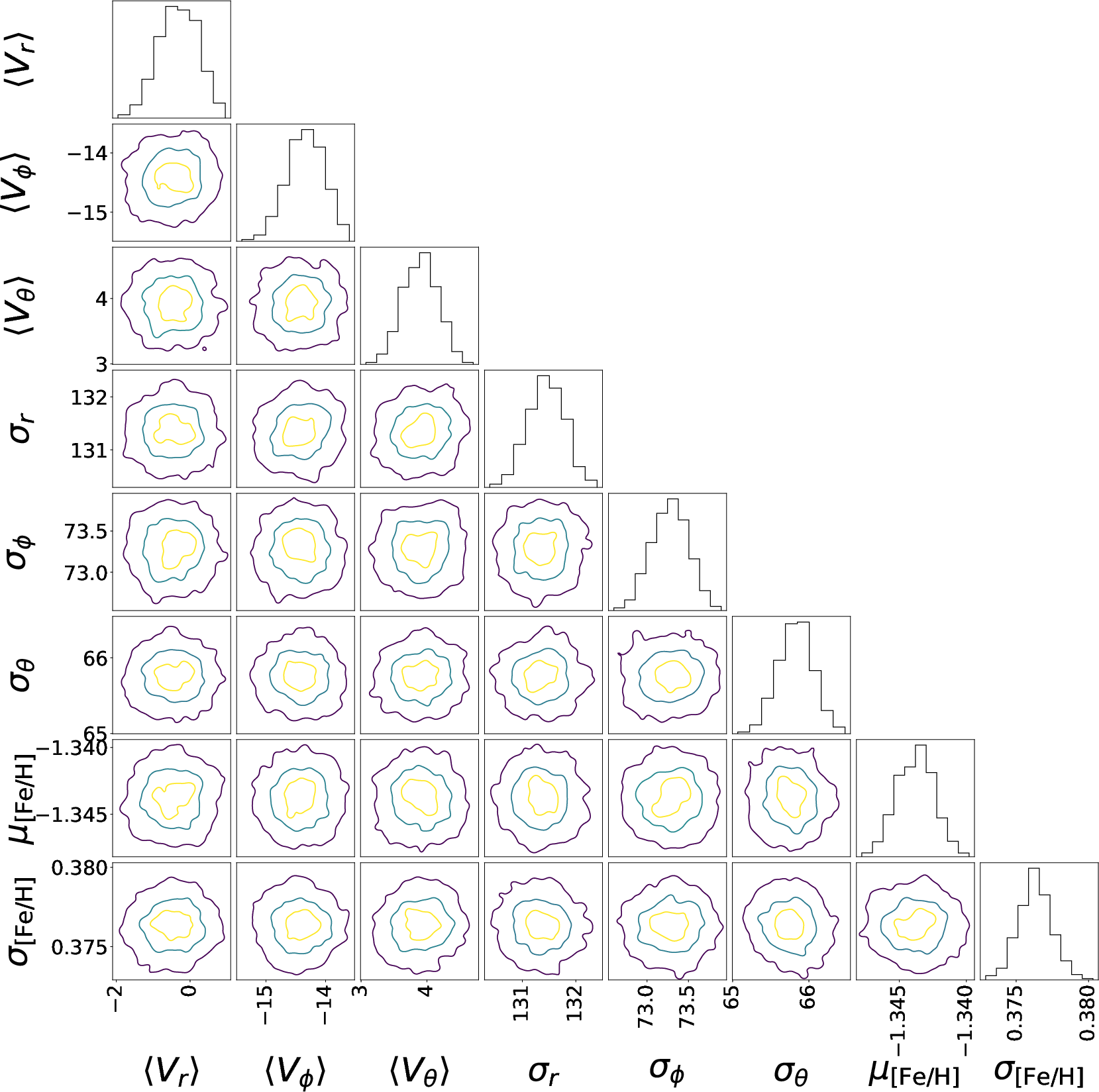
Figure 1: Error contours and marginalized posteriors of velocity and metallicity parameters for the single-component model.
The results demonstrate:
- A pronounced velocity anisotropy, β≈0.72, indicating radially biased orbits.
- Modest net prograde rotation with ⟨Vϕ⟩≈−14 km s−1 (in disk rotation direction).
- Radial velocity and polar velocity means consistent with zero out to ∼50 kpc, with deviations appearing at larger radii, suggestive of disequilibrium.
- Velocity dispersion profiles indicate a transition from radial to isotropic at large radii, and a potential bias at small radii from thick disk contamination.
A GMM-based double-component analysis reveals two distinct components—MR and MP—with nearly equal proportions but sharply different kinematics and metallicity dispersion:
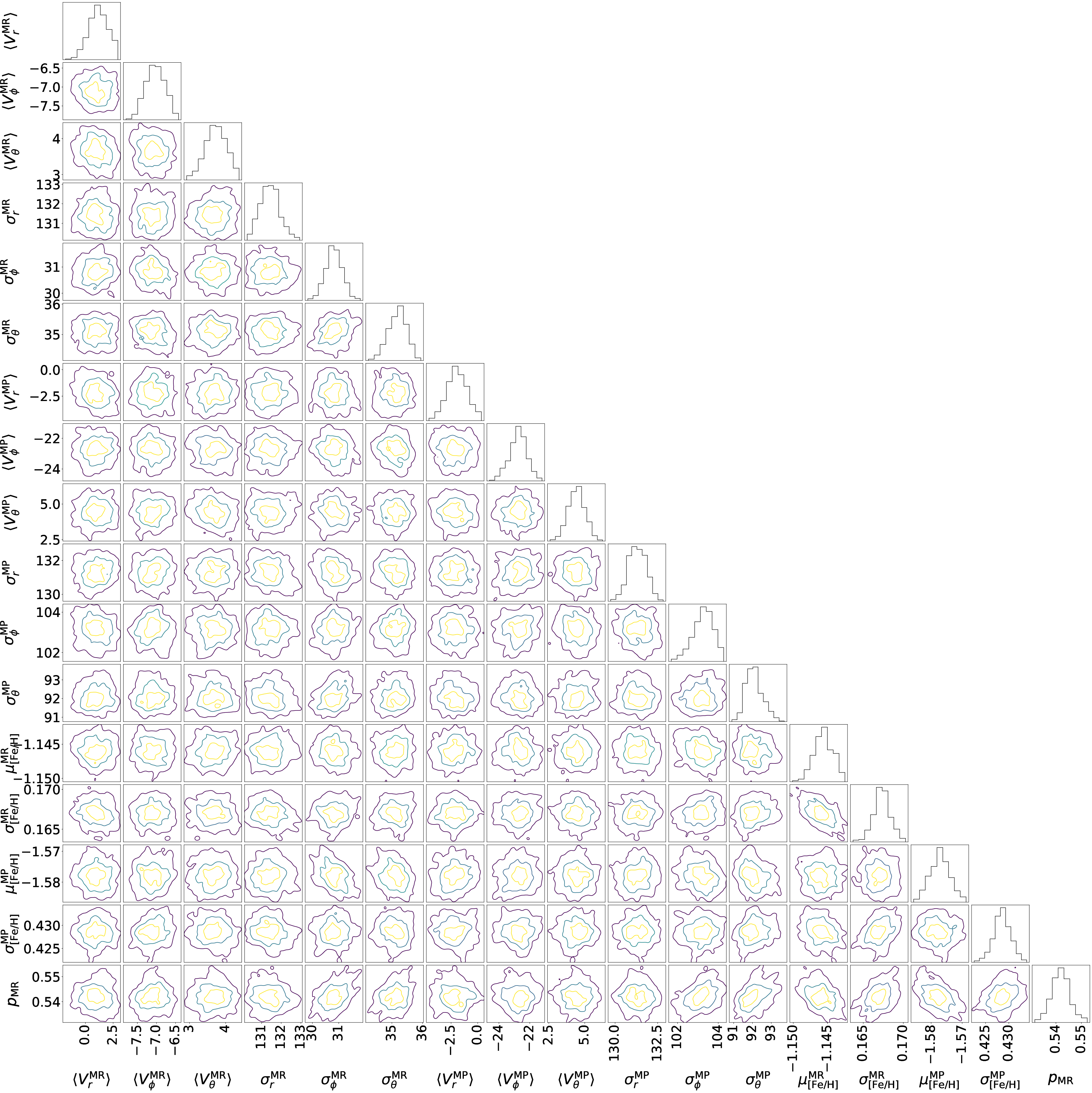
Figure 3: Joint posterior contours for parameters of the double-component (MR and MP) model.
Key numerical and conceptual results:
- MR component: ⟨[Fe/H]⟩∼−1.15 dex; σ[Fe/H]∼0.17 dex; βMR∼0.94, indicating highly radial, kinematically coherent debris, associated with the Gaia-Sausage/Enceladus (GSE) event.
- MP component: ⟨[Fe/H]⟩∼−1.58 dex; ∼120 dex; ∼121, with increased isotropy/tangential bias at larger radii, and metallicity dispersion indicative of multiple minor accretion events.
- Both components exhibit net prograde rotation (∼122–∼123), but the amplitude is larger in the MP population—a notable, somewhat counterintuitive, kinematic feature.
The radial dependency of MR fraction highlights a dominant MR halo within 30 kpc, a sharp decrease from 30–50 kpc due to dropping GSE contribution, and a mild resurgence beyond 50 kpc.
Radial Trends in the Velocity Field and Anisotropy
The distance-binned analysis of MR and MP components shows pronounced differences in mean velocity, dispersion, and anisotropy:
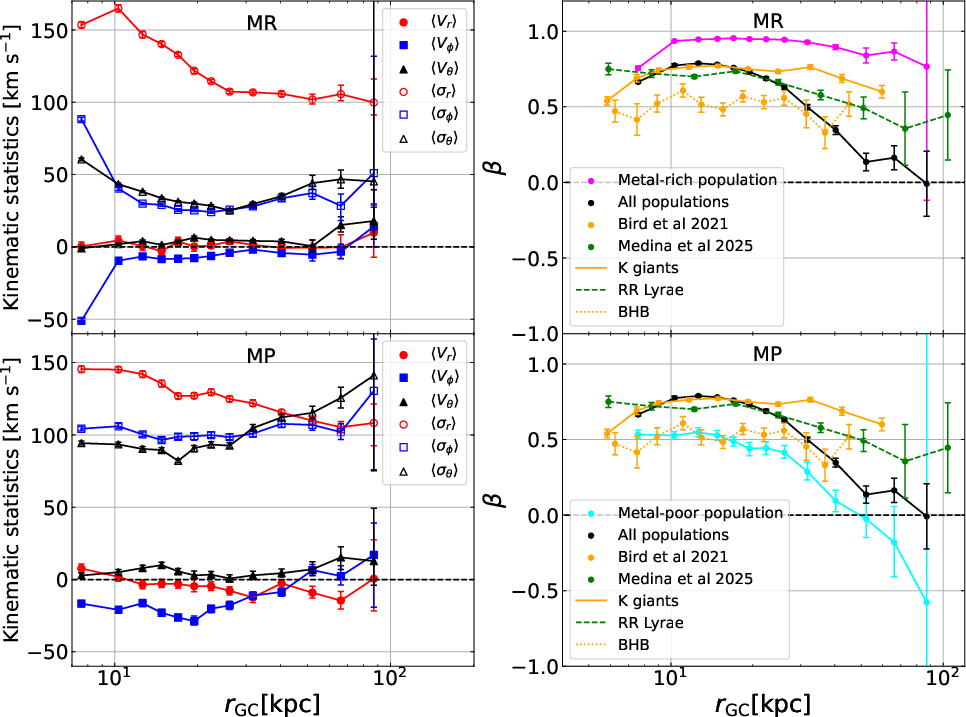
Figure 2: Radial trends in mean velocity, dispersions, and anisotropy for MR (top) and MP (bottom) populations. Right panels compare with literature K giant, BHB, and RR Lyrae results.
- The MR component maintains a high ∼124 (∼1250.9) to 50 kpc; only beyond this does anisotropy weaken.
- The MP component transitions from moderate radial bias in the inner halo to isotropy and tangential bias at ∼126 kpc.
- The observed net prograde rotation in the MP population is robust, present beyond the regime where disk/stream contamination is significant.
Crucially, the superposition of these two populations with different radial profiles and proportions naturally reproduces the heterogeneous anisotropy profiles measured in independent studies using different tracers.
Non-Equilibrium Features: Reflex and Contraction Motions from LMC Interaction
The velocity field of the outer halo reveals systematic non-equilibrium motions, quantified via the dipole-plus-contraction model:
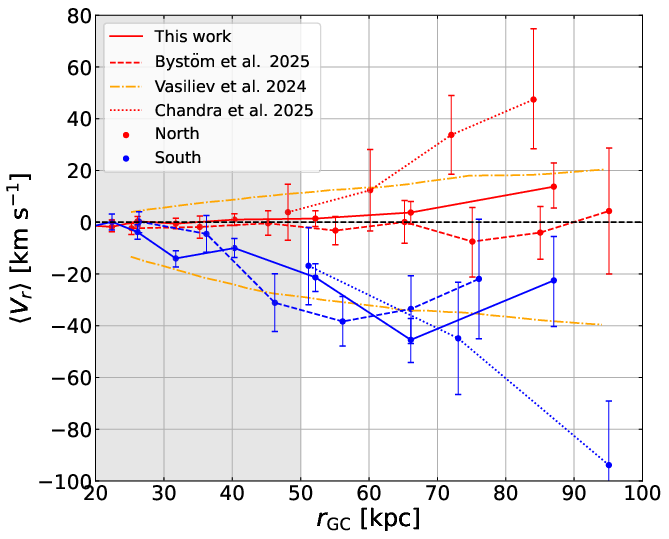
Figure 6: Mean radial velocity profiles for northern/southern halo at various radii; comparison with other works and N-body predictions.
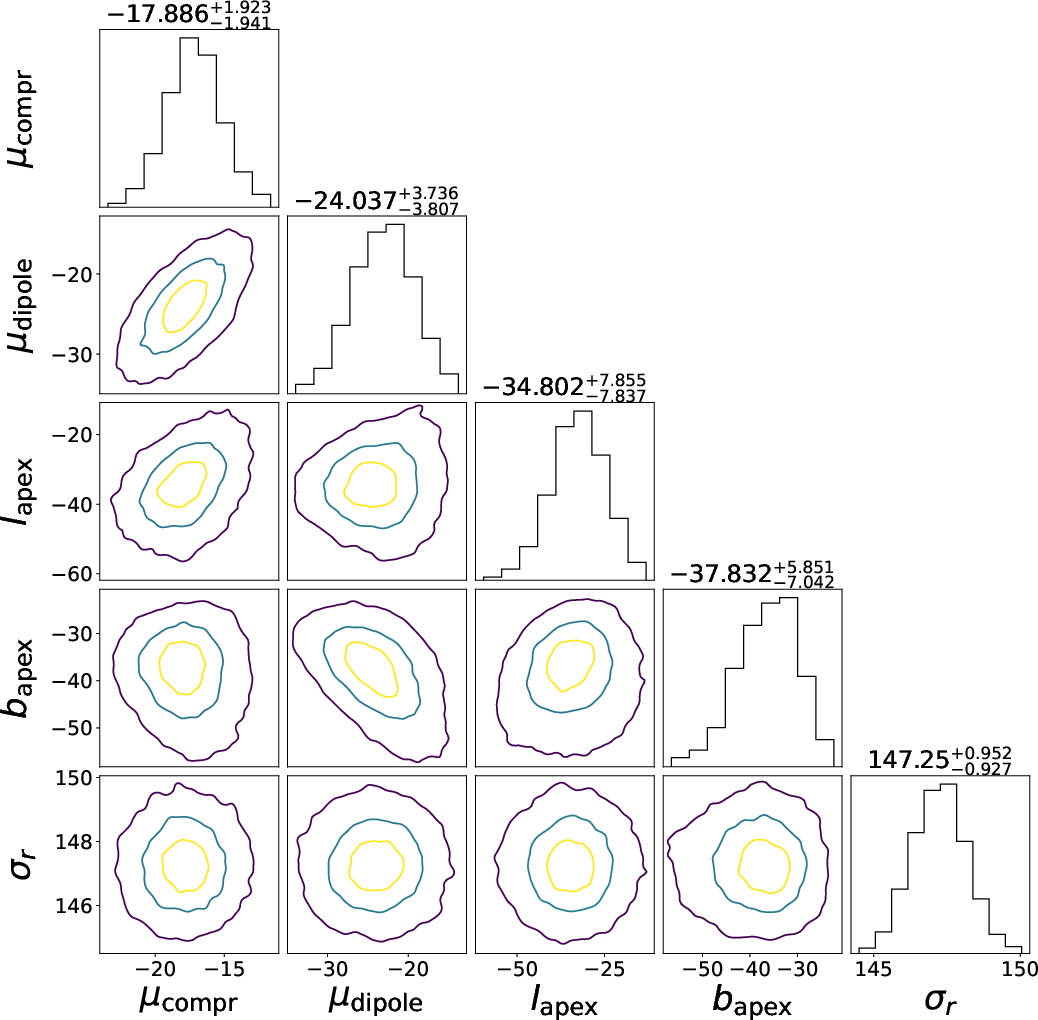
Figure 4: Posterior contours for the dipole velocity field model parameters describing the outer halo reflex and contraction motions.
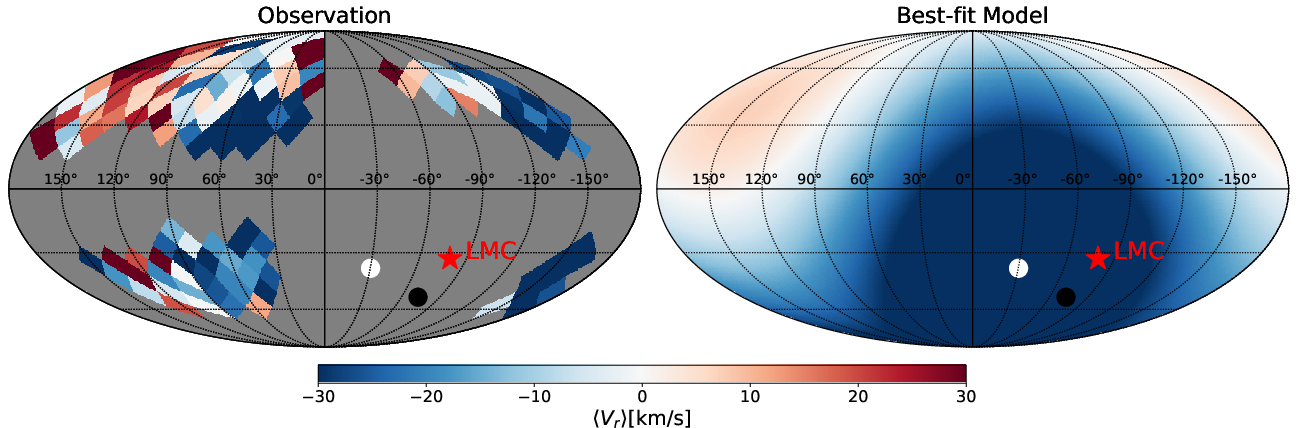
Figure 5: Mollweide projections of observed (left) and best-fit (right) mean radial velocity for ∼127 kpc, demonstrating the hemispheric asymmetry attributed to LMC perturbation.
Notable findings:
- The outer (∼128 kpc) halo shows simultaneous contraction (∼129) and a dipole reflex motion ([Vr,Vϕ,Vθ,[Fe/H]]0 increasing from [Vr,Vϕ,Vθ,[Fe/H]]1 to [Vr,Vϕ,Vθ,[Fe/H]]2 with radius), consistent with the signature of the LMC infall scenario.
- Hemispheric asymmetries in mean [Vr,Vϕ,Vθ,[Fe/H]]3 (stronger in the south) are not fully matched by N-body models, motivating further investigation of the contraction origin.
- The relationship [Vr,Vϕ,Vθ,[Fe/H]]4 directly links observed polar velocity in the outer halo to the LMC-induced kinematic dipole, as anticipated from simulation.
Systematic Effects: Impact of Distance Uncertainties
Distance uncertainties induce Eddington bias, particularly for large-radius and low-number-density bins. Quantitative correction shows outer-halo MR fraction and velocity anisotropy are modestly overestimated at large radii, but not enough to overturn key conclusions.
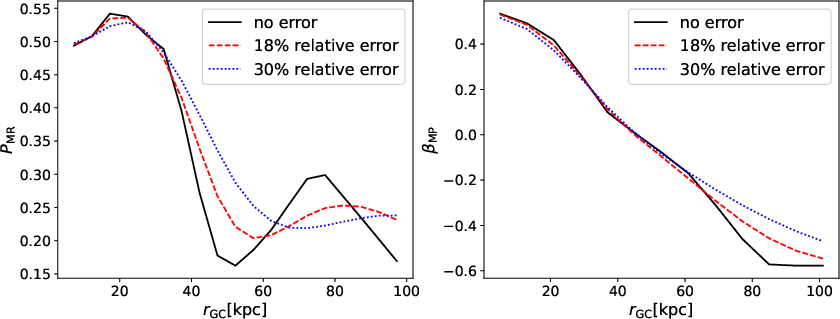
Figure 7: Impact of 18% and 30% relative distance uncertainties on MR fraction and MP velocity anisotropy as a function of radius.
Astrophysical Implications and Theoretical Outlook
- The dichotomy between the MR (GSE-dominated) and MP (minor merger-dominated) populations encodes the hierarchical assembly and last major accretion event in the MW's halo.
- The highly radial, chemically narrow MR population corroborates the GSE impact, while the more isotropic, metal-poor component provides a fossil record of numerous minor mergers.
- The robust net prograde rotation in the MP component, and retrograde features at the most extreme radii, are at tension with naive expectations; potential mechanisms include bar-halo coupling, anisotropic accretion, or disk-induced angular momentum transfer, though these remain incompletely understood.
- The clear detection of a distance-independent contracting motion in the outer halo, on par with the LMC-induced dipole reflex, is physically notable. The underlying cause remains uncertain—candidate explanations include genuine time-dependent halo response to LMC infall, lingering unrelaxed substructure, or limitations in current N-body models.
- These dynamical signatures, when interpreted in the context of simulations, provide stringent constraints on the MW mass profile, dark matter halo triaxiality, and the dynamical timescales and orbits of major accreted structures.
Conclusion
This analysis of the DESI DR2 K giant sample yields a comprehensive, distance-resolved kinematic and chemical map of the outer MW stellar halo. The data robustly identify dual chemo-dynamical halo populations whose radial trends and anisotropies reflect their assembly history. Observed non-equilibrium features, especially the dipole reflex and contraction motions, provide direct evidence of ongoing dynamical response to the LMC, with clear observational-theoretical synergy and outstanding theoretical challenges. These results, including the strong, somewhat counterintuitive net rotation in the metal-poor halo and the robust LMC perturbation signature, establish a new empirical baseline for galactic archaeology, halo modeling, and the study of time-dependent processes in massive galaxies.