- The paper introduces a framework that compresses high-dimensional medical features using tensor-network frontends and refines them with a quantum-enhanced processor.
- The paper demonstrates that integrating secure MPC aggregation with quantum-classical fusion boosts diagnostic performance on PneumoniaMNIST under threshold-optimized conditions.
- The paper highlights that TN compression significantly reduces MPC communication costs while enabling scalable, privacy-aware medical diagnosis.
Quantum-Enhanced Federated Medical Diagnosis with Tensor-Network Compression: A Technical Analysis
Framework Architecture and System Design
The paper introduces a privacy-aware federated learning (FL) pipeline for medical image classification that integrates tensor-network (TN) representation learning, multi-party computation (MPC)-secured aggregation, and post-aggregation quantum refinement. The key motivation is to jointly address two fundamental bottlenecks in privacy-aware hybrid federated settings: (i) the communication and security overhead of MPC when aggregating high-dimensional neural features, and (ii) the limited quantum resources available for processing compressed representations in practical, small-qubit quantum devices.
The overall workflow, depicted in Fig. 1 of the paper, features client-side TN encoders (MPS, TTN, MERA) that transform local data into compressed latent vectors. These features are then secret-shared and securely aggregated via a replicated three-party MPC protocol, abstracted for both passive and active security. The global latent aggregation feeds into a server-side Quantum-Enhanced Processor (QEP), which performs quantum-state embedding via parameterized circuits, expectation-value extraction for a set of Pauli observables, and classical fusion of quantum and classical pathways before classification.
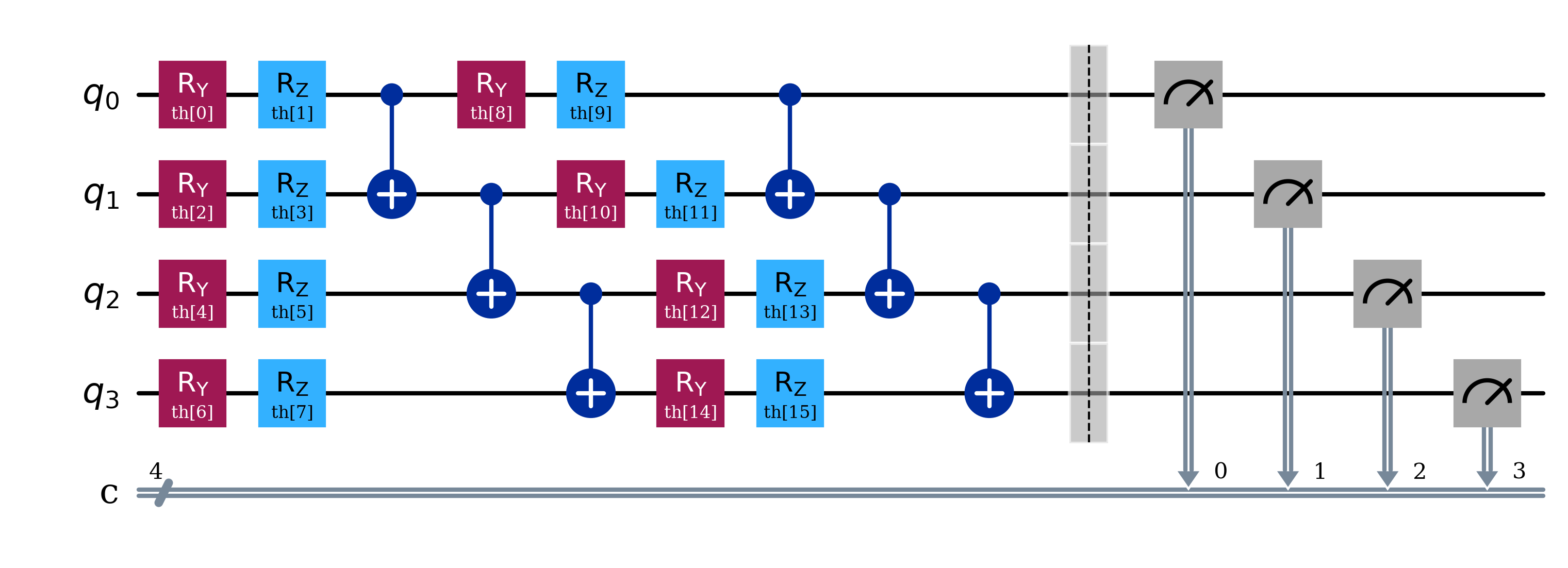
Figure 1: Parameterized quantum circuit for QEP, featuring repeated Ry and Rz layers and nearest-neighbor CNOT gates; outputs are observable expectation values rather than bitstrings.
The TN frontends serve as compressive feature extractors. MPS employs left-canonical sequential contraction, TTN uses binary-tree hierarchical aggregation, and MERA augments TTN with disentanglers for multi-scale local mixing. All compressed representations are mapped to a latent space of fixed size (e.g., d=64). This design enables quantum refinement on input dimensions compatible with current quantum device capabilities.
MPC aggregation is parameterized for communication benchmarking and privacy analysis across different security regimes. The protocol leverages replicated secret sharing for addition, truncation, and protected multiplication, with communication costs derived for aggregation, normalization, and transformation under both passive and active secure computation scenarios.
The QEP implements a non-differentiable, observable-based quantum nonlinear map: aggregated features are classically encoded into circuit parameters, routed through a fixed-depth, small-qubit (Nq) parameterized quantum circuit, and summarized via expectation values of 1- and 2-body Pauli operators. These quantum statistics are classically decoded and fused with the original aggregated features through a learnable gate structure.
Experimental Protocol and Implementation Details
All experiments are conducted on the PneumoniaMNIST benchmark for binary medical imaging. Each 28×28 grayscale chest X-ray is either flattened (for MPS) or reorganized into $16$ non-overlapping patches (TTN, MERA), with federated partitioning across $16$ client branches. The TN frontends produce d=64-dimensional latent features, followed by secure aggregation and quantum/classical post-processing. Training is by Adam with patch-stem, TN, quantum-encoder, and classifier heads optimized under different learning rates.
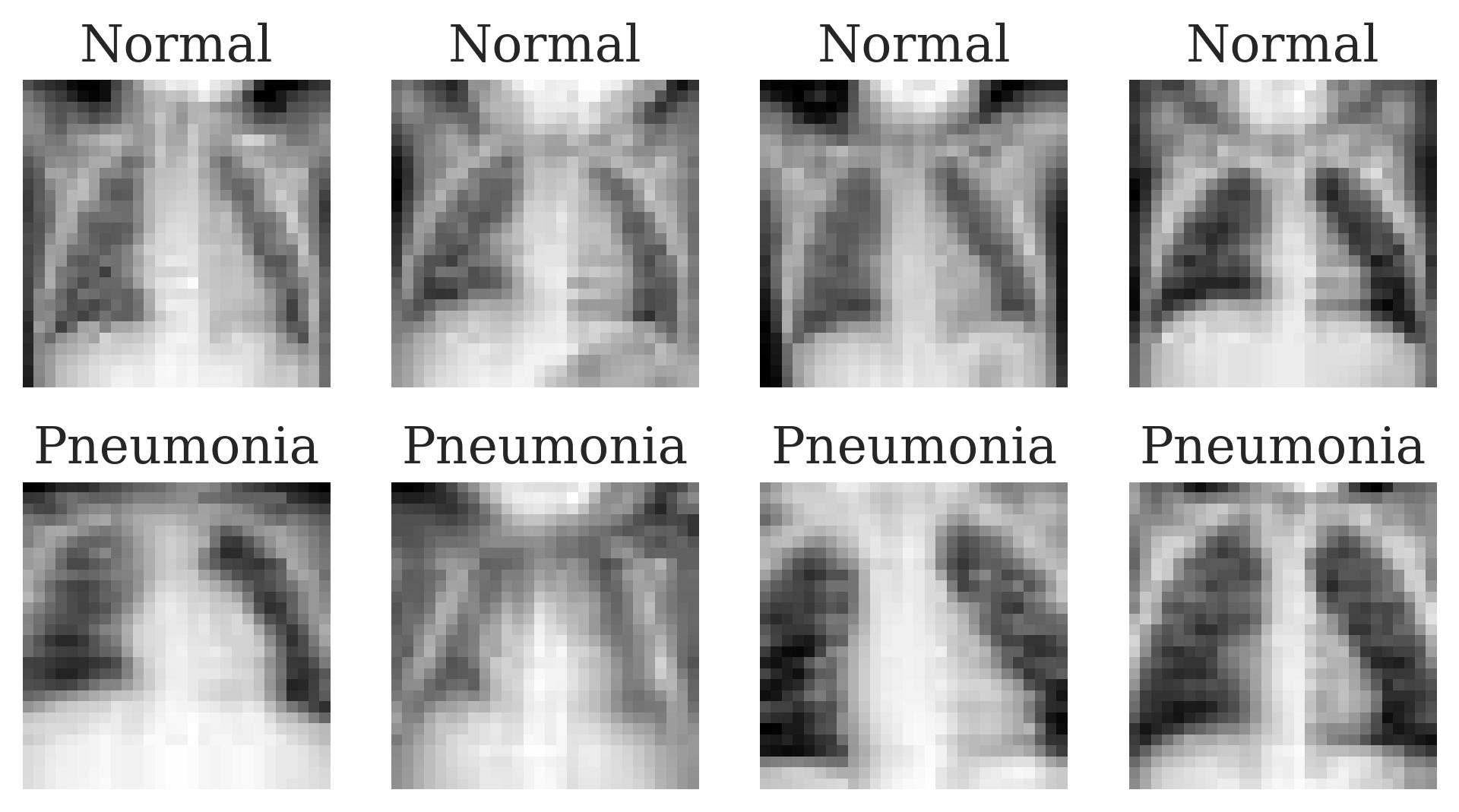
Figure 2: Example samples from PneumoniaMNIST, with Normal and Pneumonia images.
Key ablations and assessments include comparisons of Classical (no QEP) versus Quantum (QEP-enabled) end-to-end flows, class-balanced predictive metrics under standard and threshold-optimized criteria, robustness of QEP to variational noise and qubit-scaling, and communication cost scaling as a function of protected dimension and security scenario in the MPC stage.
Empirical Evaluation: Quantum Enhancement and MPC Scalability
Strong empirical findings center on the interplay between tensor-network compression, quantum feature expansion, and privacy-aware aggregation.
Frontend-Dependent Quantum Effects: The improvement offered by quantum refinement is not a generic accuracy increase, but a redistribution of predictive characteristics that are highly frontend-architecture dependent. Under threshold-optimized evaluation (Figure 3), the TTN+QEP configuration achieves the best trade-off among Accuracy, Precision, Recall, and F1, while MPS and MERA occupy distinct operating regimes.
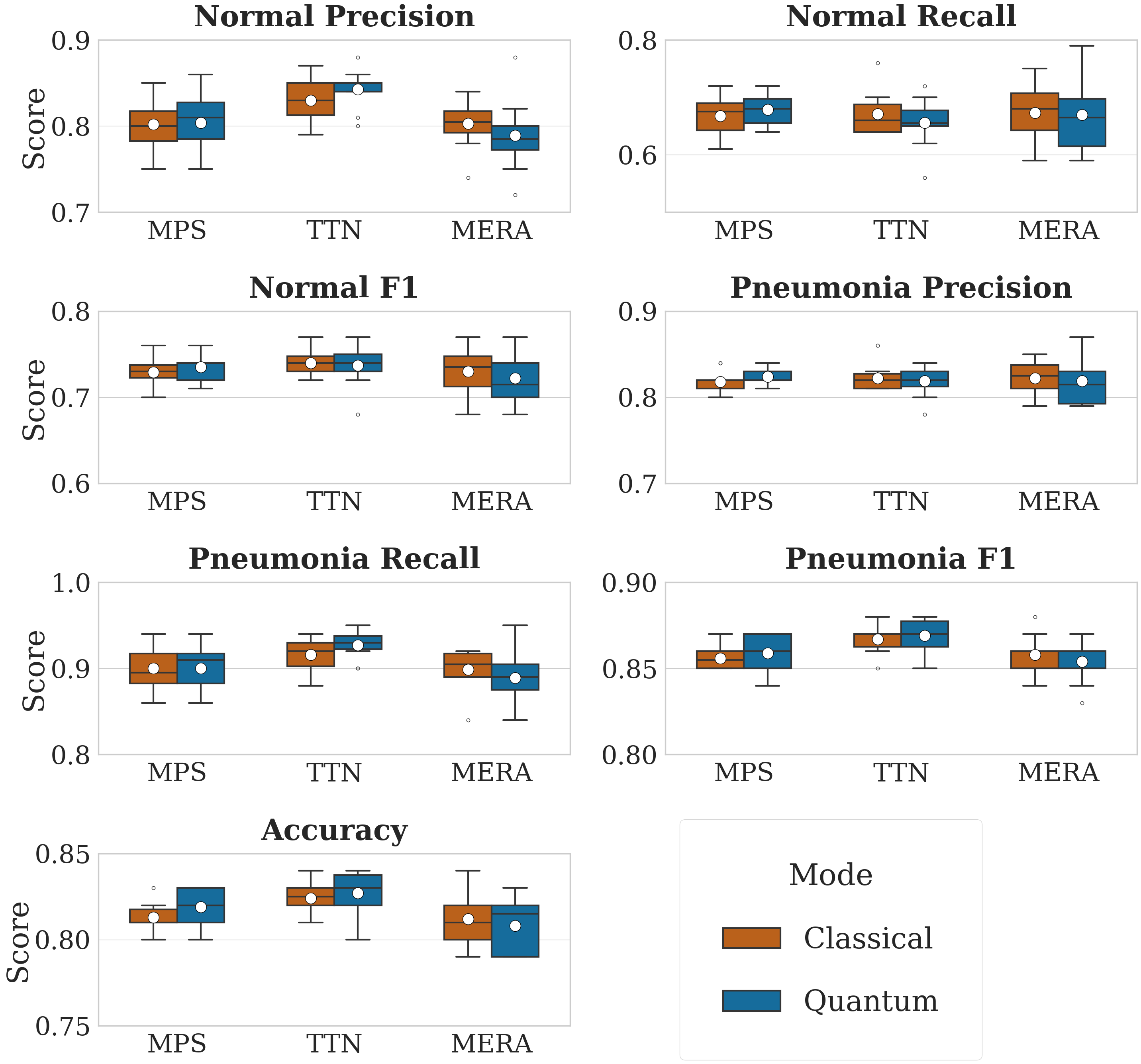
Figure 3: Boxplot comparison of test performance (Precision, Recall, F1, Accuracy) for Classical/Quantum modes and three TN frontends.
Fusion Dynamics: QEP’s internal operating regime (measured by fusion gate α and quantum-branch variability q-std, Figure 4) further highlights that the stability and informativeness of quantum features are determined not by circuit depth or quantum-specific properties alone, but by how well the latent topology (MPS/TTN/MERA) aligns with the quantum observable extraction. TTN yields the most controlled quantum behavior and balanced fusion, while MPS’s higher quantum-branch dispersion does not translate to superior generalization.
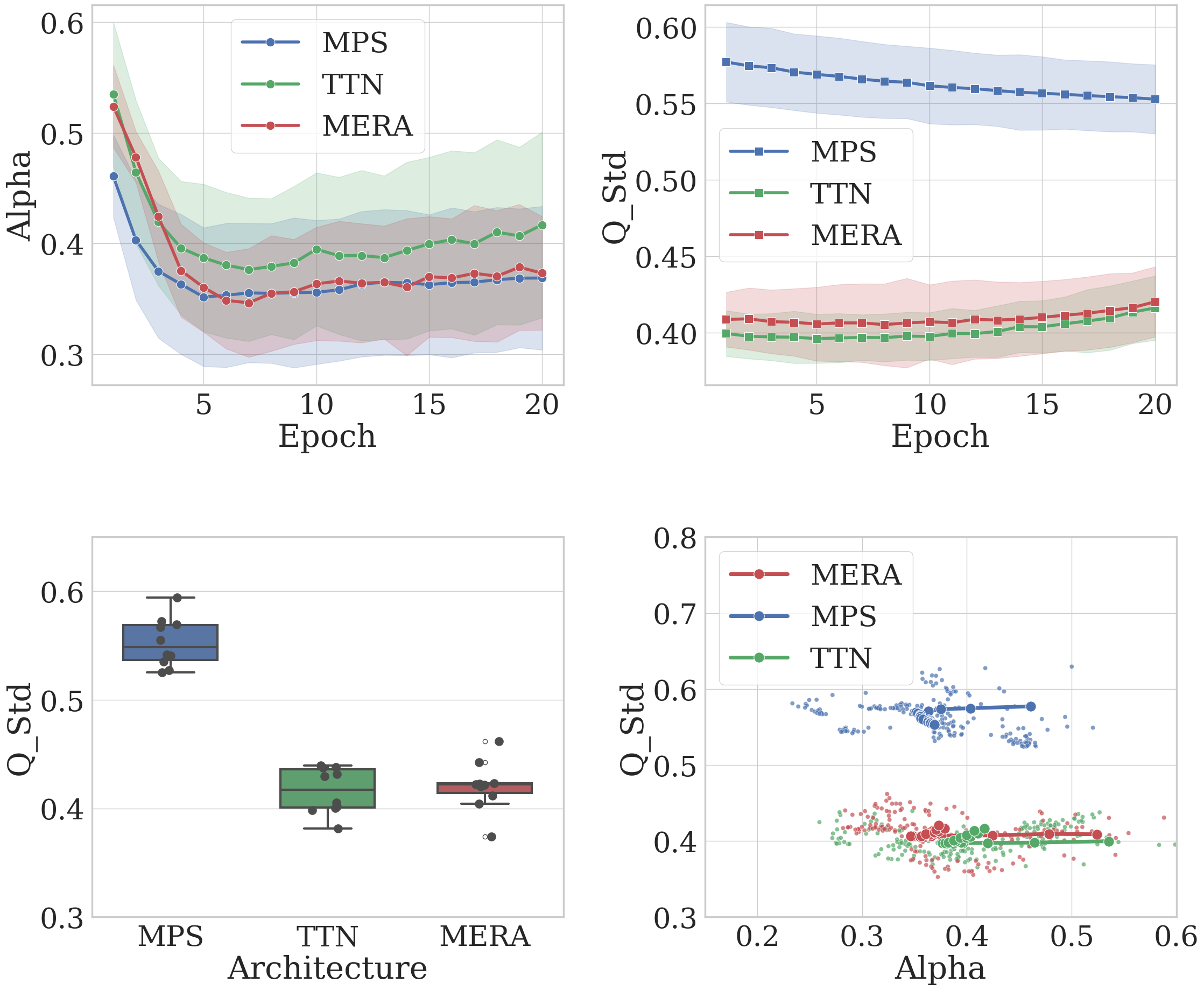
Figure 4: Panel analysis of QEP dynamics across frontends: training evolution of fusion gate Rz0, quantum feature dispersion Rz1-std, and final-epoch distributions.
Resource Matching and Robustness: QEP’s effectiveness scales with quantum register size. For the fixed latent dimension (Rz2), QEP performance stabilizes for Rz3, in line with the scaling heuristic Rz4. Lower-qubit settings yield significant degradation, indicating a minimum quantum capacity is needed for useful refinement (Figure 5). The QEP is further sensitive to quantum noise: depolarizing, thermal, and mixed noise all cause observable drops in accuracy, with thermal noise having the most pronounced effect.
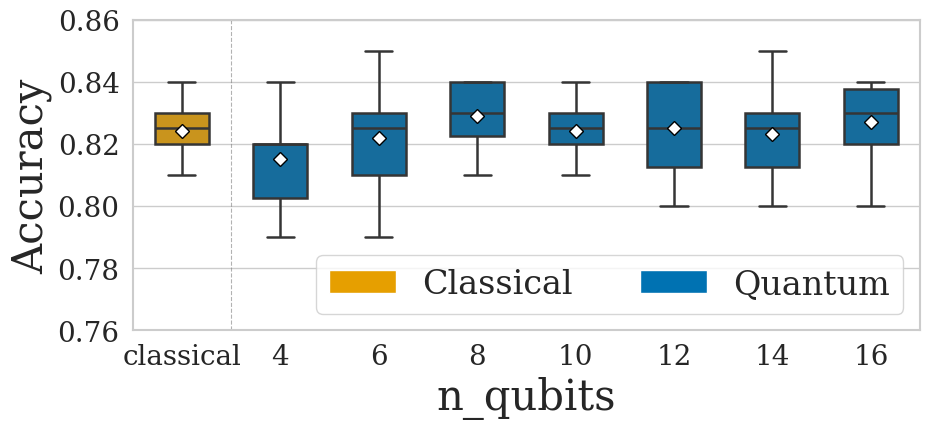
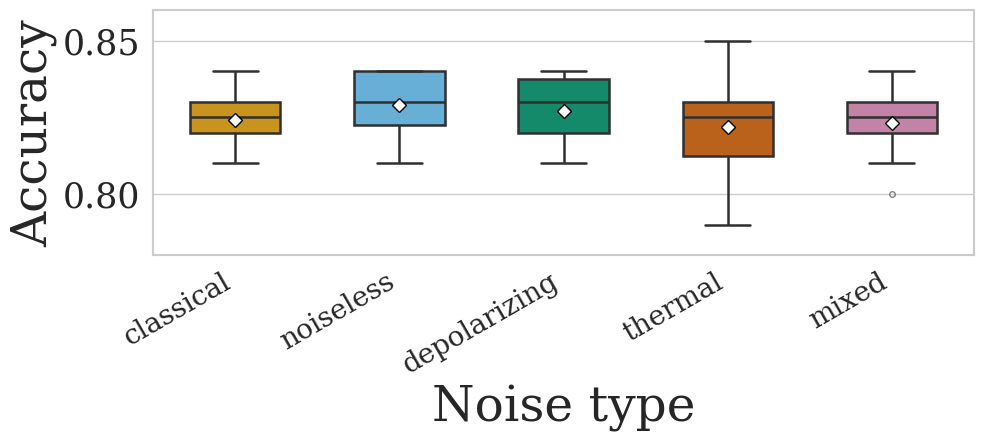
Figure 5: Qubit-count scaling for TTN+QEP, showing accuracy distributions as Rz5 increases from 4 to 16.
MPC Communication Dominated by Compression: Direct assessment of MPC communication confirms that the primary factor in protected aggregation cost is the dimensionality of the latent representation, not the number of federated clients or the use of quantum components. Both passive and active secure aggregation protocols show near-linear communication scaling in the representation dimension, with TN compression from Rz6 to Rz7 dimensions yielding a corresponding reduction in communication burden (Figure 6).
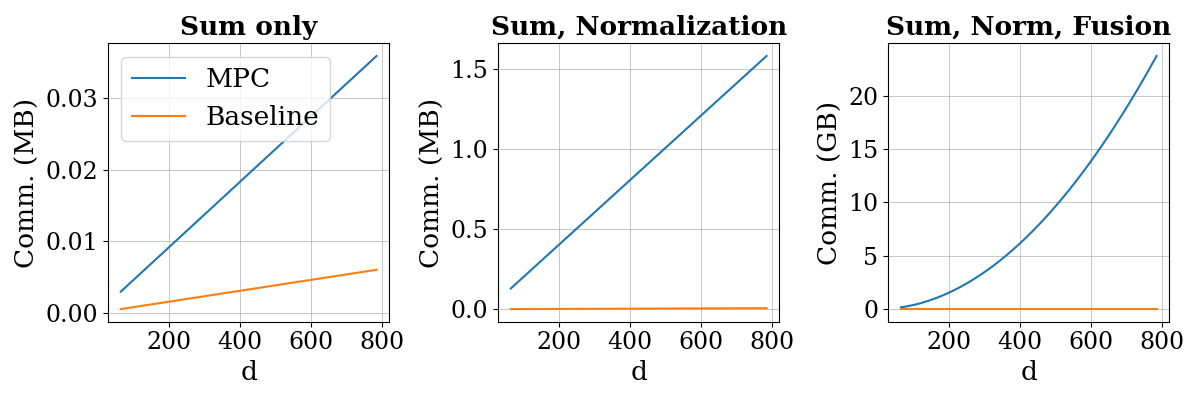
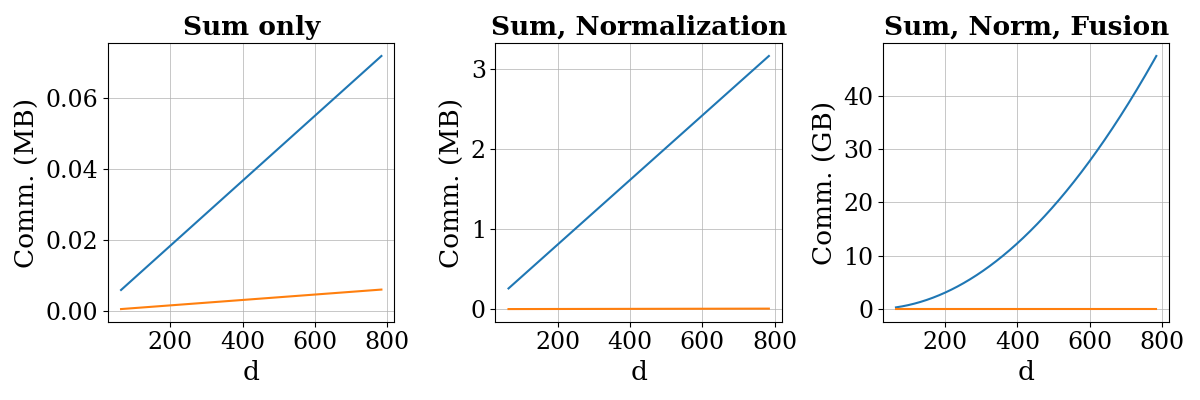
Figure 6: Communication cost versus protected representation dimension across passive and active MPC scenarios.
Theoretical and Practical Implications
The findings demonstrate that optimization of hybrid FL pipelines cannot focus on quantum or TN modeling in isolation. The QEP behaves as a feature expansion and refinement module whose value, stability, and predictive contribution are tightly coupled to the frontend’s latent compression structure. At the systems level, TN compression not only renders small-qubit QEP feasible, but directly reduces the communication cost for MPC-secured aggregation—satisfying privacy-preserving constraints under regulatory and clinical governance.
These architectural interdependencies motivate a co-design philosophy for privacy-aware, quantum-hybrid medical AI systems: The selection of latent compression scheme, secure aggregation mechanism, and quantum processing module must be optimized jointly for effective, practical, and scalable deployment.
From a theoretical perspective, the study reframes the value of quantum post-aggregation: it does not purport classical intractability or quantum advantage per se, but offers a principled route for leveraging limited quantum resources in post-classical federated settings. In the near-to-mid term, such hybrid designs are aligned with the available hardware and security landscape.
Future Directions
Several avenues for further research are identified:
- Transition from statevector simulation to hardware execution, assessing QEP utility and robustness beyond classically non-intractable regimes.
- Application to higher-dimensional, real clinical datasets, quantifying the compressibility limits of TN frontends in the presence of complex pathology.
- Fully-integrated MPC protocol deployments, closing the gap between symbolic communication modeling and end-to-end cryptographic system implementation.
- Exploration of quantum reservoir computing for robust, trainable, and hardware-validated quantum feature expansion, as an alternative or complement to observable-based QEP circuits.
- Investigation into privacy-preserving, delegated quantum computation (e.g., blind quantum computing) for secure quantum post-processing in federated learning backends.
Conclusion
This work presents a rigorous, systems-driven investigation of quantum-enhanced federated medical diagnosis using tensor-network representation compression and secure aggregation. The empirical and analytical results establish that the utility of quantum post-aggregation refinement—measured both by predictive improvement and by system cost—depends critically on the joint, architecture-aware design of the latent compression, quantum processing, and MPC aggregation modules. The framework provides a realistic blueprint for AI systems operating under privacy, security, and hardware constraints, and motivates future advances in quantum-classical co-design for scalable medical AI.