- The paper introduces SympLoc, a hierarchical alignment framework that integrates Riemannian, symplectic, and spectral techniques for text-driven 3D localization, achieving a 19% absolute improvement in recall.
- The framework utilizes a three-level alignment strategy—instance, relation, and global—to effectively disentangle and fuse multi-scale semantic structures from text and 3D point clouds.
- Empirical results on KITTI360Pose validate SympLoc's robustness with significant gains over state-of-the-art approaches, highlighting its potential for enhanced urban navigation and robotic scene understanding.
Riemannian and Symplectic Geometry for Hierarchical Text-Driven Place Recognition
Introduction
Text-driven 3D point cloud localization is emerging as a critical problem for robust robot scene understanding in tasks where semantic instructions must be grounded in large urban-scale environments. Prior approaches are fundamentally limited by reliance on global Euclidean descriptors, resulting in both representational collapse of important hierarchical and relational structures and reduced discriminability in the presence of ambiguous or overlapping scene elements. The paper "Riemannian and Symplectic Geometry for Hierarchical Text-Driven Place Recognition" (2604.01598) introduces SympLoc, a coarse-to-fine multimodal retrieval framework that addresses these limitations via multi-level alignment across three geometric representations: hyperbolic (Riemannian) instance embeddings, Fisher-Rao/symplectic relation encoding, and manifold spectral analysis for holistic global structure descriptors.
SympLoc: Multi-Level Alignment Framework
The core innovation of SympLoc is a hierarchical alignment regime within the coarse retrieval stage, disentangling instance-level, relation-level, and global-level semantics using geometry-aware cross-modal techniques.
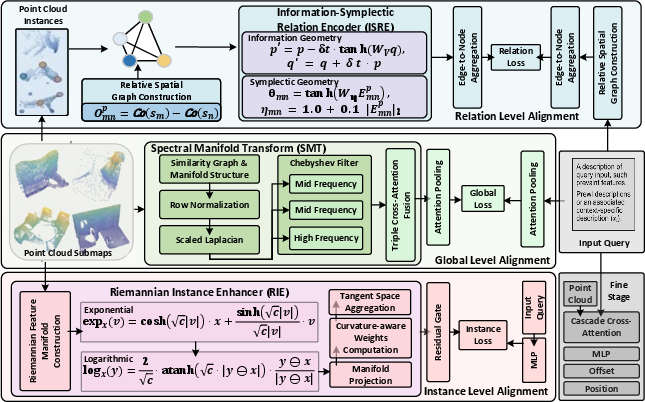
Figure 1: The SympLoc framework: multi-level alignment via information-geometric relation encoding (ISRE), spectral manifold global descriptors (SMT), and hyperbolic instance enhancement (RIE), preceding fine-stage localization.
Instance-Level Alignment via Riemannian Instance Enhancer (RIE)
SympLoc projects instance features into a Poincaré ball model of hyperbolic space with a learnable curvature parameter, optimizing a Riemannian self-attention (R-SA) mechanism. This allows the network to explicitly model tree-like, exponentially sparse structural hierarchies present in urban 3D scenes, which are highly mismatched to the uniform density assumption implicit in standard Euclidean self-attention. The use of exponential/logarithmic maps and Möbius subtraction enables faithful aggregation and comparison of instances throughout the manifold, improving robustness against semantic overlap and hierarchical ambiguity.
SympLoc constructs pairwise relation graphs for both text and point cloud modalities. Geometric and semantic features are fused at the edge level, then regularized using information geometry: relation features are parameterized as exponential family distributions on a statistical manifold with Fisher-Rao distance, dynamically downweighting noisy or ambiguous relations with embedding-norm-dependent precision. To guarantee geometric consistency and uncertainty-aware propagation, a learnable symplectic Euler update (Hamiltonian dynamics) evolves relation parameters, preserving manifold volume and preventing information loss or distortion. This two-layer composition yields robust, topology-consistent relational features especially resilient to cross-modal semantic ambiguities.
The global descriptor branch synthesizes permutation-invariant scene signatures by extracting structural invariants through Chebyshev-approximated spectral graph filtering on the normalized Laplacian derived from instance features. Three parallel branches (low, mid, high-frequency) are fused via triple cross-attention, followed by sequential modeling (GRU and Transformer stacks). This approach produces highly discriminative global descriptors with minimal informational loss—contrasting against traditional global pooling—while incurring no costly eigendecomposition.
Coarse-to-Fine Retrieval and Fusion
In the coarse stage, SympLoc computes independent cross-modal similarity scores for each branch and aggregates them for robust submap ranking, mitigating the risk of retrieval collapse due to a single noisy cue. The fine stage adopts cascaded cross-attention and MLP regression (from Text2Loc), refining the position estimate within the top retrieved submap.
Empirical Results
Extensive evaluation on KITTI360Pose (with >43k query-submap pairs) demonstrates that SympLoc achieves a 19% absolute improvement in Top-1 recall@10m over state-of-the-art (SoTA) baselines, including MambaPlace and CMMLoc—achieving scores of 0.74 (Top-1 @10m) on test, compared to 0.55 (MambaPlace) and 0.53 (CMMLoc). At the stricter @5m threshold, it attains 0.52 versus 0.39 for all previous SoTA.
The ablation study confirms the indecomposability of the performance gains: each branch (RIE, ISRE, SMT) yields significant recall improvements individually, while their aggregation is additive. The global branch alone outperforms all prior global-only models (Top-1: 0.39 vs. 0.34, Top-5: 0.71 vs. 0.65), confirming that SMT has superior structural sensitivity even independent of relational/instance cues.
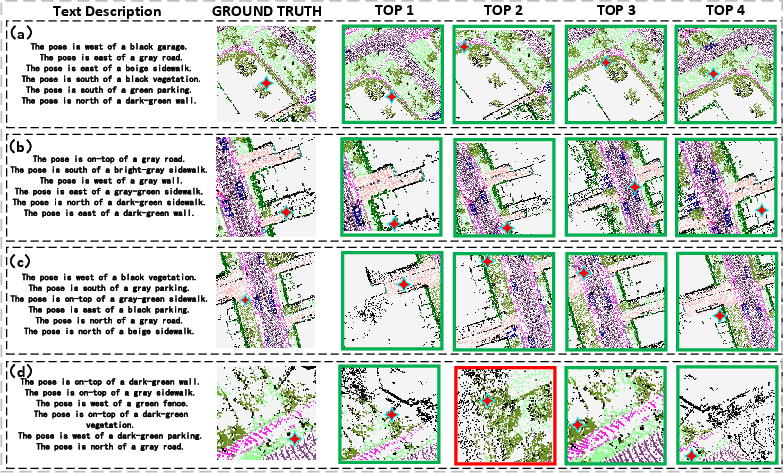
Figure 2: Visualization of submap retrieval: textual descriptions, ground truth point clouds, and Top-K retrievals with error/correctness annotation.
Qualitative analysis indicates that SympLoc is robust to language ambiguity and recurring object types, with high retrieval accuracy even under description-inherent uncertainty—attributable to ISRE’s uncertainty modeling and SMT’s topology invariance.
Theoretical and Practical Implications
SympLoc establishes the utility of explicit geometric prior incorporation at multiple scene encoding levels. The RIE’s hyperbolic attention is theoretically optimal for tree-structured and exponentially growing hierarchies, reflecting urban spatial semantics. The ISRE’s symplectic-Fisher-Rao regime bridges the gap between imprecise language and metric geometry, setting a precedent for uncertainty-aware cross-modal relation modeling. SMT enables scalable, lossless global representation of scene topology. These advances challenge the flat Euclidean attention paradigm and support further exploration of non-Euclidean unified architectures for spatial understanding.
On the practical front, significant recall improvements at strict error thresholds (Top-1 @5m and @10m) have direct implications for real-world robotics, navigation, and human-robot interaction applications where high-precision text-grounded localization is essential.
Future Directions
Potential extensions include deploying SympLoc at continental scales, exploring dynamic/temporal scene consistency, or integrating temporal geometric priors in ISRE. Integration with large-scale multimodal perception stacks (point-level captioning, referring expression segmentation) is natural given the flexible cross-modal design. There is also scope for automated geometric prior selection and adaptive fusion strategies beyond score aggregation.
Conclusion
SympLoc represents a substantive advance in hierarchical text-to-point-cloud localization by unifying Riemannian, information-geometric, and spectral manifold techniques within a modular multi-level alignment framework. Its empirical superiority and principled geometric underpinnings establish new directions for robust, semantically faithful cross-modal scene retrieval and fine-grained spatial grounding (2604.01598).

