Optimizing EEG Graph Structure for Seizure Detection: An Information Bottleneck and Self-Supervised Learning Approach
Published 2 Apr 2026 in cs.LG | (2604.01595v1)
Abstract: Seizure detection from EEG signals is highly challenging due to complex spatiotemporal dynamics and extreme inter-patient variability. To model them, recent methods construct dynamic graphs via statistical correlations, predefined similarity measures, or implicit learning, yet rarely account for EEG's noisy nature. Consequently, these graphs usually contain redundant or task-irrelevant connections, undermining model performance even with state-of-the-art architectures. In this paper, we present a new perspective for EEG seizure detection: jointly learning denoised dynamic graph structures and informative spatial-temporal representations guided by the Information Bottleneck (IB). Unlike prior approaches, our graph constructor explicitly accounts for the noisy characteristics of EEG data, producing compact and reliable connectivity patterns that better support downstream seizure detection. To further enhance representation learning, we employ a self-supervised Graph Masked AutoEncoder that reconstructs masked EEG signals based on dynamic graph context, promoting structure-aware and compact representations aligned with the IB principle. Bringing things together, we introduce Information Bottleneck-guided EEG SeizuRE DetectioN via SElf-Supervised Learning (IRENE), which explicitly learns dynamic graph structures and interpretable spatial-temporal EEG representations. IRENE addresses three core challenges: (i) Identifying the most informative nodes and edges; (ii) Explaining seizure propagation in the brain network; and (iii) Enhancing robustness against label scarcity and inter-patient variability. Extensive experiments on benchmark EEG datasets demonstrate that our method outperforms state-of-the-art baselines in seizure detection and provides clinically meaningful insights into seizure dynamics. The source code is available at https://github.com/LabRAI/IRENE.
The paper introduces IRENE, a novel framework that uses an information bottleneck to construct sparse and physiologically plausible EEG graph structures for seizure detection.
It integrates self-supervised masked autoencoding, dynamic graph learning, and structure-aware attention, yielding state-of-the-art F1-scores and AUROC on TUSZ.
Empirical results demonstrate that the approach significantly outperforms traditional methods by reducing noise and improving interpretability in clinical seizure detection.
Optimizing EEG Graph Structure for Seizure Detection via Information Bottleneck and Self-Supervised Learning
Problem Framing and Motivation
Automated detection of epileptic seizures from EEG remains difficult due to high spatial-temporal complexity and pronounced inter-patient variability. While GNN-based methods have shown efficacy in representing spatial dependencies among multichannel EEG, performance is fundamentally constrained by the quality of graph structure construction. Conventional approaches—pairwise correlation, static spatial priors, or end-to-end learned but unregularized graphs—are highly susceptible to noise and introduce redundant or spurious connections, undermining both accuracy and interpretability in clinical applications.
IRENE (Information Bottleneck-guided EEG Seizure Detection via Self-Supervised Learning) is proposed to resolve three critical issues: (i) identifying task-informative and physiologically plausible graph structure under severe signal noise, (ii) coupling topology construction with discriminative representation learning, and (iii) enhancing robustness to annotation scarcity and subject heterogeneity. The work synthesizes a mutual information-constrained dynamic graph learner (IB-based), a structure-aware attention mechanism, and masked autoencoding-based pretraining within a unified architecture.
Methodology: Information Bottleneck-Guided Graph Construction
The template for EEG-to-graph modeling represents each session as a sequence of graphs, Gt=(V,At,Xt), with nodes denoting electrodes, node features as windowed EEG embeddings, and edges encoding instantaneous functional connectivity. IRENE incorporates an explicit self-expressive formulation regularized by the Information Bottleneck (IB) criterion to jointly optimize sparse, label-relevant edge sets.
Each node embedding, zti, is constructed as a sparse linear combination of the others, with At(i,j) the learnable adjacency. The IB objective directly minimizes the mutual information between the adjacency and inputs (suppressing redundancy and overfitting to noise), while maximizing with respect to target labels. The total graph loss is:
Mutual information terms are efficiently estimated with InfoNCE (for label relevance) and Donsker-Varadhan (for redundancy), enabling end-to-end optimization. Temporal smoothness constraints further enforce dynamic evolutionary consistency:
Lsmooth=∥At−At−1∥F2
Adjacency matrices are post-processed by Min-Max normalization and top-K sparsification, enforcing parsimony and controllable edge density.
Architecture and Learning Pipeline
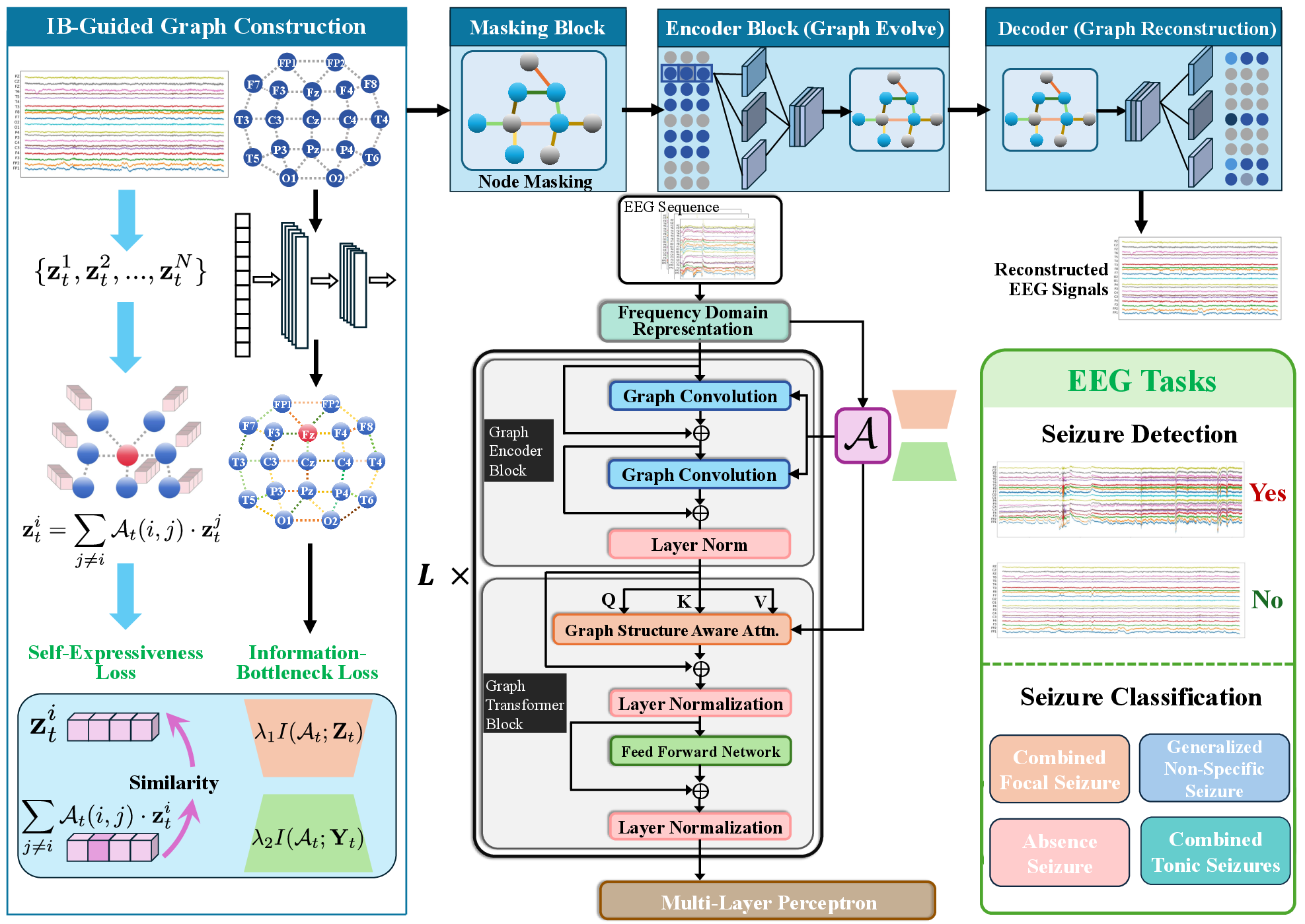
The IRENE framework integrates IB-guided graph construction with a dual-stage encoder architecture operating on masked node features (Figure 1). The encoder fuses local patchwise GCN stacking (influenced by dynamic At) and a graph structure-aware Transformer layer, in which attention coefficients are modulated by edge confidence scores (ϕij=∣At(i,j)∣):
αij=softmaxj(dqi⊤kj+γ⋅ϕij)
Masked autoencoding pretraining, with 15% random node feature dropout, forces recovery from context, improving the robustness of learned representations under annotation scarcity and physiological confounds.
End-to-end optimization is performed in two stages: (i) pretrain the encoder using a combination of IB-graph loss, temporal smoothness, and MSE reconstruction on masked nodes; (ii) fine-tune with a supervised head for seizure detection/classification using cross-entropy.
Figure 1: The architecture of the IRENE framework, integrating IB-guided dynamic graph construction, structure-aware encoder/decoder, and a graph structure-modulated attention mechanism.
Empirical Evaluation
Experiments are conducted on the Temple University Hospital Seizure Corpus (TUSZ v1.5.2). Metrics include F1, Recall, and AUROC for both 12s and 60s EEG clip settings. IRENE is benchmarked against non-graph deep models (LSTM, ResNet-LSTM) and recent spatial/dynamic graph learners (Dist-DCRNN, Corr-DCRNN, NeuroGNN, GraphS4mer).
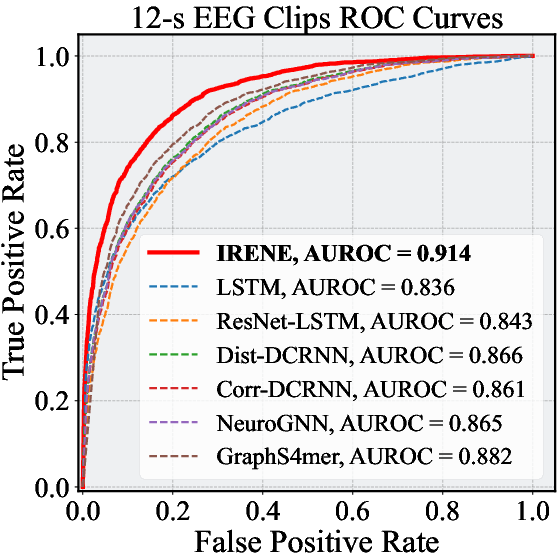
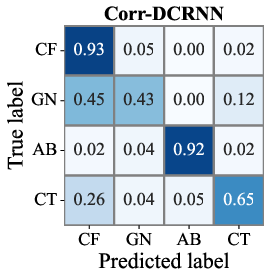
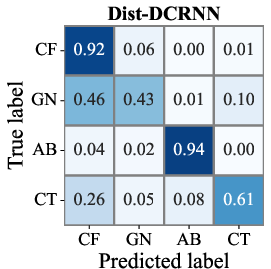
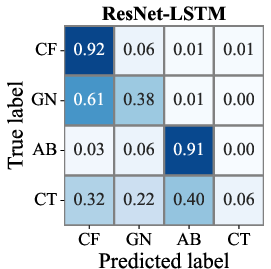
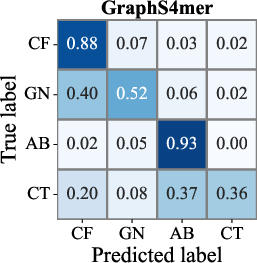
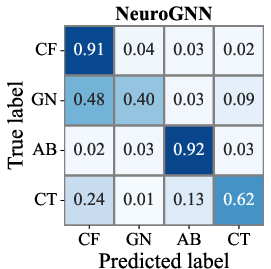
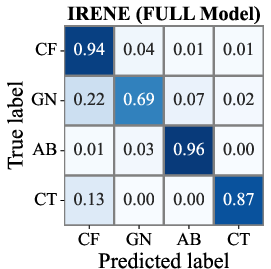
IRENE achieves state-of-the-art results across all metrics, with F1-scores of 0.749 (12s) and 0.753 (60s), and AUROC of 0.916 (60s), exceeding the strongest graph baseline by a margin of 2–3%. Notably, performance gains are most pronounced for subtle and clinically confounded seizure types (e.g., focal and generalized non-motor seizures), validated by improved per-class accuracy.
Figure 2: ROC curves demonstrating consistent superiority of IRENE over baselines in 12s EEG seizure detection tasks.
Ablation studies decisively show performance decrements upon removal of any major component (IB-graph loss, structure-aware attention, masked pretraining, or temporal smoothness), confirming each to be essential for optimal performance. Replacement of the IB-guided graph with conventional pairwise similarity or spatial distance-based construction results in substantial loss of discriminative power.
Graph Structural Insights and Interpretability
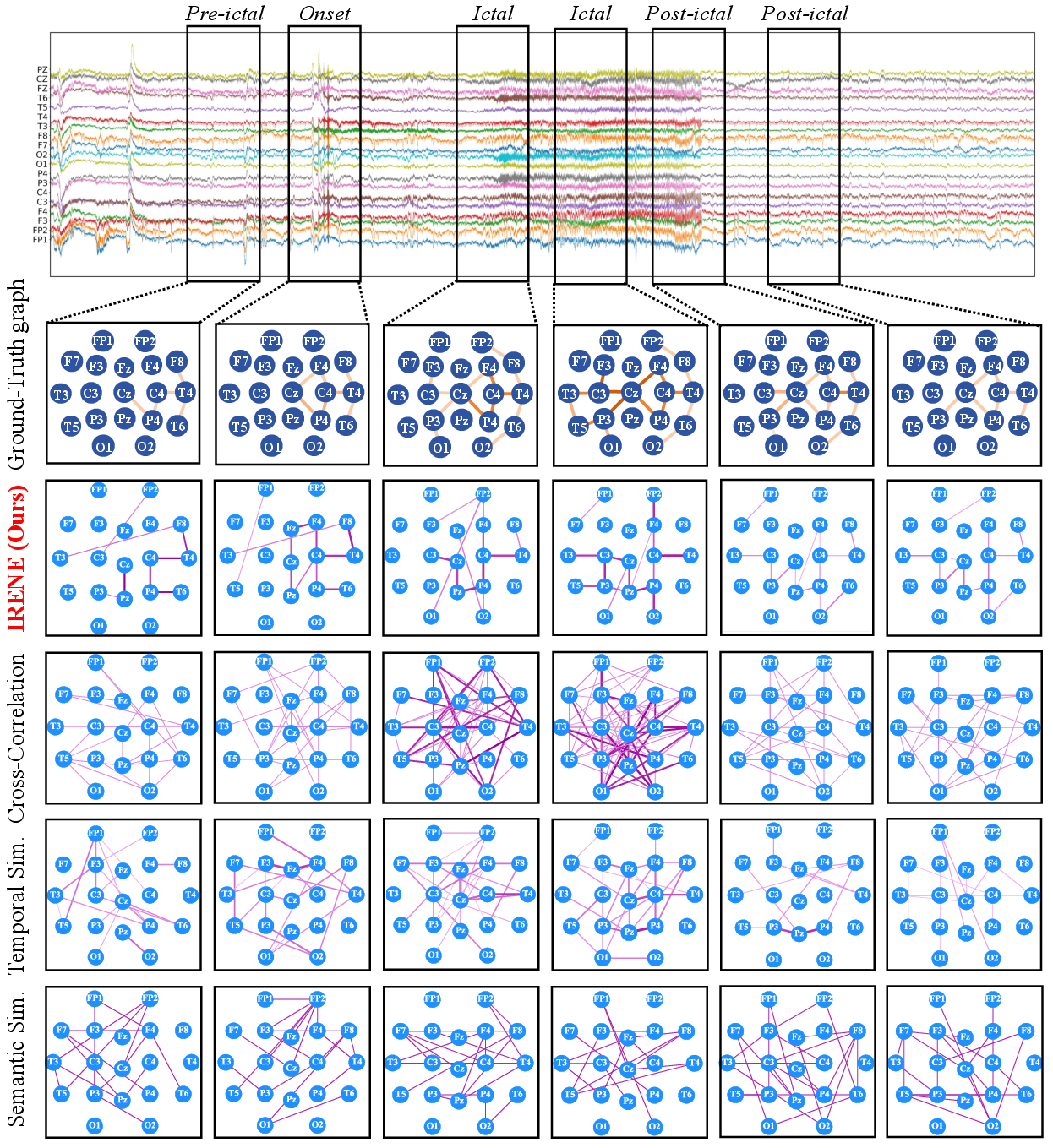
Qualitative visualization reveals that IRENE produces highly sparse, dynamic EEG graphs, whose edge activations intensify and centralize in seizure-related regions during ictal epochs, and rapidly revert to sparse background-like connectomes for normal states. This behavior closely matches ground truth annotation, whereas baseline methods yield dense, noisy, and less state-specific connectivity patterns.
Figure 3: Learned dynamic EEG graphs across different brain states—IRENE demonstrates state-dependent sparsity and center-surround connectivity matching clinical ground-truth patterns.
IRENE's learned edge density (average 0.064) nearly matches the expert-annotated graphs (0.0575), in direct contrast to high-density (0.18–0.37) produced by unsupervised methods, validating the IB principle's effectiveness in noise suppression and interpretable biomarker discovery.
Practical and Theoretical Implications
The explicit IB-guided dynamic graph learning paradigm enables robust annotation-efficient training, supporting generalization to new patients and hardware without manual feature engineering or handcrafted priors—a key advance over previous EEG biomarker paradigms. The sparsity enforcements enhance interpretability and foster direct alignment with clinical insights regarding seizure onset propagation and dynamic network reconfiguration.
This architecture also opens the pathway to other physiological time-series domains (e.g., invasive ECoG, MEG), and suggests extensions involving causal graph discovery, test-time graph adaptation, or theoretical analysis of information-theoretic generalization bounds under task-specific label scarcity. On the practical front, direct integration of the learned graphs into clinical annotation systems could inform targeted intervention, seizure foci localization, and personalized therapeutic design.
Conclusion
IRENE establishes a new class of graph-based EEG seizure detection architectures that tie dynamic, interpretable graph structure learning to robust self-supervised representation extraction using explicit information-theoretic constraints. The method defines the state of the art across accuracy, noise robustness, and clinical interpretability, and provides a framework extensible to other noisy, high-dimensional physiological monitoring scenarios, promoting the translation of graph learning theory to applied healthcare domains ["Optimizing EEG Graph Structure for Seizure Detection: An Information Bottleneck and Self-Supervised Learning Approach" (2604.01595)].