- The paper presents NED-Tree, a protocol that recursively decomposes nonlinear expressions to translate OR problem texts into executable solver code.
- NED-Tree achieves 72.51% average accuracy and up to 92.11% on nonlinear tasks, significantly outperforming baseline LLM methods on real-world benchmarks.
- The framework enhances efficiency by reducing inference time by 40-60% and exhibits solver-agnostic performance with minimal accuracy loss across tested solvers.
NED-Tree: Nonlinear Element Decomposition for LLM-based Optimization Modeling
Introduction
The automation of translating natural language Operations Research (OR) problem descriptions into executable and solver-ready models remains an open challenge. While LLMs have displayed strong performance in linear modeling, their capabilities collapse when faced with real-world nonlinear expressions. Current approaches, especially end-to-end generation, are hampered by a semantic gap between modeling and coding, frequently resulting in code that is mathematically plausible but not executable by mainstream solvers. "NED-Tree: Bridging the Semantic Gap with Nonlinear Element Decomposition Tree for LLM Nonlinear Optimization Modeling" (2604.01588) systematically addresses this gap through a protocolized, recursive intermediate representation—termed NED-Tree—coupled with sentence-wise extraction. This essay provides an expert analysis of the methodological innovations, experimental validation, and broader implications.
The Nonlinear Semantic Gap
The primary impediment to robust LLM-based OR modeling lies in the mismatch between natural/mathematical semantics and the constraints or interfaces required by solvers. Linear problems, typically exhibiting a one-to-one mapping between symbolic formulations and solver calls, mask this gap. However, the ubiquity of nonlinear constructs (e.g., Axα, exponentials, fractionals, logic-driven piecewise terms) in practical applications brings these issues to the fore. The authors empirically document a stark performance degradation—termed the "nonlinear performance cliff"—when nonlinear perturbations are introduced to previously solvable problem sets: accuracy rates for leading LLM frameworks drop precipitously, emphasizing Type II (code semantic) errors over logical misunderstandings.
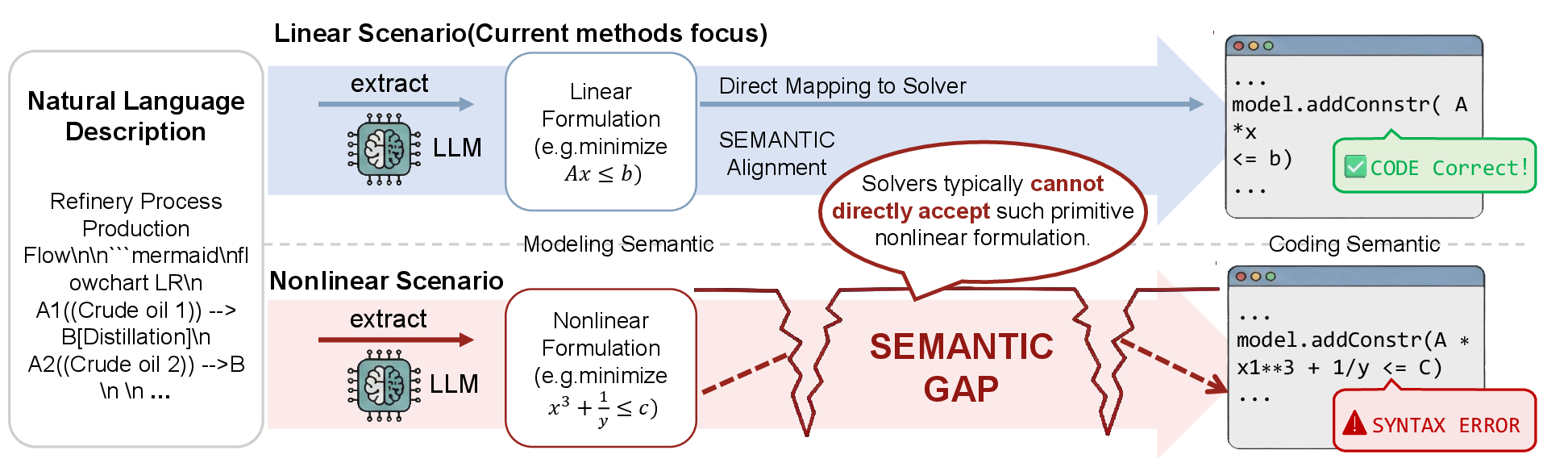
Figure 1: Visualization of the abrupt accuracy collapse ("nonlinear semantic gap") as minor nonlinear perturbations are introduced to optimization modeling tasks.
Further analysis disentangles modeling error types and illustrates that the performance cliff is driven by code synthesis failures and unstable semantic extraction, not just by logical miscomprehension.
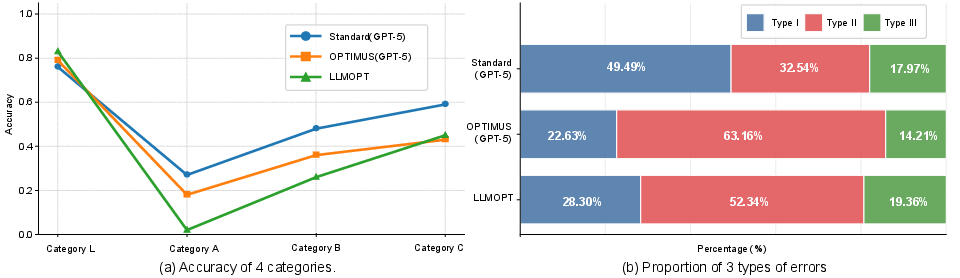
Figure 2: Subfigures (a) present category-wise accuracy of existing methods, while (b) details the dominant error types, highlighting modeling-coding semantic misalignment as the bottleneck.
NED-Tree Framework
Motivation and Design
The NED-Tree (Nonlinear Element Decomposition Tree) is introduced as a protocol layer that decomposes complex nonlinear terms into atomic, solver-compatible constructs. Rather than treating translation as an end-to-end black box, NED-Tree creates an explicit structural mapping:
- Sentence-by-Sentence Extraction (SbS): Systematic extraction of variables, parameters, constraints, and nonlinear relations from the text. Fine-grained sentence scanning mitigates the frequent information omission/hallucination observed in monolithic LLM extraction pipelines.
- Recursive Tree Construction: Every nonlinear term is recursively parsed into atomic sub-elements, with each operation or expression node mapped (possibly via transformation, e.g., logarithmic for parametric exponents) into intermediate representations and auxiliary variables.
- Mapping to Code Semantics: Structured elements are systematically converted into explicit solver API calls, ensuring compliance with backend requirements and enabling executability.
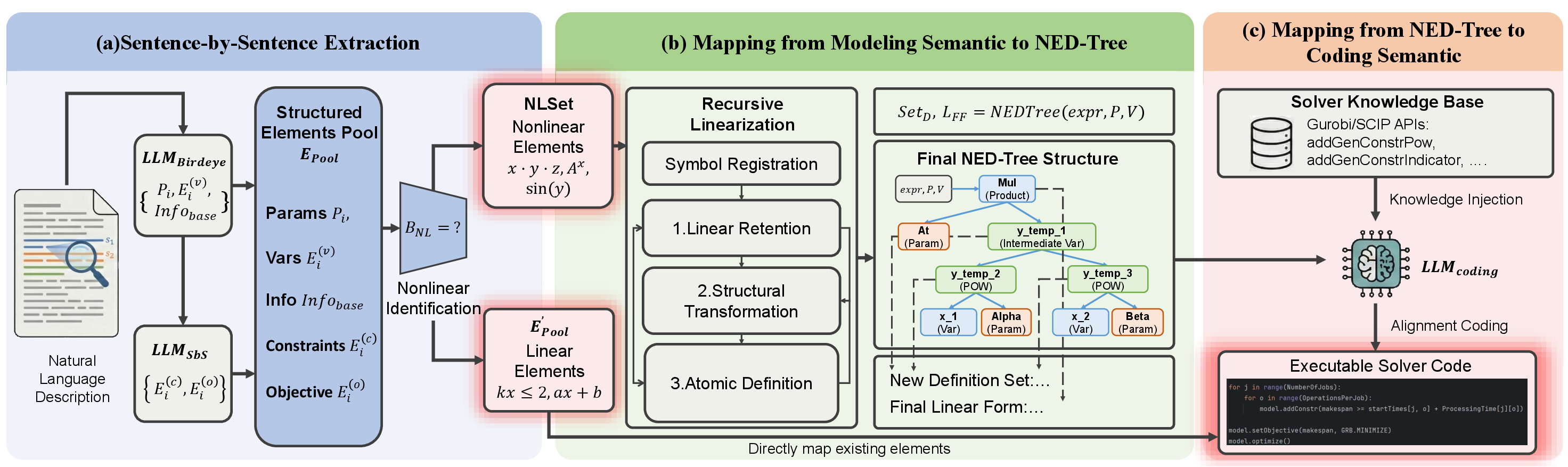
Figure 3: Schematic of the NED-Tree workflow: (a) sentence-by-sentence parameter extraction; (b) recursive semantic decomposition into the NED-Tree; (c) synthesis of solver-compatible code.
The element registration and decomposition mechanism allows generic handling of high-order powers, chained multiplications, parametric-base powers, and other non-convex forms.
Experimental Analysis
Benchmarks and Main Evaluation
The authors validate NED-Tree on 10 diverse OR benchmarks, spanning both legacy datasets (NL4OPT, NLP4LP, MAMO, IndustryOR, OPTIBench, OptMATH) and their new benchmark, NEXTOR. The latter is designed to fill the realism gap: long-form, redundant, and highly nonlinear problem statements with associated ground truths and executable solver scripts.
NED-Tree achieves 72.51% average accuracy, outperforming the best fine-tuned baselines by 13.02% and non-fine-tuned (prompt-based/agent) models by 6.27%. The results are especially pronounced in nonlinear regimes, such as NEXTOR, where NED-Tree attains 92.11% accuracy on nonlinear tasks versus sub-25% for leading GPT-based or fine-tuned systems.
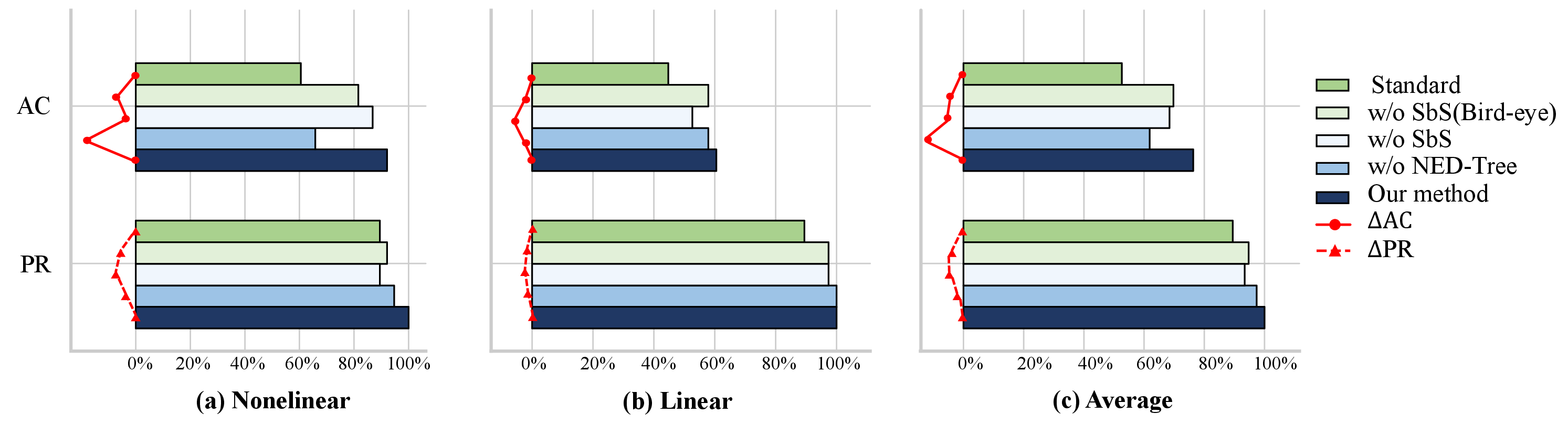
Figure 4: Ablation results on NEXTOR: removing key modules (e.g., SbS extraction, NED-Tree itself) demonstrates their necessity, especially for high-fidelity nonlinear performance.
Ablation, Efficiency, and Solver Generalization
A detailed ablation study confirms that both the SbS extraction strategy and the recursive decomposition protocol are indispensable. The absence of SbS or the NED-Tree module leads to 6-26% performance drops on non-linear tasks, substantiating the claim that decomposition—not just stronger modeling—is the differentiator.
NED-Tree also demonstrates superior efficiency versus prompt-based frameworks such as Chain-of-Experts (~40-60% faster inference) and is validated for solver agnosticism: accuracy remains stable to 0.09% margin when switching solvers (e.g., Gurobi to COPT), as all solver-dependent logic is handled modularly in the code synthesis phase.
Case Studies
A detailed decomposition example illustrates the protocol: for the nonlinear term At⋅x1αx2β, the framework:
- Registers atomic units: powers are parsed as auxiliary variables via
model.addGenConstrPow.
- Multiplies decomposed elements with auxiliary variables to enforce second-order or code-compatible constraints.
- Ensures code generation directly translates to valid solver code, minimizing run-time errors.
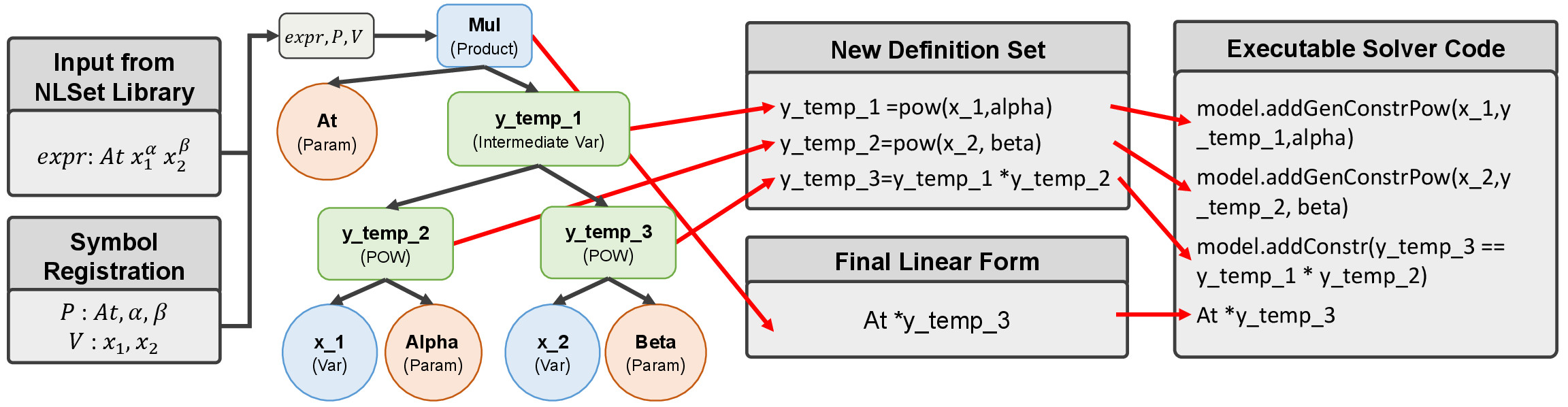
Figure 5: NED-Tree’s decomposition of Atx1αx2β to tractable, solver-executable components.
Implications and Future Directions
The NED-Tree protocol demonstrates that parameter-efficient, structured context engineering can rival (and frequently outperform) both prompt-tuned and expensive fine-tuned LLMs for automated OR modeling. By explicitly aligning modeling and coding semantics, NED-Tree eliminates the main source of failure in LLM-driven OR automation—code-execution errors due to hidden semantic divergences in nonlinear settings.
Practically, NED-Tree is deployable across solvers, robust to diverse input distributions, and highly efficient in inference time and token consumption—facilitating scalable, industrial adoption for complex OR modeling. Theoretically, this work suggests that intermediate, interpretable protocol layers offer a powerful counterpoint to naive end-to-end approaches and can support plug-and-play model improvements without costly retraining.
Extensions of NED-Tree could consist of further error-correction feedback loops, integration with more complex multimodal extraction (e.g., tabular/graph-structured input), and memory-based reasoning to handle even higher-order or cross-referential nonlinearities.
Conclusion
"NED-Tree: Bridging the Semantic Gap with Nonlinear Element Decomposition Tree for LLM Nonlinear Optimization Modeling" establishes a new paradigm for LLM-driven OR modeling, highlighting the deficiencies of prevailing black-box methods and substantiating the power of protocolized, structural alignment. The NED-Tree framework decisively improves generalization, accuracy, and transferability in nonlinear optimization modeling without recourse to fine-tuning. These findings have both immediate practical impact for industrial OR automation and broader theoretical significance for LLM applications in structured, constraint-heavy symbolic reasoning tasks.