- The paper introduces a novel dependency-guided recomposition framework that uses LLM-driven state dependency reasoning and trace stabilization to unlock deep, state-dependent GUI behaviors.
- Evaluation on 20 real-world Android apps shows absolute coverage improvements between 10–28% and up to 3–4× more marginal coverage compared to traditional forward-exploration methods.
- The approach enhances testing efficiency and bug discovery by systematically accessing previously unreachable state branches without needing source-code modifications.
EpiDroid: Dependency-Guided Recomposition for Deep State Discovery in Mobile GUI Testing
Motivation and Problem Analysis
Contemporary automated GUI exploration in mobile testing is fundamentally hampered by its inability to reason about cross-path dependencies in application state changes. Forward-execution paradigms optimize next-action selection but fail to reach deep and conditionally triggered states, particularly in scenarios where specific configurations or data mutations unlock previously unreachable functionalities. Empirical analysis on NewPipe reveals two critical bottlenecks: a structural limitation where state-dependent branches are unreachable simply via forward exploration, and an efficiency limitation where necessary prerequisites are rarely satisfied prior to exploring dependent branches. Without explicit modeling of mutable state elements (MSEs) and dependency-aware scheduling, exploration remains shallow and wasteful with significant redundancy.
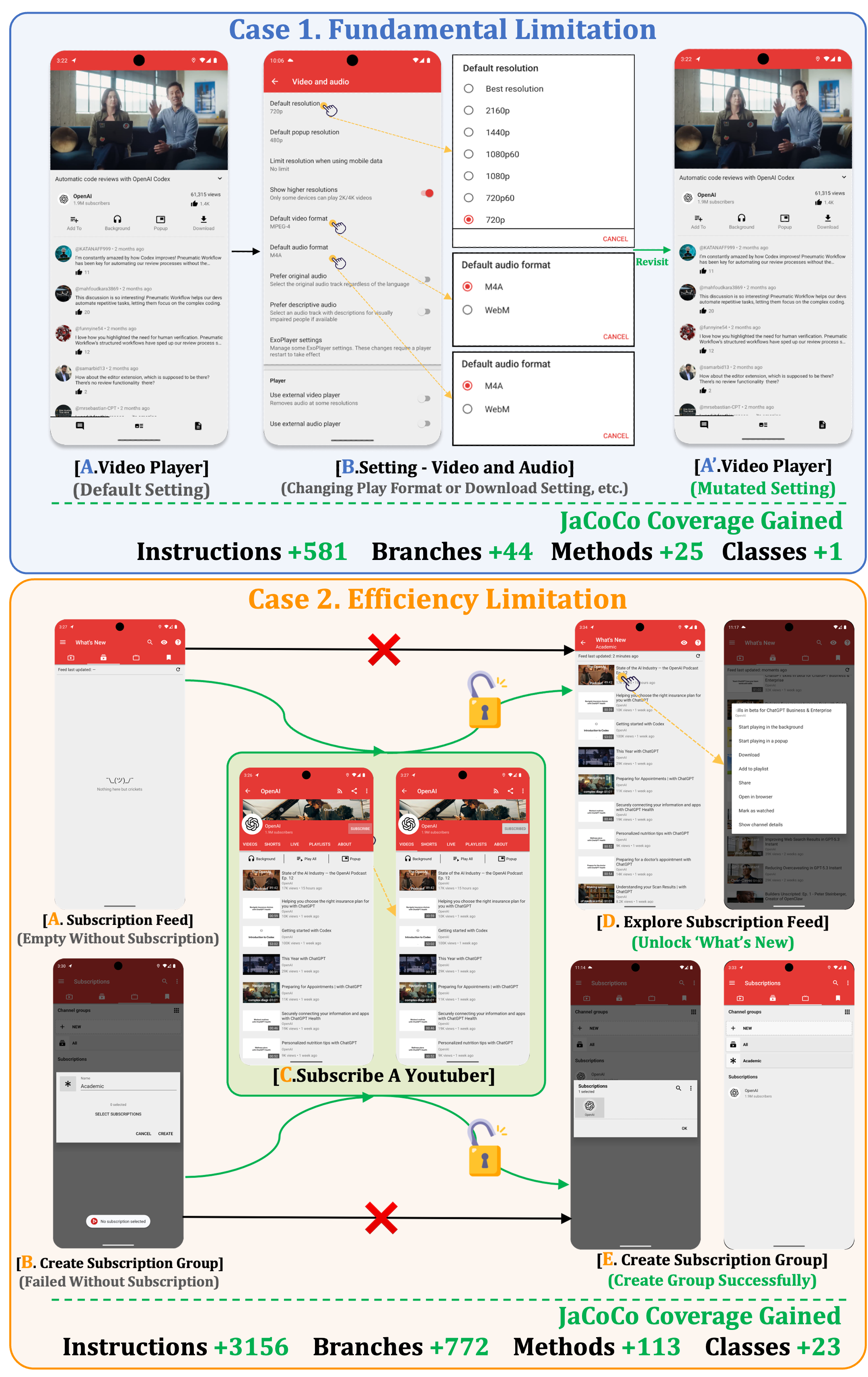
Figure 1: Motivation cases in NewPipe. Structural and efficiency limitations illustrate the inability of forward exploration tools to access deep, state-dependent branches.
EpiDroid Framework and Methodology
EpiDroid introduces a closed-loop, black-box framework, deploying as a pluggable layer to existing exploration tools that augments them with semantic state-dependency awareness. The core pipeline comprises three stages: (1) trace stabilization and state-change tracking, (2) semantic profiling with impact reasoning via LLM-driven analysis, and (3) dependency-guided sequence recomposition and replay. Trace stabilization minimizes noise and redundancy, extracting replayable fragments and runtime evidence of state changes. MSEs are extracted by monitoring GUI component attributes and confirmed through functional summarization and semantic validation, filtering non-functional fluctuations that do not contribute to meaningful state mutation.
Impact scope analysis, prioritized by the LLM, ranks mutation points by their inter-page, global, and intra-page influence. Composite sequence execution concatenates validated fragments, first performing navigation to mutation targets, then executing non-monotonic, dependency-guided replay paths under mutated states. Iterative feedback from composite execution returns new discoveries, semantic mismatches, and operational failures, progressively refining the semantic dependency graph.
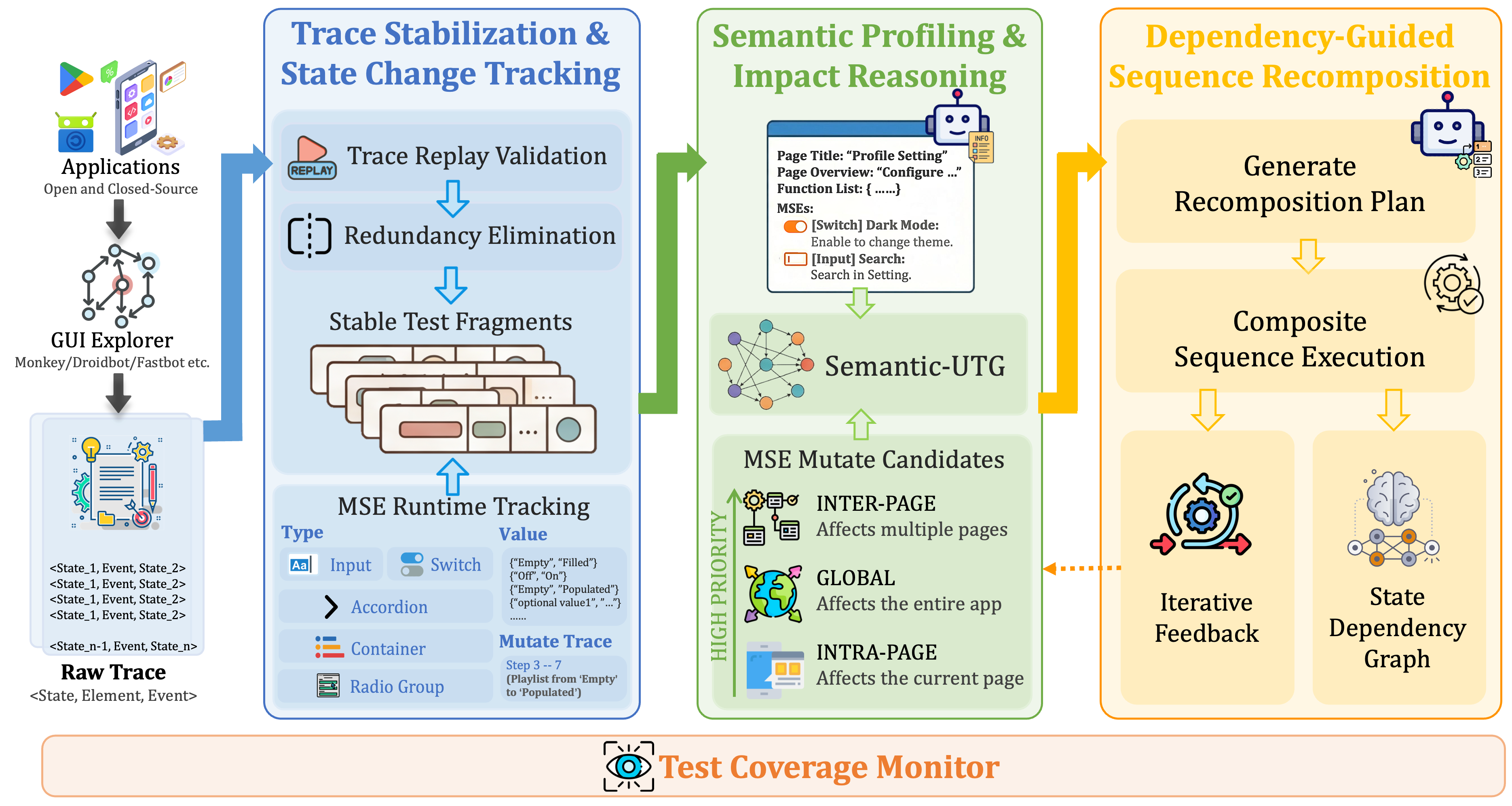
Figure 2: EpiDroid’s framework overview shows three-stage workflow: stabilization, semantic profiling, and dependency-guided recomposition, with iterative feedback for state discovery.
Evaluation and Numerical Results
Evaluation across a benchmark of 20 real-world Android applications demonstrates that EpiDroid consistently improves method-level code coverage (ACC), achieving absolute gains of 10--28\% over the strongest pre-LLM and LLM baselines and providing 3--4× more marginal coverage than simply continuing baseline exploration under the same budget. The advantage is maximized with applications exhibiting deep stateful navigation and abundant MSEs; for example, Tasks and Time Planner showed over +100% improvement in coverage.
Coverage gains correlate with the underlying event throughput of the integrated engine: tools with lower baseline throughput, such as DroidBot-based LLM-Explorer, see larger improvement gaps. Edge cases, including apps with shallow activity structures or environment-gated features, show minimal gains, underscoring structural limitations inherent to black-box testing.
Ablation studies confirm the necessity of both trace stabilization and dependency reasoning: bypassing stabilization leads to dramatic reduction in replay success rate, while omitting LLM-based dependency inference yields lower effective coverage and fewer new state discoveries, indicating that targeted recomposition is essential for unlocking deep behaviors. Cost analysis illustrates that EpiDroid’s sparse LLM invocation mechanism keeps token and dollar expenditure comparable to baseline approaches while delivering substantially higher marginal coverage.
Implications and Theoretical Outlook
EpiDroid fundamentally shifts the axis of automated GUI testing from local, next-action optimization to global, state-aware recomposition. By formalizing and operationalizing cross-path state dependencies as a semantic entity, EpiDroid enables systematic, goal-driven exploration that transcends the monotonic limitations of traditional forward paradigms. It serves as an agnostic enhancement layer for both industrial and research-grade explorers and leverages LLMs for high-level impact reasoning, achieving substantial functional coverage improvements without the need for source-code access.
The practical implication is immediate: in scenarios where QA requires deep feature assurance, automated regression, or bug discovery beyond shallow navigation, dependency-aware recomposition substantially improves state-space traversal efficiency, coverage, and discovery of corner case behaviors. Theoretically, this formalizes latent precondition dynamics within mobile UIs and opens new research directions in trace synthesis, adaptive stopping, accessibility metadata integration, and cross-app generalization, including scenarios that demand instrumentation or richer context signals.
Future Directions
Promising avenues for future work include element-level dependency abstraction for fine-grained mutation detection, convergence-aware adaptive budget allocation, and enhanced trace instrumentation for handling opaque UI structures such as WebViews or authentication-gated flows. Generalization to cross-application and multi-device testing, where state dependencies span process and device boundaries, presents scalable abstraction and orchestration challenges. Advancements in LLM-driven impact reasoning and accessibility integration will further extend the range and effectiveness of dependency-guided recomposition.
Conclusion
EpiDroid establishes a semantic recomposition paradigm for automated mobile GUI testing that systematically unlocks deep states through dependency-guided replay, consistently improving coverage efficacy while maintaining practical scalability. Its architectural agnosticism and empirical performance confirm the value of integrating LLM-driven dependency reasoning with trace stabilization and composite replay, paving the way for future research in goal-driven, state-aware mobile app testing.

