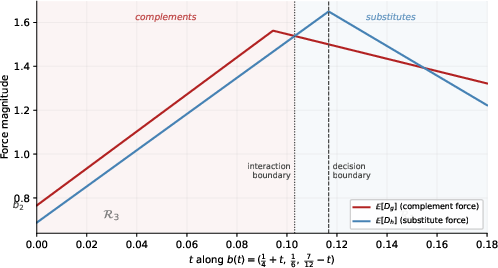
- The paper derives a Bregman decomposition of incremental VoI, partitioning complement and substitute forces in Bayesian decision problems.
- It uses geometric analysis of the belief simplex to show that substitution only arises when beliefs cross decision boundaries.
- The study offers actionable insights for active learning and sequential experiment design by localizing conditions for informational synergy.
Problem Formulation and Main Results
This paper addresses the question of when consulting one information source increases (complements) or decreases (substitutes) the value of another for a Bayesian decision-maker with finite actions. The point of departure is the value-of-information (VoI) interaction term ΔVoI(j∣i,b), representing the incremental value of channel j after observing the output of channel i at prior belief b.
Three core results underpin the work:
- Bregman Decomposition: The central structural result is that ΔVoI(j∣i,b) decomposes into two non-negative terms—a "complement force" and a "substitute force"—expressed as expected Bregman divergences with respect to two auxiliary convex functions tied to the reward structure.
- Interior Complementarity: If all possible posteriors after observing i remain within the current decision region, the substitute force vanishes and ΔVoI(j∣i,b)≥0; informational sources are thus guaranteed to be complements in the interior.
- Boundary-Crossing Substitution: Substitution (ΔVoI(j∣i,b)<0) strictly requires that at least one posterior after i straddles a decision boundary. Crossing, however, is necessary but not sufficient.
The paper formalizes these claims with complete proofs in Lean 4, and provides a geometric and decision-theoretic lens through which informational redundancy or synergy can be judged.
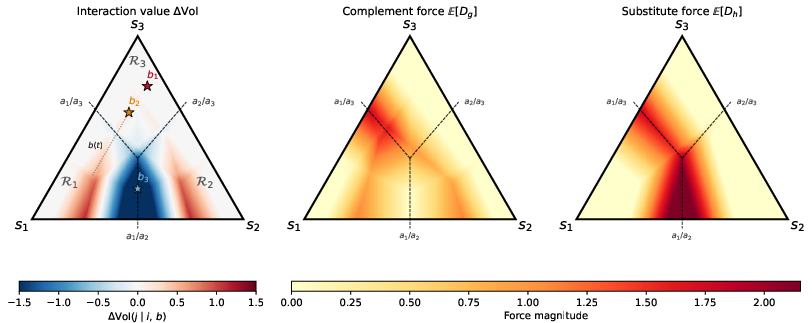
Figure 1: Geometry of the belief simplex illustrating regions of complementarity and substitution, with complement and substitute forces localized relative to decision boundaries.
Mathematical Structure
Consider a finite set of states S={s1,…,sK}, finite actions j0, and reward matrix j1. Beliefs j2 are points in the simplex. Each channel induces a likelihood kernel, and the VoI is defined as the increase in expected optimal reward after observation.
The interaction between two channels at j3 is
j4
The main theoretical result (Proposition~1) is the decomposition: j5
where j6 and j7 are Bregman divergences for convex functions j8 and j9 (the latter equals the value function), and both terms are non-negative. The complement force (i0) corresponds to how much i1 makes i2 more relevant; the substitute force (i3) quantifies how much i4 resolves the very decision at hand, potentially rendering i5 redundant.
Key technical properties:
Illustrative Example
A trinary state and action problem (with explicit reward and observation matrices) is used to exhibit all key phenomena:
- Interior complementarity: In the deep interior of a decision region, observing i9 does not influence the choice of action, but can increase the future relevance of b0 by refining beliefs toward regions where b1 becomes more discriminative. The substitute force is exactly zero, but the complement force is generically positive if b2 shifts beliefs toward boundary-adjacent areas.
- Boundary regime: Near a decision boundary, both b3 and b4 can have non-trivial VoI by transiting between decision regions. Here, both complement and substitute forces are non-zero; the sign of the interaction depends on which dominates. Empirically, if b5 and b6 resolve orthogonal uncertainties (different boundaries), the complement force often dominates, maintaining complementarity even near boundaries.
- Substitution: When both channels resolve the same boundary, b7's observation can eliminate the uncertainty that b8 would otherwise resolve, producing strong substitution (significant negative b9).
Quantitative evaluations are provided at carefully selected beliefs, confirming the precision and operational meaning of the decomposition: the sign of ΔVoI(j∣i,b)0 and the balance between forces map exactly onto the geometry of beliefs and decision regions.
Theoretical and Practical Implications
The principal theoretical implication is a precise geometric and algebraic characterization of when redundancy (substitution) or synergy (complementarity) between information sources arises in Bayesian decision problems with finite actions. Substitution is not a property of sources per se, but of their interaction at specific beliefs in relation to decision boundaries.
Practical implications are immediate for experimental design, active learning, and information acquisition:
- If a source is known to resolve one boundary, adding a source that focuses on a disjoint boundary is always value-additive (complementary) at beliefs away from shared boundaries.
- This enables local, geometry-aware heuristics in sequential information-gathering strategies, such as focusing further queries or experiments on boundaries that have not been resolved.
The results also locate the origin of adaptive submodularity for dynamic information acquisition within local geometry: global diminishing returns arise as a consequence of averaging over local boundary phenomena.
Limitations and Open Problems
Three main limitations are articulated:
- The economic content of the decomposition is valid under conditional independence; while the localization and mathematical properties persist under correlation, interpretation requires caution.
- The structure heavily relies on the piecewise-linear nature of the value function, which holds only in finite-action cases; in continuous-actions scenarios, such localization fails.
- Agents must update beliefs in a Bayesian and calibrated manner for the martingale properties to sustain the decomposition.
An open challenge remains to tightly characterize the exact geometry of complementarity: while the necessity of boundary-crossing is established for substitution, sufficiency is not; the dominance of forces in the region of overlap is not yet characterized by explicit geometric or combinatorial criteria. Asymmetries in substitution versus complementarity based on ordering of observations also warrant further inquiry.
Conclusion
The paper localizes the interaction of information sources in Bayesian decision problems to the geometry of the belief simplex and decision boundaries. It demonstrates that informational substitution is strictly local, confined to thin sets where beliefs straddle boundaries, while in the vast interior—where the decision remains unchanged—sources always weakly complement one another. This geometric insight refines the design of sequential testing and active learning procedures, and provides a foundation for future exploration of dynamic and high-dimensional inference systems.