- The paper introduces a machine-learning-inspired, primal construction framework to optimize the modular invariance condition in 2D CFTs.
- It develops a truncation uncertainty quantification method and the Sven optimizer to efficiently navigate hierarchical loss landscapes.
- The paper reveals a novel primal/dual gap in the operator spectrum, emphasizing the significant role of integer degeneracy constraints.
Exploring the Modular Bootstrap Landscape for 2D CFTs with Machine-Learning-Inspired Optimization
Introduction
This work presents a systematic investigation of the space of two-dimensional conformal field theories (2D CFTs) via constructive, "primal" solutions to the modular bootstrap equation, innovatively employing machine-learning-inspired optimization strategies. Leveraging a tailored loss function sensitive to modular invariance, the authors seek direct constructions of primary spectra for theories with Virasoro symmetry and central charge c>1. The study places particular emphasis on the interval c∈(1,8/7), a region lacking known explicit CFTs, and introduces two technical advances: an uncertainty quantification approach for operator truncation and a singular-value-based optimizer (Sven) designed to traverse hierarchical loss landscapes. Numerical evidence indicates both a continuous space of modular solutions and the emergence of stronger spectral gap constraints than currently established dual bounds.
Modular Bootstrap Constraints and Primal Construction
The central organizing principle is the modular invariance of the Euclidean torus partition function Z(τ), where the spectrum of Virasoro primaries and their degeneracies (forced to be integers for unitary CFTs) encode the physical content. The authors focus on parity-invariant, compact theories with integer spins and an explicit large (but finite) set of primary operator parameters up to dimension Δmax.
In contrast to the dual (analytic/semi-definite programming) bootstrap approach, the "primal" method seeks explicit (candidate) solutions to a truncated set of the modular invariance equations,
Z(τ)=Z(−1/τ),∀τ in the fundamental domain,
where Z(τ) is constructed term-by-term from trial spectra and integer degeneracies.
An essential challenge is the infinite-dimensional nature of the problem; the spectrum is necessarily truncated. Thus, the authors introduce a novel strategy for truncation uncertainty quantification based on deformations of known c=1 theories, allowing comparison of the impact of truncation across different central charges and thereby robust calibration of a physically meaningful χ2-style loss function.
Machine-Learning-Inspired Optimization and the Sven Algorithm
A key advance is the translation of modular invariance testing into a ML-style loss minimization problem over the spectrum parameters. The modular bootstrap condition is encoded as a τ-dependent loss, engineered for statistical interpretability: L=∣T∣1τ∈T∑(σtrunc(τ)Z(τ)−Z(−1/τ))2,
where c∈(1,8/7)0 is the uncertainty estimate from truncation. The distribution of individual loss terms closely follows a c∈(1,8/7)1 distribution, justifying statistical interpretation and enabling robust identification of physically meaningful minima.
To minimize this loss, the work introduces the Sven optimizer—a singular-value-truncated Gauss-Newton-variant—which efficiently navigates parameter spaces characterized by an exponential hierarchy of scales and strong correlations between spectrum parameters. Compared to standard gradient descent, Sven rapidly escapes shallow valleys and local minima, especially critical given the multi-scale structure induced by modular constraints and the exponential asymptotics of Virasoro characters.
Numerical Results: Explicit Spectra and the Primal/Dual Gap
The methodology is first validated using c∈(1,8/7)2 minimal models (N1MMs) with c∈(1,8/7)3 and known spectra, confirming the ability to reproduce order-one loss for truncated exact solutions (Figure 1).
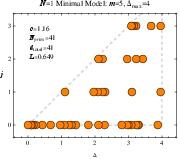
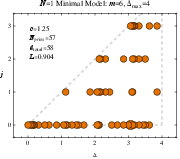
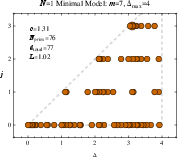
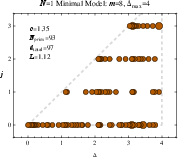
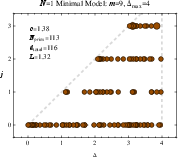
Figure 1: Spectrum of Virasoro primary operators below the truncation c∈(1,8/7)4 for the c∈(1,8/7)5 minimal model with c∈(1,8/7)6.
Loss normalization is shown to stabilize numerical estimation and prevent exponential sensitivity to both spectrum cutoff and modular parameter domain truncation (Figure 2).
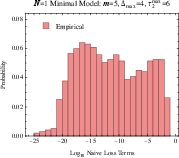
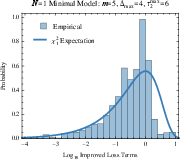
Figure 2: Distribution of individual terms in the loss for the naive MSE loss (red) and c∈(1,8/7)7-style loss (blue); the improved loss exhibits order-one clustering and statistical behavior close to the c∈(1,8/7)8 expectation.
For central charges c∈(1,8/7)9, high-confidence candidate spectra are engineered, each demonstrating modular invariance within the statistical threshold (Figures 10 and 11).
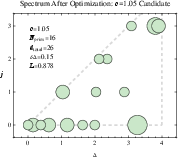
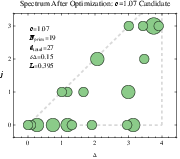
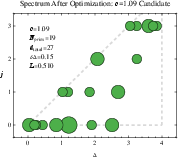
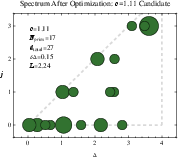
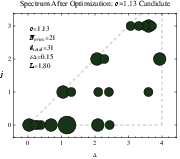
Figure 3: Optimized spectra for candidate CFTs with Z(τ)0, showing clustering of primary dimensions and operator degeneracies consistent with the statistics of known CFTs.
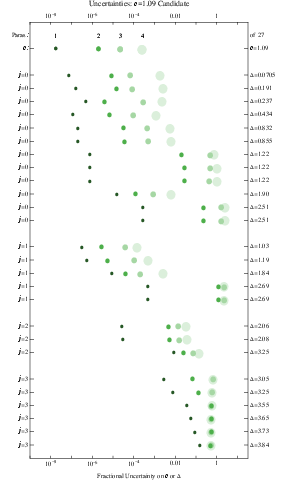
Figure 4: Fractional uncertainties on central charges and low-lying dimensions, revealing highly correlated uncertainties and strongly constrained central charges and lowest-lying primaries.
Surveying the Z(τ)1 plane, the authors systematically search for candidate spectra at fixed spectral gaps. Figure 5 presents the key result: a parameter-space map showing the space of established 2D CFTs alongside regions of high-, medium-, and low-confidence candidates, as well as zones where no candidate solution could be found.
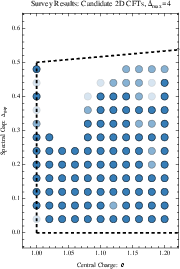
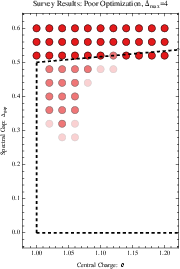
Figure 5: Results in the Z(τ)2 plane, with blue regions indicating candidate CFTs found by the algorithm and red regions marking parameter settings for which no solution is found.
A striking finding is the existence of a "primal/dual gap": modular-invariant, integer-degenerate spectra cannot be found in a substantial domain between the unitary lower bound and the best-known dual (Hellerman, Collier–Lin–Yin) upper bound on the gap,
Z(τ)3
This is significant, as the dual bootstrap bounds do not assume integer degeneracies, suggesting that integrality constraints at the primal (partition function) level are more restrictive than previously appreciated.
Characterization of the Solution Space
In both benchmark models and constructed candidates, the local loss landscape is extremely flat in multiple directions, indicating a high-dimensional, continuous family of solutions surviving the modular invariance constraint after truncation (Figure 6).
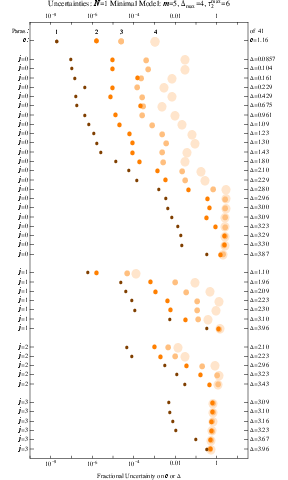
Figure 6: Fractional uncertainties on central charge and primary dimensions, illustrating the effect of simultaneous parameter variation and the highly correlated uncertainty structures typical of the constructed modular solutions.
The dimension and structure of this solution space depend critically on the inclusion and integrality of higher-spin operators. Numerical experiments varying the spectrum truncation (Z(τ)4) and lifting the integrality constraint confirm the central role of these factors in the observed primal/dual gap.
Implications and Future Directions
Theoretical Consequences
The existence of a primal/dual gap signals nontrivial modular bootstrap constraints deriving exclusively from the requirement of integer-valued degeneracies. This provides evidence for new structural constraints in the space of unitary, compact 2D CFTs and motivates revisiting bounds on the gap with integrality enforced in dual approaches. The continuous family of modular-invariant partition functions constructed suggests the modular invariance constraint alone is insufficient for a unique or even discrete classification of CFT data—additional conditions (e.g., crossing) are required.
Algorithms and Uncertainty
The introduced truncation uncertainty quantification and the Sven optimizer demonstrate a robust framework for analogous problems with hierarchical loss landscapes and correlated parameters in quantum field theory. The clear mapping of statistical behavior in losses to modular data encourages further investigation of ML-accelerated primal approaches to the conformal bootstrap, including exploration of the crossing symmetry and higher genus partition functions.
Extension to General 2D CFT Classification
The demonstration that viable candidates can be efficiently produced in the previously uncharted regime Z(τ)5, and the characterization of a continuous modular solution space, will likely impact attempts to "fill" the catalog of CFTs in the irrational regime and could provide guidance in the search for explicit irrational examples. However, no candidate constructed here, nor the known spectrum data, can guarantee full crossing or OPE associativity—future technical work must integrate such constraints explicitly.
Conclusion
This study provides strong evidence for the power and necessity of integrating ML-inspired, uncertainty-aware optimization in the numerical construction and exploration of the modular bootstrap landscape for 2D CFTs. The discovery of a primal/dual gap driven by the integrality of degeneracies raises new questions about the structure of the CFT spectrum and modular constraints, especially in the irrational regime where analytic classification is currently lacking. Ongoing improvements in algorithmic methods and deeper integration with crossing constraints are promising avenues for further progress in the constructive conformal bootstrap program.