- The paper demonstrates that targeted chemical substitution in La4Co2NiO8Cl2 induces nickelate-like electronic correlations essential for high-temperature superconductivity.
- The study employs DFT+DMFT with CT-QMC solvers to reveal pronounced layer- and orbital-selective correlations along with significant band renormalization.
- The results indicate that site-selective substitution effectively tunes electron filling and spin fluctuations, paving the way for novel superconducting platforms.
Background and Motivation
The rapid evolution in the discovery of nickelate superconductors—most notably the emergence of superconductivity in the bilayer La3Ni2O7 and trilayer La4Ni3O10 under high pressure—has ignited extensive theoretical efforts to identify structurally and electronically analogous systems capable of supporting high-temperature superconductivity. Notably, cobaltates with the Ruddlesden-Popper (RP) layered structure have been hypothesized as promising candidates by analogy, provided that their electronic filling and correlation physics can be tuned to match those of the known superconducting nickelates.
This work proposes and investigates La20Co21NiO22Cl23 (LCO-NiCl), designed through targeted chemical substitution in the trilayer cobaltate La24Co25O26, achieving both the correct multinuclear electronic filling and architectural similarity to La27Ni28O29 (LNO-4310). Using density functional theory plus dynamical mean-field theory (DFT+DMFT), the electronic structure and correlation effects in LCO-NiCl are comprehensively analyzed and contrasted with those of LNO-4310, illuminating the prospects for high-temperature superconductivity in cobalt-based layered compounds.
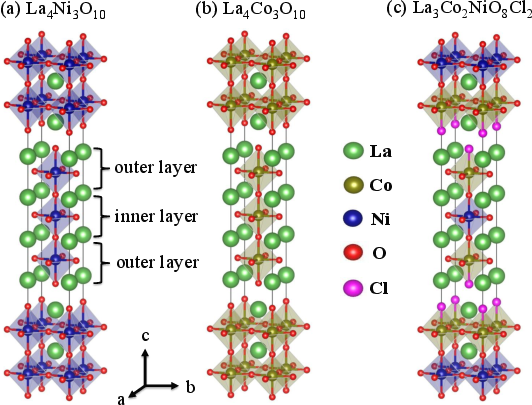
Figure 1: Crystal structure of (a) LNO-4310, (b) LCO-4310, and (c) LCO-NiCl, emphasizing the layer-resolved replacement and chemical design.
Methodology
First-principles calculations were performed via DFT (VASP for structure optimization; WIEN2K for electronic structure), followed by full charge self-consistent DFT+DMFT using the eDMFT framework. Only the 80 orbitals (81, 82) of Ni and Co were included as correlated subspaces, with on-site Coulomb repulsion 83 eV and Hund’s coupling 84 eV. The calculations were conducted at 290 K using continuous-time quantum Monte Carlo (CT-QMC) impurity solvers, and self-energy analytical continuation was performed with the maximum entropy method. Full site-selective DFT+DMFT was employed, allowing resolution of distinct inner- and outer-layer behavior.
Layer-Dependent and Orbital-Selective Electronic Correlation
Analysis of the Matsubara and real-frequency self-energies reveals pronounced layer-dependent and orbital-selective correlation effects in LCO-NiCl. The outer Co 85 orbital exhibits the largest 86 at low frequency, characteristic of strong correlation and non-Fermi liquid behavior, whereas the inner-layer Ni 87 self-energies are small and linear, indicating weakly correlated Fermi liquids—faithfully mirroring what is observed in LNO-4310.
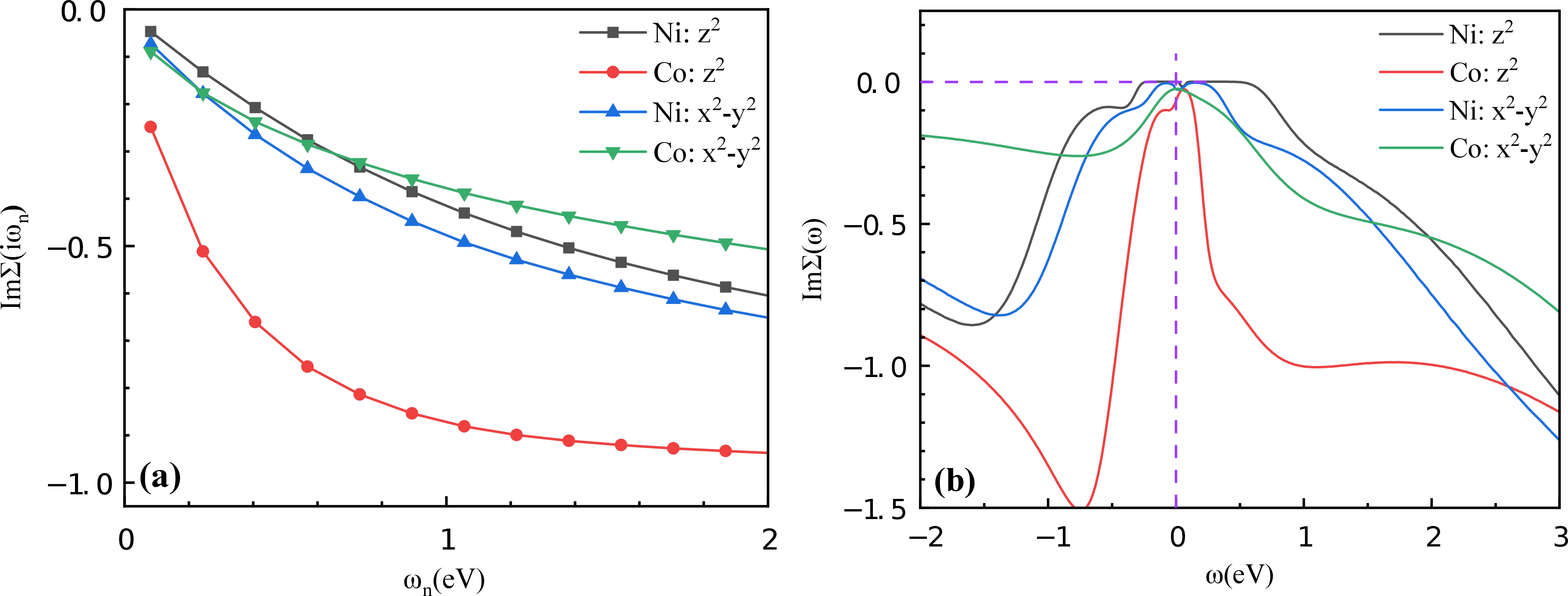
Figure 2: Imaginary parts of the self-energy at 290 K for LCO-NiCl, elucidating the orbital- and layer-selective correlation.
This layer-polarized correlation pattern is central to the physics of trilayer nickelates, where strong electronic correlation and deviations from Fermi-liquid theory in the outer layers are linked to Hund metal behavior and anomalous transport. The present calculations confirm that strategic site substitution and doping in the cobaltate analog can engineer the same correlation landscape.
Band Structure Renormalization and Spectral-Weight Distribution
The momentum-resolved DFT+DMFT spectral function 88 for LCO-NiCl features prominent band renormalization and flattening, particularly at the M point around the Fermi level, compared to the LDA band dispersions. These flat bands, associated with the outer-layer Co 89 orbital, reinforce the analogy to the nickelates, where similar features are posited as key to the emergence of unconventional SC.
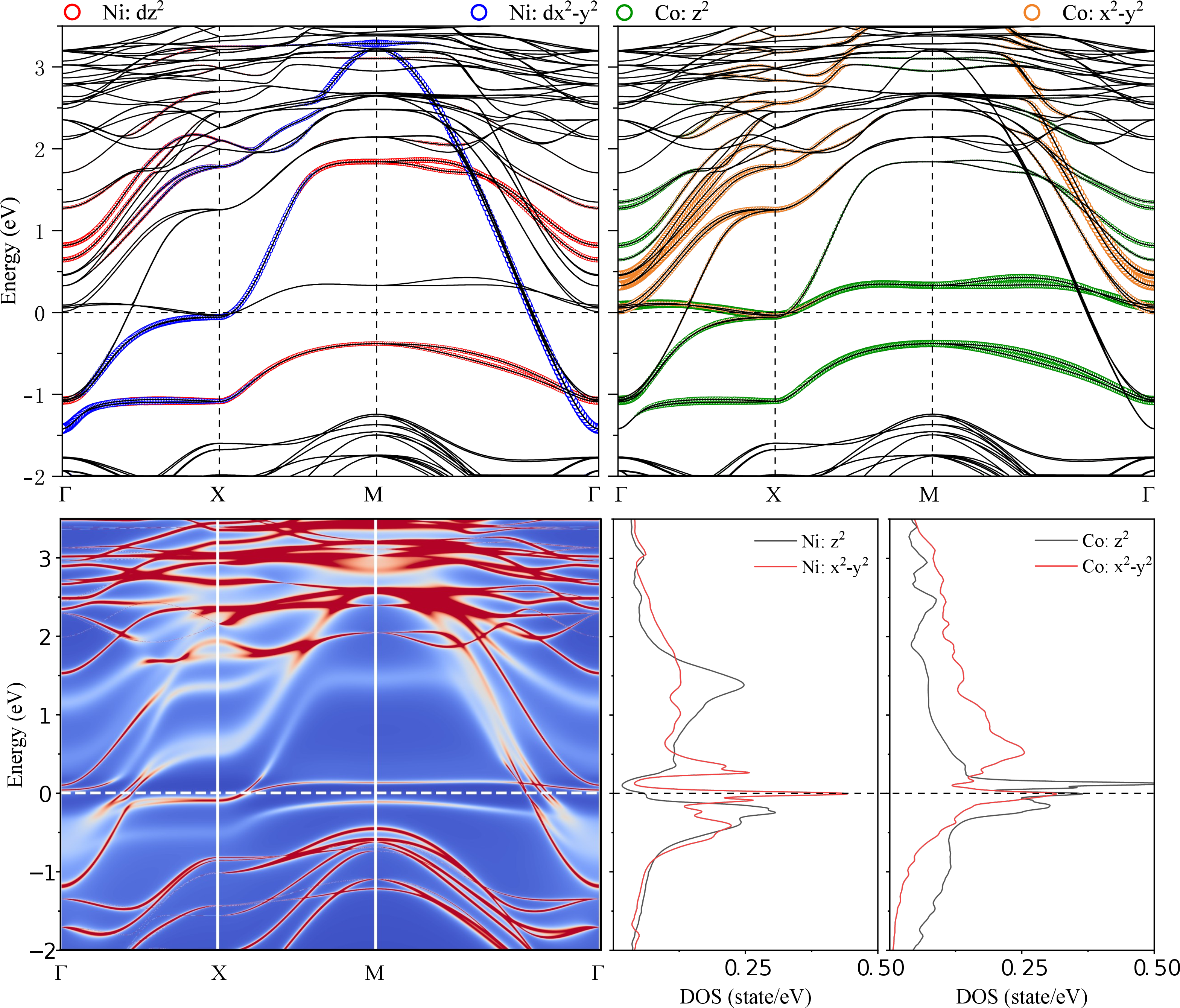
Figure 3: Upper: DFT band structures with orbital weights; Lower: DFT+DMFT spectral functions and DOS, highlighting strong correlation-induced band flattening and orbital selectivity.
The computed density of states further supports this scenario: while the Ni 20 orbital dominates at 21, the outer-layer Co 22 exhibits enhanced spectral weight just above the Fermi level, reflecting both layer and orbital selectivity analogous to that found in high-pressure LNO-4310. This architecture is believed to favor strong spin and orbital fluctuations, directly relevant for unconventional pairing channels.
Effective Mass Enhancement and Local Multiplet Analysis
Quantitative assessment of the mass enhancement 23 (where 24 is the quasiparticle weight) exposes strong orbital selectivity in LCO-NiCl, as the Co 25 orbital mass enhancement far exceeds that in the 26, with inner-layer Ni displaying significantly reduced mass. Occupation numbers and local multiplet weights, extracted from DMFT, indicate robust local high-spin fluctuations with substantial mixed-spin character in both Co and Ni sites, paralleling what is established in superconducting LNO-4310.
These results underscore that the essential prerequisites for unconventional superconductivity—layer-resolved strong correlations, orbital selectivity, flat bands, and strong local spin fluctuations—can be simultaneously realized in the designed Co-Ni-Cl trilayer oxide.
Implications and Future Directions
The theoretical synthesis and first-principles exploration of La27Co28NiO29Cl30 show that cobaltates structurally and electronically engineered to replicate nickelate superconductors can harbor the same intricate pattern of correlation driven phenomena. Notably, the failure of direct electron doping (La/Th substitution) to impart sufficient inner-layer electron count stresses the necessity for site-selective transition metal substitution to achieve optimal filling, a lesson transferable to broader materials design efforts in the search for novel SC platforms.
Experimental synthesis and characterization of LCO-NiCl are strongly motivated by these predictions. Key future theoretical efforts should address the explicit superconducting instability and its symmetry, the role of chemical pressure via substitution, and full mapping of the pressure-composition phase diagram to clarify whether superconductivity, as in nickelates, emerges only under substantial compression.
Furthermore, these strategies—site-selective substitution, carrier doping through mixed anions, and chemical pressure—can be generalized to other layered 331 transition metal systems, expanding the candidate space for unconventional SC and deepening insight into the essential ingredients of high-temperature superconductivity beyond the cuprate and nickelate families.
Conclusion
This study provides a detailed theoretical blueprint for realizing nickelate-analogous high-temperature superconductivity in cobalt-based trilayer compounds. By employing targeted chemical substitution to engineer the crystal field environment, filling, and correlation strength, La32Co33NiO34Cl35 is shown to reproduce the salient features of the recently discovered trilayer nickelate superconductor. These results offer clear direction for both theoretical exploration and experimental synthesis in the pursuit of new superconducting states in layered correlated oxides.
(2604.01223)