- The paper introduces the RRATalog—a catalog of 335 rotating radio transients—and employs Monte Carlo population synthesis to constrain underlying distributions.
- It finds that RRATs, characterized by longer periods and high burst rates, exhibit a steep luminosity function with a low-luminosity turnover that caps their observable numbers.
- The analysis resolves the RRAT birthrate tension by revealing parity with high-luminosity canonical pulsars and forecasting significant yields from future high-sensitivity surveys.
The RRATalog: Statistical Census and Population Modelling of Rotating Radio Transients
Introduction
Rotating radio transients (RRATs) constitute an important sub-population within the broader category of neutron stars. Characterized by sporadic radio bursts, RRATs are detected primarily through single-pulse searches and are typically missed by periodicity (Fourier) search techniques. Despite growing numbers of detections, RRATs’ occurrence rates, intrinsic distributions, and their relation to canonical pulsars and neutron star evolution remain incompletely characterized. "The RRATalog: a Galactic census of rotating radio transients" (2604.01203) presents a uniform, comprehensive catalog (RRATalog) of 335 RRATs, and carries out the most advanced population synthesis to date, quantifying the Galactic RRAT population and its statistical properties.
RRATalog: Observational Distributions and Sample Properties
The RRATalog compiles 335 objects discovered exclusively via single-pulse techniques, and provides a robust parameter space for population analysis. The sky distribution, viewed in Galactic coordinates, demonstrates strong clustering along the Galactic plane, indicative of both intrinsic neutron star demographics and the survey footprints of major single-pulse searches.
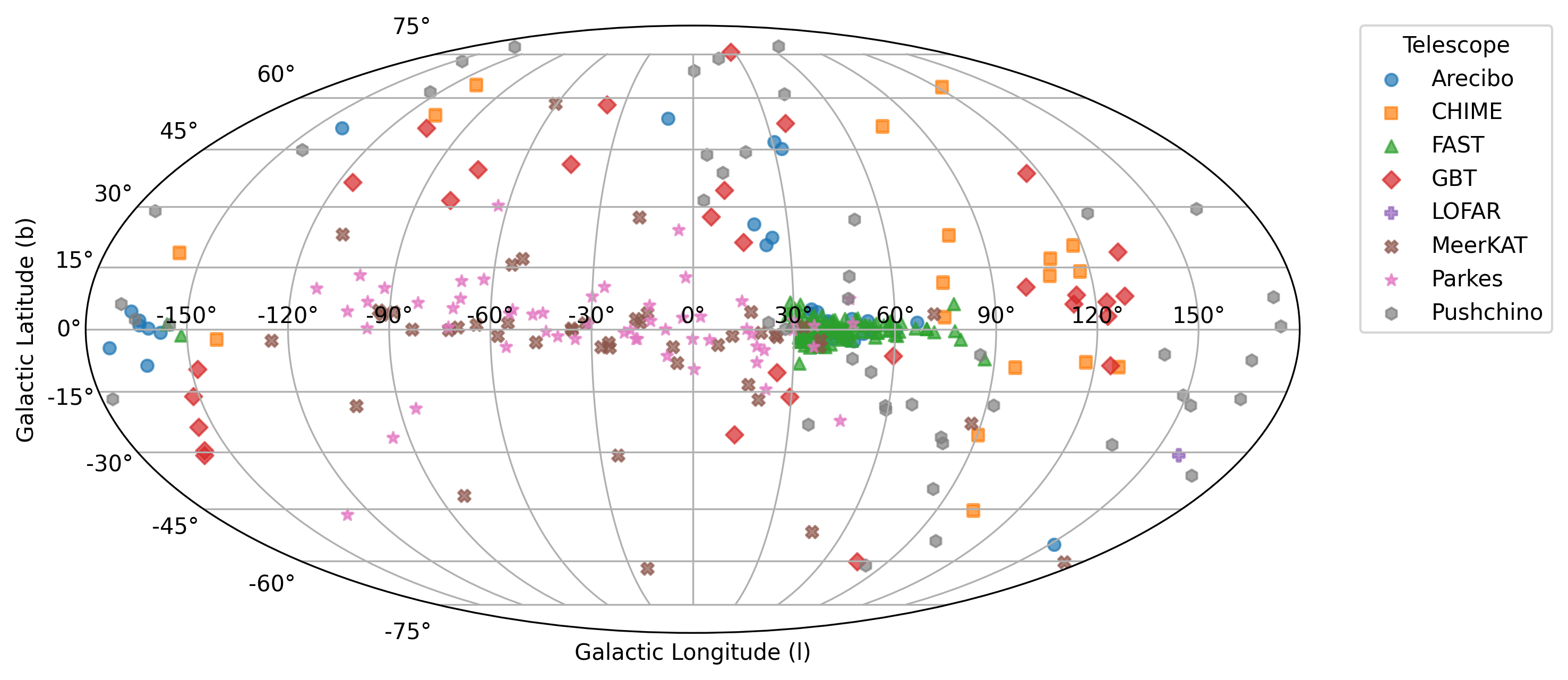
Figure 1: Mollweide projection showing the Galactic distribution of RRATs by discovery telescope.
Histograms of dispersion measure (DM), period (P), period derivative (P˙), and burst rate reveal a heterogeneous population, with no strong observational correlations among these parameters. Notably, the P vs. DM scatter diagram shows no appreciable selection bias against high DM, short-period RRATs, distinguishing them from conventional pulsar samples.
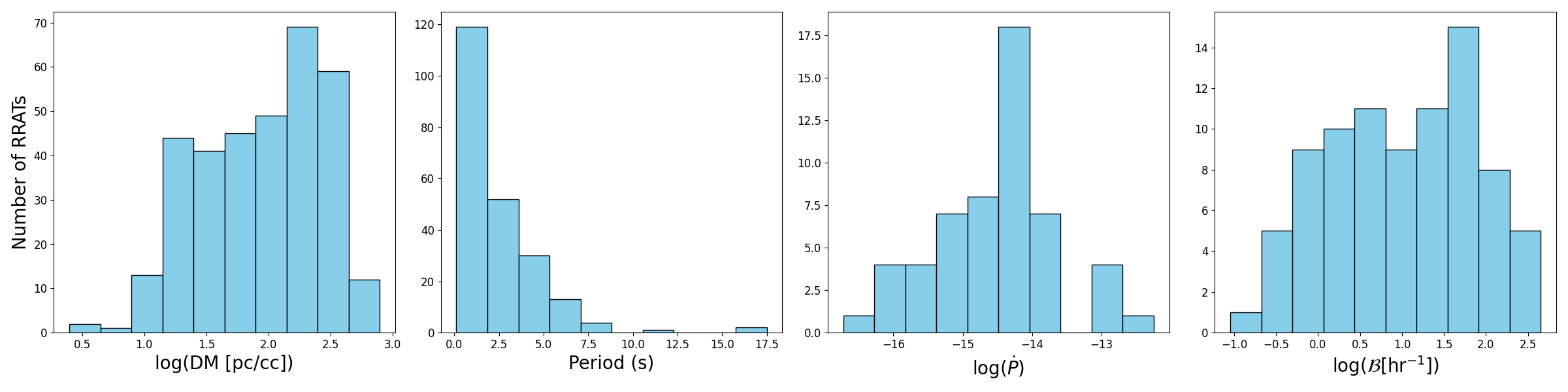
Figure 2: Histograms of RRATs’ observed DM, spin period, period derivative, and burst rate; uncorrected for selection effects.
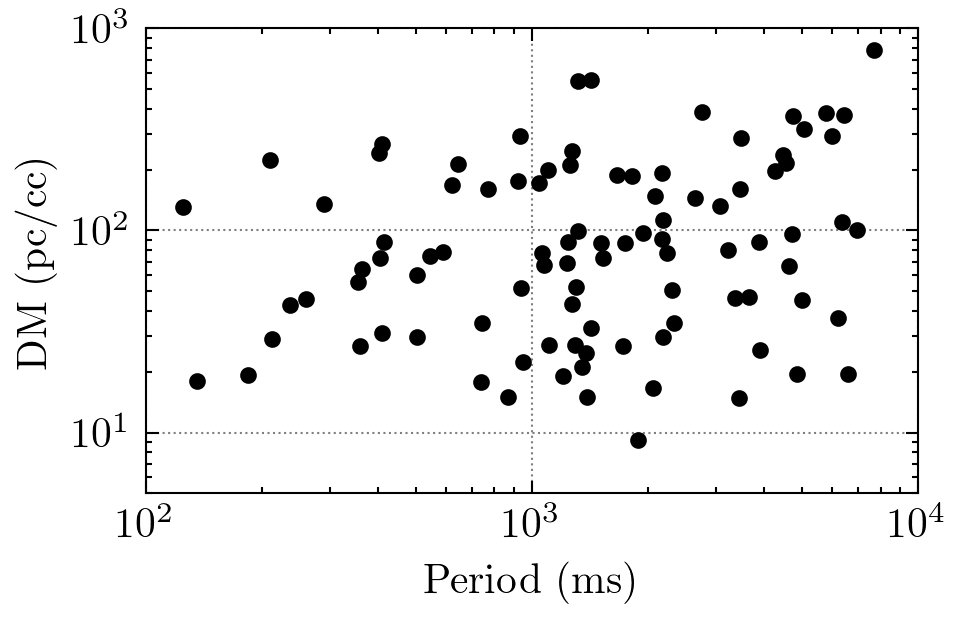
Figure 3: Scatter diagram of period versus DM; absence of selection effects against short-P, high-DM RRATs.
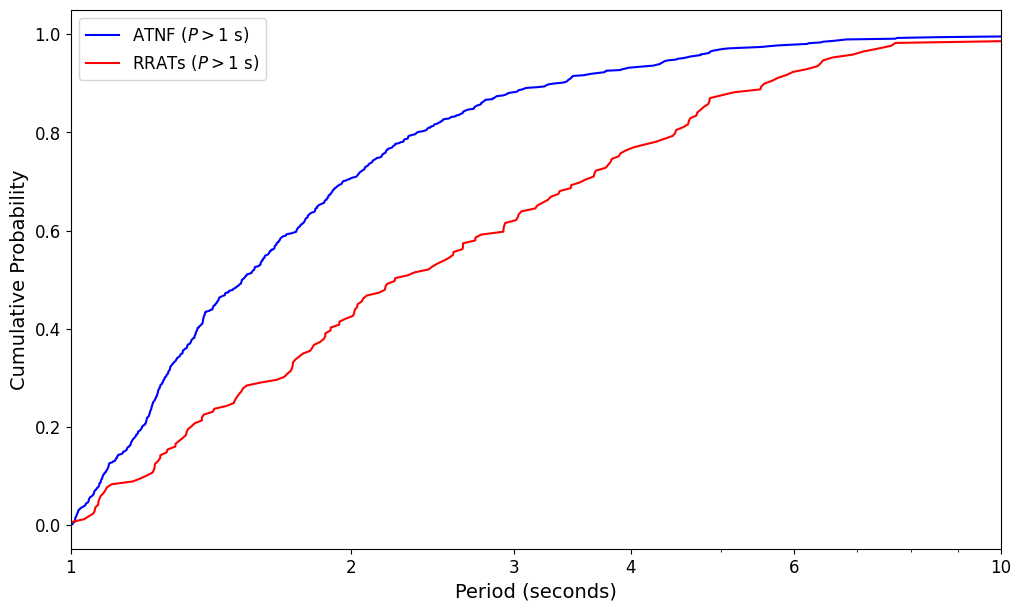
Of 335 RRATs, spin periods are measured for 230. The period distribution is distinctly shifted toward longer periods compared with canonical pulsars; median P for RRATs is 1.73 s vs. 0.66 s for ATNF-catalogued pulsars, a statistically significant difference (KS test p<0.003). The P--P˙ diagram supports the interpretation that RRATs often occupy regions of parameter space with long periods and high magnetic fields, and are predominantly more evolved systems.
Further pulse width analysis establishes a Wint--P scaling analogous to canonical pulsars, enabling accurate modeling of detectability in Monte Carlo population synthesis.
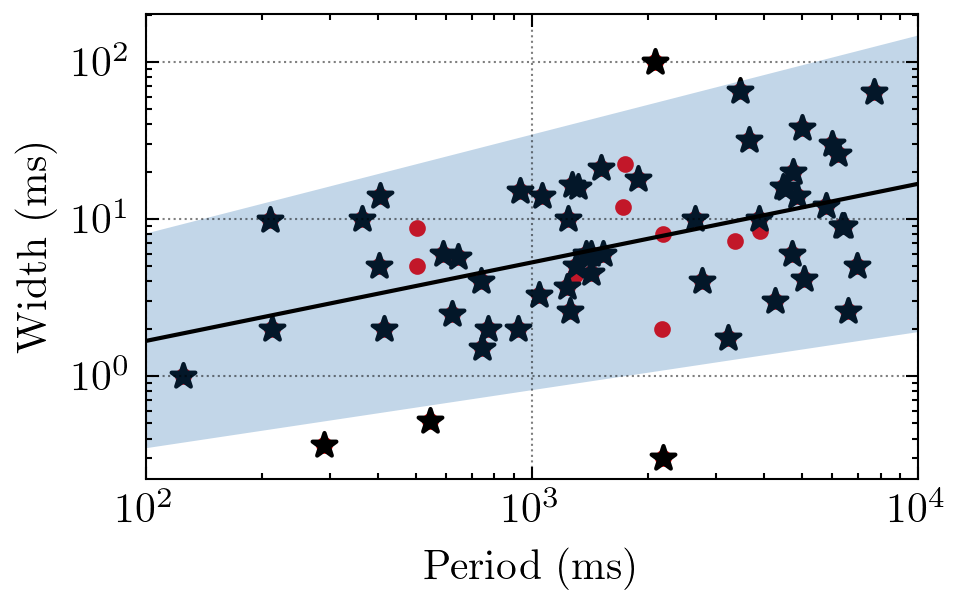
Figure 4: Distribution and model fit for intrinsic pulse widths vs. spin period, for RRATs at 1400 and 350 MHz.
Population Synthesis: Monte Carlo Modelling with PsrPopPy2
A substantially updated version of PsrPopPy (PsrPopPy2) is deployed for Monte Carlo snapshot modeling of the RRAT population, parametrized by distributions in P˙0, luminosity (P˙1), spatial coordinates (P˙2, P˙3), and burst rate (P˙4). The model incorporates realistic survey selection effects, including telescope gain, integration time, observing frequency, bandwidth, and thresholds both for periodicity and single-pulse detectability.
A critical modeling novelty is the treatment of burst amplitude distributions, with a log-normal model for single-pulse luminosities, characterized by a scaling parameter P˙5 that governs the width of the amplitude distribution. Cross-calibration of P˙6 across the major Parkes survey samples constrains its value to P˙7, substantially refining previous RRAT luminosity function estimates.
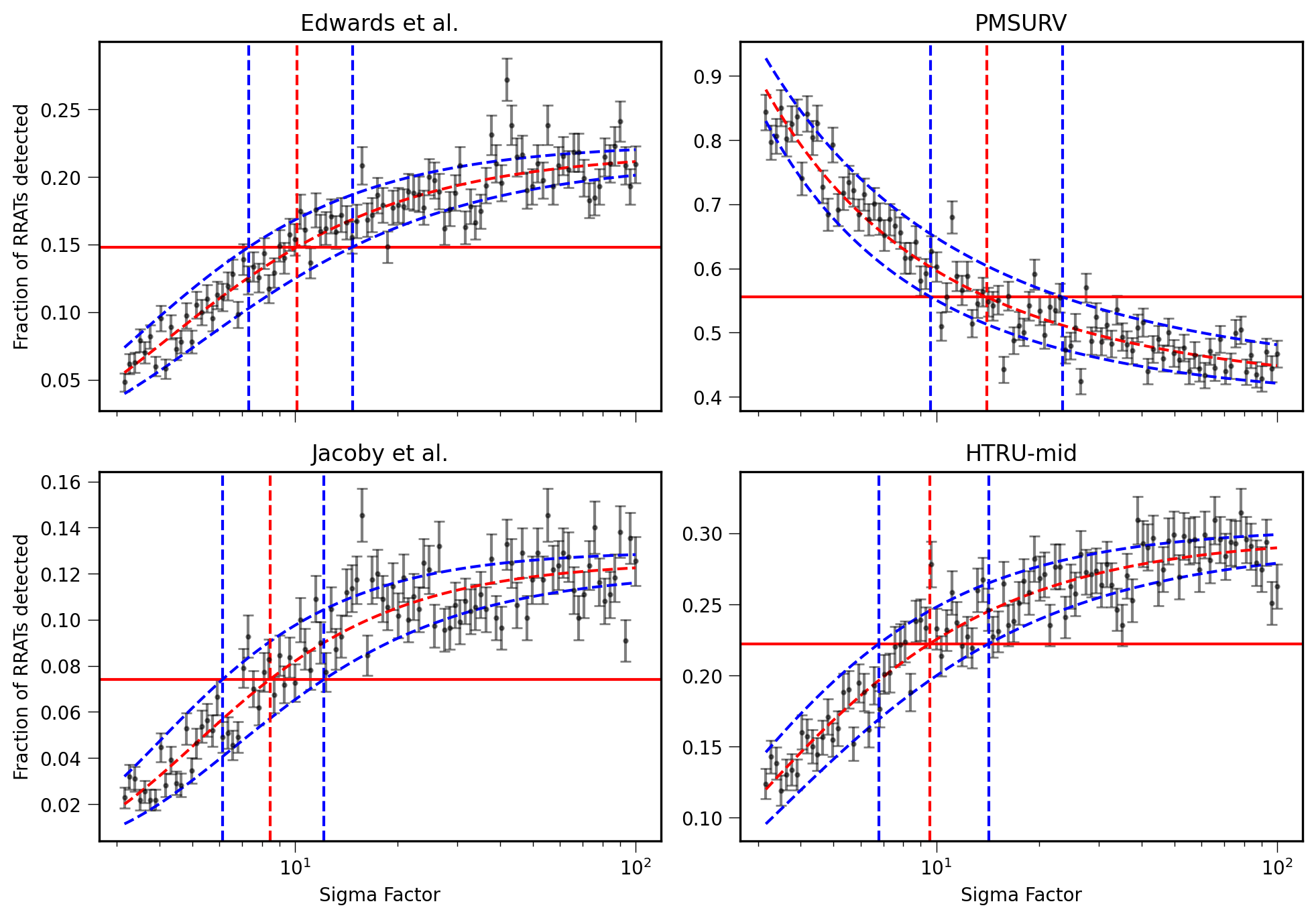
Figure 5: Determination of the luminosity scaling factor P˙8 for each Parkes survey; observationally matched via survey yields.
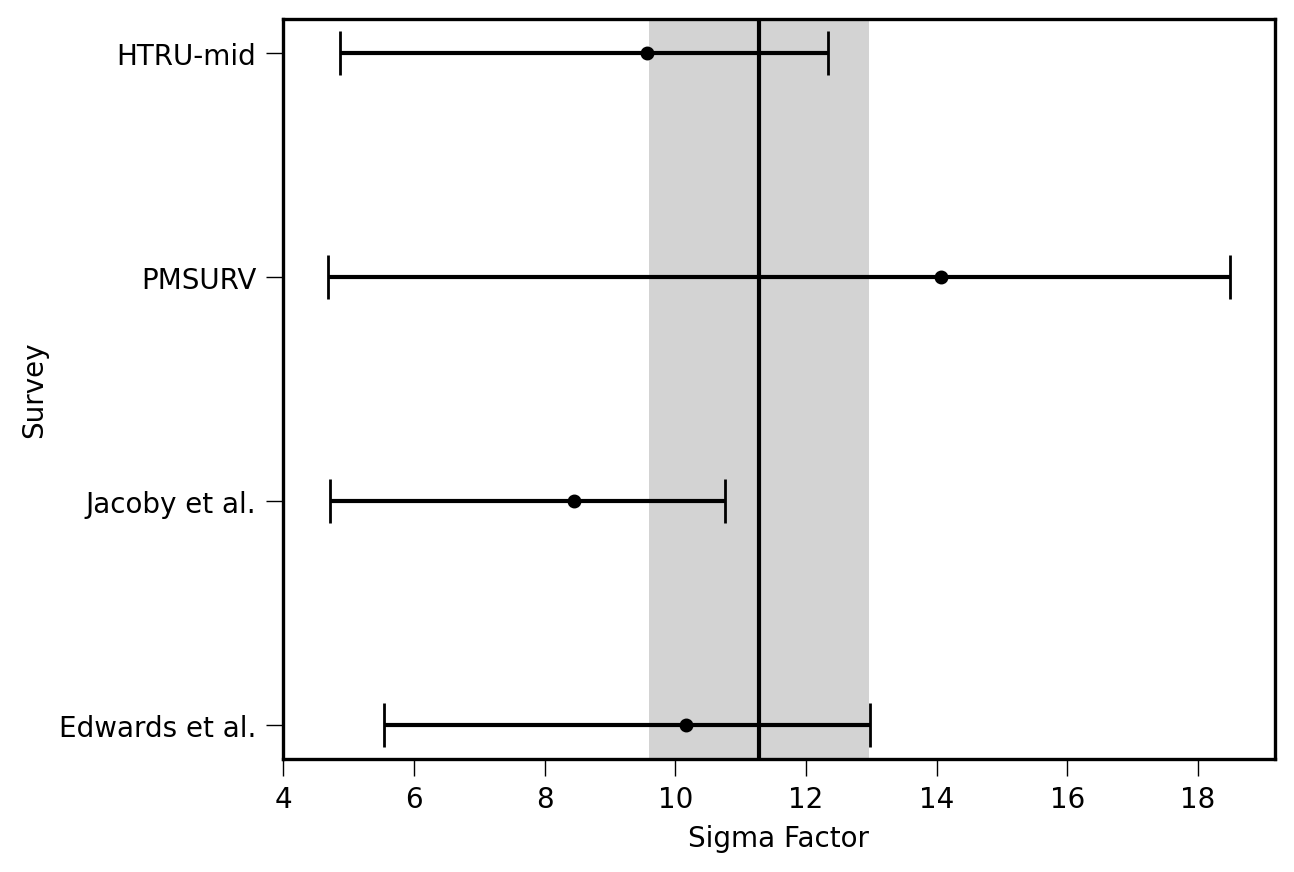
Figure 6: Consensus P˙9 values and error budget from all four Parkes surveys.
The iterative simulation approach optimizes the underlying RRAT distribution functions until the synthetic detected distributions match survey results in DM, P0, P1, P2, P3 and P4. The final model is extensively validated against cumulative distribution functions of the key observed parameters.

Figure 7: Cumulative density functions: observed vs. simulated RRAT properties (DM, period, burst rate, etc).
Quantitative Results: Galactic Population Estimates and Intrinsic Distributions
The model yields best-fit underlying distributions in Galactocentric surface density, luminosity, period, and burst rate.
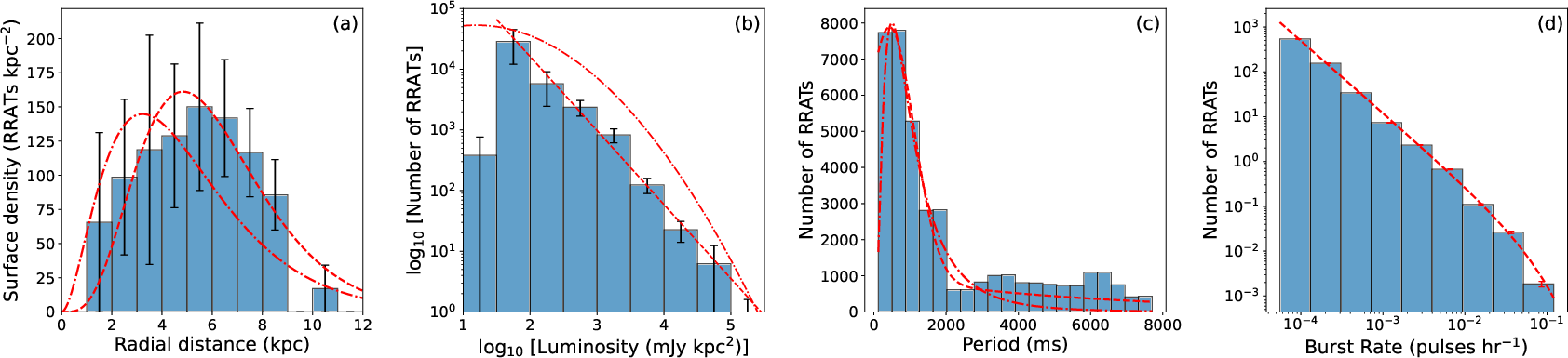
Figure 8: Model parameter distributions and analytic fits for surface density, luminosity, period, and burst rate.
Key quantitative results are:
Implications and Future Directions
From a population synthesis standpoint, RRATs cannot be considered a rare anomaly: to the detection threshold of high-luminosity, high-duty-cycle single-pulse events, RRATs are essentially as common as canonical pulsars. The distributional differences—particularly in P5 and P6—suggest that RRATs are generally more evolved, possibly post-null, high-magnetic-field objects transitioning toward radio-quiet phases. The high low-luminosity abundance, however, is sharply limited by empirical turnover, preventing an unbounded RRAT census.
These findings further support the hypothesis that long-period neutron stars are undercounted in traditional periodic surveys, and intermittent (RRAT-like) radio emission is a common late-stage manifestation. Future time-evolution (evolve-mode) synthesis and more extensive timing campaigns on RRATs are essential to quantifying evolutionary connections to nulling pulsars and magnetars.
Population synthesis yields robust predictions for ongoing and planned Galactic plane surveys. Models calibrated on Parkes RRATs accurately predict yields for PALFA and FAST, and anticipate P7 RRAT discoveries in upcoming Deep Synoptic Array (DSA) surveys. The next generation of high-sensitivity, large-FoV telescopes (e.g., FAST, MeerKAT, DSA-2000) will enable direct measurement of the faint-end luminosity function and clarify the inner Galactic RRAT density profile. This will refine the role of RRATs within the neutron star evolutionary framework and test models of radio-loud phase transitions.
Conclusion
This study presents the most comprehensive Galactic RRAT census and population model to date, grounded in a catalog of 335 RRATs and rigorous Monte Carlo simulations implementing observational selection effects and amplitude statistics. A key result is the parity between the high-luminosity RRAT and canonical pulsar population, counter to previous models; the RRAT luminosity function’s steep, turnover-limited structure enforces a firm upper bound on total RRAT abundance, resolving the birthrate tension. The analysis supports RRATs as the dominant population among long-period neutron stars and motivates further high-sensitivity transient surveys and detailed timing to uncover the evolutionary connections among pulsars, RRATs, and radio-quiet neutron stars.