- The paper introduces a new p-adic truncated recurrence that efficiently computes local zeta functions of Calabi–Yau varieties, overcoming prior computational bottlenecks.
- It employs arithmetic modulo p^A to dramatically reduce complexity and memory usage, enabling calculations for primes as high as 10^7.
- The approach supports empirical validation of Frobenius trace statistics and Hecke eigenvalues, paving the way for advancements in arithmetic geometry and mathematical physics.
Solutions of Calabi–Yau Differential Operators as Truncated p-adic Series and Efficient Computation of Zeta Functions
Overview and Motivation
This paper introduces a method for efficiently computing local zeta functions associated with one-parameter families of Calabi–Yau (CY) varieties, by leveraging p-adically truncated recurrence relations for differential equations of CY type. The authors circumvent key computational bottlenecks of previous approaches—specifically, the rapid growth in size and complexity of rational period series coefficients as the prime p increases—allowing computation of zeta functions for tens of thousands of primes, including extremely large ones (p∼106–107), using modest computational resources. This algorithmic innovation is implemented in the open-source Python package PFLFunction, which interfaces with Sage.
The deformation method (Dwork, Lauder; modern refinement by Candelas, de la Ossa, van Straten) computes local zeta functions Zp(X,T)—or more precisely their Euler factors—by associating a family of CY varieties Xφ with a differential operator of CY type L and evaluating the Frobenius action on p-adic cohomology. The action is encapsulated in a matrix Up(φ) derived from period expansions, which are solutions to p0 expressed as power series with rational coefficients.
For high p1, the order of truncation p2 required for exactitude grows linearly in p3, and the rational coefficients p4 of the period series p5 become exceedingly large integers, imposing severe demands on time and memory. Prior practical computations were therefore limited to p6.
p7-adically Truncated Recurrence Relations
The main innovation is the use of a p8-adically truncated recurrence: instead of first computing full rational coefficients and then reducing modulo p9, one constructs a recurrence whose entire arithmetic is performed modulo p0, where p1 is a rigorously constructed bound guaranteeing all relevant p2-adic digits are kept for correctness of the Euler factor. This reduces both computational complexity and memory requirements dramatically. The authors provide explicit, universal bounds for p3 in terms of the differential operator's order and the parameter p4 governing series truncation, allowing fully controlled accuracy.
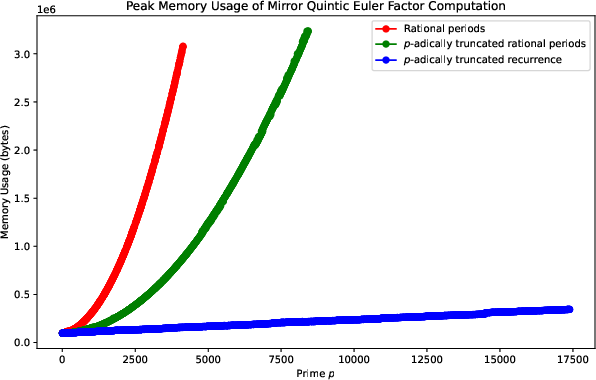
Figure 1: Comparing Euler factor peak memory usage for the mirror quintic using rational periods, p5-adically truncated rational periods, and p6-adically truncated recurrence.
As seen in (Figure 1), the p7-adically truncated recurrence method scales linearly in memory usage, spectacularly outperforming methods that require manipulation of large rational numbers.
Numerical Results and Applications
Mirror Quintic at Large Prime: For the mirror quintic family (AESZ 4.1.1), the Euler factors at p8 are computed in 22 minutes using a single Apple M5 core with p9 GB RAM. Prior methods could not feasibly reach this regime for full moduli families. The new method enables batch computations over the entire family, with per-factor timings of approximately p∼1060 seconds.
Frobenius Traces and Sato–Tate Distributions: The ability to compute Euler factors for very large p∼1061 allows for experimental exploration of the statistical properties of Frobenius traces associated to families of CY varieties (and especially K3 surfaces) over finite fields. The authors compute normalized Frobenius traces for a one-parameter family of K3 surfaces, observing that the distributions (in the normalized trace p∼1062) match Sato–Tate predictions for both CM and non-CM cases.
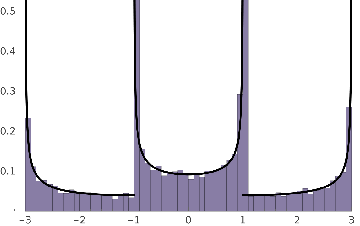
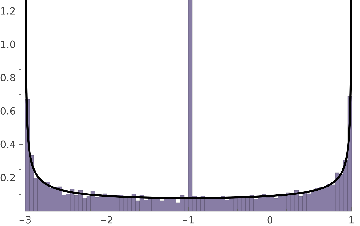
Figure 2: Normalized Frobenius traces for order 3 degree 2 CY operator at p∼1063 (CM type, flying Batman distribution) and p∼1064 (CM type, semicircle distribution), over 10,000 primes.
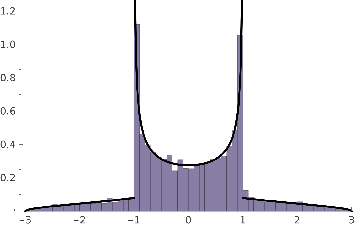
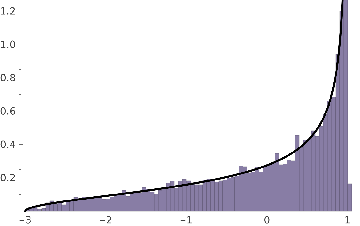
Figure 3: Normalized Frobenius traces for the same operator at p∼1065 (non-CM, Batman distribution) and p∼1066 (non-CM, wing distribution), over 10,000 primes.
Database Matching and Predicting Hecke Eigenvalues: The approach enables prediction and cross-validation of Hecke eigenvalues of paramodular (genus 2 Siegel) forms at primes well beyond current databases. The observed agreement across many primes acts as a nontrivial validation of the method, and further, the computed Euler factors enable new statistical and arithmetic studies on zeta and p∼1067-functions.
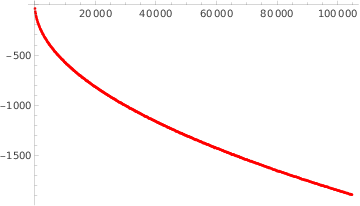
Figure 4: Binary accuracy p∼1068 of the functional equation for approximate p∼1069-function as a function of maximal included prime 1070—a monotonic improvement indicates correctness of the computed Euler factors.
Theoretical and Practical Implications
This methodology opens several avenues:
- Arithmetic Geometry & Physics: Large-scale computation of local zeta functions amplifies the ability to study arithmetic properties of CY motives, test modularity conjectures, and analyze special loci in moduli spaces relevant for string compactifications, flux vacua, and the attractor mechanism.
- Automorphic Forms and 1071-functions: Efficient access to Euler factors for vast ranges of primes allows high-precision testing of functional equations, Sato–Tate laws, and congruences for associated automorphic and modular forms.
- Algorithmic Number Theory: The 1072-adically truncated recurrence realizes a powerful new paradigm for 1073-adic arithmetic in period calculations, with possible extensions to more general families (multiparameter, higher-order operators, and beyond CY type) and broader classes of motivic zeta functions.
The explicit, rigorously justified bounds on 1074-adic accuracy guarantee reliability and scalability without ad hoc numerical heuristics.
Future Directions
Natural directions include:
- Extension to multiparameter families and to higher-dimensional Calabi–Yau varieties.
- Application to broader classes of motives, modular forms, and zeta/L-function phenomena.
- Deeper exploration of Sato–Tate distributions and their arithmetic and physical consequences for CY and K3 families.
- Comparison and integration with orthogonal computational approaches (e.g., controlled reduction in toric hypersurfaces).
The public availability and modularity of the PFLFunction package (with planned enhancements for broader operator classes) positions the method as an accessible and extensible tool for researchers.
Conclusion
The paper presents a significant methodological advance in computational arithmetic geometry by introducing 1075-adically truncated recurrences for Calabi–Yau differential operators, facilitating efficient and memory-frugal computation of zeta functions for large primes and parameter families. The new approach enables empirical exploration of arithmetic, automorphic, and physical phenomena previously unreachable by standard methods, with promising prospects for extensions and applications across algebraic geometry, number theory, and mathematical physics.