- The paper demonstrates that symmetry non-restoration persists at all temperatures in UV-complete 3+1D gauge-scalar quantum field theories.
- It extends large-N analysis to finite-N by employing one-loop RGEs, effective potentials, and explicit numerical benchmarks.
- Numerical results confirm parameter regions with negative thermal masses, pointing to implications for cosmology and dark sector models.
Infinite Heat Order in 3+1 Dimensions: Ultraviolet-Complete Symmetry Non-Restoration
Introduction
The paper "Infinite Heat Order in 3+1 Dimensions" (2604.01184) addresses the long-standing question of whether spontaneous symmetry breaking can persist at arbitrarily high temperature in strictly ultraviolet (UV)-complete quantum field theories (QFTs) with finite degrees of freedom. Contrary to conventional thermodynamic expectation—which predicts entropy-driven symmetry restoration at high T—the authors revisit the phenomenon of symmetry non-restoration (or "infinite heat order") and show that, within a carefully constructed class of perturbative and asymptotically free gauge-scalar models, ordered phases can indeed survive in the T→∞ limit.
The key advance is the extension of previously studied large-N (Veneziano limit) mechanisms to finite N, thereby establishing explicit, tuneable, anomaly-free 3+1D QFTs with bounded-from-below potentials, asymptotic freedom, and exact symmetry breaking at all temperatures. The analysis is structured analytically at leading and next-to-leading order in $1/N$, and numerically at finite N, demonstrating the generality and robustness of the mechanism.
Theoretical Framework
The class of models constructed is based on the gauge group SU(Nc1)×SU(Nc2) with two complex scalar fields, φ1 and φ2, each transforming as a fundamental under only one gauge factor. The scalar potential is
V=2λ1(φ1†φ1)2+2λ2(φ2†φ2)2−λ(φ1†φ1)(φ2†φ2),
where T→∞0 is a negative cross-coupling. Thermally, the scalar sector receives positive contributions to the quadratic term from the quartics and gauge couplings, but the portal interaction enables the possibility of negative thermal mass for one scalar, which signals symmetry non-restoration at high T→∞1.
The model is set up to be completely asymptotically free (CAF): all marginal couplings vanish in the UV, enabling arbitrary T→∞2. Real solutions for the fixed-flow RG conditions and thermal potential constraints ensure a consistent realization of infinitely persistent symmetry breaking.
Large-T→∞3 Analysis and Mechanism
In the Veneziano limit, with T→∞4 and fixed ratios, the RGEs and thermal mass corrections simplify substantially due to decoupling of certain index structures. The sign of the thermal mass, extracted from the one-loop thermal effective potential, is controlled by the balance of the positive gauge+quartic and the negative cross-coupling terms. In a large parameter region, and particularly for asymmetric ratios T→∞5, the negative thermal mass condition is satisfied while maintaining a stable, bounded potential.
This analysis confirms the intuitive "entropic order" mechanism whereby the ordering of one sector increases entropy available to the other, favoring and stabilizing the broken phase at high T→∞6—as identified recently in both continuum and lattice field theory contexts.
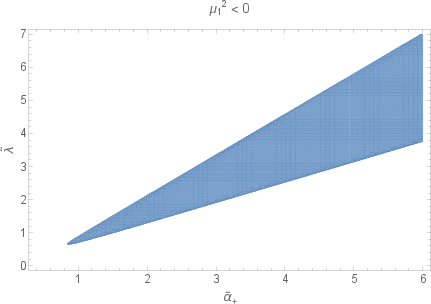
Figure 1: Parameter region in the T→∞7 plane where the squared mass of T→∞8 is negative, indicating symmetry non-restoration at large T→∞9.
Finite-N0 Extension
The principal technical challenge—a central achievement of the work—is the extension from the large-N1 (Veneziano) analysis to finite N2. The RGEs, effective potential, and thermal masses are derived at arbitrary N3, N4, with explicit N5 corrections detailed. Analytic N6 expansion demonstrates that negative thermal mass regions persist and confirms that the mechanism is not an artifact of infinite field content.
Numerically solving the coupled fixed-point and stability equations, explicit anomaly-free, finite-N7 benchmark theories are constructed. For example, the choice N8 yields couplings and thermal masses such that one scalar's mass is strictly negative at all N9, with all RG and boundedness constraints satisfied.
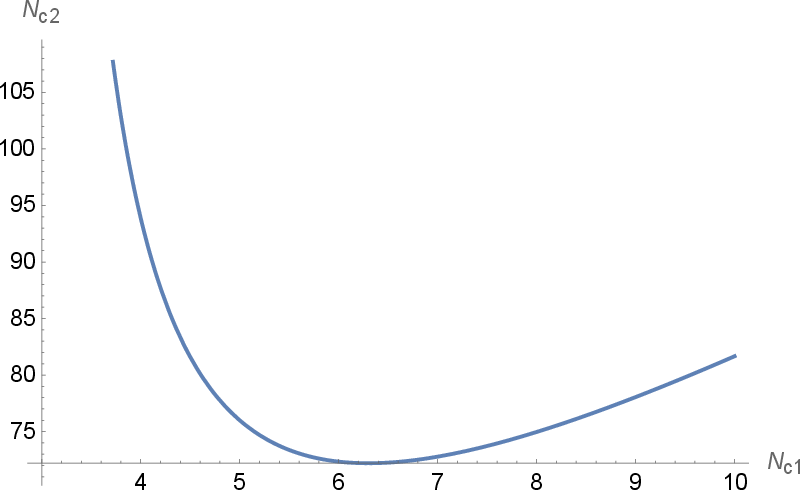
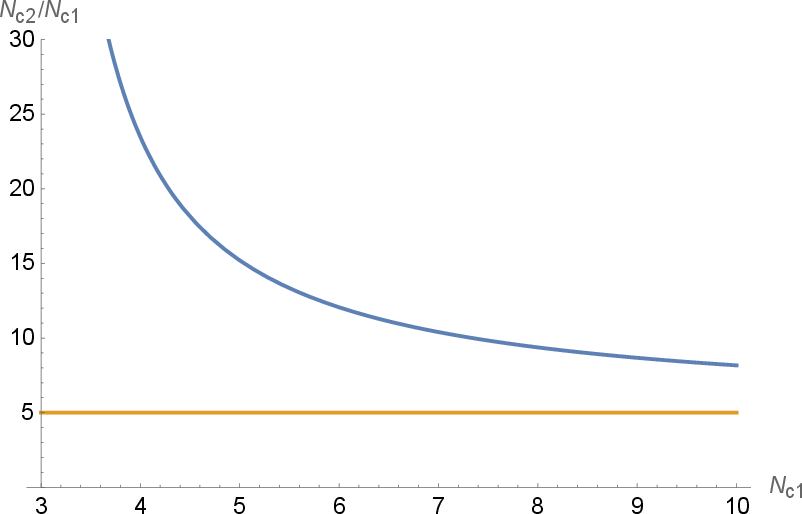
Figure 2: Region in the N0 plane with negative thermal mass square at N1. The solution is robust beyond the large-N2 limit.
Special attention is given to the minimal color/flavor content required for this phenomenon to exist, showing analytically and numerically that symmetry non-restoration requires a sufficiently large hierarchy between color multiplicities, typically N3 as N4.
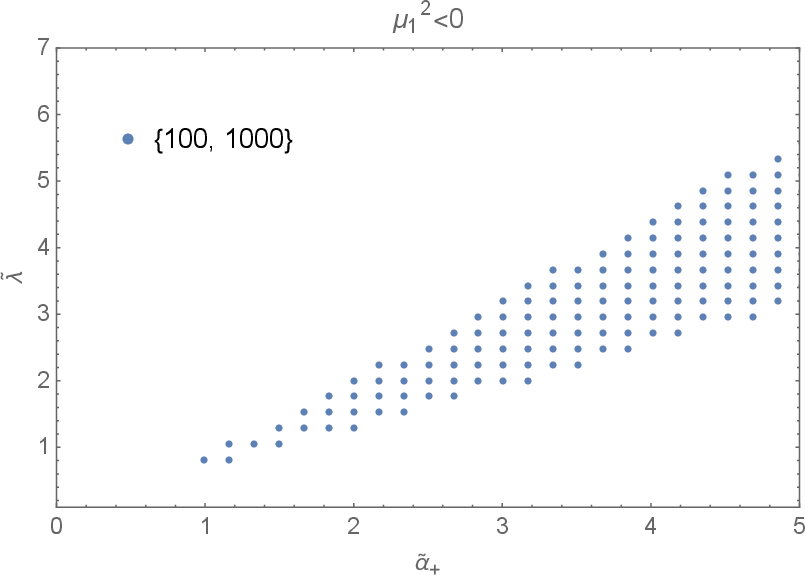
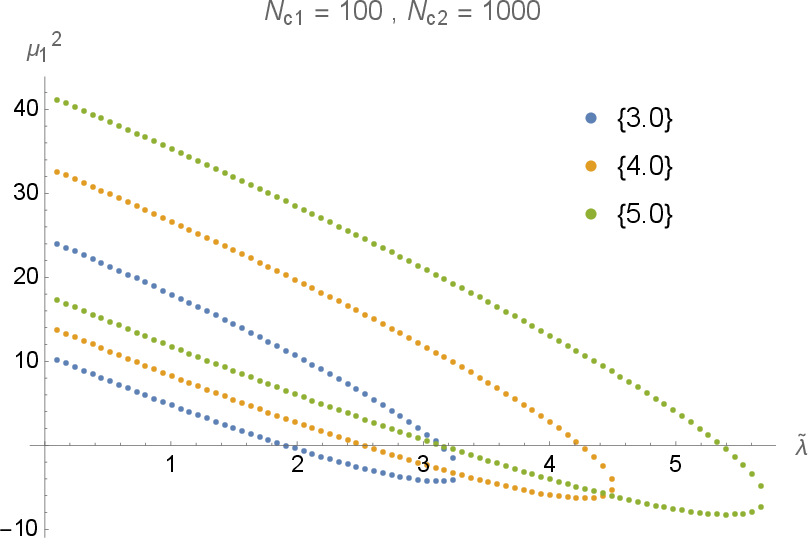
Figure 3: Boundaries in the N5-N6 plane above which symmetry non-restoration is possible (blue), and the effect of further requiring integer flavor numbers (yellow points indicate loss of allowed solutions near the bound).
Numerical Analysis and Benchmarks
The numerical results reinforce the analytic findings and allow identification of regions and benchmark points in N7 space with physically viable infinite heat order. The full set of one-loop RGEs and effective masses, including precise flavor thresholds for asymptotic freedom and vacuum stability, are implemented.
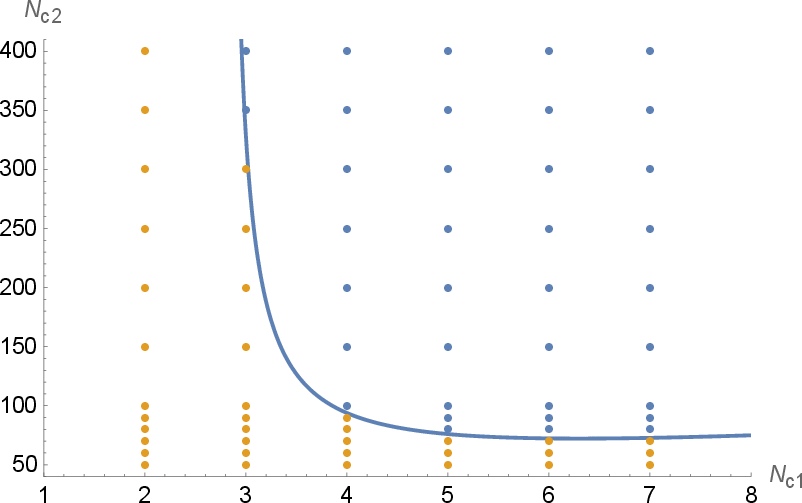
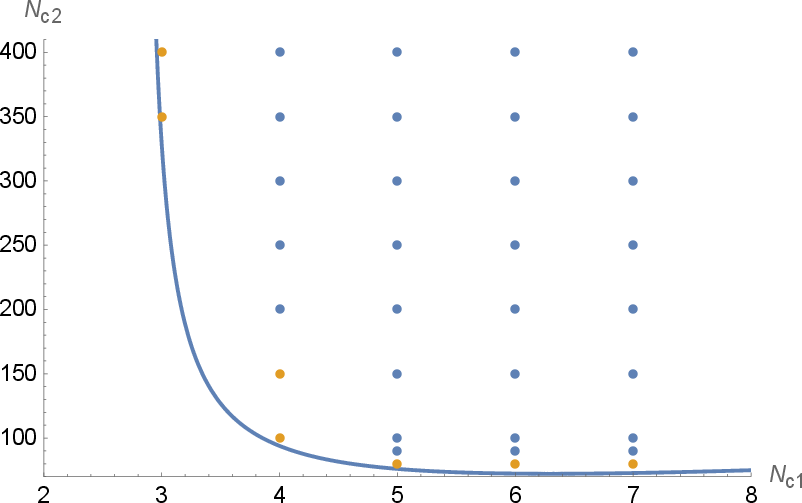
Figure 4: Regions in the N8-N9 plane (a) with/without symmetry non-restoration solutions (b) incorporating only solutions with integer $1/N$0, highlighting practical constraints for constructing explicit finite models.
Implications and Future Directions
The paper demonstrates—explicitly and constructively—that infinite heat order is viable in strictly four-dimensional, perturbative, UV-complete QFTs with finite field content. This addresses a crucial open problem in the statistical mechanics of high-energy gauge theories and extends conceptual frameworks for cosmological applications involving early universe symmetry breaking, defect formation, and baryogenesis.
Practically, this construction offers templates for dark sector models with persistent symmetry breaking at all $1/N$1, shielded from UV incompleteness/Landau poles, and may inform investigations of entropy-stabilized ordering in gauge-scalar systems, especially those coupled only gravitationally to the Standard Model.
On the theoretical side, the analysis affirms dominance of the one-loop fixed-flow mechanism in the infinite $1/N$2 limit, with higher-loop corrections entering at parametrically suppressed orders in $1/N$3. Asymptotically free systems, therefore, provide a robust stage for such phenomena unless gravitational corrections become significant near $1/N$4.
Further research directions include the full classification of all finite-$1/N$5 theories supporting infinite heat order, exploration of possible realizations in phenomenologically-motivated hidden sectors, and investigation of their roles in phase transition cosmology. Extensions to models with Yukawa couplings, more intricate symmetry structures, or alternative gauge group products may yield rich additional possibilities.
Conclusion
This work rigorously establishes the existence of infinite heat order—symmetry non-restoration at all temperatures—in explicit, UV-complete, 3+1D gauge-scalar quantum field theories with finite degrees of freedom. The essential technical advance lies in the analytic and numerical treatment of finite-$1/N$6 systems, culminating in explicit benchmarks and parameter space characterization. The mechanism relies crucially on the portal (cross-scalar) coupling and a non-simple product gauge structure, transcending limitations of earlier single-factor and effective-field-theory approaches. The results have significant implications for the theory of thermal phases in high-energy physics and open several avenues for further exploration in both mathematical physics and cosmological modeling.

