- The paper introduces a comprehensive FE-based multiphysics model that explicitly incorporates measured surface roughness to compute real contact areas in TENGs.
- The model couples detailed contact mechanics with 3D electrostatics, capturing fringing, floating electrodes, and dynamic circuit behavior under varied loading conditions.
- Experimental validation shows the FE model outperforms analytical approaches with deviations below 2.6%, accurately predicting voltage, capacitance, and transient responses.
A Multiphysics Model for Triboelectric Nanogenerator Design with Explicit Surface Roughness Representation
Introduction and Motivation
Triboelectric nanogenerators (TENGs) are central to the development of next-generation energy harvesting technologies for portable, wearable, and autonomous micro- and nanoscale systems. Accurate prediction and optimization of TENG performance demand modeling approaches that faithfully represent the interplay between realistic surface roughness, contact mechanics, triboelectric charge transfer, and three-dimensional electrostatics in composite, multiscale devices. Existing analytical models are constrained by severe idealizations: statistical assumptions for asperity geometries, simplifications in electric field computation (e.g., infinite plane approximations), and neglect or over-simplification of load/roughness dependencies. This paper introduces a comprehensive, open-source finite element (FE) framework that resolves these deficiencies by incorporating measured rough surface topographies, scalable contact mechanics, coupled 3D electrostatics, and time-dependent circuit dynamics within a unified computational pipeline.
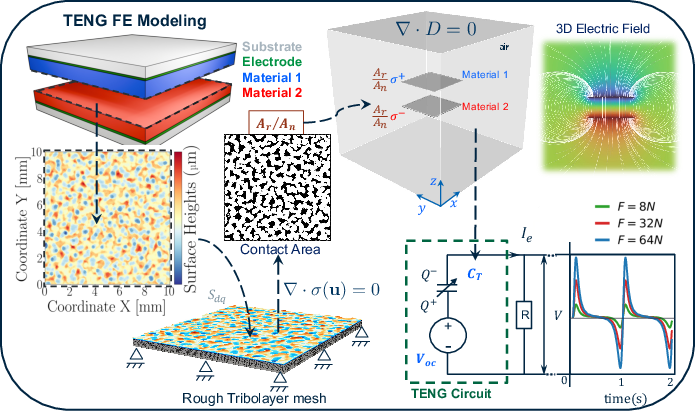
Figure 1: Schematic overview illustrating the multiphysics scope for TENGs: integrating finite roughness, contact mechanics, triboelectric charge, and electrostatic coupling into a single predictive workflow.
The approach explicitly resolves rough contact areas, implements a robust Lagrange multiplier-based contact formulation for FE analysis, and rigorously computes the scaling of triboelectric charge relative to real contact area under diverse loading regimes. Fringing effects, finite device geometry, and floating electrode conditions are handled numerically to achieve higher fidelity reproduction of TENG output characteristics, validated extensively against experiments and prevailing analytical models.
Methodological Framework
Workflow Overview
The proposed simulation pipeline operates in three modular but tightly coupled stages: (1) mechanical contact analysis with explicit surface roughness (from profilometry or algorithmic generation), (2) 3D electrostatic field computation with robust enforcement of physically-consistent boundary/interface conditions (including floating electrodes and heterogeneous dielectric stacks), and (3) time-domain integration of an ODE-based circuit model capturing transient electrical responses under variable mechanical excitation and loading.
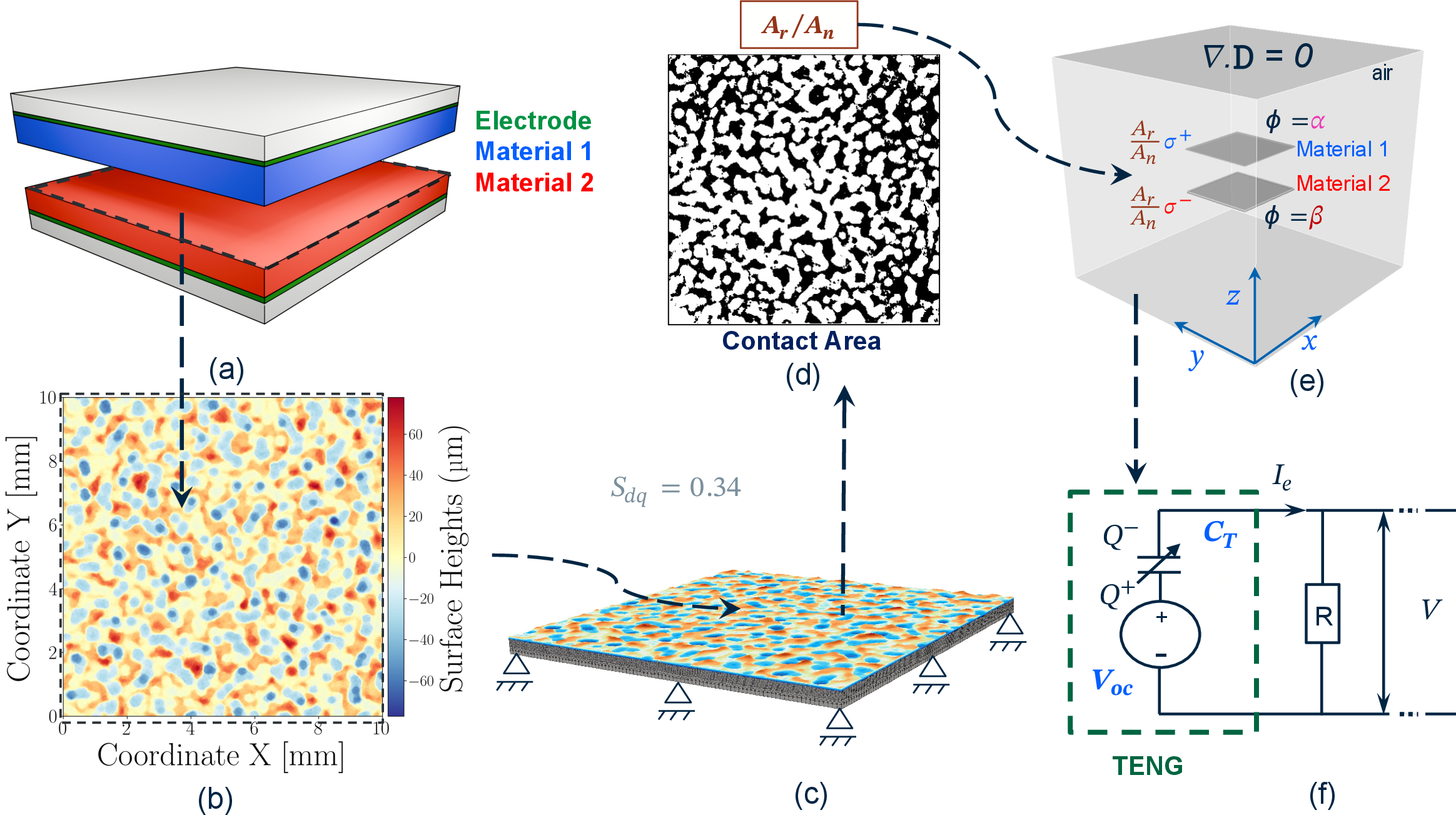
Figure 3: Simulation pipeline for TENGs: (a) layer-stack schematic and surface roughness, (b) roughness projection, (c) FE mesh with mapped surface profile, (d) resolved contact/non-contact zones, (e) electrostatic modeling with surface charge densities, (f) equivalent circuit integration.
Mechanical contact is formulated using a Raviart-Thomas mixed FE strategy, enforcing Karush-Kuhn-Tucker (KKT) complementarity conditions for frictionless, non-adhesive contact between a deformable tribolayer and a rigid counterface. The measured (or engineered) rough surface is directly projected onto the FE mesh, ensuring accurate representation of the real spatial distribution of asperities and valleys Figure 4.
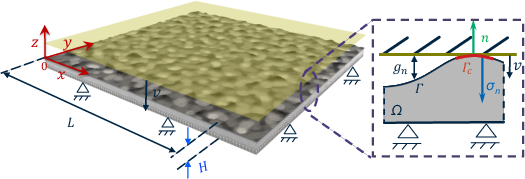
Figure 5: Contact problem schematic: deformable tribolayer with rough topography and definition of active contact subnet (Γ_c ⊂ Γ).
Contact area computation is performed at the integration (Gauss point) level, leveraging tracked status flags based on gap and contact pressure—enabling reliable summation over large, high-resolution surface meshes Figure 6.
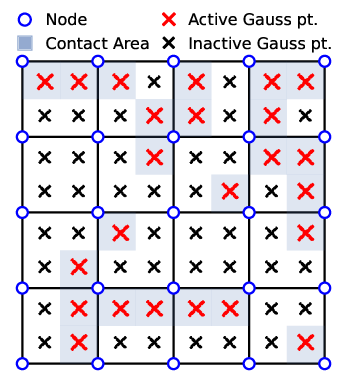
Figure 7: FE-based contact area computation: quadrilateral element interface, active Gauss points in red, real contact zones shaded.
3D Electrostatics and Circuit Integration
Electrostatic computation solves the full Maxwell equations (in quasi-static regime) for multilayer dielectrics, incorporating arbitrarily-shaped and explicitly rough interfaces. Surface charge densities are linearly scaled by the real contact area ratio Ar/An at each contact cycle. Floating electrodes are treated via coupled interface flux integrals and constant-potential boundary conditions, enabling extraction of both open-circuit voltages (VOC) and device capacitance (CT) as functions of dynamic air gap, lateral size, and surface properties. Detailed field-distribution and fringing phenomena are explicitly captured Figure 8.
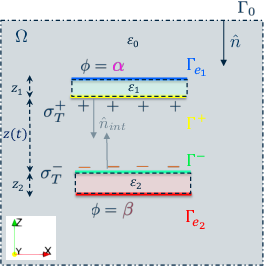
Figure 2: Cross-sectional electrostatics configuration: dielectric layers, air gap, electrode boundaries, and color-mapped 3D potential/electric field distributions.
Transient circuit dynamics are resolved by integrating the first-order ODE derived from the canonical V-Q-z relation; time evolution of charge and voltage are captured for realistic load scenarios, including variable resistive loads and mechanical excitation frequencies (Figures 10 and 17).
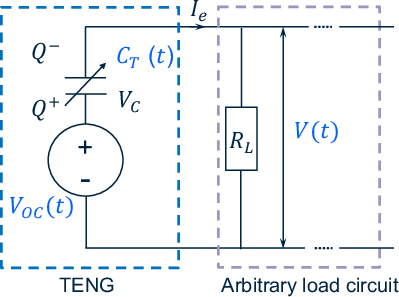
Figure 4: Equivalent TENG circuit: scalable with time-dependent VOC and CT, delivering output voltage and current across RL.
Experimental Validation and Numerical-Physical Consistency
Direct, high-fidelity comparison is provided between numerically predicted and optically measured real contact areas for a prototypical PVS-PET TENG across a broad range of applied loads Figure 11. The FE model demonstrates deviations smaller than 2.6 percentage points relative to experiment, significantly outperforming both the classical BGT and Persson models under realistic roughness and loading regimes.
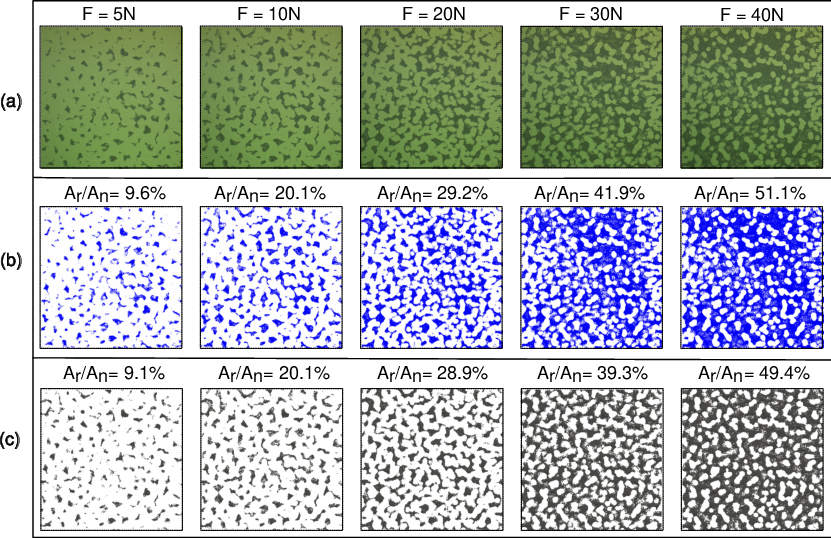
Figure 6: Experimental (a,b) and simulated (c) real contact area maps for various normal loads, confirming quantitative agreement of physical contact evolution.
Open Circuit Voltage and Capacitance
The FE-based electrostatics model accurately reproduces the dependency of VOC on air gap across dielectric/air stacks, with explicit field saturation and natural incorporation of fringing/surface finite size effects Figure 12. The error with respect to leading analytical models (e.g., Xu et al.) is observed to be within 17.5% for large air gaps, primarily due to 3D field bending outside the parallel-plate limit.
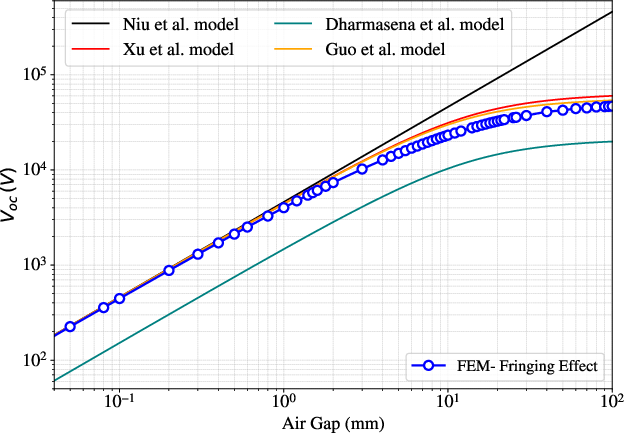
Figure 9: FEM-predicted VOC vs. analytical models for varying air gap, demonstrating impact of full field solution (3D fringing).
Similarly, capacitance measurements—performed with precision LCR setups and variable air gaps—are closely matched by FE results, again outperforming analytic projections, especially as gap/lateral size increases Figure 13.
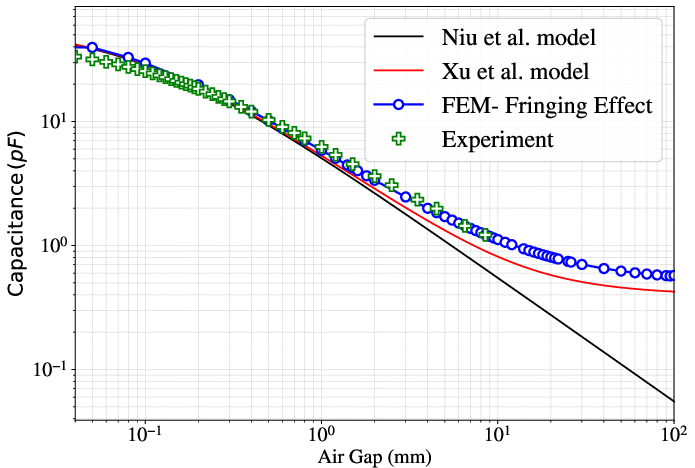
Figure 14: Capacitance experimental validation: FE vs. analytic approaches for finite-size plates.
Time-Dependent, Load-Dependent, and Frequency-Dependent Output
The framework captures load-dependent scaling of VOC and Ie with real contact area, matching experiment and improving on models which employ crude area-scaling or assume spatially uniform charge distribution. Temporal voltage and current output characteristics are accurately reproduced for dynamic excitation, and the sensitivity of response to real contact area, excitation frequency, external resistance, and device size is quantified (Figures 19–21).
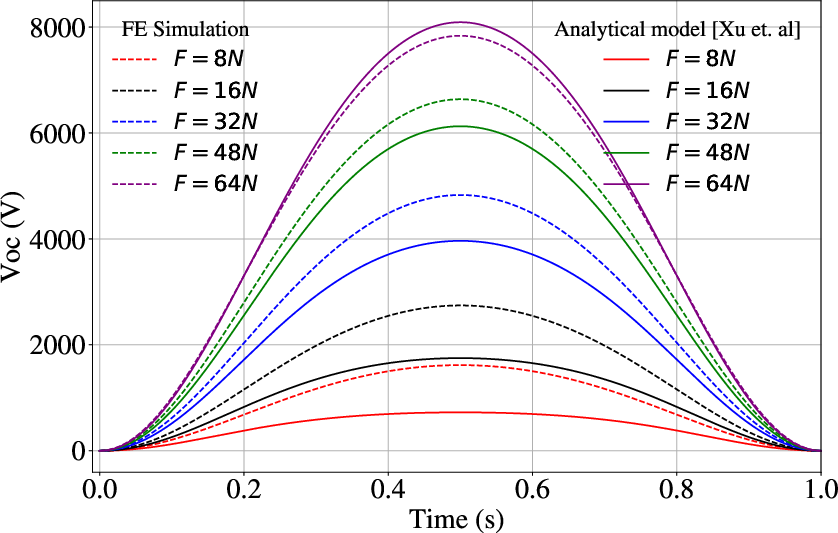
Figure 10: Transient VOC0: FEM (dashed) vs. analytical model (solid) under frequency/load modulation.
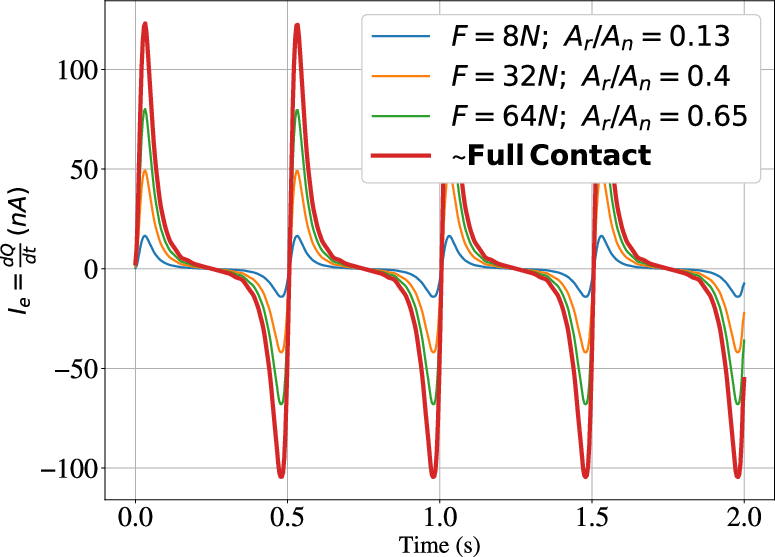
Figure 17: Short-circuit current vs. applied normal force: impact of VOC1 with fixed resistive load.
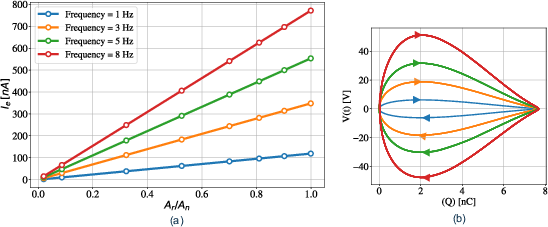
Figure 11: (a) Frequency-dependent max current vs. VOC2; (b) V-Q hysteresis loops illustrating increased charge transfer and output at higher frequencies.
Systematic investigation of resistive load sweeps reveals operable regimes—current-limited, voltage-limited, and optimal power transfer (Figures comparing peak current and voltage vs external load). The FE model identifies shifts in optimal loading with excitation parameters, a crucial aspect for power management in real-world applications.
Theoretical and Practical Implications
This work establishes that explicit, FE-based modeling of real surface roughness and contact mechanics—including large meshes representing actual measured topographies—enables predictive, quantitative design of TENGs with arbitrary geometry, material heterogeneity, and surface modification strategies. The contact area scaling for tribocharge is linear for randomly distributed asperities but diverges in lower-symmetry engineered cases, justifying the necessity of full spatial field resolution.
On the practical side, the pipeline facilitates virtual prototyping for application-driven TENGs, supporting design of surface microstructures, optimization of device scale, stack architecture, electrode patterns, and circuit interfaces for energy harvesting in textiles, robotics, wearables, and infrastructural components. The highly scalable codebase is suitable for high-performance computing and leverages open-source infrastructures for reproducibility and community adoption.
Theoretical advances include validated coupling of mechanical contact and 3D electrostatics, robust floating electrode computation, and the demonstration that edge effects, field non-uniformity, and explicit area scaling must be accounted for at all but the lowest-aspect ratio or perfectly smooth configurations. Clear trends are established relating contact area ratio, surface morphology metrics (VOC3, VOC4), and output performance figures of merit.
Future Directions
Key limitations retained by the present model include the absence of dynamic charge evolution with respect to contact history, environmental factors (humidity, temperature), and electrochemical effects at the dielectric/electrode/air interface. Likewise, viscoelastic or plastic material responses and tribo-induced wear are not currently included but are compatible with the modular framework. Integrating coupled multiphysics modules for charge leakage, flexoelectricity, and large deformation will enable study of broader operational and failure phenomena. Multiscale strategies combining local contact and global field solution are expected to facilitate design of next-generation, high-efficiency, mode-diverse TENGs (e.g., sliding, rolling architectures).
Conclusion
This paper delivers a robust, experimentally validated, FE-based multiphysics model for TENG analysis incorporating explicit surface roughness, real contact area computation, 3D electrostatics (with fringing and floating electrodes), and temporal circuit integration. The framework consistently matches experimental contact and electrical measurements across forces, frequencies, and resistive loading regimes, outperforming analytical models even in challenging parameter spaces. The approach is of immediate practical relevance for optimizing ambient energy harvesters across domains requiring scalable, adaptive, and high-fidelity device simulation, and forms the basis for further research into triboelectrification mechanisms, advanced power management, and engineered tribo-interfaces.
Reference:
"A multiphysics model for triboelectric nanogenerator design with explicit surface roughness representation" (2604.01119)