- The paper harnesses technological hype by using AI coding assistants to effectively teach empirical research methods through iterative, hands-on projects.
- It employs a dual-pilot study design with iterative testing and reflective feedback to refine research methodologies and address operational challenges.
- The findings highlight the balance between leveraging popular tech trends and maintaining rigorous empirical standards in software engineering education.
Harnessing Hype to Teach Empirical Thinking: An Experience With AI Coding Assistants
Introduction
The paper "Harnessing Hype to Teach Empirical Thinking: An Experience With AI Coding Assistants" (2604.01110) presents a comprehensive experience report on leveraging contemporary technological hype—in this case, AI coding assistants—to facilitate the teaching of empirical research skills to software engineering students. The authors describe a semester-long seminar integrating the use of AI coding assistants (e.g., GitHub Copilot) with the design and conduct of student-led empirical studies. The core hypothesis is that trending, highly relevant topics can catalyze student engagement with otherwise abstract scientific concepts such as hypothesis-driven inquiry and empirical methodology.
Seminar Structure and Pedagogical Framework
The seminar was structured according to principles of constructive alignment, carefully harmonizing learning objectives, assessment strategies, and teaching activities. The course comprised ten sessions, alternating between instructional activities (e.g., introductions to empirical methodology, literature search, and scientific presentations) and hands-on exercises involving AI coding assistants across code generation, code explanation, refactoring, and debugging scenarios.
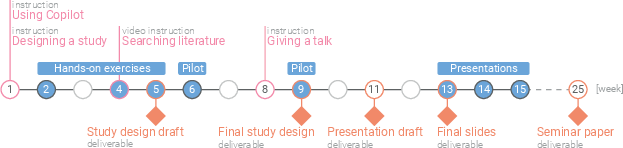
Figure 1: The architectural overview of the seminar illustrates how instructional, hands-on, and milestone sessions are distributed throughout the semester, with color-coding denoting session types and week-wise organization.
A dual-pilot empirical study design was incorporated to provide students with authentic, iterative exposure to research practice—from hypothesis formulation and study design to execution and reflective revision. Each student individually designed, piloted, and iteratively refined a small-scale empirical study on a topic pertaining to AI coding assistants, guided through one-to-one supervision and peer feedback mechanisms.
Student Engagement and Empirical Skill Acquisition
A striking empirical observation was the record level of student interest. Out of 168 applications—the highest recorded in four semesters—only 18 students could be accommodated, with 13 completing the seminar. This dramatic contrast with historical median and mean application numbers at the institution strongly implicates the motivational effect of hype-driven topics.
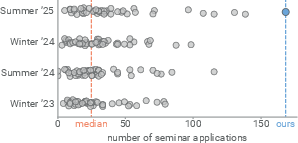
Figure 2: Student application numbers for seminars over four semesters highlight the anomalous spike associated with the AI coding assistant seminar, visually underscoring the draw of the hype topic.
The hands-on sessions were critical for experiential learning and meta-cognitive reflection. Data from session questionnaires show that while AI-coding assistants were perceived as generally helpful, students encountered both high completion rates and substantive issues with incorrect or unexpected outputs. These insights fostered classroom discussions around measurement reliability and threats to validity—concretizing core empirical concepts in the context of a contemporary tool.
All but one student adopted experimental methodologies for their empirical studies, primarily due to the hands-on session format, the time-limited nature of each study, and logistic constraints. A significant result was most students substantially refining their study designs after initial pilots, dealing with unforeseen challenges in operationalization, participant variability, and methodological feasibility. This process instilled robust empirical skepticism and iterative problem-solving.
Survey Results and Reflective Analysis
A post-seminar survey (administered to 10 of 13 students) provided both quantitative Likert-scale and qualitative data on learning outcomes. The overwhelming majority reported a strengthened ability to distinguish anecdotal from empirical evidence, heightened confidence in evaluating claims, and readiness to transfer empirical methodology to other emerging technologies. The seminar also increased motivation for empirical inquiry, particularly as students recognized the direct relevance of their research to widely-discussed AI coding assistants.
Both closed-form and open-ended responses indicated that the hype topic increased student investment, interest, and sense of ownership—although it also risked attracting participants primarily interested in the technology, rather than empirical methods per se. Importantly, hands-on and project-centric seminar design were shown to be critical in transitioning initial topic-driven excitement into meaningful engagement with empirical practice.
Implications for Pedagogy and Software Engineering Education
Key outcomes and lessons are as follows:
- Hype as Engagement Catalyst: Tightly aligning trending technological topics with methodological rigor can lower conceptual entry barriers for empirical inquiry, providing a potent source of motivation without diluting academic objectives.
- Dual-purpose Learning: Integrating hands-on tool usage with research methodology instruction advances both technical fluency and critical thinking, particularly when paired with iterative, student-driven exploration and peer communication.
- Risks of Expectation Mismatch: Overly emphasizing the hype topic in course marketing without equally clear framing of empirical learning goals can draw students whose interests veer away from research practice, leading to disengagement or attrition.
- Scalability and Transferability: The high staff-to-student ratio facilitated intense supervision and feedback but may not be scalable. The approach is most suitable for tightly-scoped, short empirical studies, and requires adaptation for other contexts or larger cohorts.
The design is directly applicable to other domains where new technological trends emerge rapidly (e.g., data science, security, or HCI), provided empirical outcomes are foregrounded, and methodological integrity is strictly maintained.
Conclusion
By exploiting contemporary technological enthusiasm (AI coding assistants) as an entry point for empirical skill development, the seminar described in (2604.01110) demonstrates how targeted course design can transform hype-driven motivation into scientifically rigorous, critical engagement. Authentic, iterative empirical experience, hands-on tool use, and structured reflection collectively accelerated the acquisition of core empirical competencies. Future pedagogical innovation should continue to strategically harness such trends, both for their intrinsic motivational power and as vehicles for enduring methodological literacy in software engineering and beyond.