- The paper establishes a novel QCD observable, the MC-EEC, that correlates jet energy-energy correlations with internal multiplicity fluctuations.
- It develops a factorization and renormalization group framework, validated against Pythia8 simulations, to extract a multiplicity-dependent anomalous dimension for angular energy flow.
- The study proposes experimental strategies to correct for multiplicity biases, ensuring accurate interpretation of jet substructure in complex collision environments.
Correlation Between Jet Energy Correlators and Multiplicity Fluctuations
Overview
The paper systematically explores the correlation between jet energy-energy correlators (EECs) and internal jet multiplicity, introducing the multiplicity-conditioned EEC (MC-EEC) as a new QCD observable. The authors develop a factorization and renormalization group framework for the MC-EEC jet function (MCJF), extending the theoretical toolkit beyond standard EEC analysis to track how jet angular energy flows are directly affected by constrained particle production histories. The established connection rigorously quantifies the impact of multiplicity fluctuations on angular observables and offers experimental strategies for disentangling physical modifications in complex environments from trivial multiplicity biases.
The EEC is defined as an IRC safe, scale-dependent two-point function measuring angular correlations in the jet’s energy flow. By conditioning the EEC on the normalized charged-particle multiplicity ν=Nch/⟨Nch⟩, the MC-EEC becomes sensitive to the underlying dynamics of particle production, linking the angular spectrum directly to the branching structure of parton showers. This is formalized by introducing the multiplicity generating function Z(s), a Laplace transform over the multiplicity distribution P(N), which encodes the probabilistic characteristics of particle yields within the jet.
The authors perform a factorized calculation of the semi-inclusive MCJF at NLO in αs, operative in the collinear regime ΛQCD/pT,jet≪χ≪R. They derive coupled renormalization group equations for the evolution of the MCJF and the multiplicity generating function, leveraging angular ordering to consistently resolve perturbative splitting and soft emission effects. Crucially, the MC-EEC inherits a power-law scaling in χ with an anomalous dimension γ(ν) that is an explicit, monotonic function of the selected multiplicity ν.
Consistency and Validation
Numerical predictions for the standard (unconditioned) EEC, evaluated at LO+LL accuracy, show excellent agreement with Pythia8 parton shower simulations across a wide angular regime. The theoretical bands, reflecting scale uncertainties, encompass the simulation results for both quark- and gluon-initiated jets, confirming the consistency and perturbative stability of the framework.
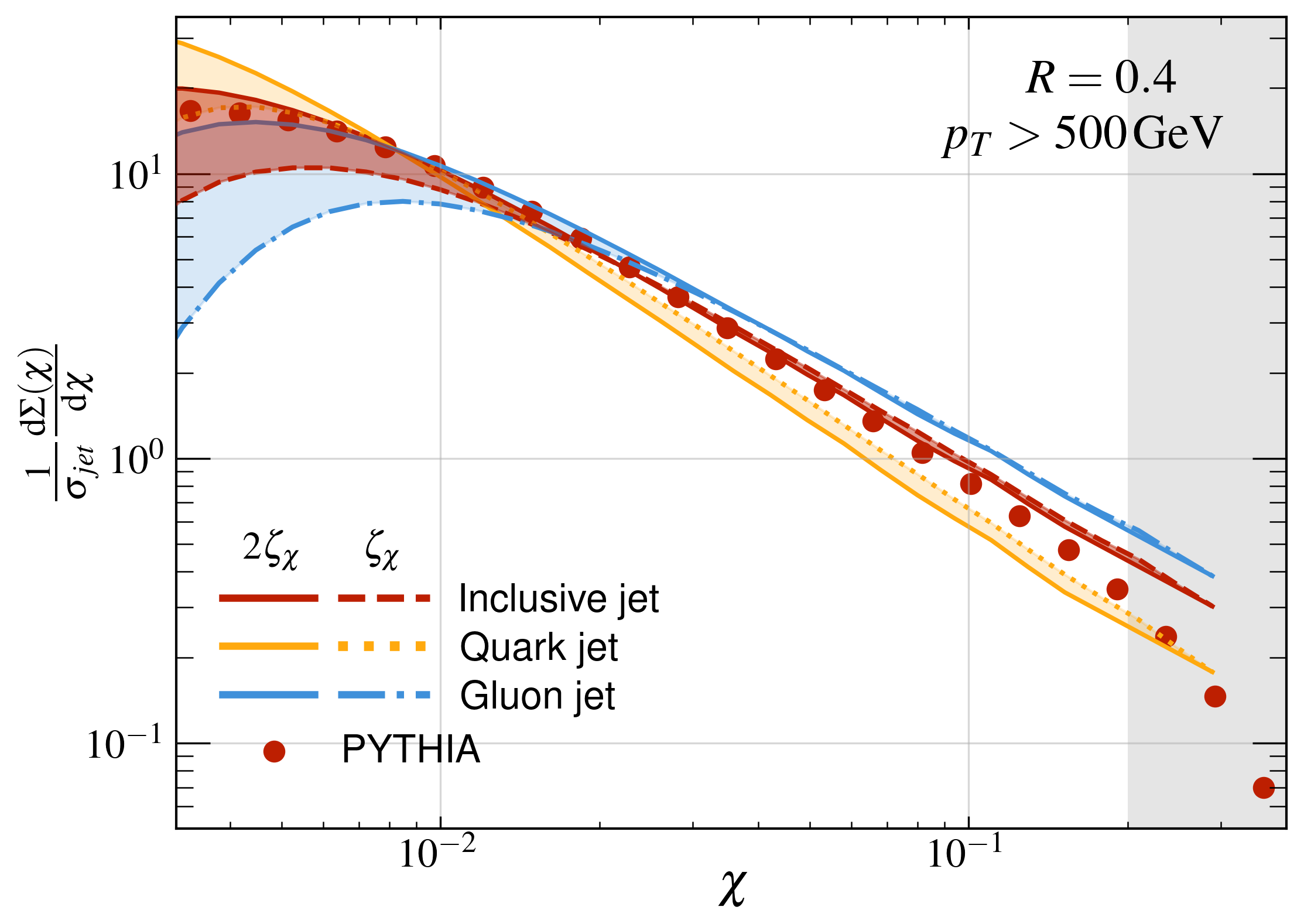
Figure 1: Standard EEC for jets with pT>500 GeV and R=0.4; bands (LO+LL) compared with Pythia8 simulations.
The validated inclusive limit establishes the MC-EEC as a proper generalization for multiplicity-differential measurements.
Multiplicity-Conditioned EEC Phenomenology
Upon binning jets by normalized multiplicity Z(s)0, the MC-EEC exhibits a markedly flatter angular distribution at higher Z(s)1. This is attributed to enhanced soft and collinear radiation in high-multiplicity jets, which drains energy away from narrow angle pairs, while boosting particle production at wider opening angles. The scaling exponent Z(s)2, extracted both from theory and simulation, shows a clear monotonic decrease with increasing Z(s)3, quantitatively encoding the interplay between parton shower activity and energy flow geometry.
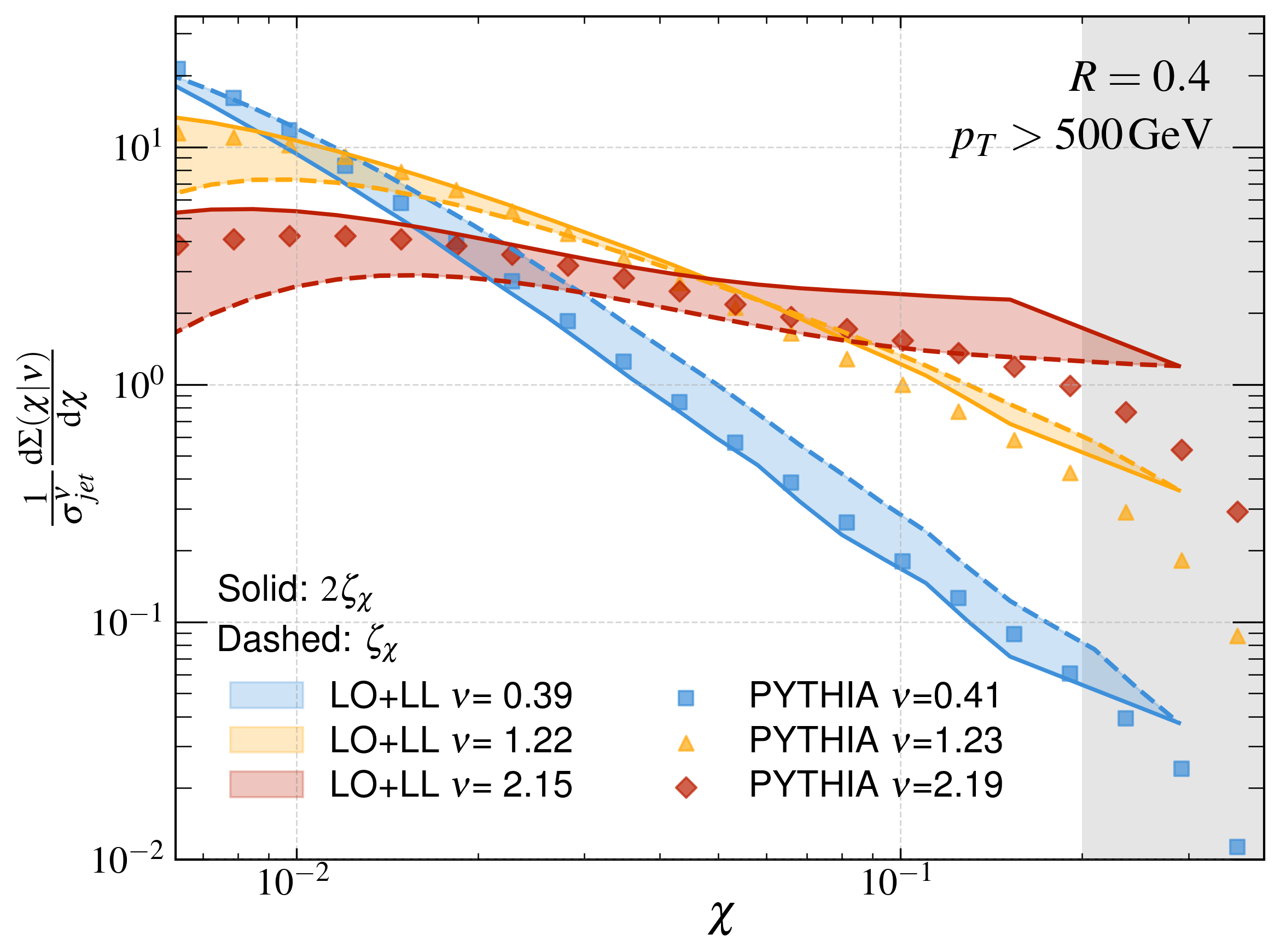
Figure 2: Multiplicity-conditioned EEC for jets with Z(s)4 GeV and Z(s)5, shown for various Z(s)6 classes and compared to Pythia8.
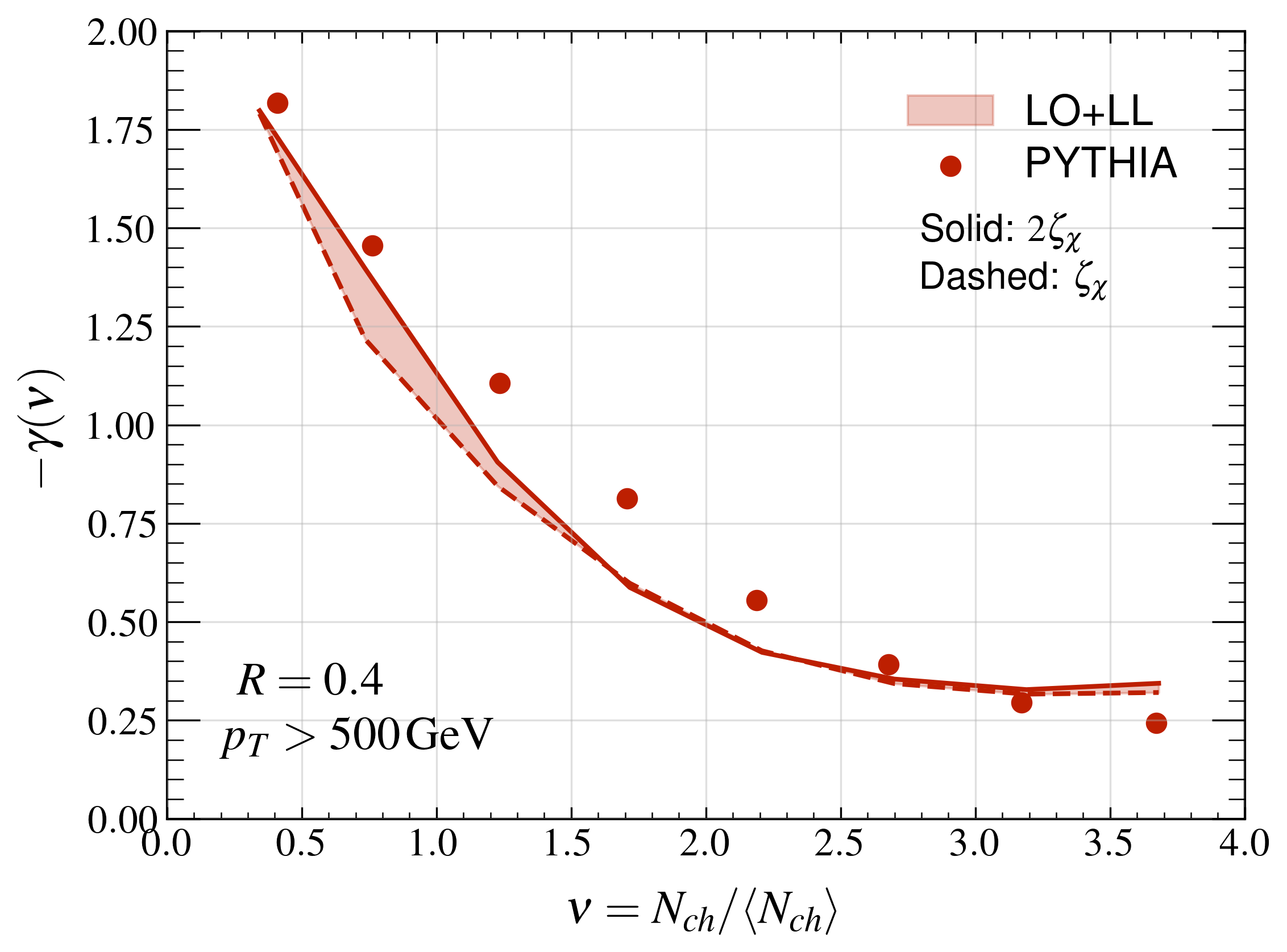
Figure 3: Exponent Z(s)7 of the MC-EEC as a function of normalized jet multiplicity Z(s)8.
While the LO+LL formalism captures the qualitative structure, residual discrepancies with Pythia8 at high Z(s)9 suggest subleading logarithmic effects or nonperturbative corrections become increasingly relevant. Nevertheless, the robust monotonicity and analytic control of P(N)0 reinforce its value as a discriminant for scale-dependent branching phenomena.
Implications for Jet Measurements in Fluctuating Backgrounds
The explicit sensitivity of the MC-EEC to the multiplicity distribution implies that apparent modifications to EEC ratios (e.g., in P(N)1 vs P(N)2) may emerge from biased sampling in the presence of a fluctuating or modified background, rather than solely from underlying physical medium effects. The authors demonstrate this by modeling ensemble-averaged EECs for gluon jets using several skew-normal multiplicity distributions, varying the mean, width, and skewness. Each parameter induces systematic and characteristic distortions in the EEC angular spectrum.
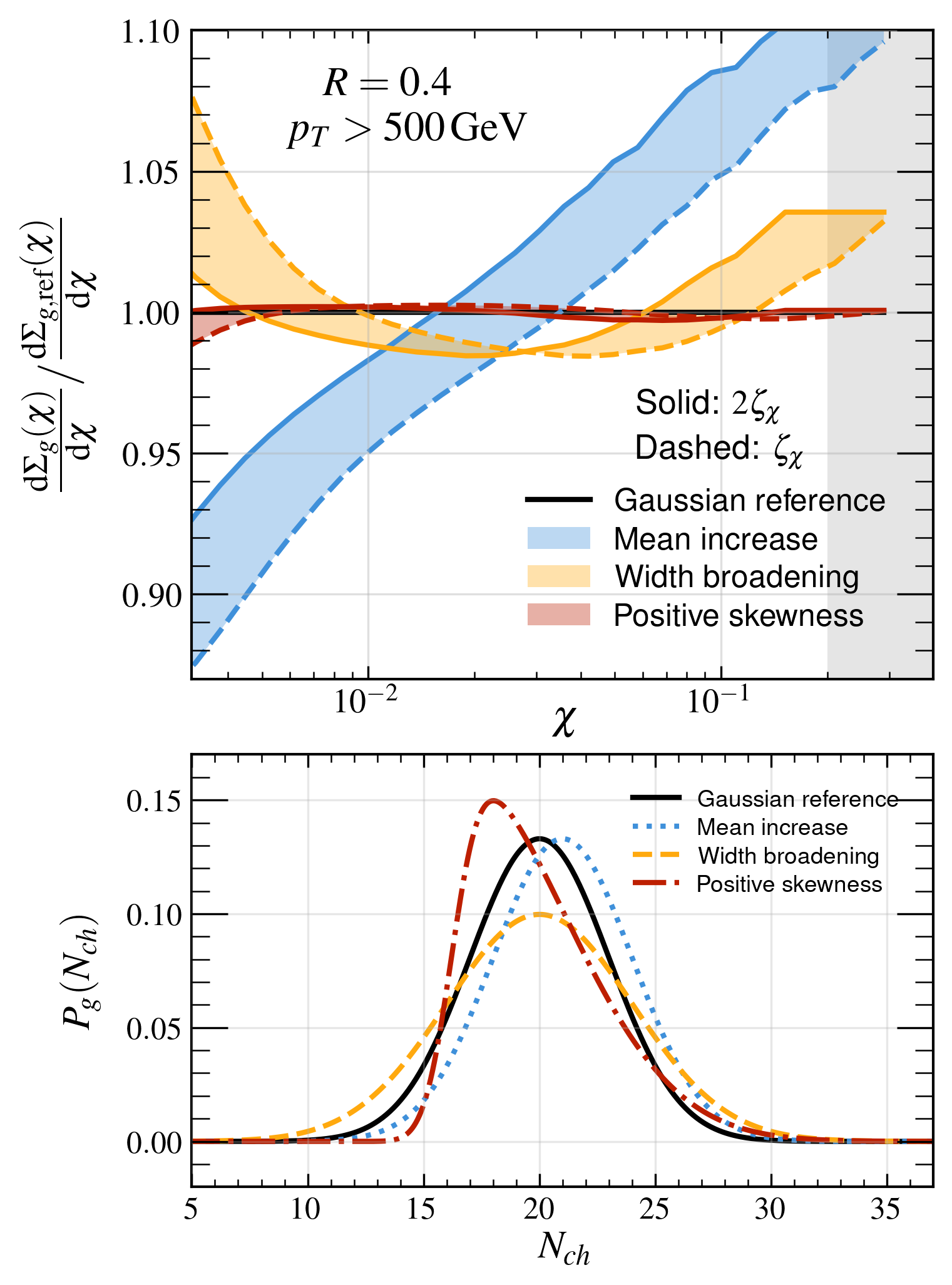
Figure 4: Ratios of the standard gluon-jet EEC for different P(N)3 models, demonstrating distortions induced by changes in the mean, width, and skewness of the multiplicity distribution.
This establishes the practical necessity for experiments to control, or at minimum correct for, sample-dependent multiplicity bias when interpreting EEC measurements as QCD medium probes, particularly in nuclear collisions.
Theoretical and Experimental Implications
The analytic formulation of the MC-EEC—linking the angular exponent P(N)4 to the structure of the multiplicity generating function—opens a path to systematically disentangle perturbative and nonperturbative sources of multiplicity fluctuations in jet samples. It supplies a theoretically clean framework for extracting scale-resolved information about the QCD parton shower, augmenting traditional substructure observables with new sensitivity.
The approach also defines clear strategies for experimental analyses: multidifferential measurements of EECs binned in P(N)5, coupled with robust modeling of underlying event fluctuations, can help isolate genuine modifications of the QCD shower from selection- and background-induced artifacts. This is particularly relevant for heavy ion and electron-nucleus collision programs, where sample composition is inherently nonuniform.
Future developments can systematically extend the accuracy beyond LO+LL—incorporating higher-order corrections, nonperturbative shape function matching, and quark flavor separation; as well as the application to more differential observables such as groomed EECs or multi-point energy correlators. The methods also provide a foundation for uncertainty quantification in the presence of sample-dependent jet selection, relevant for precision SM and BSM studies at the LHC.
Conclusion
The paper establishes a formal correlation between the jet energy-energy correlator and internal multiplicity by introducing the MC-EEC framework, computing its scaling behavior, and validating it against state-of-the-art parton shower simulations. The emergence of a multiplicity-dependent anomalous dimension for angular energy flow is demonstrated, offering both a new probe of QCD parton dynamics and a diagnostic for experimental bias effects. These results have broad implications for future jet physics studies, from basic QCD phenomenology to the interpretation of measurements in complex hadronic and nuclear environments.