- The paper presents a new multichannel Dyson equation that rigorously couples two-body and four-body Green's functions to address correlated electron dynamics in double ionisation spectroscopies.
- It employs a static self-energy approximation to capture both quasiparticle peaks and satellite features, overcoming limitations of traditional pp-RPA approaches.
- The formulation reduces the problem to an effective Hamiltonian diagonalization, enabling efficient iterative solutions and potential extensions to other correlated spectroscopies.
The Multichannel Dyson Equation for Double Ionisation Spectroscopies
Introduction and Context
Double ionization spectroscopies, including Auger and direct double photoemission, require theoretical frameworks that can rigorously account for correlated electron dynamics. A principal challenge in these methods is the accurate inclusion of both quasiparticle and satellite features in the calculation of spectroscopic observables. Historically, the particle-particle (pp) channel of the two-body Green's function has been employed, often within the random phase approximation (RPA) or its algebraic-diagrammatic construction (ADC) extensions. While such methods capture dominant quasiparticle peaks, they are fundamentally limited by neglecting correlated satellite features, which are essential for a detailed interpretation of photoemission spectra.
This work introduces and elaborates the implementation of the multichannel Dyson equation (MCDE) for spectra involving two-electron removal and addition, systematically coupling the pp two-body Green's function with the 3-hole-1-electron (3h1e) and 3-electron-1-hole (3e1h) channels of the four-body Green's function. This approach generalizes the MCDE framework and provides a tractable method for capturing correlation effects that go beyond RPA, thereby treating both quasiparticles and satellites on equal footing.
Two-Body and Four-Body Green's Functions
The spectral representation of the pp channel of the two-body Green's function explicitly encodes the double ionization and addition energies as the positions of its poles. Standard approaches yield an independent-particle approximation, e.g., Hartree-Fock (HF), which are insufficient for satellites since all correlation must be introduced via the self-energy. The one-particle-irreducible self-energy Σ2pp(ω) is in general quite challenging to approximate accurately, especially when frequency dependence and nonlocality are crucial.
In contrast, by leveraging the structure of the four-body Green's function, specifically the 3h1e and 3e1h channels, satellite features are built in at the independent-particle level due to the possible formation of electron-hole pairs accompanying double electron addition/removal. This allows for a more direct approximation scheme for the corresponding self-energy, bypassing some of the complexity inherent in the explicit two-body channel.
Multichannel Coupling and Dyson Equation
The MCDE framework formulates an extended Dyson equation where the two-body pp and the 3h1e/3e1h four-body channels are coupled via a multichannel self-energy. The equation is inherently matrix-valued, with each block corresponding to coupling or dressing of the respective channels. The self-energy structure includes diagonal (Σ2p,Σ4p) and off-diagonal coupling (Σ2p/4p,Σ4p/2p) terms.
A static but nontrivial approximation is used for the self-energy, preserving all contributions first order in the interaction—i.e., the RPAx-level terms including direct and exchange couplings. The explicit diagrammatic expansion demonstrates that, upon iteration, the MCDE is exact to second order and generates higher-order diagrams nonperturbatively in the interaction.
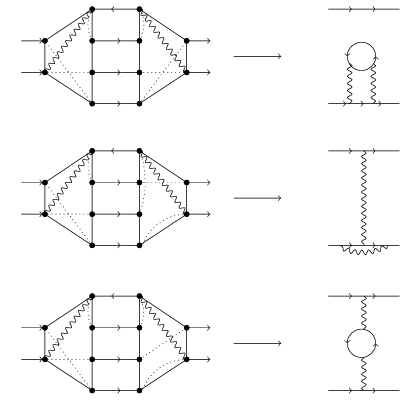
Figure 1: Examples of second-order diagrams included in K2p through the approximate Σ4, showing particle-particle and particle-hole correlation effects.
The four-body channel decomposes into block-diagonal (pure two-particle and pure four-particle propagation) and off-diagonal (couplings) components, with explicit symmetry constraints to avoid redundancy.
Effective Hamiltonian Construction
Solving the MCDE is mapped to the diagonalization of a static, Hermitian, effective Hamiltonian H4eff in a multidimensional configuration space incorporating both pp and 3h1e/3e1h states. The spectral weights and poles of the coupled system encode the double ionization and addition spectra.
By expressing the full problem as an eigenvalue equation, computational access to observables is significantly simplified. The mapping allows efficient use of iterative solvers such as Haydock-Lanczos, and the dominant computational cost is governed by constructing H4eff, scaling as N6 in the number of electrons.
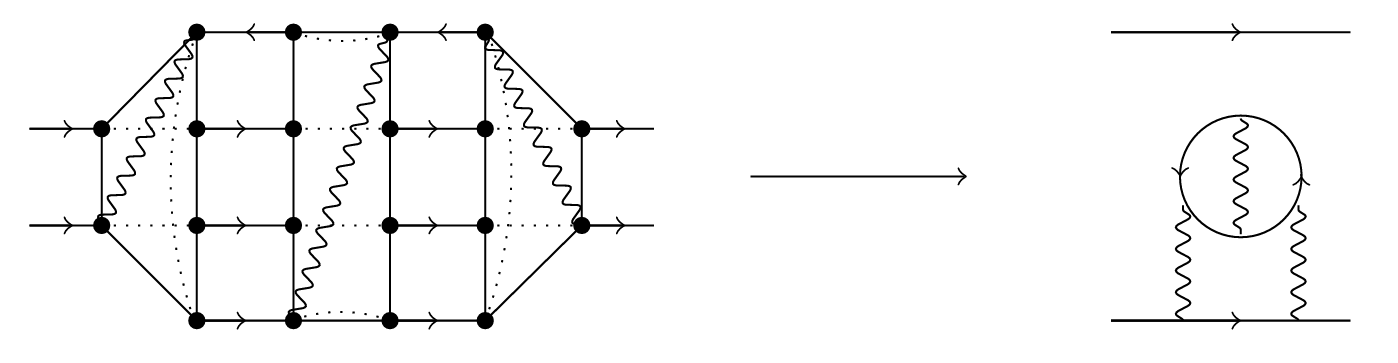
Figure 2: Example of a third-order diagram (from the MCDE iterative solution) included in K2p, reflecting the extension to higher-order electronic correlations beyond second order.
Diagrammatic and Physical Content
Analysis of the MCDE-generated diagrams reveals the explicit inclusion of both conventional pp-RPA diagrams and interaction-induced corrections (mixed dressing of propagators and interactions). Importantly, the off-diagonal couplings generate new classes of diagrams that are not accessible in standard pp-BSE, effectively resumming classes of higher-order terms crucial for capturing satellites and other correlation effects. The method ensures Hermiticity and positive-definite spectra due to the structure of the self-energy and effective Hamiltonian.
The physical interpretation is that the coupling between two-electron propagators and processes where an electron-hole pair is dynamically formed/absorbed by the two primary electrons enables both quasiparticle and satellite peaks to emerge from the same theoretical machinery. The satellites result from shake-up and shake-off processes, which are crucial in core-level Auger and double photoelectron spectra.
Practical and Theoretical Implications
The MCDE provides a systematic and extensible formalism for describing double ionization phenomena rigorously. The method is general, with extensions to higher n-body channels (even/odd order) and potential for inclusion of more sophisticated screened interactions, e.g., via Σ2p,Σ4p0-type or GT-vertex-corrected kernels. The reduction of the problem to an effective Hamiltonian enables applications to both model systems and realistic molecules or solids, dependent only on computational resources for diagonalization.
The framework is not limited to double ionization but can, in principle, be generalized to a range of correlated electron spectroscopies, including direct and inverse photoemission, absorption, and potentially nonlinear spectroscopies by suitable channel choice. The MCDE formalism unifies the treatment of satellites and quasiparticles and delivers explicit access to correlated two-particle spectra, overcoming limitations of pp-RPA and related approaches.
While the present static approximation already shows a formal advantage, future work will likely focus on incorporating dynamical vertex corrections and extending the method with screening or advanced diagrammatic resummations, possibly borrowing from modern quantum field-theoretical and tensor network developments.
Conclusion
The presented multichannel Dyson equation establishes a robust and tractable scheme for simulating double ionization spectroscopies, capturing both quasiparticle and satellite features at a uniform level of theory. The coupling of the two-body and four-body Green's function channels through a structured self-energy and the mapping to an effective eigenvalue problem address long-standing limitations of earlier approaches. The MCDE formalism opens new directions for quantitative, high-fidelity simulation of correlated electron spectroscopies and signals potential applications across photoemission, absorption, and correlated excitation domains.