- The paper introduces a hybrid framework (ProOOD) that couples prototype-guided semantic imputation with tail mining to improve 3D occupancy prediction.
- It leverages EMA-maintained prototypes and a prototype-based contrastive loss to enhance rare-class modeling and reduce overconfidence in uncertain regions.
- Empirical results show significant gains in overall mIoU and tail mIoU, demonstrating robust performance across multiple 3D occupancy benchmarks.
Prototype-Guided Out-of-Distribution Detection in 3D Occupancy Prediction: The ProOOD Framework
Introduction and Motivation
3D semantic occupancy prediction for autonomous driving presents unique challenges, particularly due to long-tailed distributions of semantic classes and the pervasive appearance of out-of-distribution (OOD) objects or regions. The semantic ambiguity inherent in occluded or visually uncertain areas, coupled with the strong class skew toward dominant categories, results in models that are frequently overconfident and miscalibrated, especially regarding rare classes or true OOD content. Existing approaches rarely couple robust tail-class modeling and OOD awareness at the voxel level.
The ProOOD framework introduces a modular solution that systematically addresses both long-tail sensitivity and OOD detection by leveraging class-wise prototypes for feature refinement, tail mining, and unsupervised OOD scoring. This addresses previously unlinked research axes in 3D occupancy—prototype-induced semantic completion, tail-class embedding robustness, and principled uncertainty quantification in a dense volumetric context.
Overview of ProOOD Framework
ProOOD is a plug-and-play module compatible with diverse 3D occupancy prediction architectures. The framework extracts coarse 3D features using a standard 2D backbone and view transformation. These features undergo two dedicated prototype-guided refinement stages: Prototype-Guided Semantic Imputation (PGSI) and Prototype-Guided Tail Mining (PGTM). The refined, semantically calibrated voxel embeddings propagate through the 3D backbone, supporting both final semantic predictions and the EchoOOD unsupervised OOD scoring module.
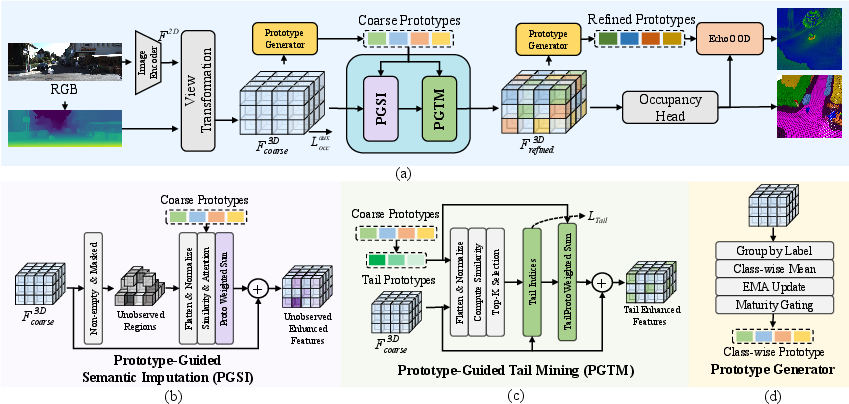
Figure 1: The ProOOD pipeline, visualizing feature extraction, prototype-based refinements for semantic completion and rare-class sensitivity, and the utilization of class-wise prototypes for both occupancy prediction and EchoOOD-based uncertainty assessment.
Prototype Learning and Refinement
ProOOD maintains global class prototypes via EMA updating, leveraging only ground-truth-labeled, non-empty voxels. This persistent anchoring provides robust, low-variance semantic means for each class, supporting both semantic imputation and rare-class mining. Prototypes are subject to a quality gating mechanism based on current-batch intra-class variance and sample count, restricting influence of immature or weakly learned prototypes.
Prototype-Guided Semantic Imputation (PGSI)
PGSI addresses semantic ambiguity in occluded/unobserved voxels by projecting coarse features toward mature global prototypes, via attention-weighted residual updates. This mechanism prioritizes not just geometric plausibility, but class-coherent semantic consistency under uncertainty—a known limitation in vision-centric 3D scene completion.
Prototype-Guided Tail Mining (PGTM)
Since OOD regions are easily misattributed as rare class instances due to poorly separated tail-class features, PGTM actively identifies and strengthens tail-class voxels early in the semantic pipeline (using similarity and margin thresholds wrt prototypes). Top-k confident voxels are updated via lightweight MLP blending with tail-class prototypes, with tailored supervision at the refined feature stage, ensuring strong rare-class representation and improved calibration.
Prototype-Based Contrastive Learning (PBCL)
A temperature-scaled, prototype-backed contrastive loss further enforces intra-class compactness and inter-class orthogonality in the refined feature space, crucial for both rare-class recall and model confidence calibration.
EchoOOD: Unsupervised Prototype-Driven OOD Scoring
EchoOOD introduces a training-free, parameterless OOD detection pipeline fully reusing the learned class prototypes. For each voxel, EchoOOD computes three orthogonal OOD cues:
- Local Logit Alignment: Measures normalized deviation from class-wise mean logit vectors, capturing softmax distribution coherence per class.
- Local Prototype Matching: Scores cosine alignment to per-scene, high-confidence local prototypes.
- Global Prototype Matching: Assesses similarity to the stable, dataset-level EMA prototype.
Voxel OOD scores are normalized and aggregate by maximum selection, ensuring robust detection even under long-tail-induced feature dispersion.
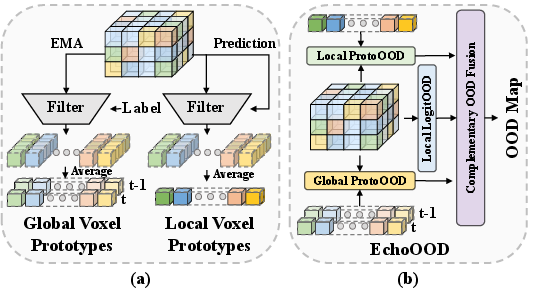
Figure 2: Construction of local/global prototypes and operation of EchoOOD, illustrating how local logit and prototype alignment cues are fused to compute voxel-level OOD maps.
Experimental Results
Across five major 3D occupancy and OOD benchmarks—SemanticKITTI, SSCBench-KITTI-360, VAA-KITTI, VAA-KITTI-360, and VAA-STU—ProOOD consistently elevates both mIoU and tail mIoU, with especially pronounced benefits on long-tail categories. On SemanticKITTI, ProOOD surpasses the highest baseline by +3.57% mIoU overall and +24.8% tail mIoU. The improvement in VAA-KITTI, which includes synthetic anomalies, reflects an absolute gain of +19.34 in AuPRCr for OOD localization.
ProOOD is robust to backbone selection (demonstrated with SGN and VoxDet) and introduces <0.3M parameters with minimal computational overhead (ΔFLOPs < 0.5G in typical settings).
Qualitative evaluation demonstrates improved semantic plausibility in dense urban environments and increased OOD sensitivity, particularly in tail-class and occluded regions, compared to prototype-free baselines.
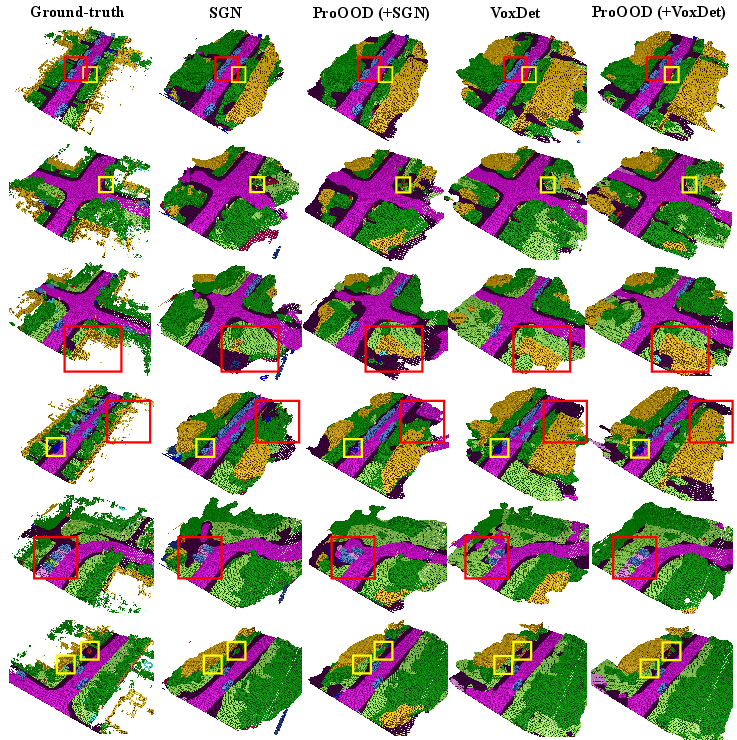
Figure 3: Qualitative evaluation of occupancy predictions on SemanticKITTI, showing improved consistency and tail-class recognition with ProOOD.
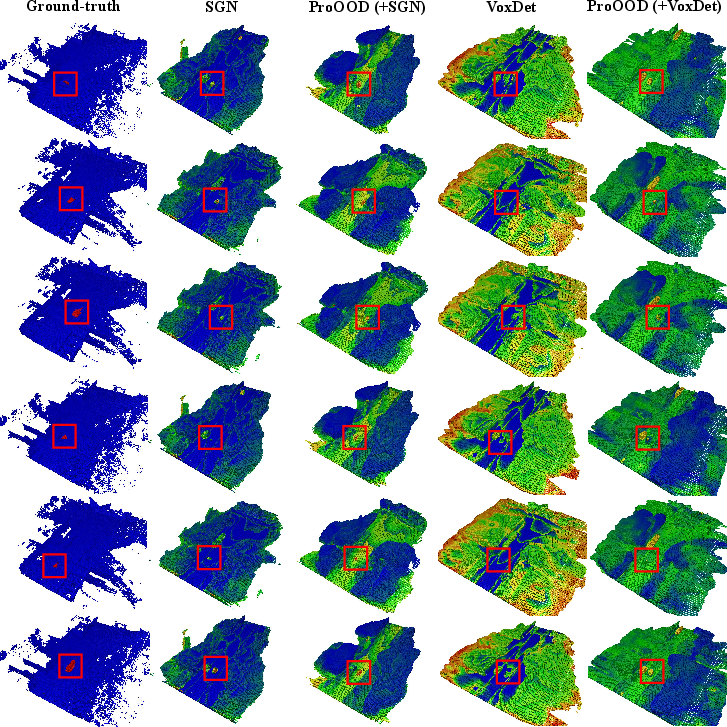
Figure 4: OOD detection qualitative results on VAA-KITTI; ProOOD localizes OOD voxels missed by overconfident baselines.
Failure Modes and Limitations
ProOOD inherits some intrinsic limitations from feed-forward 2D-to-3D occupancy networks—such as failures for small, distant OOD objects or extreme geometric occlusion—where the underlying occupancy head does not activate the correct voxel set. Occupancy error necessarily cascades to OOD scoring due to their functional coupling.
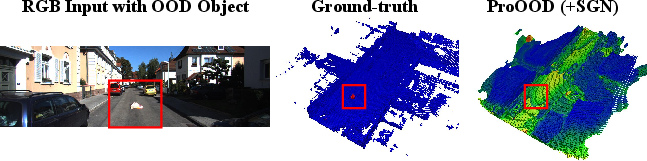
Figure 5: Representative failure due to incorrect occupancy in OOD voxels; OOD is missed when occupancy estimation fails.
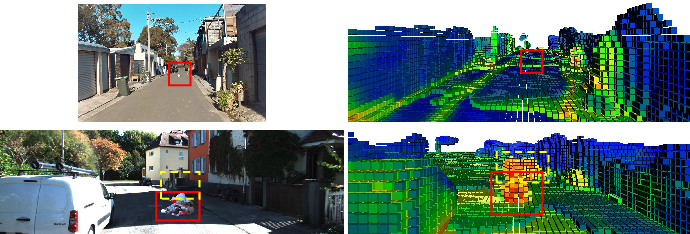
Figure 6: Challenging cases under long-range view and occlusion, where both occupancy and OOD predictions exhibit spatial inaccuracies.
Error analysis suggests that future work should address representation learning for small or ambiguous instances, possibly with higher resolution, object-centric refinement, or loss reweighting mechanisms for rare-event regimes. Depth estimation quality is also a current bottleneck.
Practical and Theoretical Implications
By unifying prototype-driven semantic feature refinement and principled OOD scoring, ProOOD shifts the 3D occupancy paradigm toward hybrid closed/open-world robustness. It establishes that tail-class modeling and OOD awareness are synergistic: robust rare-class separation reduces overconfidence and improves OOD sensitivity at scale.
Practically, the approach provides a lightweight, easily integrated module for industrial 3D perception pipelines, improving trustworthiness for AVs and robotics operating in safety-critical, open-set urban environments.
Theoretically, ProOOD demonstrates the utility of EMA-maintained prototypes for both class separation and unsupervised uncertainty estimation at the voxel level, potentially extending to other dense, structured prediction tasks.
Conclusion
ProOOD delivers a principled prototype-guided framework that systematically improves both in-distribution and out-of-distribution performance in 3D occupancy prediction. The synergy of PGSI and PGTM for semantic completion and rare-class enhancement, together with the EchoOOD unsupervised scoring mechanism, yields state-of-the-art results across established benchmarks. Future research will further address failure cases by improving depth integration, joint end-to-end training, and object-centric refinement, paving the way for more reliable, robust open-world 3D scene understanding (2604.01081).