- The paper demonstrates that transient tachyonic instabilities in multi-field inflation produce universal, non-Gaussian bispectrum signatures using detailed numerical and analytical methods.
- It distinguishes between light and heavy entropic regimes, revealing folded-enhancement, squeezed-limit non-analyticity, and tachyonic resonances in different configurations.
- The study illustrates the limitations of single-field EFT approaches and emphasizes the need for full multi-field computations to accurately capture inflationary dynamics.
Universal Non-Gaussian Signatures from Transient Instabilities
Introduction and Motivation
The paper "Universal Non-Gaussian Signatures from Transient Instabilities" (2604.01035) investigates universal features in the inflationary bispectrum originating from transient tachyonic instabilities of entropic fluctuations. These phenomena generically occur in multi-field inflation with negatively curved (hyperbolic) field-space geometries, characteristic of α-attractor models and string-motivated scenarios. The analysis proceeds at the level of fluctuations, eschewing detailed background model dependence and thereby identifying robust, model-independent phenomenology.
In scenarios with strongly non-geodesic inflationary trajectories—quantified by a large dimensionless turn rate η⊥—the entropic mode acquires a transient tachyonic effective mass. This instability magnifies isocurvature fluctuations, which in turn generate distinctive, non-trivial signatures in the inflationary bispectrum, potentially within observational reach. The paper methodically distinguishes between two regimes: a light entropic sector with mass ∼H, and a heavy regime with entropic mass mσ≫H, discussing their consequences for bispectrum shapes.
Multi-field Fluctuations and Transient Tachyonic Instabilities
In multi-field inflation, the dynamics of fluctuations transverse to the background trajectory are especially sensitive to field-space geometry. The Lagrangian under consideration is a nonlinear sigma model of N scalars with internal metric GIJ, minimally coupled to gravity. Focusing on two-field systems, curvature (ζ) and isocurvature (σ) modes naturally arise as projections of field fluctuations onto tangent and normal directions, respectively.
The crucial parameter is the turn rate η⊥, arising from the bending of the inflationary trajectory. Large η⊥ leads to a negative bare entropic mass squared: η⊥0
where η⊥1 is the field-space Ricci scalar and η⊥2 denotes the second derivative of the potential along the normal direction. Negative η⊥3 engenders a brief tachyonic instability—a transient period during which isocurvature modes grow before decaying safely on super-horizon scales. This scenario is natural for negatively curved field-space manifolds.
Bispectrum Signatures: Universal Features
Employing exact numerical methods (CosmoFlow), the authors compute scale-invariant bispectrum shapes for the dominant cubic operators. They analyze three key cubic interactions:
- η⊥4
- η⊥5
- η⊥6
Bispectra are characterized by η⊥7, normalized to unity in the equilateral limit.
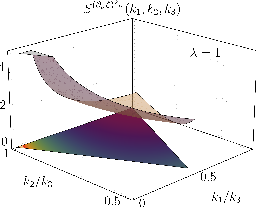
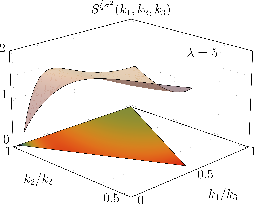
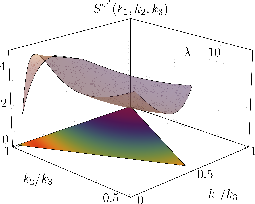
Figure 1: Dimensionless bispectrum shapes η⊥8, normalized in the equilateral configuration, across all kinematic regimes for exemplar interactions and varying instability strengths.
A detailed investigation reveals several robust, universal signatures:
- Folded-enhanced Bispectrum: All considered cubic operators yield bispectrum shapes with enhancement in the folded configuration (η⊥9), relative to equilateral. This enhancement is directly connected to the period of tachyonic growth in the entropic sector, associated with an excited non-Bunch-Davies initial state.
- Squeezed-limit Non-analytics (Cosmological Collider Signal): In the squeezed limit (∼H0), the bispectrum displays the expected non-analytic scaling:
∼H1
with ∼H2. The index ∼H3 encodes the strength of the instability (and thus the turn rate and entropic mass).
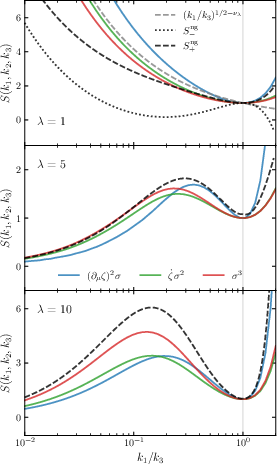
Figure 2: Isosceles slices of ∼H4 as ∼H5 is varied from folded to squeezed limits, illuminating the scaling transitions and resonance features for various cubic couplings and ∼H6 values.
- Tachyonic Resonance: For ∼H7, a pronounced resonance arises in mildly squeezed configurations (∼H8), whose position and amplitude are directly controlled by the strength of the tachyonic instability. This effect has no analog in standard single-field effective field theory (EFT) with real speed of sound.
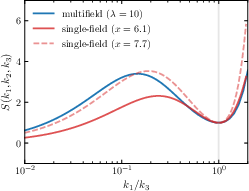
Figure 3: For large ∼H9, exact multi-field calculations reveal a pronounced resonance in the bispectrum in the mildly squeezed limit.
Breakdown of Single-field EFT and Kinematic-dependent UV Matching
In the heavy entropic regime, the system can be recast as a single-field EFT with imaginary speed of sound, reproducing several—but not all—multi-field features. Quantitatively, the paper demonstrates that no kinematic-independent UV matching exists for the EFT parameter mσ≫H0 (the cut-off for the validity of the single-field description) that reproduces the bispectrum in all kinematic settings. Specifically, while equilateral configurations can be matched by appropriate scaling, folded and squeezed configurations require kinematic-dependent rescalings. Accordingly, genuine multi-field computations are indispensable for robust predictions when entropic fields are sufficiently heavy or when backgrounds are complex.
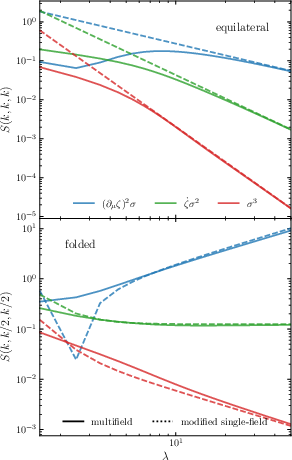
Figure 4: Comparison of bispectrum shapes in equilateral and folded regimes, contrasting exact multi-field and single-field EFT results, which highlights mismatches and the necessity for kinematic-dependent UV matching.
Non-geodesic Shape Templates
To facilitate direct application to data analyses, the paper introduces robust template families for non-geodesic bispectrum shapes. These templates capture all salient features: folded enhancement/suppression, squeezed-limit scaling, and (when heavy) the tachyonic resonance.
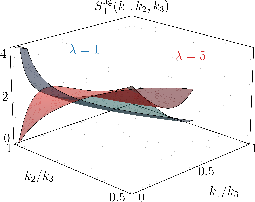
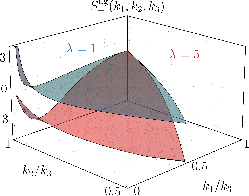
Figure 5: Exemplary non-geodesic shape templates mσ≫H1 showing both folded-enhanced and folded-suppressed behaviors for light (mσ≫H2) and heavy (mσ≫H3) entropic masses.
Shape correlations are quantitatively assessed, demonstrating that non-geodesic templates are largely distinct from standard equilateral, orthogonal, or flattened shapes, especially as the instability strength increases.
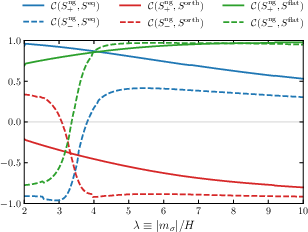
Figure 6: Shape correlations between mσ≫H4 and standard templates as a function of instability strength mσ≫H5.
Angular Inflation as Realization and Observational Compatibility
As a concrete model, the authors assess angular inflation in hyperbolic field space—a setting natural in mσ≫H6-attractor supergravity constructions—where the inflationary trajectory becomes single-field-like but resides predominantly in the angular direction due to geometric effects.
The paper derives a universal, model-independent bound for when a transient tachyonic instability will arise, demonstrating that the phenomenon is generic in hyperbolic geometries for moderate field-space curvature and modest potential mass scales.
The spectral tilt mσ≫H7 and the viability of the model within current CMB constraints are mapped in detail. There exists parameter space where significant non-Gaussian signatures coexist with compatibility to present data. The resulting bispectrum for benchmark parameters is computed numerically.
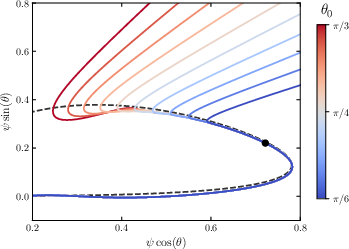
Figure 7: Example background trajectories for angular inflation with mσ≫H8 and mσ≫H9, evidencing the angular attractor.
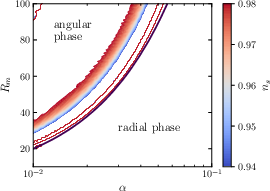
Figure 8: CMB spectral tilt N0 in the N1 plane, demonstrating observational viability for a non-trivial region.
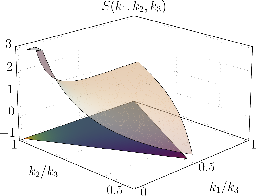
Figure 9: Bispectrum shape for angular inflation, showing all predicted universal features: enhanced/suppressed folded limit, and power-law squeezed limit.
SUGRA Embedding
A complete embedding in N2 supergravity is outlined, demonstrating that the field-space geometry and potential structure required for the universal signatures can be realized in UV-complete frameworks, such as in N3-attractor constructions with a Poincaré disk Kähler geometry and appropriate superpotential/explicit symmetry breaking.
Implications and Prospective Developments
The results underscore that non-geodesic background motion in multi-field inflation, especially in hyperbolic field-space, imprints robust and observable signatures in non-Gaussian statistics. Detection of the characteristic bispectrum shape template—particularly simultaneous observation of both the folded enhancement and tachyonic resonance—would constitute strong evidence for high-dimensional inflation with large turn rates and transient instability episodes.
These findings imply that single-field templates may be insufficient for forthcoming data analyses and motivate updates to bispectrum estimators to directly probe these non-geodesic shape templates.
A key theoretical implication is that multi-field effects are not always reducible to effective single-field parameterizations; their signatures may only be captured by direct computation of interacting multi-field fluctuations, reinforcing the phenomenological motivation for precise multi-field Boltzmann solvers in CMB/LSS pipelines.
The authors highlight extensions to larger N4-field scenarios, where even more intricate signatures, including torsion, complicated target-space geometries, and a superposition of cosmological collider resonances, are expected. This will be especially pertinent for string-motivated N-flation and related scenarios.
Conclusion
This work identifies and characterizes universal, non-analytic bispectrum signatures arising from transient tachyonic instabilities of entropic fluctuations in multi-field inflation with hyperbolic field-space geometry. The distinctive combination of enhanced folded-limit bispectrum, characteristic squeezed limit scaling, and tachyonic resonance provide model-independent probes of non-geodesic inflationary dynamics. The results have immediate implications for both the interpretation of upcoming non-Gaussianity constraints and the future direction of theoretical inflationary model-building. Precise multi-field, fluctuation-level calculations are indispensable, and future observational discoveries of the signal structure described herein could provide compelling evidence for high-dimensional field dynamics during the inflationary epoch.